
Death in Mallorca: certificates, burial, repatriation and inheritance
A death on Mallorca hits those left behind doubly hard: on top of the grief comes a wave of bureaucratic obligations in a foreign language, under time pressure and far from home. Whether a holidaymaker or a long-term resident — the procedures are similar, yet the consequences for the estate differ considerably. This guide walks you through step by step what needs to be done immediately after a death: the medical certification of death, the issuing of the Spanish death certificate (certificación de defunción), the options for burial or repatriation to Germany, and the first key decisions in the event of an inheritance. You will also learn which insurance policies are crucial, which deadlines you must not miss, and where to find practical help on Mallorca and in Germany.
- Relocation Service Mallorca — for everyone who lives on the island permanently and wants to plan ahead
First hours: certification of death and what to do immediately
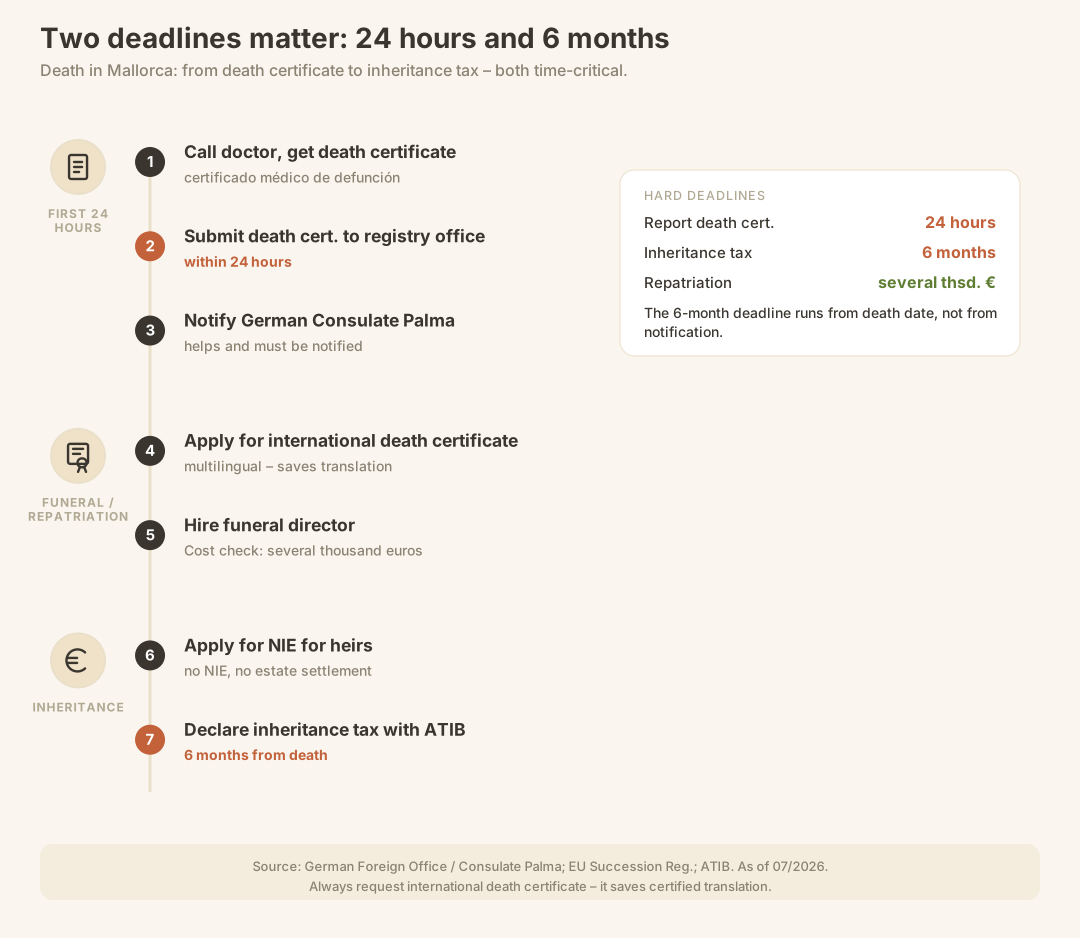
If someone dies on Mallorca, a licensed doctor must first certify the death. The doctor issues the medical death certificate (certificado médico de defunción), which records the moment, date, time and place of death. If there are indications of an unnatural death, the doctor informs the public prosecutor's office — which may then order a forensic examination, potentially delaying the subsequent steps.
If the person dies at home, the next of kin or fellow residents are obliged to report the death to the register office. If no next of kin can be reached, this duty falls to the neighbours. If the person dies outside the home — for example in a hotel, on the street or while hiking — tiered responsibilities apply depending on the circumstances.
Important: As a rule, the doctor does not forward the death certificate to the register office of their own accord. This must be arranged by the next of kin or the appointed funeral home themselves.
| Step | Responsible party | Deadline |
|---|---|---|
| Call a doctor, certify death | Doctor on site / emergency doctor | Immediately |
| Obtain death certificate (certificado médico) | Doctor | Immediately |
| Submit the death certificate to the registry office | Family members / funeral director | Within 24 hours |
| Engage a funeral home | Family members | As early as possible |
| Notify the German Consulate Palma | Family members | As soon as possible |
Note: Call the German Consulate Palma as early as possible. The consular authority can offer practical advice and assistance at this stage — and must also be formally notified in the case of German nationals.
The Spanish death certificate (certificación de defunción)
The competent registry office (registro civil) issues the official death certificate upon submission of the medical certificate of death and registers the death in the death register. At the same time, the burial permit (licencia de enterramiento) is issued upon request, without which no burial may take place.
Request an international copy: Please make sure to insist that an international death certificate is issued. This is multilingual and saves you the later certified translation into German — a significant advantage in terms of both time and cost.
If the deceased held (also) German citizenship, the registry office is required to notify the competent German diplomatic mission abroad — in this case the German Consulate Palma — of the death.
What the registry office typically requires
| Document | Note |
|---|---|
| Medical certificate of death (certificado médico de defunción) | Original |
| Identity card or passport of the deceased | A copy is generally sufficient |
| NIE / TIE of the deceased (if resident) | Helps with identification in the register |
| Information on registry office jurisdiction | Registry office at the place of death |
Please note: If you engage a funeral home, they will generally handle all communication with the registry office — this is the simplest approach in an already distressing situation.
Funeral options in Mallorca
Mallorca offers the same basic options as in Germany: burial, cremation with interment of the urn, or cremation followed by burial at sea. All three are available. Costs vary considerably depending on the type of funeral, the provider, and individual wishes. According to the German Foreign Office, total costs of several thousand euros should be expected in any case — obtain a detailed written quote before placing any order.
Important: The instruction to the funeral home must be given by the family members themselves. The consulate is not able to place orders.
| Type of funeral | Available in Mallorca | Notes |
|---|---|---|
| Burial | Yes | At local cemeteries |
| Cremation + interment of urn | Yes | The urn can also be transferred to Germany |
| Burial at sea | Yes | Requires official authorisation |
| Transfer to Germany | Yes | Licencia de traslado + death transit certificate required |
Transfer to Germany: step by step
Many families wish to bury their loved one in their home country. Transferring remains from Mallorca to Germany is possible, but involves considerable bureaucratic and financial effort.
The legal basis
Spain and Germany are both contracting states to the European Agreement on the Transfer of Mortal Remains. This agreement simplifies the formalities — but does not abolish them.
Step-by-step process
- Engage a funeral home on Mallorca that carries out international repatriations and works with a partner firm in Germany.
- Apply for a burial certificate (licencia de enterramiento) and repatriation permit (licencia de traslado) from the registry office.
- Have a transit permit ( (pasaporte de cadáver) issued — this is an absolute requirement for cross-border transport.
- Prepare the coffin in accordance with regulations: The coffin must be made of zinc, soldered and impermeable, and additionally enclosed in a wooden crate. In the event of death from an infectious disease, additional hygiene measures (antiseptic wrapping) are prescribed.
- Transport — by air or overland, depending on the distance and arrangements made.
- Import documentation in Germany — the receiving German funeral home takes care of the handover and registration with the German registry office.
Please note: A repatriation can incur very high costs. Check in particular whether the deceased held international health insurance or travel insurance that covers repatriation costs. Many international health insurance policies cover precisely this situation — without appropriate insurance, the family bears all costs themselves.
Alternative: cremation on Mallorca, urn transferred to Germany
A considerably more cost-effective alternative is cremation on Mallorca followed by the transfer of the urn to Germany. The transport and documentation requirements for urns are significantly lower than for coffins. A permit is still required here too — but the logistical effort is much smaller.
The German Consulate Palma: your first point of contact
The German Consulate Palma is the central point of contact for all German nationals on Mallorca and the Balearic Islands who are affected by a death. The consular authority can:
- provide contact details for German-speaking, internationally active funeral homes on Mallorca
- assist with communication with Spanish authorities
- initiate the registration of the death for German purposes
- provide consular assistance in exceptional cases
| Contact | Details |
|---|---|
| German Consulate Palma | Palma de Mallorca |
| Website (Federal Foreign Office) | spanien.diplo.de |
| Emergency number (outside opening hours) | Reachable via the Federal Foreign Office switchboard |
Please note: The Consulate does not issue burial orders and does not cover any costs. It does, however, assist with coordination and can, upon request, issue an overseas death certificate that is recognised in Germany.
Registration of the death in Germany
If a German national dies abroad, the death must also be registered in Germany. This is done by application to the German registry office — either at the deceased's last place of residence in Germany or, if no residence in Germany existed, at Standesamt I in Berlin, which is responsible for deaths occurring abroad.
You will generally need:
- the international Spanish death certificate (or a certified translation of the standard Spanish death certificate)
- the deceased's national identity card or passport
- marriage certificate or other civil status documents where applicable
This subsequent registration is important for all follow-on steps in Germany: pension entitlements, widow's/widower's pension, certificate of inheritance, bank accounts, etc.
Insurance: What covers what?
The question of costs is often the first thing relatives have to deal with in an exceptional situation. Early insurance provision is therefore essential.
| Type of insurance | Benefit in the event of death | Note |
|---|---|---|
| International health insurance | Repatriation costs, return transport, often also local funeral costs | Must be taken out before departure |
| Travel cancellation insurance (with repatriation cover) | Repatriation and trip cancellation | Pay attention to repatriation cover |
| Funeral expenses insurance | Funeral costs (including abroad) | Check the sum insured |
| Private health insurance (expats/residents) | Repatriation services depending on the tariff | Check the tariff carefully |
Note: For residents on Mallorca, a private health insurance policy with explicit repatriation cover is recommended. The statutory Spanish health insurance (seguridad social) does not generally cover repatriation costs.
Also read: Health Insurance in Spain and Private Health Insurance Spain Comparison
Inheritance on Mallorca: Spanish and German law
Estate costs calculator
Explanation
The value given to the property in the deed of acceptance and allocation of the estate (escritura de aceptación y adjudicación de herencia). Under the fee schedules (aranceles) the value assessed for tax purposes applies and, as long as none exists, the value stated in the deed — in the normal case the value you record there. The preset is an example, not a statement about the market. The calculation assumes one registered unit (finca registral) — if the parking space or storeroom is a unit of its own, the registry scale applies again to each.
Explanation
How many heirs take the property in equal shares. Both fees rise with every further heir: the notary charges each heir on their own share, and the registry spreads the value across the shares — and because both scales fall as values rise, the same property costs more with more heirs. Where shares are unequal, notary and registry charge on the actual value of each one.
- Subtotal of the costs entered
- €1,409.03
- Notary (deed of acceptance)
- €952.78
- Land registry (Registro de la Propiedad)
- €456.25
Without the freely agreed items — the full calculation is on the advice page.
Legal status: 1 September 2012
This calculation is provided for guidance only and is not a substitute for tax or legal advice in specific cases.
A death on Mallorca triggers — depending on the deceased's place of residence and nationality — inheritance and tax law obligations in two countries. This is the most complex chapter and the one that most urgently requires professional advice.
Which inheritance law applies?
Since 17 August 2015, the EU Succession Regulation (No. 650/2012) has applied throughout the EU. It stipulates that, as a general rule, the inheritance law of the state in which the deceased had their habitual residence (= domicile) applies. If the deceased was a resident on Mallorca, Spanish inheritance law generally applies — specifically the Catalan-Balearic inheritance law (Compilació de Dret Civil de les Illes Balears), which differs from general Spanish inheritance law in certain respects.
Exception: During their lifetime, the testator could make a choice of law by will and select the law of their home country (e.g. German inheritance law). This is expressly permitted under the EU Succession Regulation.
Spanish inheritance tax (Impuesto de Sucesiones)
Mallorca inheritance tax
Explanation
Balearic law applies when the deceased spent most days of the five years before the death in the Balearics. If they were not resident in Spain, the heirs may apply the law of the region holding the most valuable part of the Spanish estate.
Explanation
The share falling to this heir, at least the valor de referencia — the cadastral reference value, below which the tax may not be assessed.
Explanation
The group decides the allowance, the tariff, the multiplier and the relief. Within group III the law distinguishes further between blood relatives and relatives by marriage.
Explanation
The larger relief for blood collaterals applies only when no descendants of the deceased inherit alongside. Disinherited descendants do not count.
- Payable (cuota a ingresar)
- €27,129.85
- Value of the inherited property
- €300,000.00
- Kinship group
- Group III — siblings, uncles, aunts, nieces, nephews
Main-home reduction: €0.00 · Value stated in the deed within the limit: Yes, value within the limit
Legal status: 25 July 2025
This calculation is provided for guidance only and is not a substitute for tax or legal advice in specific cases.
Even if the heir lives in Germany, inheritance tax may be due in Mallorca if assets (in particular property) are located in Spain. The Balearic Islands have their own regionally adapted inheritance tax regulations, which in some cases provide more favourable allowances and rates than national Spanish law.
| Factor | Relevance |
|---|---|
| Property in Mallorca | Always taxable in Spain |
| Bank balances at Spanish banks | Generally taxable |
| Deadline for inheritance tax return | Generally 6 months from the date of death (extension possible) |
| Competent authority (Balearic Islands) | ATIB (Agència Tributària de les Illes Balears) |
Please note: The 6-month deadline for the Spanish inheritance tax return runs from the date of death. If it is missed, surcharges and interest will accrue. An extension can be requested — submit this request in good time through a lawyer or tax adviser authorised in Spain.
NIE for heirs
If the heir does not yet have a Spanish Número de Identificación de Extranjero (NIE), they must apply for one — without a NIE they cannot file an inheritance tax return in Spain or use a Spanish account for the settlement of the estate. More on this: Losing your NIE in Spain
Executorship and estate administration
If there is a will, the following must be checked:
- Is there a Spanish and/or German will?
- Has a choice of law been made?
- Has the will been lodged with the German Central Register of Wills and/or with the Spanish notary?
A notarised will drawn up in Germany is generally recognised in Spain, but must first be duly apostilled and, where necessary, submitted in translation before the Spanish notary and the probate authorities.
See also: Taxes as a Resident and Wealth Tax Spain
Most Common Mistakes When Someone Dies in Mallorca
Based on the experience of lawyers and consulate staff, certain mistakes tend to recur:
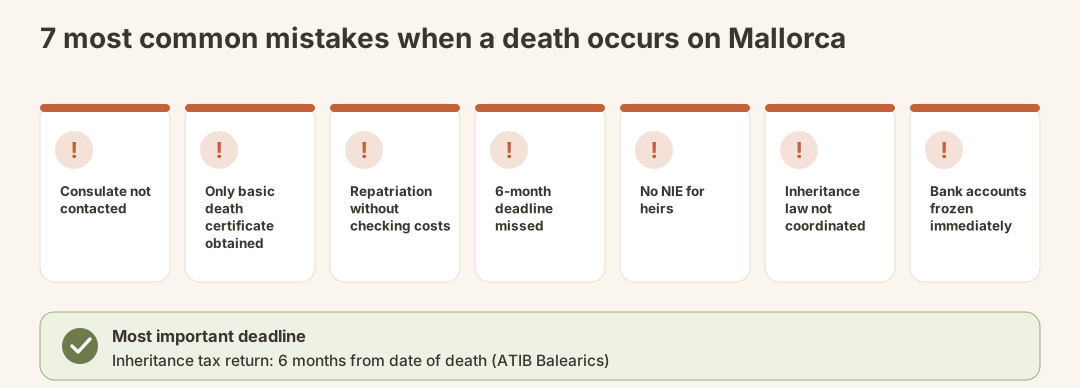
- Failing to contact the German Consulate in Palma promptly. Many relatives are unaware that the consulate can actively assist — and valuable time is lost.
- Only a simple (monolingual) death certificate requested. The international version saves considerable translation effort later on.
- Repatriation begun without checking costs. Without proof of insurance or a cost-coverage commitment, the repatriation can in the worst case be halted or refused.
- 6-month deadline for the Spanish inheritance tax return missed. The deadline runs from the date of death — not from the date of notification.
- No NIE applied for on behalf of the heir. Without a NIE, the estate administration in Spain cannot be concluded.
- Spanish and German inheritance law not coordinated. Anyone working solely with a German lawyer risks errors in the Spanish proceedings — and vice versa.
- Bank accounts in Spain blocked immediately. Spanish banks freeze the accounts of the deceased upon learning of the death. Ongoing costs (rent, insurance) should therefore be arranged early via relatives' accounts.
What comes next? Ongoing obligations in the estate
After the funeral and the initial period of shock, the actual estate administration begins. These are the points you should keep in mind:
- Deregistration from the residents' register (padrón municipal) — if the deceased was registered as a resident, they must be deregistered.
- Cancellation or transfer of utility contracts (electricity, water, internet, insurance).
- Property: Preparing the land registry entry (inscripción registral) for the heirs — this typically takes several months in Spain.
- Vehicle: Re-registration or sale of the deceased's vehicle.
- Tax residency: If the deceased was registered as tax-resident in Spain, a final income tax return (IRPF) may need to be filed. More on this: IRPF deductions Balearic Islands
- German pension: If the deceased was receiving a Spanish or German pension, the relevant pension authorities must be notified without delay. More on this: Applying for a pension in Spain
Checklist: Death on Mallorca
Print this list out or save it — it will help you avoid missing any step during the immediate aftermath.
- Call a doctor, obtain confirmation of death and the medical death certificate (certificado médico de defunción)
- Notify the German Consulate in Palma
- Engage a funeral director with experience in international repatriations
- Submit the death certificate to the registry office within 24 hours
- International death certificate — apply for one
- Apply for a burial permit and, if applicable, a repatriation authorisation
- Contact insurers (international health insurance, travel insurance, private health insurance)
- Make a decision: burial on Mallorca or repatriation to Germany
- Note the Spanish inheritance tax deadline (6 months) in your calendar
- Apply for a NIE for the heirs if they do not already have one
- Review the will (Spanish and/or German will)
- Engage a German probate solicitor and a Spanish lawyer/tax adviser
- Have the death officially registered in Germany at the relevant German registry office
- Clarify the deceased's bank accounts, insurance policies and utility contracts
- Deregister from the padrón municipal (residents' registration office)
Conclusion
A death on Mallorca is one of the most difficult situations that expats and holidaymakers can face. The good news is that the procedures are well established, and you do not have to navigate them alone. The German Consulate in Palma, experienced German-speaking funeral directors, and lawyers admitted to practise in Spain know every step of the process. The most important decisions are: apply for the international death certificate from the outset, keep the 6-month deadline for inheritance tax in mind, and engage a lawyer early who is familiar with both legal systems. Anyone who plans ahead — with a will, a choice-of-law clause, and comprehensive international health insurance that includes repatriation cover — will spare their loved ones an enormous amount of stress.
Official Sources
- Federal Foreign Office / German Consulate Palma — information sheet "Deaths in Spain": spanien.diplo.de
- EU Succession Regulation No. 650/2012 — Official Journal of the EU: eur-lex.europa.eu
- ATIB — Agència Tributària de les Illes Balears (inheritance tax Balearic Islands): atib.es
- Ministerio de Justicia — Registro Civil (civil registry, death certificates Spain): mjusticia.gob.es
- European Agreement on the Transfer of Mortal Remains (Strasbourg, 1973) — Council of Europe: coe.int
- AEAT — Agencia Estatal de Administración Tributaria (tax obligations relating to an estate): agenciatributaria.es