
School Mallorca German children: State, Concertado & International
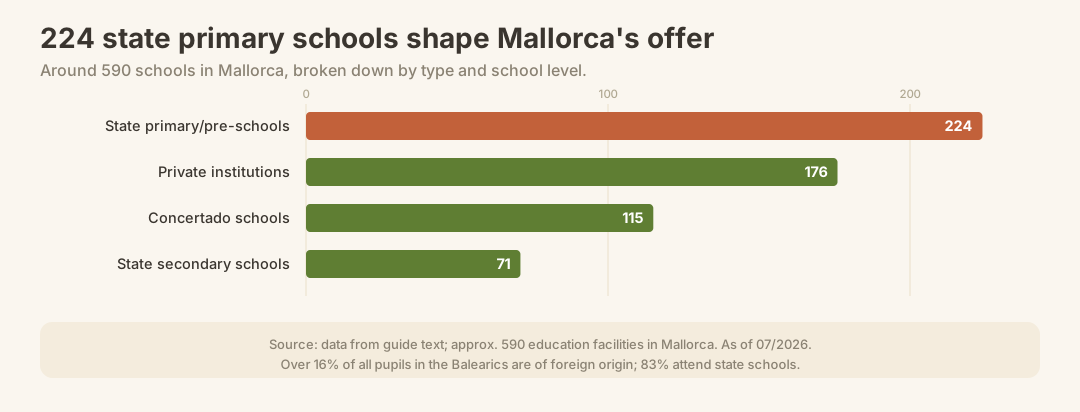
Families moving to Mallorca with children often tackle the question of school choice before they even start looking for a home – and rightly so. The island's educational offering is considerably broader than many expect: Mallorca has around 590 educational institutions, including 224 state primary and nursery schools, 71 state secondary schools, 115 semi-state Concertado schools and 176 private establishments. Over 16 % of all pupils in the Balearen are of foreign origin – a figure that stands out across Europe. This guide explains how the Spanish school system on Mallorca is structured, what state, Concertado and international schools actually cost, what role Catalan plays, how the enrolment process works step by step, and what the Eurocampus – the island's only German-language school – is all about. You'll also find out which mistakes families most commonly make when choosing a school.

An overview of the Spanish school system on Mallorca
The education system in Spain – and therefore on Mallorca – is divided into clearly defined stages. Compulsory schooling begins at six years of age and ends at 16. The following structure is a useful point of reference:
| School stage | Spanish designation | Age | Compulsory? |
|---|---|---|---|
| Pre-school (voluntary) | Educación Infantil | 0–6 Jahre | No |
| Primary school | Educación Primaria | 6–12 Jahre | Yes |
| Lower secondary | ESO (Educación Secundaria Obligatoria) | 12–16 Jahre | Yes |
| Bachillerato (upper secondary) | Bachillerato | 16–18 Jahre | No |
| Vocational training | Formación Profesional | ab 16 Jahren | No |
The school year generally begins in September and ends in June, with holidays at Christmas, Easter and over the summer. The academic year on Mallorca follows the Balearic school calendar, which is set by the Conselleria d'Educació i Formació Professional de les Illes Balears.
Please note: State schools on Mallorca teach predominantly in Catalan (more precisely, Mallorcan as a variety of Catalan). Spanish is an equal co-language, but Catalan is generally the preferred language of instruction – something you should discuss with your children at an early stage.
The four school types compared
On Mallorca there are essentially four types of school, which differ considerably in terms of ownership, costs and language of instruction:
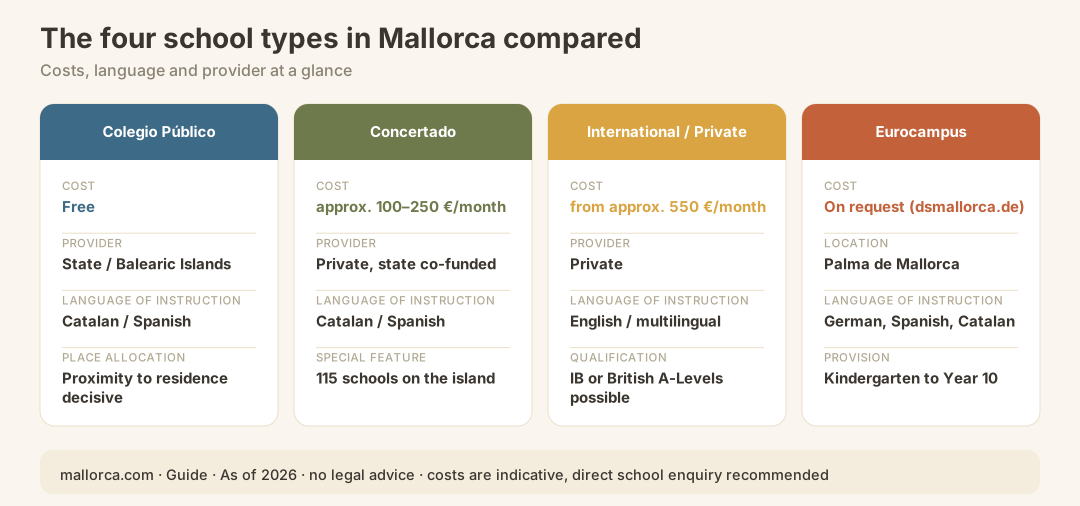
| School type | Provider | Costs | Language of instruction |
|---|---|---|---|
| Colegio Público (state school) | State / Balearic | Free | Catalan / Spanish |
| Colegio Concertado (semi-state school) | Private, partly state-funded | approx. 100–250 €/month | Catalan / Spanish |
| Colegio Privado (purely private, Spanish) | Private | variable | Spanish |
| International / German school | Private | from approx. 550 €/month | English / German / multilingual |
83 % of all foreign pupils in the Balearic Islands attend state schools – a clear signal that many families place considerable trust in the public school system.
State schools (Colegio Público): free of charge, but taught in Catalan
State schools are open to all children regardless of nationality. Tuition is free of charge; only textbooks and materials incur costs, which vary depending on the school and year group.
The most important points for German-speaking families:
- Lessons are taught predominantly in Catalan
- Many state schools offer PALIC (programmes to support pupils without Catalan language skills) – these classes help newly arrived children get to grips with the language
- After a few months, children are integrated into mainstream lessons
- Proximity to the place of residence is the decisive criterion when allocating places
Note: If you know that your children will be staying on Mallorca long term, the state school is a serious option worth considering. Children under 10 years of age typically pick up languages considerably faster than adults. Many German families report that their children speak fluent Catalan and Spanish after just one school year.
Typical additional costs at state schools (indicative):
| Item | Costs (approx.) |
|---|---|
| Textbooks (depending on year group) | 100–300 € / year |
| School meals (comedor) | 4–7 € / day |
| After-school care | varies depending on the municipality |
| School trips, materials | 50–150 € / year |
Concertado schools: the middle ground between state and private
Historically, Colegios Concertados were formerly private schools that entered into a state funding agreement (concierto). They are privately run but receive public subsidies and are therefore only permitted to charge limited top-up fees.
What sets Concertado schools apart from purely state schools:
- Often run by religious or ideological organisations (frequently religious orders)
- Tuition in Catalan and Spanish, sometimes with a focus on English
- Slightly smaller class sizes possible
- Parental contribution: typically around 100–250 € per month according to available sources
- After-school programmes, activities and meal services are often more extensive than at state schools
According to research, there are 115 Concertado schools on Mallorca, meaning provision is well distributed across the island. For families looking for a more structured environment than the state school system but not yet able or willing to meet the full costs of an international school, the Concertado route is often a compelling compromise.
International and private schools: overview and costs
For families seeking English-medium or multilingual education, requiring internationally recognised qualifications, or who plan from the outset to move abroad again, private international schools are worth considering. These schools frequently offer the International Baccalaureate (IB) or British A-Level programmes.
| School (example) | Location | Language of instruction | Costs (indicative) |
|---|---|---|---|
| Agora Portals International School | Portals Nous | English | from approx. 15.000 € / year |
| BIC (Baleares International College) | Santa Ponsa | English | from approx. 15.000 € / year |
| Eurocampus Deutsche Schule | Palma | German / Spanish | see next section |
| various private schools | Palma, south-west | multilingual | from approx. 550 €/month |
Please note: Exact annual fees change regularly and vary considerably depending on the year group. Always obtain up-to-date price lists directly from the school.
Which qualifications are internationally recognised?
The IB (International Baccalaureate) is recognised by most European and North American universities. Anyone wishing to ensure that their school-leaving qualification entitles them to study in Germany must check whether the relevant certificate is recognised by the Standing Conference of the Ministers of Education and Cultural Affairs (KMK).
The Eurocampus: the German school on Mallorca
For German-speaking families, the Eurocampus – German School on Mallorca in Palma the only option for parents who want their children to be educated entirely in German. The school covers everything from kindergarten through to Year 10 (lower secondary level).
What the research on Eurocampus confirms:
- Location: Palma de Mallorca
- School type: private German school abroad
- Provision: kindergarten, primary school (Years 1–4), secondary school lower level (Years 5–10)
- Language of instruction: German, supplemented by Spanish and Catalan
- Website: www.dsmallorca.de
Please note: Whether Eurocampus holds an officially KMK-recognised 'overseas school qualification' or is certified as a 'German School Abroad' in the stricter sense is something you should clarify directly with the school and with the Federal Foreign Office. The available research does not provide a definitive answer on this point.
Who is Eurocampus suitable for?
- Families who prioritise German as the main language of instruction
- Children who are likely to return to Germany in the foreseeable future
- Families who wish to continue the German educational pathway without any gaps
- Children who might initially struggle with the language shock at state schools
Fees: The current fee schedules for the kindergarten (school year 2025/2026) are published at www.dsmallorca.de Specific monthly fees for primary and secondary school cannot be verified from the available research — please enquire directly with the school.
Catalan: what this means for your children
On Mallorca, Catalan is not only the language of instruction at school but also the language of everyday life and official business. For children this means:
Children up to around age 10 typically adapt within a matter of months, in our experience. Many state schools offer PALIC classes, which provide structured support for the language transition.
Children aged 11–12 and above often find the switch in language more demanding, particularly when it coincides with the transition to secondary school.
Practical recommendation:
- Before the move: build up a foundation in Spanish (Spanish is more accessible than Catalan)
- In the first few weeks: arrange tutoring in Spanish/Catalan
- When choosing a school: actively ask about the school's PALIC provision
Enrolling at school on Mallorca: the step-by-step process
Registering at a Spanish school generally requires you to be empadronado (registered with the local residents' registration office). Proof of residence is the key document when places are allocated at state schools.
Step by step:
- Empadronamiento complete (registration with the Ayuntamiento of your place of residence) → Guide to Empadronamiento Mallorca
- NIE number obtain for the parents (required for contracts and registration forms) → NIE Number Mallorca
- Choose a school type – state, Concertado or international
- Enrolment forms – request these from the Conselleria d'Educació or directly from the school
- Gather your documents (child's birth certificate, vaccination record, most recent school report from Germany, Empadronamiento certificate, parents' ID documents)
- For a German school report: if required, apply for Homologation (recognition of the foreign school report)
- Confirm the place and ask for the start date
| Document | Where from? | Note |
|---|---|---|
| Child's birth certificate | Registry office in Germany | With apostilled translation if required |
| Most recent school report | German school | For placement in the appropriate year group |
| Vaccination record | Paediatrician | Spanish vaccination certificate recommended |
| Empadronamiento certificate | Ayuntamiento Mallorca | No more than 3 months old |
| Parents' NIE | Policía Nacional | Required for signing contracts |
| Passport photo of child | — | Required depending on the school |
Please note: The Homologation (recognition of foreign qualifications) is applied for at the Ministerio de Educación y Formación Profesional in Madrid. This often takes several months. In the meantime, children can be provisionally placed in the appropriate year group.
Choosing a school based on location: Where do families live on Mallorca?
The choice of school depends greatly on where you live or intend to live on Mallorca. The majority of international schools are concentrated in the south-west:
| Area | School options (overview) |
|---|---|
| Palma (city area) | State schools, Concertados, Eurocampus, various private schools |
| South-west (Santa Ponsa, Portals Nous, Son Vida) | International schools (BIC, Agora), Concertados |
| Andratx / Port Andratx | State schools, a few Concertados |
| North / island interior | Predominantly state schools, few private schools |
Anyone living in a more rural area who wishes to enrol a child at an international school will need to factor in longer commutes or, where applicable, make use of the school's own bus service.
The most common mistakes when choosing a school in Mallorca
Advisory sessions with German families relocating abroad repeatedly reveal the same stumbling blocks:
1. Applying too late Popular state schools and Concertados allocate their places according to fixed deadlines. Anyone who only gets in touch in August risks missing out on a place at their preferred school. Register as early as possible — ideally before you move.
2. Underestimating Catalan Many families assume that a knowledge of Spanish will be sufficient. However, in state schools Catalan is the primary language of instruction. Failing to account for this can come as a nasty shock for children.
3. Choosing a school type that doesn't fit your life plans Families who plan to return to Germany after two or three years are not doing their children any favours by opting for a purely English-language IB school, whose qualifications are not directly transferable to the German system.
4. Forgetting the Empadronamiento Without a registered address you cannot secure a place at a state school — something that catches many newcomers badly off guard.
5. Not applying for homologation in time If your child is to be officially placed in a particular year group, you will need the homologation. Waiting times of several months are not unusual.
6. Underestimating the budget Even 'free' state schools come with additional costs (books, canteen, after-school care). According to available information, international schools can cost up to 15.000 € per year per child — this must be factored into the budget from the outset.
What comes next? Secondary schools and university entrance qualifications
After lower secondary education (up to Year 10, ESO), Spain has the two-year Bachillerato, which provides access to higher education in Spain. Anyone aiming for the German Abitur will need to check whether the school in question issues a German Abitur certificate, or whether the qualification needs to be recognised separately.
According to our research, the Eurocampus offers tuition up to Year 10. For the sixth form, affected families currently need to explore other routes — either transferring to a Spanish upper secondary school, choosing an international school with an IB programme, or returning to Germany for the final years of schooling.
If you are also thinking about healthcare for your family: our guide to health insurance in Spain explains how you and your children can be integrated into the Spanish Sistema Nacional de Salud.
Checklist: enrolling a child at school in Mallorca
To tick off before you arrive on the island, or shortly after:
- Life plans clarified: permanent or temporary stay?
- School type selected (state / Concertado / international / Eurocampus)
- Budget for school costs including additional expenses established
- Empadronamiento completed
- NIE numbers applied for on behalf of parents
- Obtained documents from Germany (birth certificate, school reports, vaccination record)
- Arranged translation and apostille for German documents where required
- Applied for homologation (if required)
- Researched the enrolment deadline of the preferred school
- Requested the PALIC offer from the school (for state schools)
- Organised school bus / transport route
- Arranged Spanish / Catalan tutoring for the initial period
Conclusion
The school system on Mallorca is well established and offers German families genuine choices. The crucial question is not which school is objectively the "best", but which one suits your family's situation: How long are you staying? Which language do you want your children to learn? Which qualifications do you need? And what can you spend each month?
State schools are free, strongly oriented towards Catalan, and ideal for children who will remain on the island permanently. Concertados offer a more structured environment at moderate cost. International schools open doors to English-speaking universities, but are expensive. And the Eurocampus is often the first choice for German-speaking children who are to continue along the German educational path – at least up to Year 10.
Start looking for a school early, clarify the enrolment requirements directly with the school, and get the empadronamiento sorted as your very first administrative priority. The rest is planning – and that is in your hands.
Other important administrative matters after the move: Authorities & registration on Mallorca – the complete overview
Official sources
- Conselleria d'Educació i Formació Professional de les Illes Balears – the Balearic Islands' responsible education authority: www.caib.es/govern/organigrama/area.do?lang=de&coduo=10
- Ministerio de Educación, Formación Profesional y Deportes – homologation of foreign qualifications: www.educacionyfp.gob.es
- Eurocampus – Deutsche Schule auf Mallorca (school operator, fee schedule 2025/2026): www.dsmallorca.de
- BOE (Boletín Oficial del Estado) – Spanish school law, Ley Orgánica 2/2006 (LOE) in its current version: www.boe.es
- Ayuntamiento de Palma – empadronamiento and local school information: www.palma.es