
FP Vocational Training in Spain: Grado Medio and Superior on Mallorca
You're considering starting a vocational training programme in Mallorca or integrating your children into the Spanish education system – and you immediately stumble across abbreviations such as FP, Grado Medio, Grado Superior and FP Dual. The FP vocational training Spain works fundamentally differently from the German dual system: it is more school-based in its organisation, divided into two clearly distinct levels, and is administered autonomously by the regional government of the Balearic Islands. This guide explains how the system is structured, what entry requirements actually apply, how much practical workplace training is included, what the Balearic education authority has planned for the 2026/27 academic year, and how a foreign qualification is recognised – in plain terms, without bureaucratic jargon.

Are you planning the move to Mallorca and don't know where to start when it comes to schools, training or official procedures?
- 📩 Submit a personal enquiry — We'll help you find the right path for you or your family
- Schools for German children in Mallorca – an overview
The Spanish education system: where FP fits in
To understand FP, a brief look at the overall framework is helpful. Compulsory schooling in Spain runs from age six to sixteen and comprises six years of primary school (Educación Primaria) followed by four years of lower secondary education (Educación Secundaria Obligatoria, ESO). Those who successfully complete the ESO receive the Título de Graduado en Educación Secundaria Obligatoria – broadly comparable to the German mittlerer Schulabschluss (intermediate school-leaving certificate).
After the ESO, the path divides:
| Pathways after the ESO | Qualification | Leads to |
|---|---|---|
| Bachillerato (2 years) | Bachiller | University or FP Grado Superior |
| FP Grado Medio (1.5–2 years) | Técnico | Entry-level employment or FP Grado Superior |
| Programa de Cualificación Profesional | Basic certificate | FP Grado Medio |
Unlike Germany, Spain has no division into Hauptschule, Realschule and Gymnasium – all pupils go through the same ESO. This means that anyone who has grown up in Mallorca and passed the ESO already meets the basic requirement for FP Grado Medio.
FP Grado Medio – intermediate vocational training
Entry Requirements and Qualification
The standard entry requirement for the FP Grado Medio is successful completion of the ESO (Título de Educación Secundaria). Those who do not hold this qualification may, under certain conditions, gain entry via an entrance examination – the specific regulations are set by the relevant autonomous region.
The qualification awarded is called Técnico (formerly: Técnico Auxiliar). It entitles holders to enter the workforce and – following a transitional period or an additional examination – to progress to the FP Grado Superior.
Structure and Hours
| Feature | Detail |
|---|---|
| Total scope | approx. 2.000 hours |
| Of which work-based training (FCT/dual) | at least 25 % |
| Remaining training | school-based |
| Typical duration | 1,5 to 2 years |
| Language of instruction (Balearic Islands) | Catalan and Spanish |
The work-based training element is traditionally known as Formación en Centros de Trabajo (FCT) and takes place in a company at the end of the course. Under the FP Dual model, it is more closely integrated into the school timetable – more on this below.
Note for German parents: If your child attended a Hauptschule or Realschule in Germany and holds the mittlerer Abschluss, this is generally considered equivalent to the ESO qualification in Spain – however, formal homologation may be required.
FP Grado Superior – Higher Vocational Education and Training
Entry Requirements
There are two main routes into the FP Grado Superior:
- Bachillerato qualification (Spanish A-level equivalent or a recognised foreign equivalent)
- Técnico qualification from an FP Grado Medio plus a passed entrance examination if demand exceeds the number of available places
Those who have completed the Bachillerato also gain direct access to university. Conversely, the Técnico Superior qualification likewise entitles holders to enter higher education – the FP Grado Superior is therefore not a dead end.
Qualification and entitlements
| Qualification | Entitlements |
|---|---|
| Técnico Superior | Entry into employment at an intermediate specialist level |
| Técnico Superior | Access to certain university degree programmes |
| Técnico Superior | Enrolment on an FP Grado Superior in a different field |
Please note: The Técnico Superior is not automatically recognised in Germany as a Fachhochschulreife. Anyone planning to return to Germany after their training or wishing to study there should check recognition at an early stage with the relevant German authority – generally via the anabin database of the KMK.
Responsibility: the federal government, the Balearic Islands, and the schools
In Spain, responsibility for vocational education and training is shared between the central government and the autonomous regions. The Ministry of Education and Vocational Training (Ministerio de Educación y Formación Profesional) sets the minimum standards and framework curricula. The Balearic Islands – and therefore Mallorca as well – independently determine the specific syllabuses, the number of cycles on offer, and the locations of schools.
For Mallorca, the Conselleria d'Educació i Universitats del Govern de les Illes Balears is the responsible authority. It manages admissions procedures, approves new cycles, and coordinates FP Dual partnerships with businesses.
Catalan is an official language in the Balearic Islands alongside Spanish and is correspondingly present in FP teaching as well. For German-speaking newcomers this means: a command of Spanish is an absolute prerequisite, while a basic knowledge of Catalan is a considerable advantage.
What is new on Mallorca for 2026/27: 25 additional cycles
The Balearic education authority has announced a significantly expanded vocational training (FP) offering for the 2026/27 academic year. According to the Conselleria's press release, the following are planned:
- 25 new training cycles in addition to the existing provision
- More Certificados Profesionales (professional certificates below full FP qualifications)
- A notable expansion of FP Dual
This is good news for expats and families arriving in Mallorca: the island's provision is becoming broader. Which 25 cycles these will be specifically had not been published in detail at the time of research; up-to-date information is available directly from the Conselleria d'Educació.
| 2026/27 update (Balearic Islands) | Status according to GOIB press release |
|---|---|
| New FP cycles | 25 |
| Certificados Profesionales | Expanded |
| FP Dual | Major expansion announced |
FP Dual: Where school and workplace are genuinely integrated
The traditional Spanish FP model is school-dominated – at least 75 % of training time takes place in school, with workplace practice (FCT) following at the end. FP Dual changes this: here, the trainee works regularly in a company throughout the course of their training, similar to the German dual principle, but with its own rules.
Key features of FP Dual:
- Training contract (contrato de formación en alternancia) or cooperation agreement between school and employer
- Workplace learning time is generally higher than in standard FP
- The employer is officially part of the training system, not merely a placement provider
- In the Balearic Islands, FP Dual is being explicitly expanded for 2026/27
For expats running their own business in Mallorca, this is worth noting: as an employer, you can actively enter into FP Dual partnerships and train your own skilled staff – coordination runs through the schools and the Conselleria.
Note: The German dual system and Spanish FP Dual share a similar name but operate differently. In Spain, the primary organisational responsibility lies more with the school than with the employer.
Step by step: How to apply in Mallorca
The admissions process for FP places in the Balearic Islands is handled centrally via an online portal run by the Conselleria d'Educació. The main steps are:
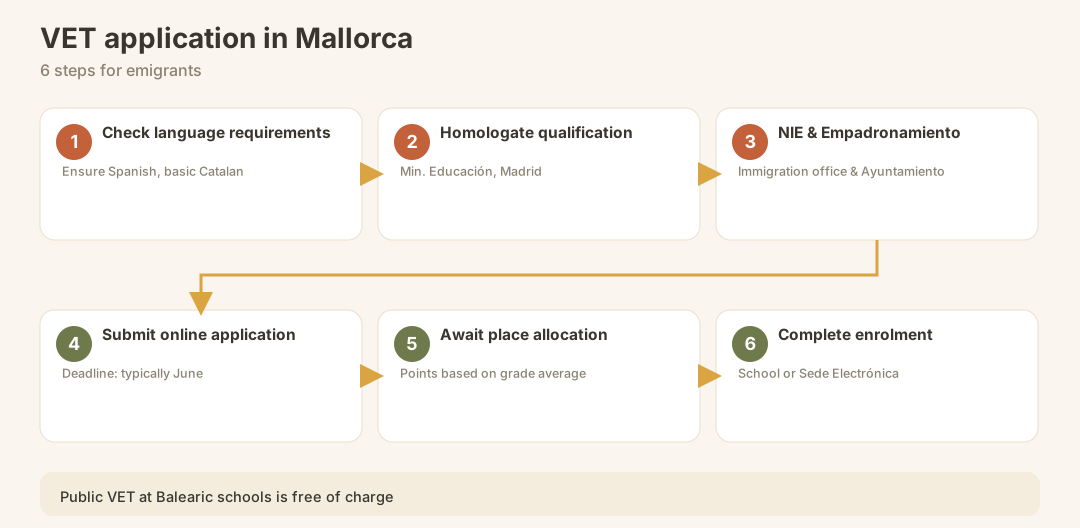
- Check language requirements – Ensure you have sufficient Spanish language skills; a basic knowledge of Catalan is a bonus. Our guide Learning Spanish in Mallorca.
- Get your foreign qualification recognised – Anyone without a Spanish ESO or Bachillerato certificate will need to have their qualification officially recognised (homologación). This is handled by the Ministerio de Educación y Formación Profesional in Madrid.
- Obtain your NIE and Empadronamiento – Both documents are required for enrolment. For further details, see our guide Empadronamiento in Mallorca.
- Submit your application online – Via the Balearic Islands' central platform; deadlines are generally in June for an autumn start (check the GOIB website each year for exact dates).
- Wait for your place allocation – Where demand exceeds capacity, places are awarded on the basis of grade point average. Applicants who do not receive a place are added to a waiting list or may opt for distance-learning FP instead.
- Complete enrolment – Either in person at the school or digitally via the Sede Electrónica.
| Step | Documents | Where |
|---|---|---|
| Qualification recognition | Original + certified translation | Min. Educación, Madrid |
| Apply for NIE | Passport, forms EX-15/EX-18 | Foreigners' Registration Office, Palma |
| Empadronamiento | Rental agreement or proof of ownership + passport | Ayuntamiento |
| Online FP application | Accredited qualification, NIE, photo | Portal Conselleria d'Educació |
Costs and funding
Vocational training at state schools in the Balearic Islands is generally free of charge – no tuition fees apply. Only enrolment fees (tasas de matrícula) may be charged; these are modest and vary depending on the course and type of school.
Possible additional costs:
| Item | Approximate figure |
|---|---|
| Certified translation (homologation) | variable, depending on scope |
| Textbooks and materials | varies by cycle |
| Vocational training at private or Concertado centres | monthly fees may apply |
Anyone registered as a resident in Spain who has children or young people undertaking vocational training should check whether scholarships from the Spanish Ministry (becas MEC) are available – these are advertised annually and are means-tested based on household income.
Recognition in Germany: what is the Técnico worth there?
This is one of the most frequently asked questions by families who do not intend to remain on Mallorca permanently. The clear answer from our research: there is no automatic equivalence between the Spanish Técnico or Técnico Superior and a German vocational qualification.
What you can do:
- Recognition advisory service via the Netzwerk IQ or the BIBB (Federal Institute for Vocational Education and Training) in Germany
- anabin database of the KMK: Spain is listed there with a validity date from 1990; you can use it to provisionally classify qualifications
- case-by-case assessment by the relevant German chamber or authority depending on the professional field
The Técnico Superior is recognised as a route into universities of applied sciences in some German federal states – but not automatically and not everywhere. It is worth enquiring early.
Most common mistakes when applying
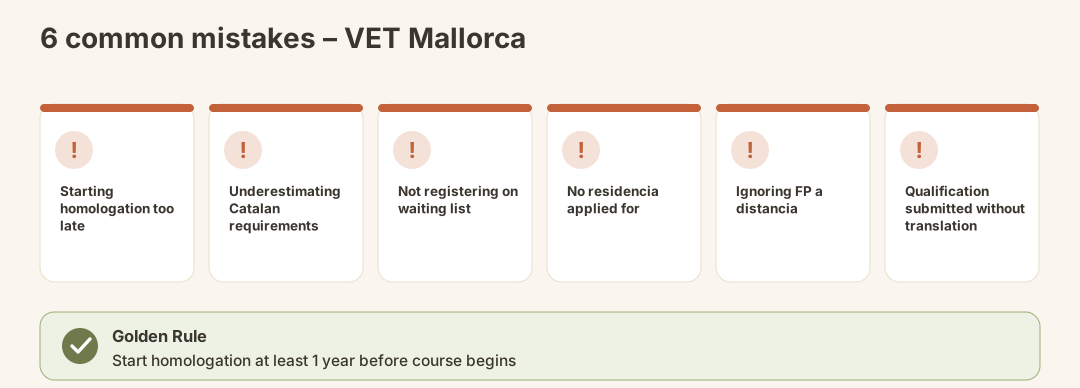
- Starting the homologation process too late. The procedure can take months – begin no later than the autumn of the previous year if you want to join the next course.
- Underestimating the Catalan language requirements. Lessons, examinations and documents in the Balearic Islands are often in Catalan. Those who only speak Spanish can manage, but it requires considerably more effort.
- Hoping for a place without joining the waiting list. Popular courses (e.g. in tourism or healthcare) are often oversubscribed. Those on the waiting list still have a chance – those who have not registered at all will miss out entirely.
- Not having applied for residencia. EU citizens formally need the Residencia in order to have full access to state educational services. Our guide Applying for Residencia in Spain will help you with this.
- Not having explored distance-learning FP as an alternative. Those who cannot secure an in-person place can complete many courses via FP a distancia – including the practical work placement on site.
- Submitting German qualifications without a translation. Officially certified translations (traducciones juradas) are mandatory; simple copies are not sufficient.
What comes next? Further study and career prospects
After completing the FP Grado Superior, several paths are open:
- Direct entry into employment – the Técnico Superior is a fully recognised professional qualification on the Spanish job market
- University study – via the university entrance qualifications of the Bachillerato or directly for certain degree programmes
- Further FP study in a different specialist field – lateral entry is possible
- UIB (Universitat de les Illes Balears) in Palma as the next step – more on this in our guide UIB Mallorca Studium
Anyone working in a company on Mallorca and completing an FP alongside their job can also enter through the route of Formación Profesional para personas adultas – even as an adult. This is an often-overlooked path for expats looking to reorient their careers.
Checklist: preparing for FP on Mallorca
- Check whether your foreign educational qualification requires homologation
- Bring your Spanish up to at least B1 level
- Apply for your NIE (if you don't already have one)
- Complete your Empadronamiento in your municipality of residence
- Register your Residencia as an EU citizen
- Check the application deadlines of the Conselleria d'Educació for the desired cycle (typically: June)
- Submit your online application via the Balearen portal
- For popular cycles: get yourself added to the waiting list
- For FP Dual: involve a company as a cooperation partner
- After completion: research recognition in Germany via BIBB/anabin
Conclusion
FP vocational training in Spain is a fully recognised, state-approved route into employment – and on Mallorca the offering is growing: 25 new cycles and an expanded FP Dual programme are launching from the 2026/27 academic year. The system differs considerably from the German dual model: it is more school-based in its organisation, but practical workplace experience is embedded, and the Grado Superior system even opens the door to university. For expat families, it is worth starting early – above all with the homologation of foreign qualifications and language acquisition. Anyone who has these in hand will find a readily accessible, cost-free vocational training programme on Mallorca at a European standard.
Official sources
- Govern de les Illes Balears – Conselleria d'Educació i Universitats: Press release on the expansion of the FP offering for 2026/27: https://www.caib.es/webgoib/
- BQ-Portal of the BIBB – Country profile Spain, description of the vocational education and training system: https://www.bq-portal.de/db/Länder-und-Berufsprofile/spanien
- Ministerio de Educación y Formación Profesional – Homologation of foreign qualifications: https://www.educacionyfp.gob.es
- Sede Electrónica CAIB – Online administration of the Balearic Islands (enrolments, applications): https://www.caib.es/seucaib/es/
- BOIB – Butlletí Oficial de les Illes Balears (official publications of the Balearic regional government): https://www.caib.es/eboibfront/