
Homologación: Getting Your Qualifications Recognised in Spain
Anyone who wants to study, work or demonstrate a professional qualification in Spain with a German, Austrian or Swiss degree will sooner or later come across the word Homologación. The procedure ensures that your foreign qualification is formally recognised as equivalent to its Spanish counterpart – and it is more complex than a simple translation. Depending on your country of origin, the type of qualification and the target university, the processes differ. This guide explains the complete path: from non-university school-leaving certificates through UNEDasiss accreditation to the Pruebas de Competencias Específicas (PCE). You will find out which documents you need, where to submit your application, what exceptions apply to EU citizens – and which mistakes can delay the process by months.

What does Homologación mean – and what doesn't it mean?
The Homologación is the formal recognition of a foreign educational qualification as equivalent to a Spanish degree. The procedure is carried out by the Ministerio de Educación, Formación Profesional y Deportes (MEFPD) – digitally via the Ministry's Sede Electrónica.
This is distinct from Convalidación (subject recognition), whereby individual subjects or courses are credited without formally reclassifying the entire qualification. Anyone who wishes to continue a degree already begun at a Spanish university and have subjects from their home country credited will generally need the Convalidación – not necessarily the full Homologación.
| Term | What is recognised? | Responsible authority |
|---|---|---|
| Homologación | Entire qualification ↔ Spanish degree | Ministerio de Educación (MEFPD) |
| Convalidación | Individual subjects / years of study | Ministerio de Educación (MEFPD) |
| UNEDasiss accreditation | University access for international students | UNED (specialist service) |
| PCE (Prueba de Competencias Específicas) | Subject-specific entrance examination at UNED | UNED |
Note: Pupils from other EU countries who wish to transfer to a Spanish university generally do not need to apply for a full Homologación – for them there is a simplified route via UNEDasiss. More on this later.
Non-university qualifications: The route to Homologación of the Bachillerato
Anyone wishing to have a foreign upper secondary school qualification (equivalent to the German Abitur or Austrian Matura) recognised must submit their application to the MEFPD. The process can be completed online via the Sede Electrónica of the Ministry.
Step by step: Applying for Homologación (non-university)
- Check your qualification – Check whether your qualification falls under the Homologación. Pupils who are entering directly into Spanish Primaria or ESO (Educación Secundaria Obligatoria) do not need a Convalidación.
- Gather your documents (see table below)
- Obtain the Apostille – All foreign certificates must bear the Hague Apostille
- Certified translation into Spanish – By a sworn translator (traductor jurado)
- Submit your online application – Via the Sede Electrónica of the MEFPD; you will need a digital certificate (Certificado Digital) or Cl@ve
- Submit your documents – By upload via the Sede Electrónica
- Await the decision – Processing times vary; reports from applicants suggest anything from several months to over a year
Please note: Bachillerato qualifications completed online or by distance learning from within Spain are, according to the Ministry,not eligible for homologación. This also applies to certain courses offered by foreign distance-learning schools.
| Document | Note |
|---|---|
| Original certificate / leaving certificate | With Apostille |
| Certified translation (Spanish) | By a sworn translator |
| Valid passport or national identity card | Copy |
| Completed application form (Sede Electrónica) | Online |
| Proof of payment of application fee (Tasa) | In accordance with the current fee schedule of the Ministry |
Special regulations in Catalonia, Galicia and the Basque Country
If you live in one of the three regions with their own education authority, you should apply not to the national Ministry, but to the relevant regional authority:
| Autonomous Community | Responsible body |
|---|---|
| Catalonia | Generalitat de Catalunya (Tramits Portal) |
| Galicia | Xunta de Galicia – Consellería de Educación |
| Basque Country | Hezkuntza / Departamento de Educación del Gobierno Vasco |
EU citizens and the alternative route via UNEDasiss
For pupils from EU member states (and countries with corresponding reciprocal agreements), there is a dedicated pathway to Spanish universities: the Acreditación UNEDasiss.
UNEDasiss is a service of the UNED (Universidad Nacional de Educación a Distancia) and assesses international school-leaving certificates in a consistent, regulated manner. The digital accreditation certificate allows applicants to apply to Spanish universities for undergraduate degree programmes – without first having to complete a full homologación of their school-leaving qualification.
What UNEDasiss does not replace: The Acreditación is not a degree qualification or a Homologación. It is proof of entry eligibility for universities that accept the UNEDasiss system.
The 5 steps with UNEDasiss
- Check whether you are an EU citizen or whether an agreement applies – UNED draws a clear distinction between EU and non-EU applicants
- Contact your target university – Not all Spanish universities accept the UNEDasiss accreditation; check the admission criteria and the weighting tables (tablas de ponderación) for your chosen subject
- Prepare your documentation – School transcripts, apostille, certified translation
- Submit your online application and pay the fee – Your application will only be processed once payment has been received
- Send in your documents – By post or in person; all communication is conducted by email
Please note: Non-EU citizens must additionally apply for Homologación of the Bachillerato through the Ministry before they can use the UNEDasiss accreditation.
The PCE: Pruebas de Competencias Específicas
The PCE (Pruebas de Competencias Específicas) are subject-specific examinations sat at UNED. They work similarly to A-level examinations in individual subjects and can improve your grade in the UNEDasiss accreditation process – which matters if you are applying for degree programmes with restricted places.
| Aspect | Detail |
|---|---|
| Who can sit the PCE? | International students in the UNEDasiss process |
| Purpose | Improving the entry grade (nota de admisión) for universities |
| Number of subjects | Depending on the target degree programme and university requirements |
| Examination venue | UNED centres in Spain and abroad |
| Examination language | Spanish |
| Relevance | Decisive for degree programmes with restricted admission |
Which subjects you need to sit PCE examinations in depends on the weighting table (tabla de ponderación) of the relevant university and your chosen degree programme. The universities publish these tables themselves – make sure you call or send an email before registering for PCE subjects.
Having university degrees recognised (homologación)
Anyone wishing to have a foreign university degree recognised in Spain – for example in order to work in a regulated profession (doctor, lawyer, architect) – applies for homologación through the Ministerio de Ciencia, Innovación y Universidades / Secretaría General de Universidades.
The process also runs via the Sede Electrónica. For non-regulated professions, homologación is, according to the sources, often not a mandatory requirement – many employers accept foreign qualifications without formal recognition. Nevertheless, some employers do explicitly require homologación.
Please note: For admission to a Master's degree programme in Spain, homologación of a foreign Bachelor's degree is frequently not required – this depends on the individual university.
| Type of qualification | Responsible authority | Particular features |
|---|---|---|
| School-leaving qualification (Bachillerato equivalent) | Ministerio de Educación (MEFPD) | Or autonomous authority in Cat./Gal./PV |
| Vocational training / FP | Ministerio de Educación (MEFPD) | Separate Sede Electrónica page for FP |
| University degree (regulated profession) | Ministerio de Ciencia, Innovación y Universidades | Mandatory for regulated professions |
| University degree (non-regulated) | Optional / employer decides | Homologación not always required |
Vocational training (Formación Profesional): its own rules
Anyone bringing a foreign vocational qualification (comparable to the German dual training system) who wishes to continue in an FP programme or work in Spain must have it homologated separately. The procedure also runs through the Sede Electrónica des MEFPD, but has its own entry page (trámite for FP homologación).
Important: In Spain, compulsory secondary education (ESO) covers 10 school years. Anyone coming from a country where fewer years of schooling are required to obtain a qualification may need to complete an additional school year.
Deadlines: when do you need to start at the latest?
This is one of the most common mistakes: the application is submitted too late. Universities have admission deadlines – and the Ministry works to its own timetable.
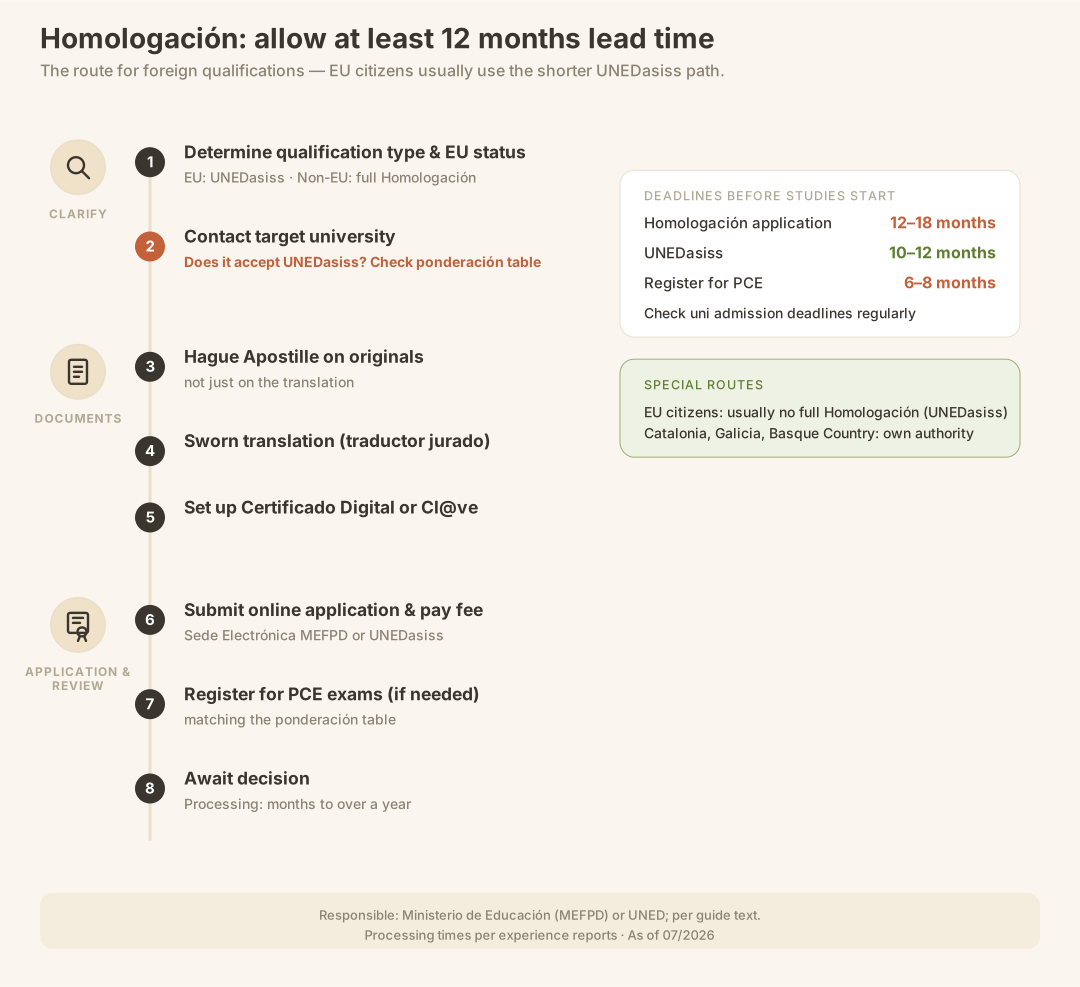
| Timeframe | What needs to be done? |
|---|---|
| 12–18 months before the start of studies | Submit the homologación application to the Ministry (non-university) |
| 10–12 months before the start of studies | Prepare the UNEDasiss application, have documents apostilled |
| 6–8 months before the start of studies | Register for PCE examinations (observe UNED registration deadlines) |
| Ongoing | Check with your target university for current admission deadlines |
Please note: According to first-hand accounts, processing of the homologación at the Ministry can take several months to well over a year – plan generously. Missing the deadline risks, in the worst case, being de-registered or having to wait a full academic year.
Most common mistakes and how to avoid them
Based on what those affected report and what the Ministry itself clarifies, there are a number of classic pitfalls:
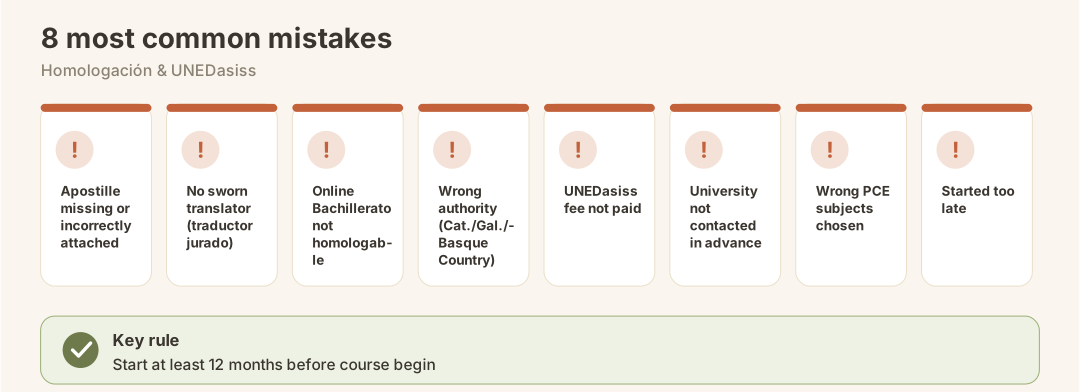
- Apostille forgotten or incorrectly attached – The apostille must be on the Originaldocument (or a certified copy) — not only on the translation.
- Non-sworn translator – Only a sworn translator (traductor jurado) is accepted; a standard translation is not sufficient.
- Online Bachillerato from abroad – Foreign school-leaving qualifications completed by distance learning from Spain cannot be homologated, according to the Ministry.
- Wrong authority – Anyone living in Catalonia, Galicia or the Basque Country must apply to the relevant regional authority, not to the national Ministry.
- Application fee not paid – UNEDasiss will only process the request once payment has been received.
- University not contacted in advance – Not every university accepts UNEDasiss; without prior consultation you may apply for the wrong accreditation.
- Wrong PCE subjects chosen – The PCE examination subjects must match the weighting table of the target university; choosing the wrong subjects will not improve your grade.
- Started too late – The most common reason for missing admission deadlines.
What does the Homologación cost?
Research does not yield specific fee figures from the current Ministry fee schedule. Please bear this in mind:
- The Ministry charges an administrative fee (tasa), the exact amount of which can be found in the current Trámite on the Sede Electrónica — please check there for the latest figures.
- UNEDasiss charges its own fees for accreditation and for each PCE examination.
- Additional external costs include: Apostille (varying by country of issue), sworn translation (depending on length and translator), and any agency consultation fees.
Note: In addition to the official fees, budget time and money for the Apostille and sworn translator — these costs are frequently underestimated.
Checklist: Homologación & UNEDasiss
- Country of origin and type of qualification determine the process (school / vocational training / university)
- Checked whether EU citizen or non-EU (determines the pathway)
- Contacted the target university and enquired about admission criteria
- Reviewed the university's weighting table for PCE subjects
- Original documents provided with Hague Apostille
- Certified translation commissioned through a sworn translator
- Digital certificate (Certificado Digital) or Cl@ve set up
- Online application submitted via the Sede Electrónica of the MEFPD (non-university) or UNEDasiss application completed
- Fee paid
- Documents submitted in full
- PCE examinations registered for in good time (if required)
- Deadlines checked against the admissions office of the target university
What comes next?
With the Homologación decision in hand (or the UNEDasiss accreditation), you can apply to Spanish universities through the standard process. For life in Spain – not just your studies – there are further steps ahead of you:
- Empadronamiento (municipal registration) – Without registering you will receive neither student discounts nor access to public services
- Residencia in Spain – Required for EU citizens after three months of residence
- Certificado Digital & Cl@ve – For all further online dealings with public authorities
- Children in school on Mallorca – Anyone moving with a family will find all the information here on international schools and Spanish state schools
- International schools Mallorca – An overview of alternatives to the Spanish school system
Conclusion
The Homologación is nothing to be afraid of – but it requires time, care, and the right documents. EU citizens can generally access Spanish universities without a full Homologación by using the UNEDasiss route and getting in touch with their target university early. Non-EU citizens must first have their school-leaving qualification recognised by the MEFPD before UNEDasiss can become involved. Those living in Catalonia, Galicia, or the Basque Country should contact the relevant regional authority. And everyone should bear one thing in mind: Start early – at least one year before your planned start of studies.
Official sources
- Ministerio de Educación, Formación Profesional y Deportes (MEFPD) – Homologación and Convalidación of non-university qualifications: https://www.educacionfpydeportes.gob.es/servicios-al-ciudadano/catalogo/general/05/051270/ficha/051270.html
- Homologación and Convalidación Portal (MEFPD): https://www.educacionyfp.gob.es/mc/convalidacion-homologacion/portada.html
- UNEDasiss – University access for international students: https://unedasiss.uned.es/home
- UNEDasiss – Information on Homologación: https://unedasiss.uned.es/homologacion
- UNEDasiss – FAQs: https://unedasiss.uned.es/faqs
- Sede Electrónica – Application for FP Homologación: https://www.educacionyfp.gob.es/servicios-al-ciudadano/catalogo/general/22/2214991/ficha/2214991.html
- Homologación of university degrees (regulated professions) – Sede Electrónica Universidades: https://universidades.sede.gob.es/procedimientos/portada/ida/3513/idp/1029/language/en
- German Consular Authority – Recognition of qualifications (Ministry page in German): https://www.educacionfpydeportes.gob.es/alemania/de_DE/reconocimiento-titulos.html
- TodoFP – Homologación of FP qualifications: https://todofp.es/convalidaciones-equivalencias-homologaciones/homologaciones.html