
Catalan on Mallorca: School and Official Dealings — What Families Need to Know
Anyone relocating to Mallorca with their family will encounter Catalan at the latest on the first day of school — and often as early as their first visit to the local council offices.Catalan at school in Mallorcais not an option but a structural reality: at state schools and most semi-private schools on the island, Catalan is the dominant language of instruction, with Castilian (Spanish) playing a supplementary role. For German-speaking families choosing a state school, this means a clear language leap — but also a genuine opportunity for integration. This guide explains how the language system works in everyday school life, what the PALIC programme offers, what alternatives exist, how to enrol your child, and what to expect from the authorities when Catalan is involved.

Which school suits your family — state, concertado, or international?
- 📩 Submit a personal enquiry— we'll help you with school selection, enrolment, and your first contact with the authorities
- Everything about schools in Mallorca for German-speaking children
Why Catalan is compulsory in Mallorca — the legal background
Mallorca is part of the Autonomous Community of the Balearic Islands. Since the democratisation of Spain, Catalan has been recognised here as an official language on an equal footing with Castilian. In practice, this means the following for schools: the Balearic education system has enshrined Catalan as the primary language of instruction. This is not a local anomaly but is regulated by law — and is the subject of passionate political debate.
Recent headlines show just how lively the debate remains: according to the Mallorca Zeitung, PP and Vox have pushed through relaxations of the mandatory Catalan requirement for certain posts in the public sector — including in schools. However, the fundamental structure of the school language policy remains largely unaffected. For families from Germany, Austria, or Switzerland, everyday practicalities matter more than political debate: your child will be taught primarily in Catalan at a state school in Mallorca.
Please note:The language policy situation in the Balearic Islands is evolving. Before enrolling your child, check with the relevant school about the current language breakdown in the timetable.
An overview of the school system: three paths, three language profiles
Before we go into detail, it helps to look at the three pillars of the Mallorcan school system — they differ not only in cost but, crucially, in their approach to language.
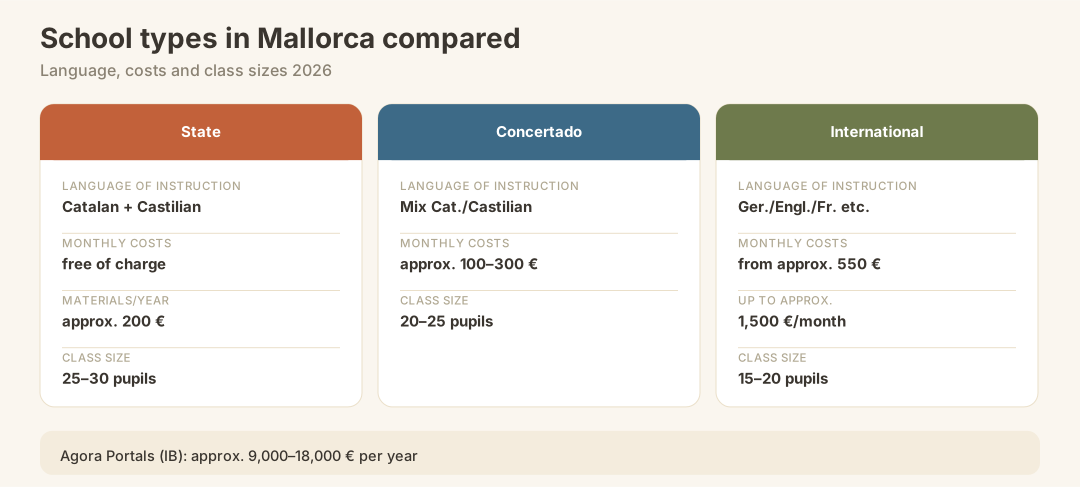
| School type | Language of instruction | Monthly costs | Class size |
|---|---|---|---|
| State school (Colegio Público) | Catalan (main language) + Castilian | free (approx. €200/year for materials) | 25–30 pupils |
| Semi-private (Concertado) | Mix of Catalan/Castilian | approx. €100–300 | 20–25 pupils |
| Private/International | German, English, French, and others | from approx. €550 (up to approx. €1,500/month) | 15–20 pupils |
At state schools, Catalan is clearly dominant. Castilian Spanish is also taught, but parents enrolling a child with no prior knowledge will find the first few weeks a genuine language immersion — in Catalan, not Spanish.
Concertado schools are state-subsidised and often run by religious (Catholic) organisations. Their language profile varies more than at purely state schools: some operate primarily in Castilian, while others also emphasise Catalan.
International and private schools operate largely independently of the Balearic language regulations. Enrolling here means avoiding the compulsory Catalan requirement in everyday school life — but you pay the corresponding school fees and forgo deep local integration.
PALIC: The programme for newly arrived children
The PALIC programme (Programa d'Acolliment Lingüístic i Cultural) is the most important tool that state schools on Mallorca provide for newly arrived children with no language skills. It is aimed at pupils who speak neither Catalan nor Castilian Spanish.
What PALIC offers:
- Intensive language support in small groups — running alongside regular lessons
- Cultural orientation to help children settle into school life more quickly
- Gradual integration into mainstream classes
The programme is free of charge and starts automatically once the school identifies at enrolment that a child has no knowledge of Catalan. You do not need to apply for PALIC separately — but do raise it proactively at the admission meeting so that the school can place your child correctly from the outset.
Please note: PALIC is not equally well established at every school. When visiting, ask specifically how many PALIC hours per week are offered and whether there is a dedicated teacher for the programme.
The linguistic reality of everyday school life: what actually happens
Theory and practice sometimes diverge. Here is a realistic picture based on the available sources:
| Situation | Reality for German-speaking children |
|---|---|
| First few weeks at a state school | Lessons almost exclusively in Catalan; classmates may also speak Castilian or their own mother tongue, depending on the school |
| After a few months | Most children develop passive Catalan; active speaking follows at the child's own pace |
| Official school communications | Parent letters and forms frequently in Catalan — a Castilian version is usually available on request |
| Reports and official documents | Issued in Catalan; a certified translation is required for German authorities |
Children under ten generally adapt quickly in practice. For teenagers moving directly into secondary school, the linguistic pressure is considerably higher — here PALIC is particularly important, or a serious case can be made for an international school.
Enrolment: step by step
School enrolment in Mallorca is handled centrally through the Balearic Ministry of Education. Registration deadlines for state schools are generally in spring before the respective school year. Those who apply too late risk not being allocated their preferred school.
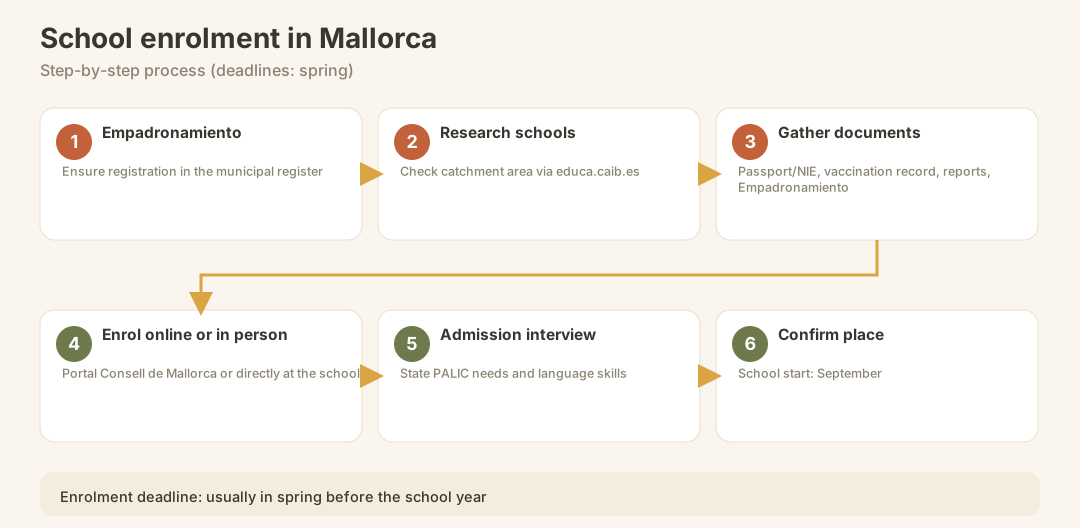
Step-by-step process:
- Secure your empadronamiento — without registration in the municipal register, you cannot obtain a place at your preferred school within the catchment area. More on this: Empadronamiento on Mallorca
- Identify schools in the catchment area — the Balearic Ministry of Education (educa.caib.es) lists all state schools with their catchment areas
- Gather the required documents (see table below)
- Register online or in person — via the Consell de Mallorca portal or directly at the school
- Admission interview — register any PALIC requirements here and inform the school of the child's language skills
- Confirm the place and prepare for the start of school
| Required document | Note |
|---|---|
| Proof of empadronamiento | Must be current; address must fall within the school's catchment area |
| Passport or NIE of the child | For EU citizens, a passport is sufficient |
| Vaccination record (Cartilla de vacunación) | Spanish format or international equivalent |
| Most recent school reports | With a certified translation where applicable |
| Homologation (for higher year groups) | Important for secondary level — recognition of the German educational qualification |
Catalan in everyday dealings with authorities: what you need to know
Not only the school, but also official communication in Mallorca is formally conducted in Catalan. This applies to:
- Municipal authorities (Ajuntaments): Forms, official notices and announcements frequently in Catalan
- Balearic regional authorities: Official correspondence in Catalan, though also available in Castilian upon request — this is guaranteed by law
- Education authority (Conselleria d'Educació): Application forms, school place notifications, and reports in Catalan
Practical tip: As an EU citizen, you have the right to communicate with Spanish authorities in Castilian. With Balearic authorities, you can insist on Castilian — this is legally protected. That said, it doesn't hurt to know a few basic terms in Catalan: it signals respect and opens doors.
For your official registration as a resident and all related dealings with the authorities, find out more under Residencia Spanien.
International schools: the Catalan-free alternative
Anyone looking to resolve the language question pragmatically will find a well-developed network of international schools on Mallorca. According to current directories, there are around 19 to 21 international schools on the island — an exceptionally high density for the Mediterranean. Over 16 per cent of all pupils in the Balearic Islands are of foreign origin, which explains the breadth of provision.
| School / Profile | Curriculum | Age groups | Approximate costs/year |
|---|---|---|---|
| Eurocampus Deutsche Schule (Palma) | German curriculum, recognised German qualifications | Kindergarten to secondary | on request |
| Agora Portals International School | IB (PYP, MYP) | 0–18 years | approx. 9.000–18.000 € |
| Escola Global International School | British Curriculum, Cambridge IGCSE | 2–18 years | depending on year group |
| Svenska Skolan Palma | Swedish curriculum, English/Spanish from Year 1 | 2–18 years | on request |
| Queen's College, Palma College and others | British National Curriculum | variable | variable |
The Eurocampus Deutsche Schule in Palma is the only licensed German school on the island and therefore the first port of call for families who want to secure a German educational qualification for their children.
Note: International schools are popular and often have waiting lists. Get in touch with your preferred school as early as possible — ideally several months before the planned start date.
A more detailed overview of school selection in general can be found in the guide Schule Mallorca für deutsche Kinder.
Learning Catalan: Is it worth it — and how?
For children attending a state or Concertado school, the question is not whether Catalan will come, but how quickly. For parents, the question is somewhat different: should I, as an adult, learn Catalan in order to keep up with day-to-day school life?
An honest assessment from practice:
- For everyday dealings with authorities, Castilian is perfectly sufficient — you have the right to be served in Castilian
- For parental involvement at school (parent councils, class chats, notices), at least a passive reading comprehension of Catalan is a real advantage
- Catalan is closer to Spanish speakers than to native German speakers, but there are certainly structural differences
- Courses in Catalan are offered by the Escola Oficial d'Idiomes (EOI) on Mallorca — state-run, affordable, and practically oriented
Those who want to consolidate their Castilian first will find guidance in the article Spanisch lernen auf Mallorca.
Most common mistakes regarding Catalan and school
These stumbling blocks come up time and again with families preparing for the move:
- Starting the school enrolment process too late — state places in the catchment area are in high demand, and enrolment deadlines (usually in spring) tend to be underestimated
- Not proactively raising PALIC — the programme exists, but the school will only activate it once it knows your child requires additional support
- Equating Catalan with Spanish — many parents assume that knowledge of Spanish is sufficient; Catalan is an independent language with its own grammar and vocabulary
- Submitting school reports without a translation — to place a child in the correct year group, the school requires certified translations of German school reports
- Not living in the correct school catchment area — anyone who has a preferred school in mind should choose their address accordingly; without an empadronamiento in the catchment area, there is no priority place
- Enquiring about international schools too late — waiting lists fill up months in advance
- Ignoring official letters written in Catalan — deadlines still apply, even if you do not fully understand the letter; if in doubt, have it translated or contact the relevant authority
What comes next? Integration, further study, and prospects
Children who have attended a state school on Mallorca for several years typically leave it bilingual — in Catalan and Castilian Spanish — and, depending on the school, may also have English as a third language. This is a considerable advantage.
Anyone wishing to go on to study in Spain after secondary school (ESO) sits the Selectividad (university entrance examination). In the Balearic Islands, this examination is offered in both Catalan and Castilian Spanish. The Universitat de les Illes Balears (UIB) in Palma is the most obvious option for further study afterwards — more on this in the guide UIB Mallorca Studium.
Anyone arriving on the island with a German Abitur who wishes to study in Spain will generally need a Homologation of the German qualification from the Spanish Ministry of Education. This is a separate and time-consuming process.
Checklist: Language preparation for school in Mallorca
Use this checklist as a guide before your child's first day at school in Mallorca:
- Type of school decided — state, Concertado, or international?
- Empadronamiento completed and the catchment area of the preferred school checked
- School application submitted in good time (generally in spring before the start of the school year)
- PALIC requirement raised at the enrolment meeting
- School reports from the German school obtained with a certified translation
- Vaccination record checked for completeness against Spanish requirements
- Basic Catalan vocabulary started for parents (school letters, class chats)
- Child's Castilian Spanish proficiency assessed — arrange a language course before the start of school if necessary
- For international school: waiting list enquire early
- Child's NIE in place (relevant for older children) — more on this: NIE lost Spain
Conclusion: Catalan as an opportunity, not an obstacle
Catalan at school on Mallorca is neither a bureaucratic hurdle nor a quirk of Spanish regional politics — it is the living everyday language of a vibrant community. Children pick it up quickly when they grow up in a supportive environment and the PALIC programme kicks in early. For parents, passive reading comprehension in Catalan is a realistic and worthwhile goal.
Those who would rather sidestep the language barrier will find good alternatives among the roughly 19 to 21 international schools on the island — from the German school to the British curriculum. The choice between state, Concertado and international is not a question of right or wrong, but of priorities: cost, language, integration, qualifications.
Plan ahead, ask specific questions — and seek professional support for school selection and enrolment if needed: Relocation Service Mallorca.
Official sources
- Conselleria d'Educació i Formació Professional del Govern de les Illes Balears — responsible education authority: https://www.caib.es/sites/educacio
- Escola Oficial d'Idiomes (EOI) Mallorca — state language school for Catalan and Castilian Spanish courses: https://eoipalma.caib.es
- Universitat de les Illes Balears (UIB) — for information on the Selectividad and higher education: https://www.uib.es
- Ministerio de Educación, Formación Profesional y Deportes (Spain) — recognition of foreign educational qualifications: https://www.educacion.gob.es
- Govern de les Illes Balears — Informació lingüística — Language policy and rights: https://www.caib.es