
Learning Spanish in Mallorca: Language Schools, EOI and Subsidised Courses
Learning Spanish in Mallorca is no holiday cliché – it is a genuine necessity once you actually live here. Whether you finally tackle the paperwork at the town hall yourself, communicate with tradespeople, or simply shop on equal terms at the Mercado Olivar: without Spanish, the island will always remain a little closed off to you. This guide sets out exactly what the language schools in Palma offer, what the courses cost, how the state-run Escuela Oficial de Idiomas (EOI) works, what subsidised options exist, and whether you can even fund a course through educational leave. You will find real price tables, addresses, and decision-making tools – so you do not have to visit three providers before you know where to begin.

You are moving to Mallorca and want to avoid being dependent on translation apps from day one?
- 📩 Submit a personal enquiry — we will recommend suitable courses, schools, and funding options based on your situation
- Read everything about settling in on Mallorca
Why Spanish – and not just Mallorquinisch?
Mallorca is bilingual: Castilian Spanish and Catalan (on the island called mallorquí ) are both official languages. In everyday life – at public authorities, doctors, supermarkets, and at work – Spanish will get you through everywhere. Catalan is a pleasant bonus upgrade when you truly want to feel at home on the island; it is not, however, an essential requirement for getting started.
For the Residencia and the Empadronamiento you do not need a language certificate yourself – but you will be glad of at least B1 for every one of those official appointments. Anyone aiming for Spanish citizenship officially requires a DELE certificate at level A2 or B1.
Overview: Language schools in Palma de Mallorca
Palma has a compact but high-quality range of schools. Most providers are located in or near the old town, which means short distances and an authentic environment.
| School | Location / Address | Speciality |
|---|---|---|
| Akzent Palma | Palma Old Town | Founded 2014, native speakers, in-house bookshop, individual and group classes |
| MAXX Institutes | Avenida de Portugal 1 | Historic building, 10 air-conditioned classrooms, edge of the old town |
| Die Akademie | Historic centre, near the cathedral | International clientele, 16th-century building, established 1998 |
| Spanisch Aktiv Mallorca | Palma, exact address on request | Overnight stay at the school possible, breakfast & cooking together |
| Alpha Institute / fremdsprache.de | Palma (info evenings Wed 18 Uhr, Thu 10:30 Uhr) | Spanish & English, half-day courses, online via Zoom possible |
Please note: Addresses change. Always verify directly on the school's website or call before booking.
Course formats and prices compared
The differences between formats are greater than those between schools. Here are the most important options:
Intensive course (group)
The classic choice for rapid progress. At Akzent Palma this means 2 weeks, Monday to Friday from 10 to 14 Uhr, i.e. 40 teaching hours of 60 minutes each. The course is available to book year-round.
| Provider | Duration | Hours | Price 2026 |
|---|---|---|---|
| Akzent Palma – intensive course | 2 weeks (Mon–Fri) | 40 hrs of 60 min. | 440 € |
| Akzent Palma – intensive course | 2 weeks (Mon–Fri) | 40 hrs of 60 min. | (2025: 420 €) |
For 2026, Akzent Palma is planning the following course start dates, amongst others: 7.4., 20.4., 4.5., 18.5., 1.6., 15.6., 29.6., 13.7., 27.7., 31.8., 14.9., 28.9., 13.10., 26.10., 9.11., 23.11., 7.12.
One-to-one tuition
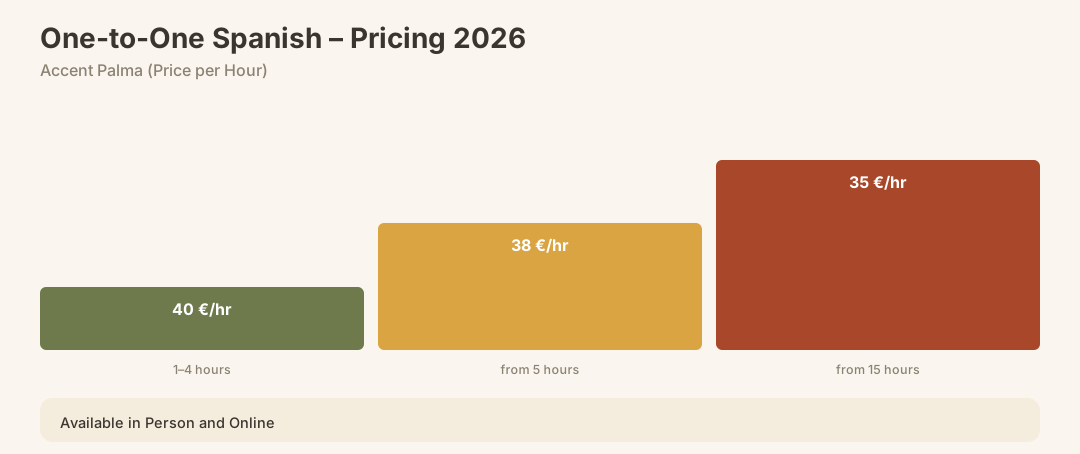
More flexible, more expensive – but unbeatable when you have a specific goal (dealings with authorities, business Spanish, exam preparation). At Akzent Palma the following tiered pricing applies in 2026:
| Number of hours | Price per hour |
|---|---|
| 1–4 hours | 40 € |
| from 5 hours | 38 € |
| from 15 hours | 35 € |
One-to-one tuition at Akzent Palma can be booked both in person and online – practical if you already live on the island and want to keep your schedule flexible.
Longer language stays
Spanisch Aktiv Mallorca offers an unusual concept: you live at the school, have breakfast and cook with the team. This is not a tourist product but a genuine immersion programme in which everyday situations feed directly into lessons. Courses for all levels from A1 to C2 are available, and there is a free taster lesson with placement assessment.
CIEE offers pupils and young adults a 4-week summer immersion programme in Palma – with tuition from local teachers, a host family, and excursions to the Serra de Tramuntana, Alcúdia, and the nature area La Victoria (Pollença Bay). The programme ran in 2026 across two sessions (7.6.–4.7. and 5.7.–1.8.).
The Escuela Oficial de Idiomas (EOI) – the state-sector route
The EOI is Spain's public adult language school system and is well regarded among professionals. On Mallorca there are locations in Palma (main school) as well as further Centros across the island.
What the EOI offers
- Official language courses at levels A1 to C2 in line with the Common European Framework of Reference (CEFR)
- Completion certificates that are officially state-recognised
- Considerably lower course fees than private schools
Key framework conditions
| Feature | Details |
|---|---|
| Provider | Gobierno de las Islas Baleares (Conselleria d'Educació) |
| Enrolment | Typically in September for the new academic year (October–June) |
| Waiting lists | Popular – enrol early, waiting lists possible |
| Languages offered | Spanish for foreigners (español para extranjeros), Catalan, English and others |
| Level placement | A placement test is required upon new enrolment |
| Fees | More affordable than private schools; exact rates set annually by the Conselleria |
Please note: The EOI is generally intended for residents and persons with Empadronamiento Without registration in the municipal register, there may be difficulties with enrolment.
The official website of the EOI Balears can be accessed via the Balearic education portal: https://www.ecoibalears.cat
Subsidised Spanish courses: What is available on Mallorca?
Courses from the Consell de Mallorca and local municipalities
Various municipalities and the Consell de Mallorca periodically offer free or heavily subsidised integration courses for newcomers. These are often aimed at people settling on the island permanently. The content frequently covers not only language but also orientation in everyday life.
Where to enquire:
- At the Ajuntament de Palma, Área de Participació Ciutadana
- At the Consell de Mallorca, Departament de Benestar Social
- At local Centros Cívicos (community centres)
SOIB – Servei d'Ocupació de les Illes Balears
The Balearic employment and skills service SOIB regularly funds language courses for jobseekers and employees. Eligibility typically requires active unemployed status or participation in an official training programme.
Website: https://www.soib.es
Konsorci per al Foment de la Llengua Catalana (COFUC)
For those who also wish to learn Catalan: the COFUC offers courses in the Catalan language across the Balearic Islands, often free of charge or heavily subsidised. This is a genuine advantage, particularly for entering the job market and participating in everyday social life on the island.
Educational leave: Spanish course on Mallorca with time off work
Those still employed in Germany who are planning a course on Mallorca may be able to apply for Bildungsurlaub in many German federal states — these are paid special leave days for recognised educational activities.
Which federal states offer Bildungsurlaub?
Not all German federal states have an educational leave law. Bayern and Sachsen, for example, have traditionally had no statutory Bildungsurlaub. In most other federal states, entitlement exists provided the course is recognised.
What requirements must the course meet?
| Criterion | Requirement |
|---|---|
| Recognition | The course must be recognised by the relevant federal state |
| Minimum scope | As a rule, at least 6 teaching hours per day |
| Content | Language proficiency is widely regarded as professional development |
| Evidence required | Certificate of attendance, and where applicable the school's attendance register |
Please note: The application is handled through your employer. Submit your application in good time – depending on the federal state, several weeks before the course begins. Check directly with your relevant state authority whether a specific course on Mallorca will be recognised.
A 2-week intensive course comprising 40 hours of tuition meets the formal requirements in terms of scope in many federal states – however, recognition in each individual case must be verified.
Language levels and certificates: what you need
The level system is crucial so that you know where you are starting from and where you want to get to.
| Level | Everyday description | Relevance on Mallorca |
|---|---|---|
| A1 | Basic phrases, greetings | Starting out, initial orientation |
| A2 | Simple conversations, shopping | Minimum target for a functioning everyday life |
| B1 | Independent communication | Dealings with authorities, doctor's appointments, job searching |
| B2 | Fluent conversation | Professional use, negotiating rent |
| C1 | Near-native proficiency | Academic or demanding professional contexts |
| C2 | Full mastery | Citizenship test, interpreting |
DELE certificates (Instituto Cervantes) are the internationally recognised Spanish language qualifications. A minimum of DELE A2 is required for Spanish citizenship; B1 is recommended if you want to handle official appointments with confidence. Exam dates and locations can be found on the Instituto Cervantes website (www.cervantes.es).
Accommodation during the course
| Option | Advantage | Note |
|---|---|---|
| Host family (homestay) | Maximum immersion, pure everyday language | Limited availability, may be arranged through the school |
| Living at the school | All-inclusive package (e.g. Spanisch Aktiv Mallorca) | The most intensive option, little privacy |
| Own flat / Airbnb | Flexible, a place to retreat to | Less immersion outside of lessons |
| Hotel / apartment | Comfort, familiar pricing structure | No linguistic added value outside the course |
Those who live on the island permanently need no separate accommodation – daily life provides the immersion for free.
Most common mistakes when learning Spanish in Mallorca
Starting too late. Many people wait until their residencia has come through – yet that is precisely the moment when you really need Spanish. Start in parallel.
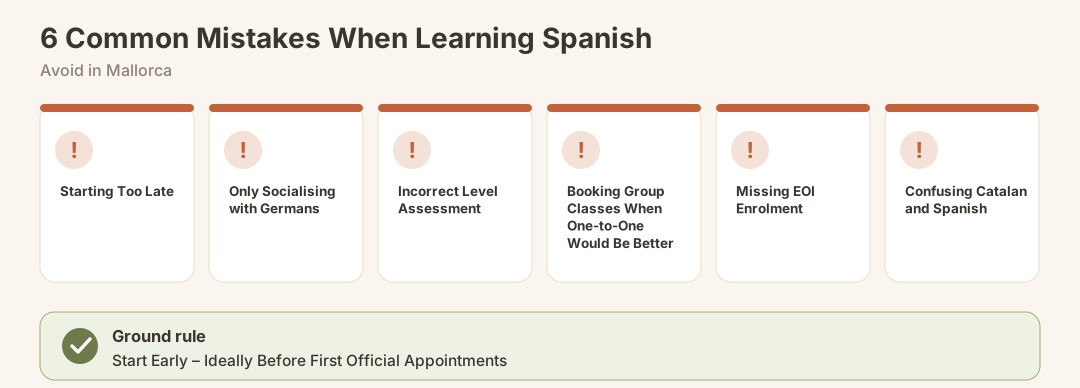
Only socialising with other Germans. The German-speaking community in Mallorca is large. That is entirely understandable on a human level, but it is a killer for language learning. Actively seek out Spanish-speaking environments.
Wrong level placement. Too easy is frustrating; too hard is discouraging. Make use of the placement tests that most schools offer free of charge.
Booking only group classes when one-to-one tuition would be more effective. If you have a very specific goal (e.g. Spanish for tax conversations or contract negotiations), private lessons are the more efficient investment.
Missing the EOI enrolment window. The registration period is short and places are in high demand. Anyone wanting to start in autumn needs to look into it in early summer.
Confusing Catalan and Spanish. On Mallorca you will encounter both languages – on signs, on the radio, in conversation. This is not a mistake on anyone's part; it is simply the linguistic reality of the island.
What comes next?
Learning Spanish is not the end goal – it opens doors to everything else:
- Official matters: With B1–B2 you can handle your Empadronamiento, Certificado Digital and Cl@ve PIN independently.
- Work: Anyone wanting to work on the island – whether remotely or locally – communicates in Spanish with authorities, landlords, and business partners. Find out more in the guide Remote Work Mallorca.
- Family: Children in Spanish schools pick things up faster than adults – but you can support them far better if you keep up yourself. Read more in Schule Mallorca für deutsche Kinder.
- Citizenship: The path to Spanish citizenship runs via a DELE certificate.
Checklist: how to go about it the right way
- Honestly assess your language level (free placement test at Akzent Palma or Spanisch Aktiv Mallorca)
- Define your learning goal: everyday life, work, a certificate, or citizenship?
- Choose your format: intensive course, private tuition, EOI, or a combination?
- Check with EOI Baleares (do not miss the enrolment period, typically September)
- Check SOIB and local council offerings if you are job-seeking or a new arrival
- Apply to employers in Germany for educational leave in good time (at least several weeks in advance)
- Research DELE exam dates at the Instituto Cervantes if obtaining a certificate is your goal
- Actively build language contacts outside the course (language partners, clubs, markets)
Conclusion
Learning Spanish on Mallorca is easier to organise today than ever before: private schools such as Akzent Palma or Spanisch Aktiv Mallorca offer structured courses at transparent prices, the EOI provides state-recognised certificates on considerably more affordable terms, and subsidised options through SOIB or local councils can make getting started almost cost-neutral. The crucial thing is to begin early – ideally before your first appointments with the authorities, not after. With the right course format and genuine everyday language contact, you will reach B1 faster than you might expect.
Official Sources
- EOI Baleares (Escuela Oficial de Idiomas): https://www.ecoibalears.cat
- SOIB (Servei d'Ocupació de les Illes Balears): https://www.soib.es
- Instituto Cervantes – DELE exams and exam dates: https://www.cervantes.es
- Conselleria d'Educació i Universitats – Govern de les Illes Balears: https://www.caib.es/govern/organigrama/area.do?lang=es&coduo=4
- Akzent Palma (language school): https://www.akzent-palma.com
- MAXX Institutes Palma: Avenida de Portugal 1, Palma de Mallorca
- Spanisch Aktiv Mallorca: https://www.spanisch-aktiv-mallorca.de