
Children without Spanish in Spanish schools on Mallorca: The PALIC Programme
Anyone moving to Mallorca with children faces a very concrete question early on: what happens if my child doesn't speak a word of Spanish — let alone Catalan — but is due to start state school in September? There is a programme specifically designed for this situation: the PALIC programme (Programa d'Acollida Lingüística i Cultural), the Balearic language and cultural reception programme for newly arrived pupils. This guide explains how PALIC works, who is eligible, how the enrolment process runs, what you can realistically expect — and how to combine the programme optimally with other measures so that your child doesn't merely keep up, but truly thrives.

Are you planning your child's school start in Mallorca and don't know where to begin?
- 📩 Submit a personal enquiry — we'll help you approach school, enrolment and PALIC in a coordinated way
- All information about schools in Mallorca
What exactly is PALIC?
PALIC stands for Programa d'Acollida Lingüística i Cultural — roughly translated: Programme for Linguistic and Cultural Reception. It is a support initiative run by the Balearic education authority (Conselleria d'Educació, Cultura i Universitats) and is aimed at pupils who are new to the Balearic Islands and have little or no knowledge of Catalan and/or Spanish.
The programme is not a separate school stream or a special class in the traditional sense. It is an accompanying language support provision that runs in parallel with regular lessons. Children are integrated into their mainstream class from the outset — meaning they sit alongside Mallorcan peers of the same age right from day one — and additionally receive targeted language sessions to bring their Catalan and Spanish up to a functional level as quickly as possible.
Please note: PALIC is available at state schools (Colegios Públicos) and at semi-private Concertado schools that participate in the programme. The programme is not available at purely private international schools — nor is it generally needed there, as tuition is usually delivered in English or another language.
The programme differs markedly from the German concept of a 'welcome class': in Mallorca, integration into the mainstream class is compulsory from day one, and language support is additive rather than a replacement for regular lessons.
Why is language support particularly complex in Mallorca?
In Mallorca, children are not just exposed to one new language but two: Catalan (Català, sometimes referred to in its Balearic variant as Mallorquí) and Spanish (Castellano). The state school system of the Balearic Islands operates on a model in which Catalan is the primary language of instruction.
| Language | Role in the classroom | For new arrivals |
|---|---|---|
| Catalan (Català) | Primary language of instruction, administrative language of the school | Often the greater hurdle |
| Spanish (Castellano) | Compulsory subject, parts of lessons taught in Spanish | Generally easier for many EU children |
| English | Compulsory foreign language from primary school onwards | More familiar for many children |
| German | Only at select schools/programmes | Not part of PALIC |
German children frequently arrive with little or no knowledge of either language — Spanish is at best familiar from holidays. Catalan is entirely new to most of them. The PALIC programme addresses precisely this dual challenge.
Who is entitled to PALIC?
The programme is in principle open to all pupils who
- are newly entering the Balearic school system,
- have no or insufficient knowledge of Catalan and/or Spanish,
- are enrolled at a participating state or Concertado school.
There is no citizenship or residency status requirement — EU children are equally entitled. Eligibility applies regardless of whether the child holds a German passport, another EU passport, or a third-country passport.
Please note: PALIC is not automatic. It is activated upon application or at the school's assessment. When you attend the enrolment meeting, make a point of mentioning that your child has no knowledge of Spanish or Catalan. The school will then initiate the relevant procedure.
The assessment of language level is generally carried out by the teaching staff and — at larger schools — by specially trained PALIC coordinators (tutors d'acollida).
Step-by-step guide to school enrolment
Enrolling at a state school in Mallorca and activating PALIC are two processes that go hand in hand. Here is the typical procedure:
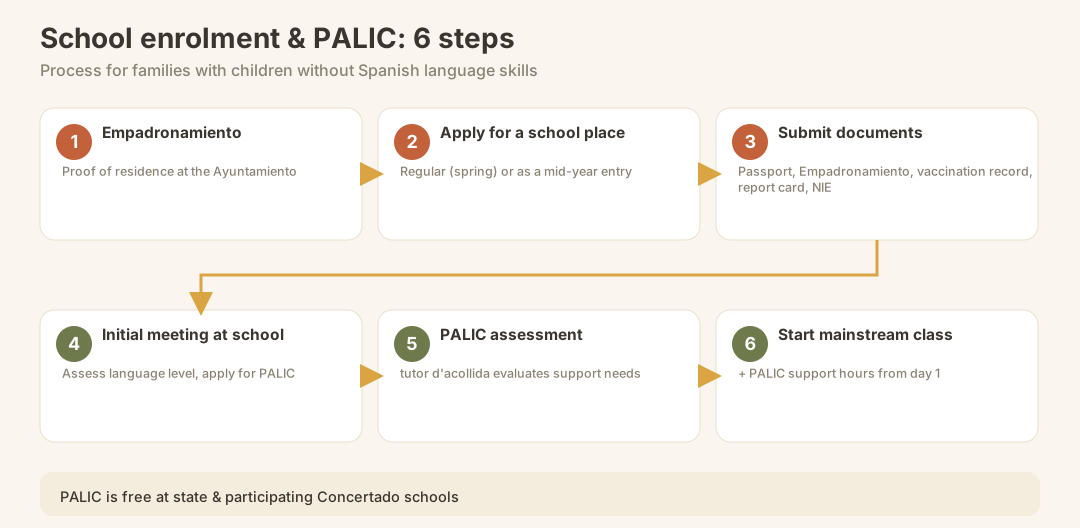
Obtain your Empadronamiento — The proof of residence (Empadronamiento) from the local council is generally required for school allocation. Without it, your child will not be assigned a confirmed school place. Find out more in our guide to the Empadronamiento on Mallorca.
Applying for a school place — There is usually an official enrolment period in spring (for the following school year). Outside this period, a mid-year application (matrícula extraordinaria) is possible — your child will then be assigned a available place within the school zone.
Submitting documents — The following documents are typically required:
- Passport or DNI/identity card of the child
- Empadronamiento (proof of residence)
- Vaccination record (Cartilla de vacunación)
- Most recent school report / school certificate from Germany (ideally translated, or at least with a certified translation)
- NIE of the child (if available)
Initial meeting with the school — This is where the child's language level is assessed and PALIC is applied for if needed. Bring a German–Spanish translation aid or someone who speaks Spanish — very few school offices have German-speaking staff.
PALIC assessment — The tutor d'acollida or class teacher assesses which year group the child should be placed in and how much additional support is required.
Start in the mainstream class + support lessons — From the very first day, the child joins the class group. The PALIC sessions run alongside regular lessons but are generally not counted as part of the standard timetable.
| Step | Responsible authority | Typical timeframe |
|---|---|---|
| Empadronamiento | Ayuntamiento of the local council | Possible at any time |
| School place allocation (standard) | Conselleria d'Educació | Spring (usually March–April) |
| Mid-year enrolment | Receiving school + Conselleria | At any time, subject to available places |
| PALIC activation | School / tutor d'acollida | From the start of school |
| First assessment of language progress | School | After a few months |
What actually happens during PALIC sessions?
PALIC is not a standardised course format — the specific implementation depends on the school, the availability of staff, and the composition of the newly arrived pupils. In practice, this means:
- Small groups or one-to-one support: Depending on the number of children without language skills at the school, support is provided in small groups or individually.
- Focus on everyday language: The initial aim is the lengua de comunicación — meaning the child should be able to communicate in everyday school life as quickly as possible, rather than focusing on academic writing.
- Catalan as the priority: Since Catalan is the main language of instruction, PALIC generally begins with Catalan. Spanish is often acquired in parallel, as it is omnipresent in the social environment and in parts of the curriculum.
- Duration: As a rule, PALIC sessions are provided for one school year, with the possibility of an extension if progress requires it.
Please note: The quality and intensity of the PALIC programme varies considerably from school to school. Large urban schools in Palma often have experienced tutors d'acollida with dedicated PALIC hours. At smaller rural schools, the support can look considerably more informal. At your enrolment meeting, ask specifically: "How many PALIC hours per week are planned?"
School types at a glance: Where does PALIC fit in?
The Mallorcan school system has — broadly speaking — four types:
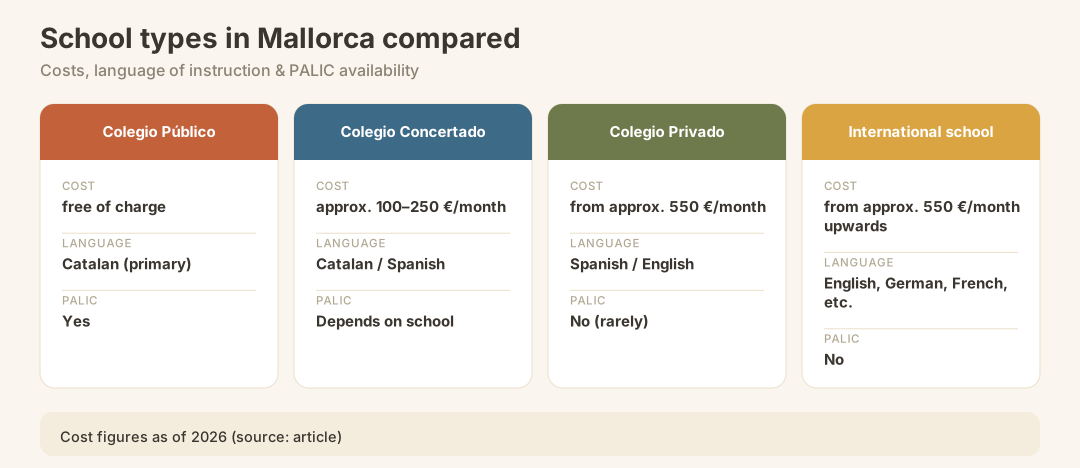
| School type | Cost (approx.) | Language of instruction | PALIC available |
|---|---|---|---|
| Colegio Público (state school) | free | Catalan (primary) | Yes |
| Colegio Concertado (semi-private) | approx. 100–250 €/month | Catalan/Spanish | Depends on the school |
| Colegio Privado (fully private, Spanish-curriculum) | from approx. 550 €/month | Spanish/English | No (rarely) |
| International school | from approx. 550 €/month upwards | English, German, French, etc. | No |
The cost figures for Concertado and private schools are based on research into the Balearic school system (as of 2026) and may vary depending on the institution.
For families planning to stay on Mallorca long-term and aiming for genuine integration, the combination of a state school and PALIC is often the most straightforward route. Those coming for only one or two years, or who want their children to work towards an internationally recognised qualification, frequently opt for an international school — PALIC is not available there, but linguistic integration into Spanish progresses more slowly. Find out more about the options in our guide to international schools on Mallorca.
A realistic timeline: how long does language integration take?
An honest assessment matters more here than rose-tinted reassurances. Experiences shared by families paint a fairly clear picture:
| Phase | Timeframe (guideline) | What children typically achieve |
|---|---|---|
| Orientation phase | 1–3 months | First everyday words, understanding the school routine |
| Communication phase | 3–6 months | Simple sentences, playground communication works |
| Learning-capable phase | 6–12 months | Follows lessons in broad outline |
| Full integration | 1–2 years | Equal participation in lessons becomes possible |
Younger children (primary school age) tend to integrate linguistically far more quickly than teenagers. Children in the early primary years are often barely distinguishable from their classmates after a single school year.
Please note: The timeframes mentioned above are guideline figures based on personal accounts. Individual factors — language aptitude, social environment, whether Spanish is also spoken at home, and the intensity of support provided — vary considerably.
PALIC and supplementary support: what else you can do
PALIC alone is not sufficient for many children, particularly where the level of provision at school is low. The following supplements have proved effective:
Private language courses for children In Palma there are several language schools that also offer Spanish courses for children and young people. As an example: MAXX Institutes (Avenida de Portugal 1, Palma) offers Spanish courses for various levels and is located on the edge of Palma's old town. Please contact the school directly for up-to-date information on their course offering for children and young people.
Language partners and private tutoring Many families arrange a Spanish or Catalan language partner for their child through the neighbourhood, a sports club, or school. This is cost-effective and, thanks to the social context, often more impactful than formal lessons.
Extracurricular activities in Mallorcan Football, swimming, music school — all in Spanish or Catalan. The more social contacts a child has on the island, the faster things progress. Clubs (clubs deportivos) are an underrated tool in this regard.
German-language tutoring for subject lessons To prevent a child from falling behind academically while learning the language: maths, science, or history explained in German — this stops a language problem from becoming a knowledge problem.
Most common mistakes when registering for school with PALIC
Many families make avoidable mistakes that make the start unnecessarily difficult. Here are the most common ones:
1. Registering too late The official enrolment period is generally in spring for the following school year. Families who arrive in Mallorca in summer and only then begin looking for a school frequently find no places available in their preferred zone. Mid-year places do exist, but the choice is limited.
2. Overlooking or underestimating the Empadronamiento Without a residence registration there is no school place in the school zone. The Empadronamiento is the first step — even before searching for a school.
3. Not actively requesting PALIC Many parents assume the school will act automatically. This is not always the case. Ask specifically about PALIC, ask about the tutor d'acollida and about the number of hours.
4. Not bringing school records or not having them translated Without school documents from Germany, the school will find it difficult to assess the child's level. A certified translation is ideal; for straightforward documents an informal translation will sometimes suffice — but bringing something is better than bringing nothing at all.
5. Underestimating linguistic isolation The first few weeks can be emotionally very demanding for many children. As parents, plan proactively to counter this: reach out to other parents, enrol your child in a club or activity, and keep in regular contact with the class teacher.
6. Not understanding the school's language policy Some parents are surprised to find that lessons are taught in Catalan rather than Spanish. On Mallorca this is standard practice in the state school system. PALIC supports both languages, but Catalan takes priority.
What comes next? Life after the first school year
When PALIC comes to an end — typically after one school year — the child will generally be able to participate in lessons at a basic level. That said, full linguistic and academic integration takes longer. The following are things to keep an eye on in the second and third years:
- Performance assessment: Children with a PALIC background usually receive additional support during the first year. From the second year onwards, the same performance expectations apply as for all other pupils.
- Building on Catalan: Anyone who intends to stay on Mallorca long-term should take Catalan seriously — not only for school, but for social life on the island.
- Secondary school (Secundaria):): The transition to ESO (broadly comparable to the German Sekundarstufe I) is more demanding linguistically. Plan ahead for this.
- Moving to an international school: Some families transfer to an international school after primary school in order to secure a recognised qualification. This is perfectly possible, but some of the linguistic integration already achieved will then be lost.
Checklist: Starting school with PALIC on Mallorca
- Empadronamiento applied for and obtained (how to do it)
- School placement requested from the Conselleria d'Educació or applied for directly at the preferred school
- German school reports / school certificates obtained and (where possible) translated
- Vaccination record prepared
- Actively asked about PALIC at the enrolment meeting
- Tutor d'acollida or PALIC contact person at the school identified
- Number of PALIC support hours enquired about and confirmed in writing
- Supplementary language support (private course, language partner) arranged
- Child enrolled in an extracurricular activity in Spanish/Catalan
- Regular teacher meetings scheduled
Conclusion
The PALIC programme is a genuine strength of the Balearic school system — it integrates children with no Spanish or Catalan from day one into mainstream classes whilst supporting them in parallel. Parents who understand the programme, actively request it, and supplement it with their own measures give their child a significantly better start. The biggest levers: register early, don't underestimate the Empadronamiento, and don't treat PALIC as something that happens automatically — ask questions and follow up. Full linguistic integration takes time — typically one to two school years — but it works when all the pieces fit together. Schools in Mallorca are well used to welcoming international children. You simply need to know how to make the system work for your child.
Official Sources
- Conselleria d'Educació, Cultura i Universitats (Govern de les Illes Balears): http://www.caib.es/govern/organigrama/area.do?lang=de&coduo=6
- PALIC information from the Govern Balear: https://www.caib.es (under Educació > Programes d'acollida)
- Empadronamiento (Padrón Municipal): Ayuntamiento Palma de Mallorca — https://www.palma.cat
- School enrolment in the Balearic Islands (matriculació): Conselleria d'Educació — https://weib.caib.es