
UIB Mallorca Studies: Admission, EBAU and Enrolment for EU Citizens
Studying at UIB Mallorca is a genuine option for many EU citizens who are relocating to the Balearic Islands or want to give their children access to a Spanish university education — and one that is often underestimated. The Universitat de les Illes Balears (UIB) is the only public university in the Balearic Islands, offers a full range of programmes from Bachelor's degrees through to Master's and doctoral level, and is currently growing considerably: from the 2026/27 academic year, new Bachelor's degree programmes will be added. This guide explains how admission works for EU citizens, what the EBAU exam has to do with it, which deadlines and formalities you need to be aware of, where the campus is located, and what studying there costs — all of it practical, with no glossy-brochure waffle.

Are you planning the move to Mallorca and wondering whether studying at UIB is the right fit for you or your child?
- 📩 Submit a personal enquiry — We'll help you assess your situation and work out the next steps
- Everything about Residencia in Spain — The right of residence as the foundation for day-to-day university life
UIB at a glance: who studies here?
The Universitat de les Illes Balears was founded in 1978 and is a state university headquartered in Palma de Mallorca. With around 14,000 enrolled students and over 1,000 teaching staff, it is compact but fully comprehensive — it is divided into six faculties and covers subjects ranging from the humanities to engineering and the natural sciences.
The main campus is located approximately 7,5 kilometres from Palma city centre and is easily accessible by bus and tram (Metro). There are also satellite campuses on Menorca as well as on Ibiza and Formentera. This makes UIB the only university that covers all the Balearic Islands with in-person teaching.
The languages of instruction are Catalan (Mallorcan), Spanish, and — depending on the degree programme — English as well. For EU citizens without knowledge of Spanish or Catalan, a language course is almost always the first compulsory step. UIB offers relevant courses during the semester and as an intensive course in summer (July/September) — exchange students receive 6 ECTS credits for these.
Current degree programmes: what can you study at UIB?
The existing Bachelor's offering is broad. The degree programmes are divided into five main areas:
| Faculty | Examples of Bachelor's degree programmes |
|---|---|
| Humanities and Cultural Studies | Catalan Language and Literature, Spanish Philology, English, Philosophy, History, Art History |
| Engineering and Architecture | Computer Science, Automation and Industrial Electronics, Agri-Food Sciences, Civil Engineering |
| Health Sciences | (available, with numerus clausus restrictions depending on the programme) |
| Natural Sciences | (among others, prepared for expansion — see new programmes) |
| Social Sciences and Law | Economics, Law, Tourism, Education, and more |
There is also a range of Master's programmes; examples with published annual fees:
| Master's programme | Tuition fee/year (indicative) |
|---|---|
| Advanced Physics and Applied Mathematics | approx. 1.761 € |
| Chemical Science and Technology | approx. 1.807 € |
| Physics of Complex Systems | approx. 1.761 € |
| Economics of Tourism – Monitoring and Evaluation | approx. 2.080 € (concessionary rate approx. 1.630 €) |
Please note: The Master's fees quoted are taken from published programme information. Bachelor's fees are governed by the current pricing decisions of the Balearic regional government; the exact amount varies depending on the degree programme and residency status – please check the current rates directly with the UIB.
New degree programmes from 2026/27: What's coming?
The UIB has announced a significant expansion of its academic offering, with the stated aim of keeping young people on the island and closing skills gaps.
| Programme | Planned start |
|---|---|
| Bachelor's in Oceanography (Ciències de la Mar) | 2026/27 |
| Dual degree in Mathematics and Physics | 2026/27 |
| Architecture | 2027/28 at the earliest |
| Mechanical Engineering with a focus on Nautical Studies | 2027/28 at the earliest |
| Teacher Training in Science and Technology | 2027/28 at the earliest |
| Dual Bachelor's in Catalan and English | 2027/28 at the earliest |
The first two programmes – Oceanography and the dual degree in Mathematics/Physics – are due to launch in the 2026/27 academic year; this is confirmed by official UIB documents. The remaining four subjects have been announced and are to be introduced on a phased basis. Anyone interested in Architecture or Engineering should check the official UIB website (uib.eu) regularly for the latest updates.
Access to the UIB: Spanish university entrance qualifications (EBAU) and alternatives
The standard route to a Spanish university runs through the EBAU (Evaluación del Bachillerato para el Acceso a la Universidad) – the Spanish university entrance examination, taken after the two-year Bachillerato upper-secondary stage. It is broadly equivalent to the German Abitur, but is course-relevant: alongside the General Phase there is a Specific Phase with subjects that can boost the grade for particular degree programmes.
For EU citizens with a foreign school-leaving qualification a separate procedure applies:
- Homologation or recognition of the school-leaving qualification: Anyone holding the German Abitur (or an equivalent EU school-leaving certificate) must have it officially recognised in Spain (homologación al título de Bachillerato español) – the competent authority is normally the Spanish Ministry of Education (Ministerio de Educación).
- EBAU participation: Following successful homologation of the qualification, EU citizens may sit the EBAU examination at a Spanish university in order to obtain the Spanish admissions grade (nota de acceso). This is relevant if you are applying for a degree programme with restricted admission (numerus clausus).
- Direct entry without EBAU: For degree programmes without restricted admission, enrolment may also be possible without sitting the EBAU, provided that homologation of the school-leaving qualification has been completed. Whether a programme is free of an NC requirement can be checked in the official course listings of the UIB for the relevant academic year.
Please note: The homologation process can take several months. Plan well ahead of your intended start date.
Step by step: enrolment at the UIB as an EU citizen
The admissions process in Spain is largely centralised through the respective university and – for access from abroad – through the national system. Here is the concrete procedure:
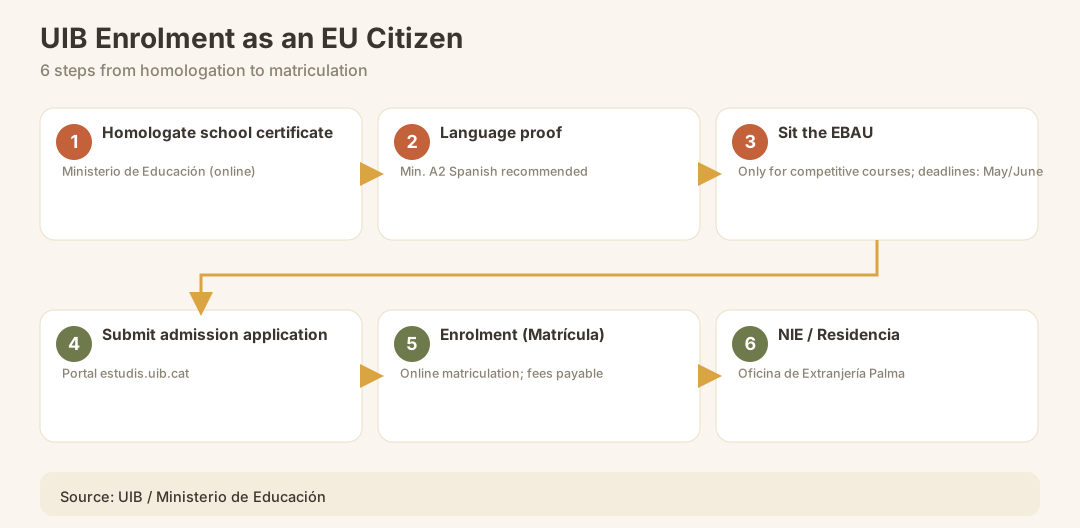
- Have your school-leaving qualification homologated at the Ministerio de Educación, FP y Universidades (Madrid). This can be done online via the Ministry's website.
- Compile proof of language proficiency: Spanish at a minimum A2 level is recommended for study at the UIB; a higher level is expected for many degree programmes (typically DELE, SIELE or equivalent).
- Sit the EBAU (if a programme with NC is desired): registration with the competent authority of the Comunitat Autònoma de les Illes Balears – deadlines and procedures vary by calendar year, generally in May/June.
- Submit your application for admission: Via the UIB portal (estudis.uib.cat) within the designated admissions window.
- Enrolment (Matrícula): Following admission, completed online via the UIB portal. Registration fees and tuition fees are then due.
- Apply for a NIE / Residencia: As an EU citizen you will need a NIE (Número de Identidad de Extranjero) for all dealings with authorities and the university, and, for a permanent stay, a Residencia.
| Step | Responsible authority | Important Note |
|---|---|---|
| Homologation of School-Leaving Certificate | Ministerio de Educación, FP y Universidades | Apply early (waiting times possible) |
| EBAU Registration | Comunitat Autònoma de les Illes Balears | Check deadlines (usually spring) |
| Admission Application | estudis.uib.cat | Only within the official admissions window |
| NIE / Residencia | Immigration Authority / Oficina de Extranjería Palma | Ensure this is in place before enrolment |
| Matriculation | UIB Student Secretariat | Deadline following admission notice |
Deadlines: What Do You Need to Do and When?
The UIB follows the Spanish higher education calendar. Specific deadlines are set anew each year and published on the official UIB website. Based on the available information, the following indicative timeframes can be derived:
| Process | Indicative Timeframe |
|---|---|
| Submission of Nomination (Erasmus/Exchange, Winter Semester) | by 30 April |
| Exchange Application Winter Semester / Full Academic Year | by 30 June |
| Submission of Nomination (Exchange, Summer Semester) | by 30 September |
| Exchange Application Summer Semester | by 30 November |
| EBAU Examination (standard sitting) | May/June (depending on the year) |
| Admission applications Bachelor (direct) | depending on UIB publication, typically summer |
Please note: These deadlines are indicative figures taken from published partner university documents and are subject to change. The binding dates can always be found at estudis.uib.cat.
Languages, Courses and Language Requirements
The UIB is multilingual – and that is taken seriously. Depending on the degree programme, courses are taught in Catalan, Spanish or English. For international students:
- Spanish is the most important everyday language on campus and in Palma.
- Catalan (here: Mallorcan) is a co-official language and is used in many courses. Students without prior knowledge will still manage, as Spanish is always understood – but a basic knowledge of Catalan is appreciated.
- The UIB offers language courses in Spanish and Catalan during the semester and as intensive courses in July and September. Exchange students receive 6 ECTS credits for a 60-hour course.
- Recommended minimum level for a degree programme: A2 Spanish (minimum recommendation according to Erasmus documents); for a full degree programme it should be considerably higher.
If you are still working on your language skills: a B1 level is helpful for everyday life in Palma, so that you can also get along well outside the campus.
Campus Life and Accommodation: What to Expect in Palma?
The main campus is located on the Ctra. de Valldemossa, km 7,5 (07122 Palma) and has all the usual university facilities: library, computer rooms, canteen and cafeteria, sports centre (CampusEsport), medical centre, pharmacy, and an office for academic guidance and careers advice (DOIP). There is also an office for students with special support needs (Oficina de Suport a Persones amb Necessitats Especials).
Accommodation: There are no university halls of residence on campus. The UIB recommends that international students use platforms such as Erasmus Play, through which apartments and shared rooms in Palma can be found. Further information for incoming students: uib.eu/With-you/mes-per-a-tu/Incoming-Students-FAQs/
The cost of living in Palma is moderate to high for a Spanish city. An overview:
| Item | Indicative figure |
|---|---|
| Room in shared flat, Palma (near campus) | variable depending on location and season |
| Canteen meal on campus | inexpensive (state-subsidised) |
| Monthly bus/metro pass | Students receive discounts |
| Bachelor's tuition fees (public) | according to Balearic tariff (depending on subject) |
For more detailed figures on rent, food and everyday costs, see our guide to Cost of living in Mallorca.
For EU citizens: Important administrative steps related to studying
EU citizens who live and study permanently in Mallorca must complete several administrative steps – independently of the actual university enrolment:
- Empadronamiento: Registering with the relevant Ayuntamiento (residents' registration office) is a prerequisite for many further steps and should be done first. Details: Empadronamiento in Mallorca
- NIE / Residencia: EU citizens do not need to apply for a residence permit in the traditional sense, but the Residencia (EU citizen certificate) and a NIE are essential for university administration, bank accounts and official matters. To the Residencia
- Health insurance: As a student, you must have health insurance. EU citizens who are still insured in their home country can use the EHIC/EKVI card; for a permanent stay, a Spanish solution is more practical. Health insurance in Spain
- Certificado Digital / Cl@ve: An electronic identity is recommended for dealing with authorities online (including university administration). Apply for a Certificado Digital
International contacts and points of contact at the UIB
| Contact / Office | Details |
|---|---|
| International Relations Office (SRI) | Support for all exchange students |
| Erasmus Coordinator (Ricardo Sagrera Gazeley) | Tel. +34 971 17 27 66 |
| E-mail International Relations | direccio.internacional@uib.es |
| Address UIB Main Campus | Ctra. de Valldemossa, km 7,5 – 07122 Palma |
| Incoming Students Guide | uib.eu/With-you/mes-per-a-tu/Incoming-Students-FAQs/ |
| Degree programmes and admission | estudis.uib.cat |
For EU citizens who wish to enrol outside the Erasmus framework, the SRI is likewise the first point of contact – even if you are not an exchange student but are pursuing a full regular degree programme.
Most common mistakes when studying at the UIB as an EU citizen
In practice, people tend to trip up on the following points:
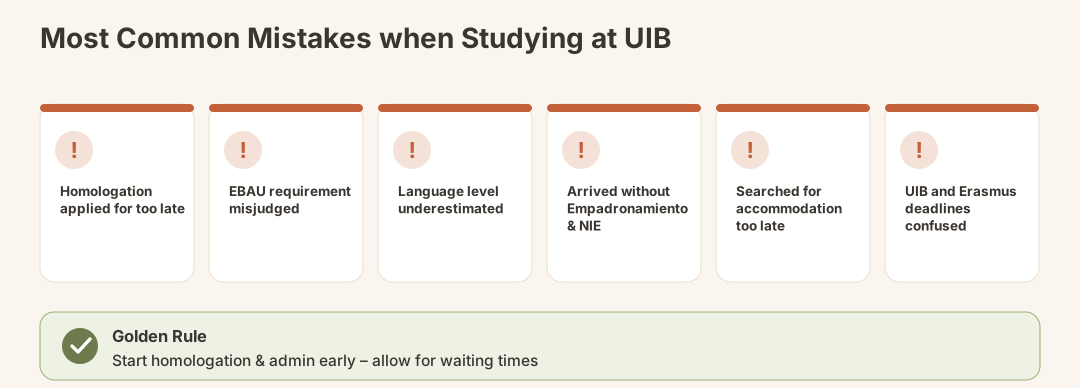
- Applying for homologation too late. The process for having a foreign school-leaving qualification recognised can take months. Anyone wishing to start in September must get the ball rolling by autumn/winter of the preceding year at the latest.
- Misjudging the need for the EBAU. The EBAU is not compulsory for every degree programme – but for subjects with a numerus clausus you simply cannot avoid it. Make sure you check the requirements for your specific subject.
- Underestimating the language level required. Catalan and Spanish are equal languages of instruction. Anyone arriving with only English will face considerable difficulties on a regular degree programme at the UIB.
- Turning up to enrolment without Empadronamiento and NIE. Without these documents, the university administration will not be able to process anything.
- Leaving the search for accommodation until just before the semester starts. Palma is heavily in demand on a seasonal basis. Anyone starting in September should begin looking for a flat in spring.
- Confusing UIB deadlines with Erasmus deadlines. The deadlines for regular enrolment and for Erasmus/exchange students are different – neither set automatically applies to the other.
What comes next? Prospects after graduating from the UIB
A UIB degree is a fully recognised Spanish and EU higher-education qualification that is recognised within the European Higher Education Area (Bologna). For many fields – tourism, agricultural technology, computer science, teacher-training subjects – there is a direct regional job market in the Balearic Islands.
Anyone wishing to pursue a master's degree after their bachelor's can do so at the UIB itself (master's programmes in physics, chemistry, tourism, and more) or transfer to another Spanish or European university.
And for those working on Mallorca as an autónomo or as an employee: you should familiarise yourself with the tax framework that applies to residents in Spain – IRPF, possible deductions, registration obligations. Our guide to taxes as a resident.
Checklist: studying at the UIB as an EU citizen
- Have your school-leaving qualification recognised (Ministerio de Educación)
- Bring your Spanish language skills up to the required level (proof of language proficiency)
- Clarify whether the EBAU is required for your chosen degree programme
- Register for and sit the EBAU (if necessary, check the deadlines)
- Complete your Empadronamiento with the local authority
- Apply for NIE and register for Residencia if applicable
- Sort out health insurance for Spain
- Submit your application via estudis.uib.cat
- Start looking for accommodation in Palma in good time (start early!)
- Plan for a language course at the UIB (July/September or alongside your semester)
- Set up Certificado Digital / Cl@ve PIN
Conclusion
Studying at UIB Mallorca is a fully valid option for EU citizens who live on the Balearic Islands or are planning to move there – with a growing range of courses, a manageable campus in Palma, and the Mediterranean bonus that sets student life apart from your typical big-city university. Getting there takes preparation: school-leaving qualification homologation, EBAU if required, language skills, and the usual dealings with the authorities. Anyone who tackles these points early has a good chance of being there for the first lecture in September, right on time.
For all organisational and administrative questions related to relocating to Mallorca – from Residencia to bank account to tax number – our Relocation Service Mallorca is here to help.
Official Sources
- UIB official website (English): https://www.uib.eu
- Courses and admissions: https://estudis.uib.cat/en/estudis-de-grau/Com-hi-pots-accedir/admissio/
- UIB bachelor's degree programmes: https://www.uib.eu/Learn/estudis-de-grau/grau/
- UIB Incoming Students Guide: https://www.uib.eu/With-you/mes-per-a-tu/Incoming-Students-FAQs/
- New courses 2026/27 (Oceanography): https://seras.uib.cat/digitalAssets/799/799606_InfografiaUIB-Seras-Ciencies-de-la-Mar2.pdf
- Homologation of foreign school-leaving qualifications: Ministerio de Educación, Formación Profesional y Universidades – https://www.educacionyfp.gob.es
- EBAU Balearic Islands: Govern de les Illes Balears / Conselleria d'Educació – https://www.caib.es
- Balearic tax and administrative information (ATIB): https://www.atib.es