
Yacht Charter Mallorca: Bareboat, Skippered Charter and Licence Requirements
Anyone looking to charter a yacht in Mallorca will quickly find themselves facing more questions than expected: Do I actually need a boating licence? What does a catamaran with crew really cost? And where are the most beautiful anchorages I can sail to on a bareboat charter? This guide answers all of that – factually, comprehensively, and without marketing fluff. You'll learn about the different types of charter available, what licences Spanish law requires, what marinas around Palma de Mallorca charge, what mistakes beginners commonly make, and how to book your voyage with full legal certainty. Whether it's a day trip from Port Sóller or a week-long cruise through the Balearic Islands: proper preparation is what determines whether you set off relaxed or find yourself stuck at the jetty.

Are you planning a charter in Mallorca and want to make sure everything is in order from a licensing and insurance perspective?
- 📩 Submit a personal enquiry — We'll connect you with vetted charter experts and maritime lawyers on the ground
- Premium lifestyle in Mallorca: further guides
The three charter types at a glance
In Mallorca there are essentially three models to choose from – each with its own target audience, its own price range, and its own requirements for you as the charterer.
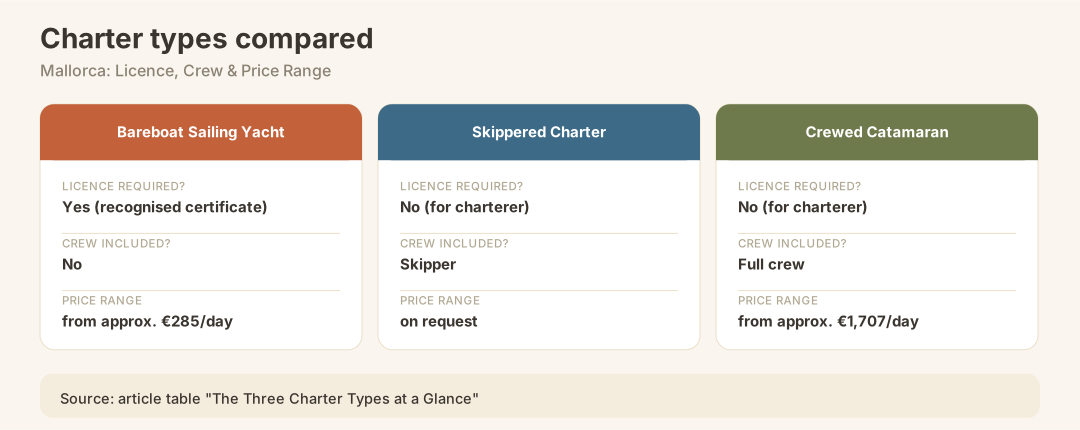
Bareboat charter means: you hire the boat without a crew. You are the skipper, you navigate, you anchor, and you are responsible for everything on board. This requires a valid sailing qualification that is recognised by the charter company and, where applicable, the Spanish maritime authority. In return, you have maximum freedom: your own pace, your own route, your own decisions.
Skippered charter is the middle ground: you hire the boat but book a professional skipper to go with it. They take care of navigation, harbour manoeuvres, and responsibility towards the authorities. You don't need to present your own licence. For many visitors to Mallorca – particularly those unfamiliar with the local waters – this is the most relaxed option.
Crewed charter (full crew) is the premium segment: in addition to the captain, the crew includes a steward, chef, and possibly a deckhand. The vessel is typically a large yacht or a luxury catamaran; the charterer is a guest, not a sailor.
| Charter type | Licence required? | Crew included? | Price range (indicative) |
|---|---|---|---|
| Bareboat sailing yacht | Yes (recognised licence) | No | from approx. €285/day [7] |
| Bareboat motor yacht | Depends on HP/length | No | depending on model |
| Skippered charter | No (for the charterer) | Skipper | on request |
| Crewed catamaran/yacht | No (for charterers) | Full crew | from approx. 1.707 €/day [10] |
| Day charter | No (for guests) | Skipper/crew | depending on boat type |
Licence requirements: what Spanish law actually demands
Spain applies national maritime regulations to all leisure craft – including in the Balearic Islands. The decisive factors are engine power and boat length.
Licence-free boats: Smaller motorboats below certain power and length thresholds may be operated in Spain without a boating licence. For these vessels – often small day-trippers – no proof of qualification is generally required [9].
Larger yachts: Once a boat exceeds the legally defined limits for power or length, a recognised Spanish or international certificate of competence is mandatory. Premium motor yachts departing from marinas such as Puerto Portals invariably require a licensed skipper, in accordance with standard practice [9].
Important for bareboat charterers: The charter company will typically check your licence at check-in. In addition to a formally recognised qualification, many operators also require logbook entries or proof of experience for insurance purposes [9].
Official checks: Spanish maritime authorities actively carry out document checks in popular waters during the high season. Anyone found on board without valid paperwork risks fines [9].
Please note: The specific thresholds for licence-free operation (horsepower limit, length in metres) may change as a result of national regulations. Before booking, check the currently applicable requirements with the charter company or a maritime lawyer.
| Factor | Relevance to licence requirement |
|---|---|
| Engine power (hp/kW) | Primary criterion for the licence-free threshold |
| Boat length (metres) | Secondary criterion |
| Waters (coastal/offshore) | Determines licence type (e.g. PNB, PER, Patron de Yate) |
| Insurance requirements | May go beyond statutory requirements |
| Proof of experience | Additionally required by the charter company |
Boat types: sailing yacht, catamaran or motor yacht?
The choice of boat type is not merely a matter of style – it significantly influences your route, your comfort expectations and your budget.
Sailing yachts are the classic choice for bareboat charter. The market offers models from 36 to well over 44 feet – such as the Bavaria Cruiser or Sun Odyssey. Daily rates for a Bavaria Cruiser 36 start at around 285 €, with a Sun Odyssey 440 priced correspondingly higher [7]. Sailing yachts allow for quiet sailing, are economical on fuel and offer an unparalleled experience in good wind. The downside: dependence on wind and a slower average speed.
Catamarans offer significantly more deck and interior space, are more stable and are particularly popular with families or larger groups. A Bali Catsmart (2024) is available in Palma de Mallorca from around 299 €/day in the bareboat variant; a fully equipped Lagoon 560 S2 with crew starts from approximately 1.707 €/day [10]. The flat-bottomed design allows access to shallow coves that would be too shallow for monohulls.
Motor yachts offer speed and comfort. They are the first choice if you want to visit several islands in a week or are not counting on wind. Motor yachts are popular for day charters from Port Sóller, Port Pollença or Palma [6]. Premium offerings in this segment are aimed at groups who wish to use the boat primarily as a floating clubhouse.
The most important marinas on Mallorca
Mallorca has a remarkably good infrastructure for charterers. The four key departure points:
| Marina / harbour | Location on the island | Special features |
|---|---|---|
| Palma de Mallorca (various marinas) | South-west | Largest selection, many charter fleets, international connections [1][4] |
| Marina Naviera Balear | Palma | Home port of several major charter operators [1][10] |
| Port de Sóller | North-west | Picturesque, ideal for the north-west coast |
| Port de Pollença | North-east | Calmer waters, departure point towards Formentor and Menorca |
| Puerto de Andratx | South-west | Exclusive, access to south-west coves and Cabrera |
Tip:Those with flexibility can start in Palma and return the boat at a different port (one-way charter). Many fleet operators offer this option for an additional charge – ask about it explicitly when booking.
Seasonality: When Is the Right Time to Sail?
The best time for sailing around Mallorca is between May and October [8]. The high season – July and August – brings reliable winds, but also crowded harbours, higher berthing fees, and a scarce supply of anchorages in the most popular calas.
The early season (May/June) and the shoulder season (September/October) are considered by seasoned sailors to be the best compromises: more pleasant temperatures, fewer crowds, lower charter prices, and a wider choice of boats. In October, however, the weather can change quickly; strong wind events become more frequent from mid-month onwards.
| Month | Charter availability | Anchorage density | Weather |
|---|---|---|---|
| May | High | Low | Very good |
| June | High | Moderate | Excellent |
| July/August | Very high | Very high | Hot, reliable |
| September | Good | Moderate | Excellent |
| October | Moderate | Low | Changeable |
Selected anchorages for bareboat charterers
The true advantage of a bareboat charter lies in being able to reach bays that are inaccessible by car. Here are the most important destinations confirmed by research [8]:
Sa Calobra / Torrent de Pareis (north-west coast): One of the most spectacular anchorages on the island – accessible only by boat or via a winding mountain road. Crystal-clear water and dramatic cliff faces.
Cap de Formentor (north-east): Anchoring off the lighthouse. Strong Tramuntana winds can make this challenging – always check the wind forecast.
Cabrera Archipelago (south-east): A national park requiring a permit to enter. The permit must be applied for in advance from the Parque Nacional de Cabrera – the charter company will often arrange this on request.
Cala Mondragó (south-east): Nature reserve with a shallow entrance – ideal for catamarans. Be aware of anchoring restrictions in parts of the area.
Please note: Anchoring and engine restrictions apply in certain protected zones of the Balearic Islands. Up-to-date zone maps are available from the Consell de Mallorca and the Capitanía Marítima de Palma. Using outdated maps can result in fines.
What does a charter really cost? Understanding the pricing structure
The base price for a charter yacht is only part of the true cost. A realistic budget covers several items:
| Cost item | Description | Approximate guide price |
|---|---|---|
| Charter rate | Weekly or daily price for the boat | from approx. 285 €/day (sailing yacht) [7] |
| Skipper (optional) | Daily fee for a skippered charter | varies by market |
| End cleaning | Usually compulsory | varies by boat |
| Security deposit | Held and returned on handover | varies by boat size |
| Fuel | Settled on return | varies by engine and distance travelled |
| Marina fees | Varies per night and marina | depending on the marina |
| Provisions / APA | For crewed yachts: "Advance Provisioning Allowance" | typically approx. 30–40 % of the charter rate |
| Insurance surcharge | Compulsory for bareboat | depending on the provider |
Note: With crewed yachts, an "APA" (Advance Provisioning Allowance) is frequently charged on top. This amount typically covers fuel, marina fees and provisions – any unspent funds are refunded at the end.
Charter and taxes: what you should know as a resident
If you are tax-resident in Spain and regularly charter a yacht – or even charter out your own – there are tax implications to be aware of. As a charterer (pure guest) you pay no separate special tax, but VAT (IVA) on the charter price is generally either included in the quoted price or shown separately.
Anyone wishing to charter out their own yacht in Spain will need to register a business activity and may require a charter licence (Lista 7 / Lista 6 of the Spanish ship register). That is a topic in its own right – if it interests you, our guide to Taxes & Finances on Mallorca will help, as will a conversation with a gestoría.
The most common mistakes when chartering a yacht on Mallorca
Charter companies and skippers see the same mistakes repeated time and again:
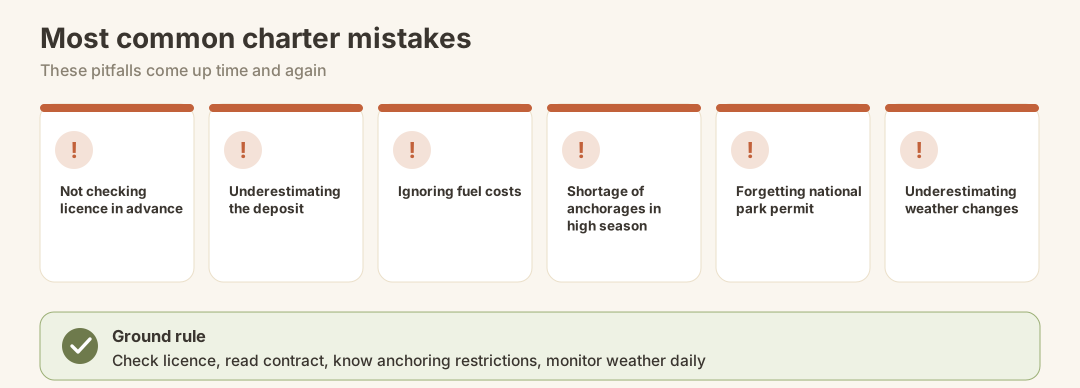
Not having your licence checked in advance: Not every international boating licence is automatically recognised in Spain. Clarify this with the charter company before booking – not on the day of departure.
Underestimating the deposit: The deposit can be substantial depending on the size of the vessel. Factor it in as a liquidity requirement; credit card holds are standard practice.
Ignoring fuel costs: Motor yachts with high fuel consumption can rack up expensive refuelling stops depending on your itinerary. Ask for the average consumption figure upfront.
Lack of anchorage in high season: Anyone hoping to sail into popular bays in August without a reservation will often find no space available. Contact fleet coordinators and harbourmasters early.
Forgetting the national park permit: An entry permit is compulsory for the Cabrera archipelago – anyone arriving without one will be turned away [8].
Underestimating weather changes: The Tramuntana can pick up quickly and fiercely on the north-west side of the island. Check maritime weather forecasts daily.
Allowing too little time for the handover: The technical briefing at a bareboat check-in can easily take two hours on an unfamiliar yacht. Allow plenty of time on your arrival day.
Checklist: Booking Your Bareboat Charter Safely
Use this list as a working document before booking:
- Boating licence: recognised type, valid, copy ready
- Logbook: nautical miles and cruising area experience documented
- Charter agreement: deposit, cancellation conditions, APA arrangement reviewed
- Insurance: what does the boat's insurance cover, and what do you need yourself? (→ Health & Insurance)
- National Park permit applied for (if Cabrera is planned)
- Anchoring zones map (current, Balearic Islands Marine Protected Areas)
- Weather app / GRIB data: suitable app installed
- Emergency numbers: Salvamento Marítimo (900 202 202) saved
- Marina reservations: book high-season berths well in advance
- Handover time allowed for (handover day ≠ first sailing day)
What comes next? Charter as part of your Mallorca lifestyle
Anyone who charters regularly in Mallorca will eventually start thinking about living here more permanently – or at least combining the best of both worlds. As a tax resident you can benefit from attractive arrangements such as the Beckham Law, which can offer significant tax advantages for certain newcomers. A Residencia also gives you access to authorities and infrastructure that make life on the island considerably easier.
Those who do not wish to exceed the 183-day threshold will find the key details in the 90/180-day rule for non-EU citizens. And for anyone who also wants to emigrate formally, our Emigration Guide is the right next step.
Conclusion
Chartering a yacht in Mallorca is not a bureaucratic minefield – but you do need to know the rules of the game. Bareboat requires a recognised licence and knowledge of the cruising area; skippered charter makes the licence question largely irrelevant for you. Prices range from around 285 €/day for a simple sailing yacht to well over 1,700 €/day for a luxury catamaran with full crew. The high season (July/August) books up fast – those who opt for the early or late season travel more cheaply and at a more relaxed pace. The key is careful booking: check your licence, read the contract, know the anchoring restrictions, and monitor the weather daily.
Official Sources
- Capitanía Marítima de Palma (maritime authority, registration, inspections): https://www.mitma.gob.es
- Salvamento Marítimo (sea rescue, emergency number 900 202 202): https://www.salvamentomaritimo.es
- Parque Nacional del Archipiélago de Cabrera (entry permits): https://www.miteco.gob.es/es/red-parques-nacionales/nuestros-parques/cabrera/
- Consell de Mallorca – Medi Ambient (marine protected zones, anchoring restrictions): https://www.conselldemallorca.cat
- Govern de les Illes Balears – Pesca i Medi Marí: https://www.caib.es
- AEAT – Agencia Tributaria (tax on charter income, IVA): https://www.agenciatributaria.es