
Recreational Boat Licence Spain: PER, PNB and Foreign Licences
Anyone navigating a boat with more than 15 HP or over 5 metres in length around Mallorca, Ibiza or Formentera needs a valid leisure boat licence — no exceptions. But which licence applies where, and what happens to your German SBF See or SKS? This guide explains the Spanish licensing system from the entry-level qualification right up to Capitán de Yate, shows you exactly when your foreign licence is recognised in the Balearic Islands, and walks you step by step through training, examination and any potential conversion. Whether you're chartering as a holidaymaker, have just moved to Mallorca, or have registered your own yacht — here you'll find solid figures, clear boundaries and no half-truths.
The Spanish licensing system at a glance
Spain has five official licence categories for recreational boats, governed by the BOE regulation of 11 October 2014 (most recently amended in 2019 and 2024). They differ according to boat length, range from shore, and whether the licence covers private or commercial use.
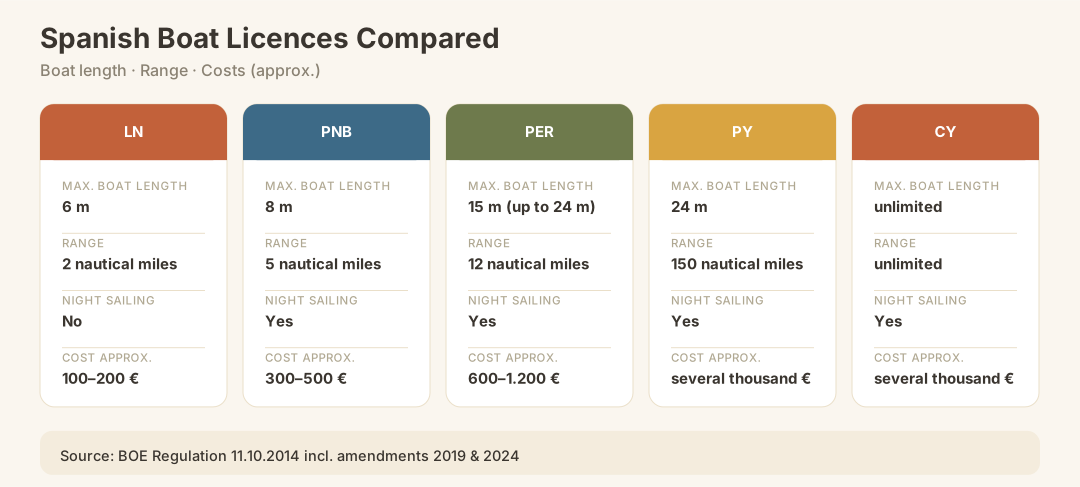
| Licence | Boat length (max.) | Range from shore | Night navigation | Training costs (approx.) |
|---|---|---|---|---|
| Licencia de Navegación (LN) | 6 m | 2 nautical miles | No | 100–200 € |
| Patrón de Navegación Básica (PNB) | 8 m | 5 nautical miles | Yes | 300–500 € |
| Patrón de Embarcaciones de Recreo (PER) | 15 m (extendable to 24 m) | 12 nautical miles | Yes | 600–1.200 € |
| Patrón de Yate (PY) | 24 m | 150 nautical miles | Yes | several thousand € |
| Capitán de Yate (CY) | unlimited | unlimited | Yes | several thousand € |
Note: The PER is the most sought-after licence for recreational sailors on Mallorca. It permits the handling of boats up to 15 metres (with an additional endorsement up to 24 metres) and travel up to 12 nautical miles from the coast – which covers almost the entire coastal area of the Balearen for a day trip.
When do you actually need a licence in the Balearen?
In Spain, the requirement to hold a licence is not triggered solely by engine power, but rather by a combination of length and motorisation. According to the applicable regulation (BOE of 11 October 2014 including amendments):
- Motorboats over 5 metres in length → licence required
- Sailing boats over 6 metres in length with an engine output of more than 15 PS → licence required
- Boats below these thresholds may be operated without a licence, though only within prescribed distances from the coast
In practical terms, this means: a jet ski with typically well over 100 PS also falls under the licence requirement.
Caution: The widespread misconception that the SBF Binnen is valid on Mallorca up to 3 nautical miles from the coast is incorrect. For the waters around Mallorca, only the SBF See (or an equivalent Spanish licence) is applicable – the SBF Binnen only entitles the holder to navigate on lakes, rivers and canals.
The five Spanish boat licences in detail
Licencia de Navegación (LN)
The entry-level licence for boats up to a maximum of 6 metres in length. The range is limited to 2 nautical miles from the coast, and night sailing is not permitted. The training consists of just a course of around 6 hours; costs range between 100 and 200 Euro. Sufficient for day trips in a sheltered bay – anyone wanting to venture further will quickly encounter limitations.
Patrón de Navegación Básica (PNB)
The PNB is the first proper coastal licence: boats up to 8 metres, up to 5 nautical miles from the coast, night sailing included. Several days of training are required, with costs ranging from 300 to 500 Euro depending on the school. Sufficient for smaller charter boats and coastal day trips around Mallorca, but quickly too restrictive for most recreational skippers with their own boat.
Patrón de Embarcaciones de Recreo (PER)
The PER is the standard licence for ambitious recreational skippers in Spain. It entitles the holder to operate boats up to 15 metres (the endorsement can be extended to 24 metres) within a radius of up to 12 nautical miles from the coast. Night sailing is permitted. The PER also includes a radio licence. Training costs: 600 to 1.200 Euro, depending on the school and course format. Requirements: minimum age 16 years, a medical certificate confirming physical and mental fitness, and a passed theory and practical examination.
For the Balearen, the following applies: there are no restrictions with regard to boat size and weight for PER holders – a significant advantage over some other EU countries.
Patrón de Yate (PY)
Building on the PER, the Yachtmaster allows sailing up to 150 nautical miles offshore. Vessels up to 24 metres. Training costs run into several thousand euros, and the course duration extends over several months. Anyone planning bluewater passages or wishing to skipper a larger yacht professionally cannot do without this licence.
Capitán de Yate (CY)
The highest nautical qualification in Spain: no restrictions on length or distance. The Patrón de Yate is a prerequisite. Costs and training duration can amount to several thousand euros and take several months to over a year.
Foreign boat licences in Spain: who is allowed to do what?
This is where things get specific for German, Austrian, and Swiss boaters – and the rules are more nuanced than many people assume.
The basic rule for non-residents from EU countries
Charter guests who are not resident in Spain and come from an EU country (or a country listed in the relevant BOE table) may skipper a Spanish-flagged vessel using their licence issued in their home country – provided the country of issue and the licence holder's country of origin match.
Example: A German national with a German SBF See may skipper a Spanish-flagged vessel in Spanish waters because the country of issue (Germany) and the home country (Germany) are identical.
Exception: If a German national obtained their licence in England, they must prove that they were resident there at the time of obtaining it (e.g. through studies or registered address).
What applies to residents in Spain?
Different rules apply here. Anyone whose primary residence is in Spain should check whether, and to what extent, a foreign licence is recognised for ongoing use. When in doubt, obtaining a Spanish licence (PNB or PER) is the safest course of action.
Note: The rules for residents and non-residents differ considerably. Anyone who has emigrated to Mallorca and regularly skippers a vessel should clarify their status with a nautical school or a specialist lawyer.
German licences at a glance: what applies in Spain?
| German licence | Recognition in Spain | Restriction |
|---|---|---|
| SBF See | Generally recognised (for non-residents) | Coastal waters only (within sight of the coast) |
| SKS (Sportküstenschifferschein) | Generally recognised (for non-residents) | Valid up to approx. 30 nautical miles from the coast |
| SBF Binnen | Not valid at sea | Inland waterways only (rivers, lakes, canals) |
Please note: Under German law and the ICC standard, the SBF See only entitles the holder to navigate coastal waters. It is not sufficient for passages that go beyond sight of the coast — for those, the SKS or a Spanish PER/PY is required.
The flag of the boat makes a difference
If a boat is operated in Spanish waters under the flag of another EU country (not Spain), the licence issued in the home country generally applies. The exact conditions depend on the flag of the boat and the skipper's place of residence — if in doubt, check with the marina or a recognised boat school.
Training for the PER or PNB on Mallorca: how it works
Anyone wishing to obtain an official licence in Spain can do so directly on the island. There are several recognised boat schools.
Well-known training locations on Mallorca
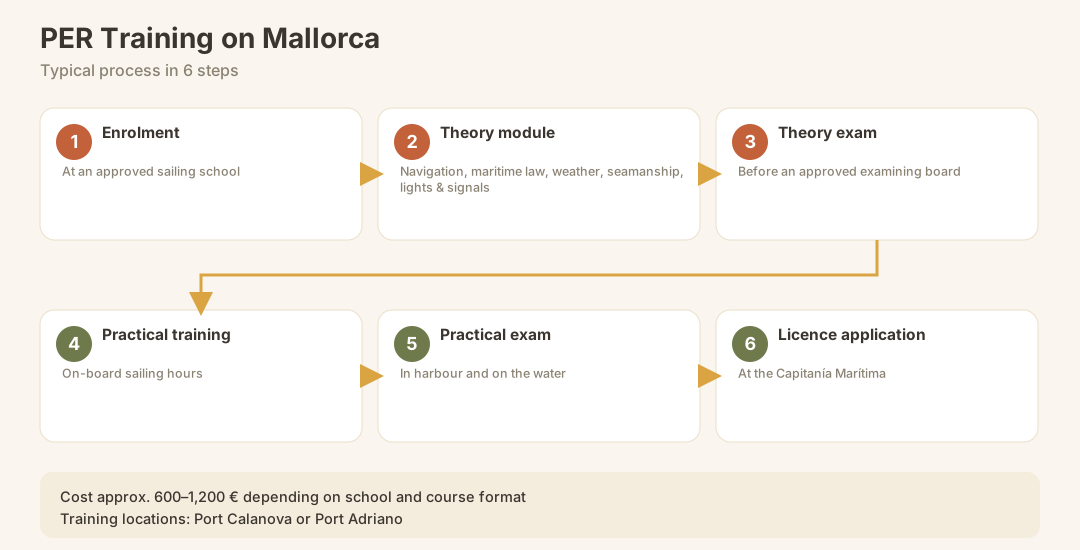
- Port Calanova (approx. 5 minutes from Palma): practical and theory examinations, base of ONWATER Mallorca
- Port Adriano (south-west coast): base of the Bootakademie, practical training on site, theory also available online via Zoom
Typical training process for the PER
- Enrolment at a recognised boat school
- Theory section (navigation, maritime law, weather, seamanship, lights and signals) — available as an in-person or online course
- Theory examination before an authorised examining board
- Practical training on board (all practical hours usually included in the course package)
- Practical examination in the harbour and on the water
- Licence application with the competent authority (Capitanía Marítima)
Note: The PER requires a medical certificate confirming physical and mental fitness. Sort this out early, as obtaining one can take some time.
Costs and Course Packages Compared
| Licence | Typical Course Scope | Cost (approx.) | Note |
|---|---|---|---|
| SBF Binnen (German) | Online course + practical | from 375 € | Valid for inland waterways, not for the sea around Mallorca |
| SBF See + Binnen Combo (German) | Online course + practical | from 490 € | Exam also possible on Mallorca |
| PNB (Spanish) | Several days | 300–500 € | For coastal trips up to 5 sm |
| PER (Spanish) | Several weeks | 600–1.200 € | Standard licence for Balearic leisure skippers |
Taking the German SBF See on Mallorca – is that possible?
Yes. Recognised German sailing schools offer courses on Mallorca where both theory and practical training are completed on location. The examination is conducted by a German examining board – the DSV (Deutscher Segler-Verband) is authorised by the Federal Ministry of Transport to conduct examinations and issue recreational boat licences.
From 1 January 2026 new fees will apply for the issue of the German recreational boat licence by the DSV:
- New issue following examination: 29,82 €
- Provisional recreational boat licence: 24,90 €
- Duplicate certificate / transfer: 42,66 €
The course system is modular in structure: Basic (weather, knots, etc.), Navigation, Lights and Signals, Maritime Law and Seamanship can be combined flexibly – ideal for anyone who wants to combine their holiday with training.
Radio licence: don't forget it
A frequently overlooked point: anyone sailing at sea should also hold a VHF radio operator's licence. In Spain, the radio licence is already included with the PER. For the German SBF See, it must be obtained separately.
Please note: Foreign radio certificates are not automatically recognised in other countries. Anyone sailing in different countries should apply for the ICC version of the German radio certificate in order to achieve the broadest possible international recognition.
The most common mistakes – and how to avoid them
Mistakes regarding boat licences on Mallorca can quickly lead to unpleasant consequences: fines, insurance problems, or in the worst case the confiscation of the hired boat. These are the most typical pitfalls:
- SBF Binnen taken instead of SBF See – The SBF Binnen is not valid on the open sea around Mallorca. Full stop.
- Country of issue ≠ country of origin of the licence holder – Anyone who obtained their licence abroad must be able to prove their place of residence at the time of obtaining it.
- Resident with a foreign licence – Different recognition rules apply to residents in Spain than to holidaymakers. Don't simply set off with an old German licence without clarifying the situation first.
- No radio licence on board – Compulsory in Spain on certain vessels; already integrated with the PER, required separately for the German SBF See.
- Range overestimated – With the PNB you can only go up to 5 nautical miles, with the SBF See only within sight of the coast. Anyone wanting to venture further needs more.
- Medical certificate forgotten – Compulsory for Spanish licences; no certificate = no licence.
- Boat licence not carried – The licence must be carried on board. A digital copy alone is generally not sufficient.
What comes next? Further qualifications
Once you have the PER in your pocket, you can progress step by step:
- Patrón de Yate (PY): For passages of up to 150 nautical miles, requires the PER. Ideal for bluewater trips from Mallorca to Sardinia, Corsica, or the western Mediterranean.
- Capitán de Yate (CY): No restrictions, requires the PY. For anyone who wants to sail professionally or on large yachts.
- Additional qualifications: First aid at sea, safety training, meteorology certificate – all recommended, and partly required for certain sailing areas.
By the way: if you want to register not just a yacht but also a berth or even a car in Mallorca, you'll find further useful guides with us – for example on importing a luxury car to Mallorca or on converting your driving licence in Spain.
Checklist: boat licence in Mallorca
- Clarify boat type and length (from 5 m or >15 HP = licence required)
- Define your sailing area (coastal up to 5 nm → PNB; up to 12 nm → PER; further → PY)
- Check residency status (tourist / EU citizen without residence in Spain vs. resident)
- Check validity of any existing foreign licences in Spain
- Obtain a medical certificate of fitness
- Choose a sailing school in Mallorca or an online provider
- Complete the theory course (in person or app-based)
- Sit the theory exam
- Complete practical hours on the water (Port Calanova or Port Adriano)
- Pass the practical exam
- Apply for the licence at the Capitanía Marítima
- Check / arrange the radio licence separately (already included with the PER)
- Always carry the licence + all on-board documents on board
Conclusion
The Spanish boat licence system is well structured, but initially unfamiliar for newcomers from German-speaking countries. The key point: as a non-resident from Germany, Austria or Switzerland, you can generally skipper a Spanish-flagged vessel using your German licence (SBF See or SKS) – provided the country of issue and your home country match. However, as soon as you become resident in Spain or regularly want to venture further than within sight of the coast, obtaining a Spanish PER directly is well worth it. The course in Mallorca can easily be combined with a stay on the island, the costs (600–1.200 €) are manageable, and you'll end up with a licence that carries no restrictions whatsoever in the Balearic Islands. Anyone aiming for larger yachts and extended sailing areas should plan the Patrón de Yate as their next step.
For all questions relating to residencia, registration and life in Mallorca, our Relocation Service is also on hand to help.
Official sources
- BOE regulation of 11 October 2014 (regulation on recreational craft licences in Spain, including amendments of 2019 and 2024): https://www.boe.es
- DSV – Deutscher Segler-Verband (Examination and issue of recreational craft licence / radio certificate): https://www.sportbootfuehrerscheine.org
- Capitanía Marítima Palma de Mallorca (competent authority for licence issuance in the Balearic Islands): https://www.mitma.gob.es
- Marina Balear – Licence Regulations Balearic Islands: https://marina-balear.com/fuhrerscheinregelung
- ADAC Skipper – Cruising Area Spain/Balearic Islands: https://skipper.adac.de/revier/revier-spanien
Jet ski documents: two different Licencias de Navegación
For jet skis, Licencia de Navegación refers to two different documents. The personal nautical qualification shows that you are permitted to operate the jet ski. Separately, there is a Licencia de Navegación for the craft itself, issued by the Capitanía Marítima when it is registered. It must be kept on board together with proof of valid insurance. These craft documents are distinct from the personal nautical qualification.
Note: This information is not legal advice.