
Spain’s 90/180-day rule: how long Britons can stay in Mallorca
Since Brexit, British nationals on Mallorca – and throughout the Schengen Area – are subject to the same rules as other third-country nationals: a maximum of 90 days within any rolling 180-day period, without a visa. It sounds straightforward, but in practice it is one of the most common pitfalls for Britons who want to use their home on Mallorca for more than three months a year or relocate permanently. In this guide, you will learn exactly how the 90/180-day rule in Spain works, how the calculation is made, what the new EU Entry/Exit System EES will change from April 2026, what the consequences of overstaying are – and which routes lead out of the tourist trap.

- Everything about Residencia Spain — the next logical step after 90 days
Why the rule is new for Britons since Brexit
Before 1 January 2021, British nationals could live, work, and pay taxes in Spain without restriction as EU citizens. With the departure from the European Union, that right came to an end. Since then, Britons have been treated from a residency law perspective in the same way as nationals of other third countries – such as Americans, Canadians, or Australians.
In practical terms, this means: the United Kingdom is not a member of the Schengen Area, and British passports now only entitle their holders to a short visa-free stay. Anyone who therefore wishes to spend more than three months a year at their holiday home on Mallorca, or who wants to move to the island permanently upon retirement, must navigate entirely new legal territory. The 90/180-day rule in Spain is the first point of reference.
Please note: Many Britons who were already registered on Mallorca before Brexit and hold a Residencia are not affected by this restriction – their status as residents generally remains intact, provided it has not been voluntarily relinquished or forfeited.
The 90/180-day rule explained in detail
The rule is based on the Schengen Agreement and is codified in EU Regulation 610/2013. In Spain itself, it is reflected in Article 30 of Law 4/2000 (the Foreigners Act).
The core rule states:
Stays in the Schengen Area must not exceed 90 days within any period of 180 days.
The crucial point: this is not a fixed calendar year or a half-year beginning on 1 January or 1 July. Instead, the calculation is made backwards.
How the rolling calculation works
Since 2013, the so-called rolling calculation has applied. This means: on every single day that you are present in the Schengen Area, a check is made as to how many days you have already spent in the Schengen Area during the preceding 180 days. That number must not exceed 90 on any given day.
Both the day of entry and the day of departure are counted as full days of stay.
Practical example:
| Period | Stay on Mallorca | Days used |
|---|---|---|
| 1 January – 31 March | 90 days | 90 of 90 |
| 1 April (entry) | Immediate violation | Allowance exhausted |
| 29 June (after 90-day break) | New entry possible | 0 of 90 |
The example illustrates: anyone who enters on 1 January and stays continuously for 90 days cannot re-enter until the earliest day used (1 January) has dropped out of the 180-day window — i.e. at the earliest at the end of June.
Note: The German Federal Foreign Office provides a free Schengen stay calculator for download, which you can use to check your travel plans in advance.
What is the difference from the 183-day rule?
Days spent in Spain
Explanation
Days of presence are every day you were in Spain, including days between two documented stays unless you can prove you were abroad. Arrival and departure days each count in full.
Explanation
Sporadic absences (“ausencias esporádicas” — short trips abroad) are days not included in the figure above. The law adds them rather than subtracting them.
Explanation
A tax residence certificate (“certificado de residencia fiscal”) is confirmation from a foreign tax authority that you are tax-resident there; it is valid for one year. It excludes only sporadic absences, not your presence in Spain.
Based on your entries, neither criterion is met.
Interim result: the calendar year is still in progress.
- Total residence days counted
- 150 days
- Statutory threshold (more than)
- 183 days
150 = 150 days
Days needed to cross the threshold: 34.
Legal status: 1 January 2007
This calculation is provided for guidance only and is not a substitute for tax or legal advice in specific cases.
There is frequently confusion between the two. Both rules concern stays in Spain, but they govern entirely different things:
| Rule | Time frame | Subject | Who is affected? |
|---|---|---|---|
| 90/180-day rule | Rolling 180 days | Right of residence (entry, visa) | All third-country nationals including British citizens |
| 183-day rule | Calendar year | Tax residency (IRPF) | Anyone with a connection to Spain |
The 183-day rule (governed by Art. 9 LIRPF) states: anyone who spends more than 183 days in Spain in a calendar year is deemed tax-resident and must declare their worldwide income in Spain. Temporary absences may, in certain circumstances, also be counted towards this total. The Spanish tax authority (AEAT) also examines whether the individual's main economic centre of life is in Spain.
Warning: It is theoretically possible to comply with the residence-law limit of 90 days and still be considered tax-resident — namely when other criteria (centre of vital interests, family home) point to Spain. Have this clarified by a tax adviser.
You can find more on this in our guide to Taxes & Finances and specifically on the Non-resident tax in Spain.
New from 2026: the EES entry system and ETIAS
Two new European systems will change, from 2026 onwards, how the 90/180-day rule is monitored in practice — and will make violations considerably harder to conceal.
EES – Entry/Exit System (introduced on 9 April 2026)
The EU Entry/Exit System (EES) was introduced on 9 April 2026 . It applies to all non-EU nationals — including British citizens — when crossing all Schengen external borders.
| Feature | Details |
|---|---|
| Date of introduction | 9 April 2026 |
| What is recorded? | Biometric data (fingerprints, facial image) |
| Where? | At all Schengen external borders |
| Purpose | Automatic recording of entries and exits |
| Who does it affect? | All third-country nationals including British citizens |
| EU citizens? | No, not affected |
The EES replaces the previous manual passport stamping with a digital real-time record of every entry and exit. This means the used portion of the allowance is recorded automatically and without gaps – including for repeated short trips out and back in.
ETIAS – European Travel Information and Authorisation System
ETIAS is a travel authorisation for visa-free third-country nationals (similar to the American ESTA). For British citizens, ETIAS is currently planned for the 4. Quartal 2026 . It will only become mandatory at that point. Until then, a valid British passport is sufficient for visa-free entry.
Note: ETIAS is not a visa requirement and does not replace the 90-day restriction. It is an advance security check, applied for online, and is intended to be valid for several years.
Passport requirements for British citizens in 2026
| Requirement | Details |
|---|---|
| Minimum remaining validity | 3 months beyond the planned date of departure from the Schengen area |
| Date of issue | Within the last 10 years |
| Biometric registration (EES) | Mandatory at the border from 9. April 2026 |
| Passport stamp | No longer applicable with the introduction of EES; recorded digitally |
Warning: An expired passport or one that does not meet the validity requirements can result in entry being refused – regardless of whether the 90-day allowance has not yet been used up.
What happens if you exceed the 90 days?
Exceeding the 90-day limit is not a trivial matter. The following consequences are possible:
- Fines if discovered by the authorities
- Possible entry ban into the Schengen area
- Enforced departure, if the violation is detected at the border crossing
- Tax investigations when the length of stay approaches the 183-day threshold
With the introduction of the EES on 9 April 2026, overstays will be recorded far more reliably than before — the previous manual passport stamping, which allowed for gaps, will no longer apply.
Please note: According to research, Spain has already begun actively monitoring Schengen stays of British nationals prior to the introduction of the EES.
Can you get around the rule by briefly leaving?
No. This is one of the most common misconceptions. The 90-day limit applies within a rolling 180-day period, regardless of how many times you leave the island or the Schengen Area and re-enter. A weekend trip to Morocco or a quick visit to London does not reset the clock.
The only legitimate way to stay on Mallorca for longer than 90 days in 180 days on a permanent basis is to hold a legal residence status — that is, a visa or a Residencia.
Escaping the 90-day trap: your options for longer stays
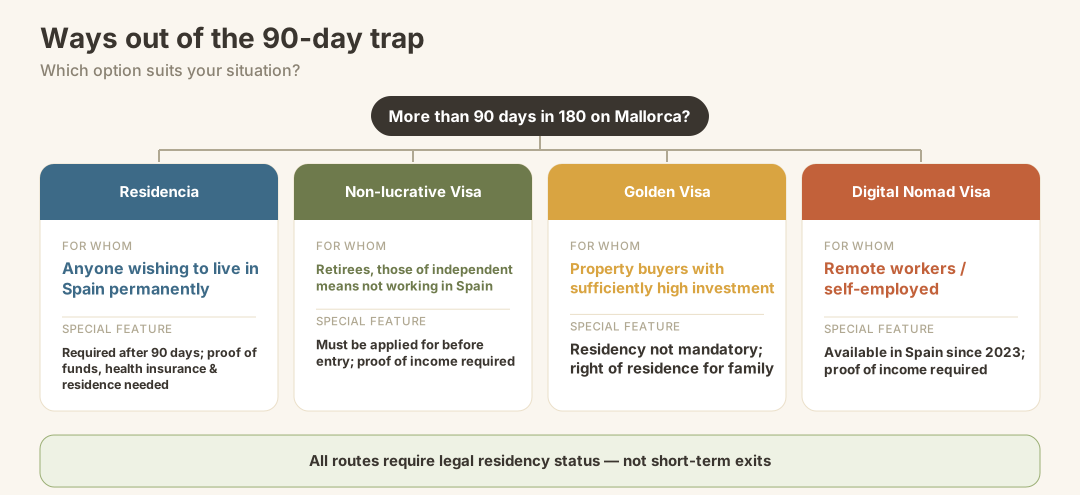
Anyone wishing to spend more than 90 days in 180 days on Mallorca has several legal options. The right one depends on your personal circumstances.
| Option | Who is it suitable for? | Key details |
|---|---|---|
| Residencia (residence permit) | Anyone who wants to live in Spain permanently | Required after 90 days; proof of means, health insurance, and residence needed |
| Non-lucrative Visa (visa without gainful employment) | Retirees and those with sufficient means who do not work in Spain | Must be applied for before entry; proof of income required |
| Golden Visa (investor visa) | Property buyers with a sufficiently high level of investment | Physical residence not mandatory; right of residence for family members |
| Digital Nomad Visa | Remote workers / self-employed individuals | Available in Spain since 2023; proof of income required |
| Autonomo (self-employment) | Those who wish to work and live in Spain | Registration as self-employed; tax liability in Spain |
Please note: Anyone applying for the Residencia will generally need to appear in person at the relevant Oficina de Extranjería. Documents typically required include: a valid passport, proof of sufficient financial means, proof of health insurance, and proof of residence.
You can find detailed information in our guide to the Residencia in Spain.
The Residencia: the standard route for Britons on Mallorca
For most Britons who wish to live permanently on Mallorca, the Residencia is the crucial step. It removes the 90-day limit on a permanent basis and forms the foundation for all subsequent dealings with the authorities — from registering with the Empadronamiento to obtaining a driving licence.
Documents that are generally required:
- Valid passport (original + copy)
- Proof of sufficient financial means (e.g. bank statements, pension notice)
- Proof of health insurance (private or via S1 form)
- Proof of residence (rental agreement, purchase contract or Empadronamiento certificate)
- Completed application forms (depending on residency category)
After the Residencia, the following steps are commonly required: Empadronamiento (local registration), NIE (if not already in place) and the decision regarding health insurance – either via the S1 form or a private policy.
Tax implications: what you need to know as a non-resident
Even if you stay within the 90-day limit and do not apply for a Residencia, you are not invisible from a tax perspective. As a non-resident with property in Spain, you are generally obliged to pay the non-resident tax (IRNR) – regardless of whether you rent out the property or use it solely for your own purposes.
Find out more in our guide to non-resident tax in Spain.
Those who do apply for the Residencia and spend more than 183 days per year in Spain are treated as tax residents and must declare their worldwide income in Spain (IRPF). More on this in our guide Taxes as a resident.
Most common mistakes made by British nationals regarding the 90/180-day rule
Incorrect calculation method: Many people assume a fixed six-month period (e.g. January–June) rather than the rolling 180-day calculation. This means the allowance runs out more quickly than expected.
Misunderstanding short trips abroad as a reset: A weekend in Gibraltar or Morocco does not reset the clock to zero.
Underestimating EES: From April 2026, entries and exits will be recorded automatically and digitally. Gaps in the old stamp system will no longer exist.
Failing to check passport validity: Three months' remaining validity beyond the departure date – not the entry date.
Confusing the 90-day rule with the 183-day rule: The right of residence and tax law follow different rules and timeframes.
Starting the Residencia process too late: The application can take several weeks. Anyone who starts on day 88 is too late.
Forgetting health insurance: Without uninterrupted proof of health insurance, the Residencia will generally not be approved. More on this: health insurance in Spain.
What comes next? Your path to residency
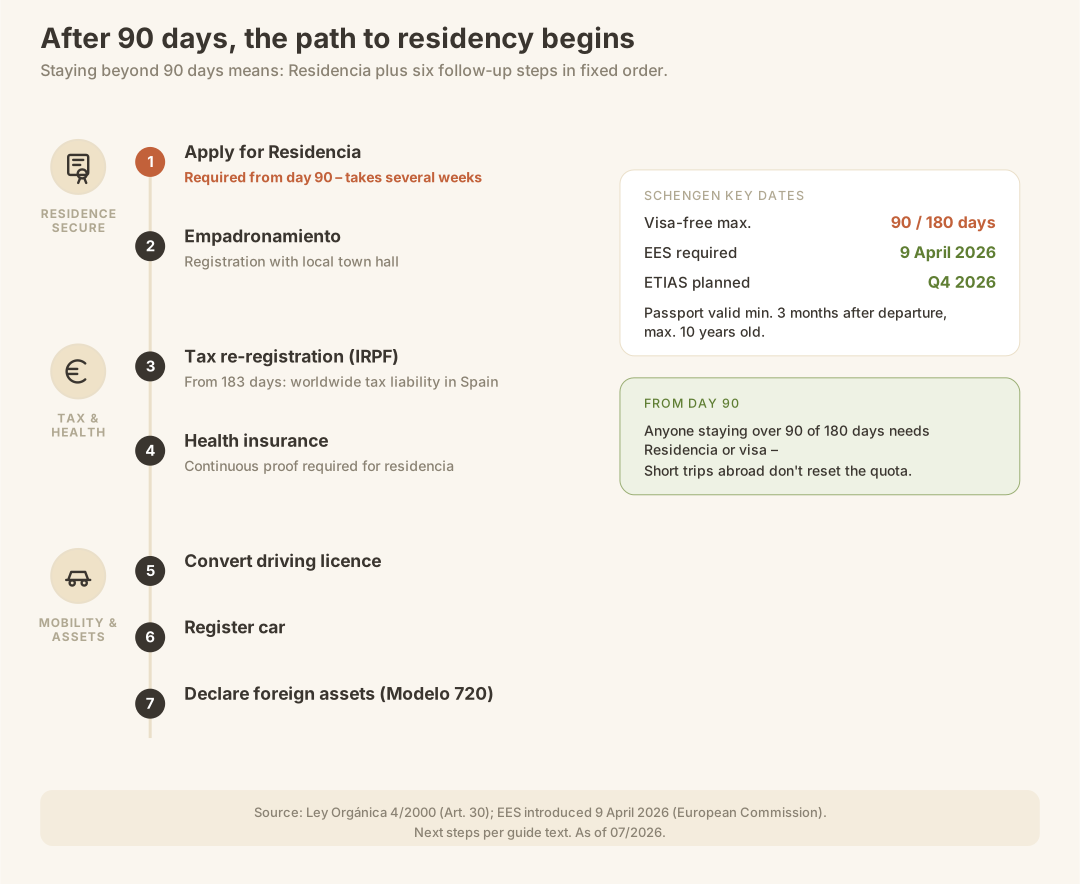
Once you have made the decision to live permanently on Mallorca, the Residencia is followed by a whole series of further steps. Here is an overview:
| Step | Topic | Guide |
|---|---|---|
| 1 | Applying for residencia | Residencia Spain |
| 2 | Residents' registration office | Empadronamiento Mallorca |
| 3 | Tax re-registration | Taxes as a resident |
| 4 | Health insurance | Health insurance Spain |
| 5 | Converting your driving licence | Converting your driving licence Spain |
| 6 | Re-registering your vehicle | Registering a vehicle Spain |
| 7 | Declaring overseas assets | Modelo 720 |
Checklist: Staying on top of the 90/180-day rule in Spain
- Passport validity checked (min. 3 months beyond planned departure date, issued within the last 10 years)
- Days spent in the last 180 days across the entire Schengen Area documented
- Schengen calculator from the Foreign Office used for next trip
- Difference between the 90-day rule (right of residence) and the 183-day rule (taxation) understood
- EES requirement from 9. April 2026 noted; biometric registration planned for next border crossing
- ETIAS introduction for Q4 2026 on the radar
- For planned extended stays: residencia options reviewed
- Proof of health insurance in place
- Tax situation (non-resident tax on property ownership) clarified
- If in doubt: gestoría or solicitor contacted (Gestoría Spain)
Conclusion
The 90/180-day rule in Spain is the key residence law boundary for British nationals since Brexit – and since the introduction of EES on 9. April 2026, it is being monitored more rigorously than ever before. Anyone using Mallorca purely as a holiday destination and keeping track of their 90 days has little to worry about. However, those who wish to spend more time on the island – as retirees, remote workers, investors, or simply out of love for the place – need a legal residence status. For most people, the residencia is the most straightforward route. The crucial thing is to act in good time: dealing with the authorities takes time, and leaving an application to the last minute is not a good strategy.
Official sources
- Schengen Borders Code / EU Regulation 610/2013 (basis for the 90/180-day calculation): eur-lex.europa.eu
- Spanish Immigration Act (Ley Orgánica 4/2000), Article 30 – Length of stay: boe.es
- Ley del Impuesto sobre la Renta de las Personas Físicas (LIRPF), Article 9 – Tax Residency: agenciatributaria.es
- German Federal Foreign Office – Calculating length of stay with Schengen visa (90/180) incl. stay calculator: auswaertiges-amt.de
- German Embassy London – British nationals in the Schengen Area: uk.diplo.de
- EES – Entry/Exit System of the EU (introduced 9. April 2026): ec.europa.eu/home-affairs
- ETIAS – European Travel Information and Authorisation System: ec.europa.eu/home-affairs
- ATIB – Agència Tributària de les Illes Balears (Balearic tax authority): atib.es
- Oficina de Extranjería Palma de Mallorca (residencia application): extranjeros.inclusion.gob.es