
S1 Form Spain: Health Insurance for Retirees Step by Step
Anyone who lives permanently in Mallorca or elsewhere in Spain as a retiree will face a crucial question early on: how do I access the public health system — without paying Spanish social security contributions? The answer is the S1 form Spain. This official EU document, formerly known as the E121, certifies to Spain that your German health insurer will cover the costs. It grants you full access to the Spanish Sistema Nacional de Salud (SNS) — that is, a GP, hospital care, and subsidised prescriptions — exactly as if you were a Spanish insured person. This guide explains who is entitled, how to apply for the form and register it in Spain, what you need to bring to the INSS registration appointment, and what alternatives exist if you cannot obtain an S1.

Are you a retiree planning a move to Mallorca — but not yet sure how to arrange seamless health insurance cover?
- 📩 Submit a personal enquiry — We will connect you with experienced expat advisers and local specialists
- Everything about the healthcare system in Mallorca
What is the S1 form and why is it so important?
The S1 form is an official EU social security document. It certifies to the host country — in your case Spain — that you are covered by health insurance in your country of origin, namely Germany, and that the relevant institutions there will bear the costs of your healthcare. For you as a retiree, this means: you can use the Spanish public health system (SNS) just like a locally insured person, without paying any additional Spanish contributions.
The form is part of the EU-wide coordination of social security systems and makes your health insurance entitlements essentially portable — they travel with you. Once the S1 has been registered with the Spanish INSS, you will receive the Tarjeta Sanitaria Individual, the Spanish health card, which you can use at any public health centre (centro de salud).
Please note: The S1 is not a holiday form. It is intended specifically for people who are permanently relocating their main residence to another EU country. The European Health Insurance Card (EHIC) covers only temporary stays and does not replace the S1.
Who is entitled to the S1 form?
Not every German national moving to Spain automatically receives an S1. The eligibility criteria are clearly defined:
| Criterion | Requirement |
|---|---|
| Insurance status | Member of a German statutory health insurance scheme (GKV) |
| Type of pension | Receipt of a German statutory pension (DRV) |
| Residence | Permanent move to Spain (not a holiday stay) |
| Privately insured | No entitlement to S1 (different arrangement — see below) |
| Family members | Separate S1 per person; no family form |
Privately insured retirees do not fall under this arrangement. They must either take out private health insurance in Spain or — depending on their individual policy — check whether their German policy continues to apply abroad.
Please note: EU coordination law applies to all EU/EEA states. British retirees (post-Brexit) are subject to the Withdrawal Agreement — the S1 system continues to apply to them, but the application is handled through NHS Overseas Healthcare Services.
Step 1: Applying for the S1 form in Germany
The first step is taken while you are still in Germany — ideally before you complete your move. Applying retrospectively is possible, but can lead to gaps in cover.
How to apply for the form from your German health insurer
- Contact your German health insurer (AOK, TK, Barmer, DAK etc.) — by phone, in writing, or in person.
- Inform them that you are relocating your primary residence to Spain permanently and that you require an S1 form.
- Have the following details to hand:
| Required information | Details |
|---|---|
| Insurance number | On your EHIC card or membership card |
| New address in Spain | A provisional address is also acceptable |
| Date of move | Planned or actual moving date |
| Start of pension | Date of retirement |
The health insurance fund issues the form as an original. It is issued per person — your spouse will need a separate S1, provided he or she is also a statutory health insurance member with pension insurance cover.
Step 2: Register the S1 form with the INSS in Spain
With the S1 in hand, you move on to the next step: registration with the Instituto Nacional de la Seguridad Social (INSS) — the Spanish social security authority.
Option A: Online registration (without a digital certificate)
You can register the S1 form electronically on the official INSS website. According to current guidance, this is possible without a digital signature or electronic certificate. Have a scanned copy of the S1 form and the supporting documents listed below ready.
The official URL for online registration is:
https://tramites.seg-social.es → Search term: "Registro S1 cobertura asistencia sanitaria España"
Option B: In-person appointment at the INSS
For many people, attending in person is simpler and more straightforward, especially the first time.
Documents required for the INSS appointment:
| Document | Note |
|---|---|
| S1 form (original) | Issued by the German health insurance fund |
| Passport or national identity card | Valid proof of identity |
| NIE number | Spanish tax identification number (mandatory) |
| Empadronamiento | Certificate of registration with the local authority |
Please note: The NIE number and the empadronamiento must be in place before registering with the INSS. Make sure to complete these steps beforehand. For more information, see our guide to Residencia in Spain.
Step 3: Applying for the Tarjeta Sanitaria
After successfully registering with the INSS, you will receive confirmation of your entitlement to healthcare cover. With this confirmation, you go to thehealth centre (centro de salud) in your area of residence — or, on Mallorca, to the relevant office of the Balearic health authorityIB-Salut (Servei de Salut de les Illes Balears).
There you will be assigned a GP and receive yourTarjeta Sanitaria Individual — your personal Spanish health card. With this card you can:
- visit your assigned GP
- receive referrals to specialists and hospital services
- have prescriptions dispensed under the Spanish co-payment system
- use emergency departments within the public system
What does S1 health cover include — and what doesn't it cover?
The S1 gives you access to the full range of public services provided by the SNS. This is considerable:
| Area of cover | Covered by S1? |
|---|---|
| GP visits | ✅ Yes |
| Specialist treatment (with referral) | ✅ Yes |
| Hospital stays | ✅ Yes |
| Emergency care | ✅ Yes |
| Prescription medicines (co-payment) | ✅ Yes (reduced co-payment) |
| Dental treatment (basic) | Limited (depending on region) |
| Optician / vision aids | ❌ No (as a rule) |
| Repatriation to Germany | ❌ No (separate arrangement with German health insurer) |
| Private doctors / clinics | ❌ No |
Please note: Your German health insurer remains your formal insuring body. For services that can only be provided in Germany — such as nursing care, certain rehabilitation measures, or repatriation — you remain registered with your German insurer and can continue to contact them directly.
What applies to EU pensioners from other countries?
The S1 system is not limited to German nationals. In principle, all pensioners from EU/EEA member states can use the S1 procedure, provided they hold statutory health insurance in their country of origin and receive a state pension. The precise process varies slightly from country to country:
- German pensioners: Application to be made to the German health insurer (GKV)
- Austrian pensioners: Apply through the Austrian health insurance fund (ÖGK or occupational pension funds)
- British pensioners (post-Brexit): Apply through NHS Overseas Healthcare Services — reachable on +44 (0)191 218 1999, Monday to Friday 8am–6pm, Saturday 9am–3pm; email: s1applications@nhsbsa.nhs.uk
In all cases, the second step is identical: registration with the INSS in Spain.
Alternatives to the S1: if you are not eligible
Not all pensioners moving to Spain meet the S1 requirements. Those with private insurance, early retirees without a pension entitlement, or people who are not yet drawing a state pension will need other solutions:
1. Private health insurance
The most common alternative. Many expats based in Mallorca combine private health insurance with the public emergency system. Private insurance is also a requirement for certain visa types (e.g. the Non-Lucrative Visa). Providers specifically geared towards Residencia applications are available in the Balearic Islands as well.
2. Convenio Especial
The Convenio Especial is a voluntary contribution agreement with the Spanish Seguridad Social for people who have no automatic entitlement to the SNS. You pay monthly contributions in return for access to public healthcare services. You should enquire directly with the INSS about the terms (contribution amounts, waiting periods), as these can vary depending on your personal circumstances.
3. Combination of EHIC and international health insurance
Only worthwhile for people who spend fewer than 183 days per year in Spain and maintain their primary residence in Germany. The EHIC covers emergencies and unexpected illnesses — but not ongoing care as a resident.
You can find more about the insurance options in our overview of health insurance in Spain.
The role of NIE, Empadronamiento and Residencia
The S1 form alone does not open any doors — you need the right administrative foundations in place. In practice, this means three bureaucratic steps must be completed before registering with the INSS:
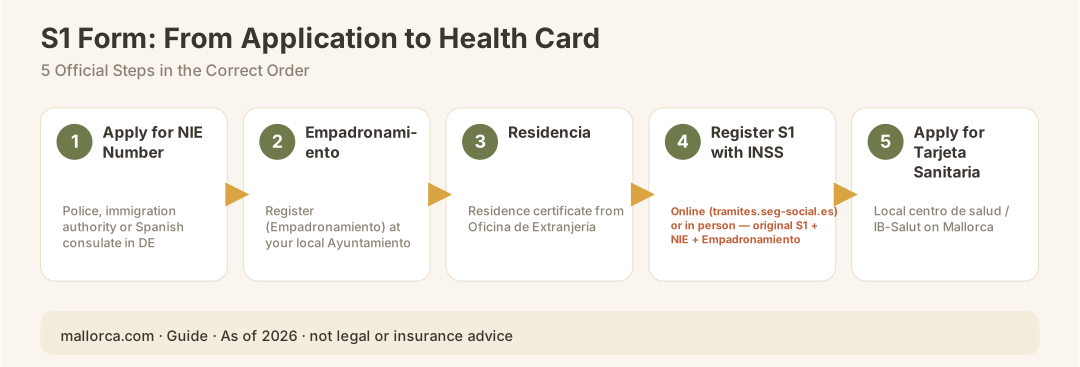
| Step | What | Where |
|---|---|---|
| 1 | Apply for NIE number | Police station, foreigners' registration office, Spanish consulate in Germany |
| 2 | Empadronamiento (certificate of registration) | Ayuntamiento (local council) of your place of residence |
| 3 | Residencia (certificate of residence) | Oficina de Extranjería or police station |
| 4 | Register S1 with the INSS | INSS office or online |
| 5 | Apply for Tarjeta Sanitaria | Local centro de salud / IB-Salut |
You can find more about step 2 in our Empadronamiento guide, and we explain the Residencia in detail under Residencia Spain.
Tax considerations: what pensioners need to know
The S1 form only covers health insurance — tax matters are handled separately. As a resident in Spain (generally more than 183 days per year), you are liable to pay income tax in Spain and must declare your German pension there. The German-Spanish double taxation agreement sets out which state holds which taxation rights.
This is a complex area and should be discussed with a tax adviser who specialises in Spain. Our guides on taxing your German pension in Spain and on taxes as a resident (IRPF).
Most common mistakes with the S1 form
Experienced advisers on Mallorca regularly see people trip up on the following:
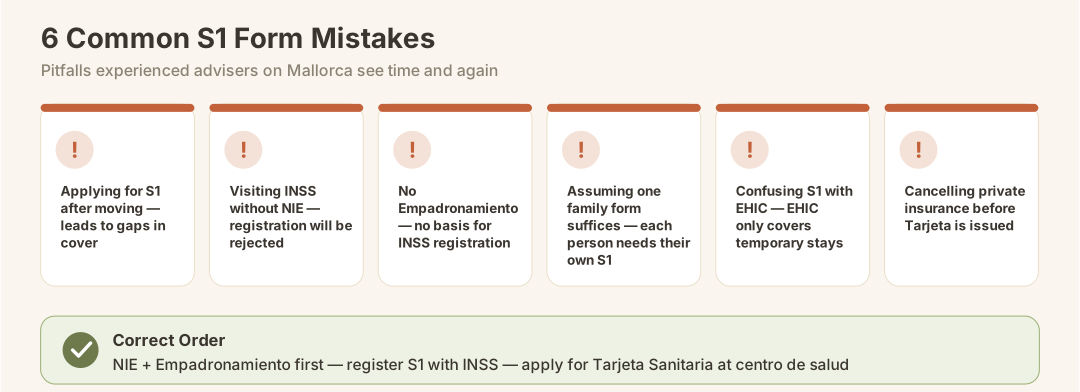
- Applying too late: Requesting the S1 from your German health insurer only after you have moved often leads to gaps in cover. Apply in good time before your move.
- Trying to submit the form without a NIE: Without a NIE number, the INSS will not process your registration. The NIE must be obtained beforehand — no exceptions.
- No Empadronamiento: Without being registered on the municipal roll, you have no basis for registration with the INSS.
- Assuming there is a family form: There is no joint S1 for couples — each person needs their own document.
- Confusing the S1 with the EHIC: The EHIC only covers temporary stays. As a resident, you need the S1.
- Cancelling private insurance before the Tarjeta is in your hands: As long as you do not yet have your health card, you should not give up uninterrupted insurance cover.
- No follow-up after registering with the INSS: Registering with the INSS is step 4 — after that you must actively apply for the Tarjeta Sanitaria at your local centro de salud.
What comes next? Living with the SNS on Mallorca
Once you have the Tarjeta Sanitaria in your hands, you are fully integrated into the Spanish system. On Mallorca, IB-Salut (Servei de Salut de les Illes Balears) is the regional body responsible for the public health system. Your assigned GP (médico de cabecera) is your first point of contact — they issue referrals to specialists and hospitals.
Despite a solid standard of basic care, many expats on Mallorca opt for supplementary private health insurance in order to:
- enjoy shorter waiting times for specialist appointments
- have access to English- or German-speaking doctors
- use services not covered by the SNS (optical, dental, alternative medicine)
This does not mean giving up the SNS — the combination of S1-based SNS access and supplementary private insurance is widespread on Mallorca.
More on everyday life on the island: Cost of living Mallorca and the comprehensive Retirees on Mallorca guide.
Checklist: S1 form Spain
- Membership of a German statutory health insurance fund confirmed
- Statutory pension (DRV) being received or pension start date known
- S1 form requested from the German health insurance fund (before the move)
- NIE number applied for and received
- Empadronamiento completed at the Spanish municipality
- Residencia applied for or registered
- S1 form registered with the INSS (online or in person)
- Confirmation of entitlement to insurance received from the INSS
- Tarjeta Sanitaria applied for at the local centro de salud / IB-Salut
- GP (médico de cabecera) assigned
- Interim insurance cover (private) secured until the Tarjeta is issued
Conclusion
The S1 form Spain is the most straightforward and cost-effective route into the Spanish public health system for statutory-insured retirees from Germany. You pay no additional contributions in Spain, remain a member of your German health insurance fund, and still enjoy full access to the SNS. The process involves several steps — from applying in Germany to receiving your Tarjeta Sanitaria in Spain — but it is well structured. The most common problems arise from applying too late or from missing documents such as the NIE and Empadronamiento. Those who put these foundations in place in good time will arrive in Spain without any gaps in healthcare cover.
Official Sources
- INSS – Instituto Nacional de la Seguridad Social (Online S1 registration): https://tramites.seg-social.es
- Seg-Social.es (general INSS information): https://www.seg-social.es
- German Embassy Madrid – FAQ Health and Nursing Care Insurance: https://spanien.diplo.de/es-de/service/2675862-2675862
- NHS Overseas Healthcare Services (UK retirees): https://www.nhsbsa.nhs.uk/going-live-abroad
- IB-Salut – Servei de Salut de les Illes Balears: https://www.ibsalut.es
- European Commission – Social Security Coordination: https://ec.europa.eu/social/main.jsp?catId=26