
Receiving German TV in Spain: an overview of legal options
Anyone moving to Mallorca or mainland Spain quickly notices: the familiar ARD Mediathek, Joyn or RTL+ no longer work the way they do back home. Receiving German television in Spain is, however, no witchcraft – there are essentially three tried-and-tested routes: a satellite system on Astra 19.2° East, an IPTV streaming service via your internet connection, or the direct use of media libraries and live TV apps, sometimes supplemented by a VPN. This guide explains why geoblocking applies in the first place, which solution suits your living situation, what it costs, and where the legal boundaries lie between "technically possible" and "recommended for long-term use".
Why is German television suddenly blocked in Spain?
The reason is called geoblocking. ARD, ZDF, RTL and other broadcasters have usually only acquired broadcasting and streaming rights for films, series and especially live sport for the German market. As soon as your device has a Spanish IP address – for example from Movistar, Orange or Vodafone – the server detects your location and automatically blocks certain content.
The following are mainly affected:
- Films and series in the media libraries
- Live sports broadcasts such as Bundesliga and Champions League
- Content from RTL+, Joyn and other private streaming platforms
- in some cases also documentaries and selected news formats
Note: Not every programme is blocked. News and many in-house productions from the public broadcasters' media libraries are often freely available abroad too. Check this first before investing in technology.
The three reception methods at a glance
Which solution is worthwhile depends on your living situation (rented vs. owned flat, balcony available?), your internet connection and your budget.
| Reception method | Cost (monthly) | Number of channels | Quality | Internet required? |
|---|---|---|---|---|
| Satellite (Astra 19.2°) | 0 euros after installation | 200+ free-to-air channels | HD/SD | No |
| IPTV (e.g. Waipu.tv, Zattoo) | 6–14 euros | 100–250 | HD/Full HD | Yes, at least 15 Mbit/s |
| Media libraries (ARD, ZDF) | €0 | On-demand | HD | Yes, min. 5 Mbit/s |
Please note: A VPN doesn't replace any of the three options, but complements them – usually in combination with media libraries or streaming apps when geoblocking kicks in. More on this below.
Setting up satellite reception via Astra 19.2° East
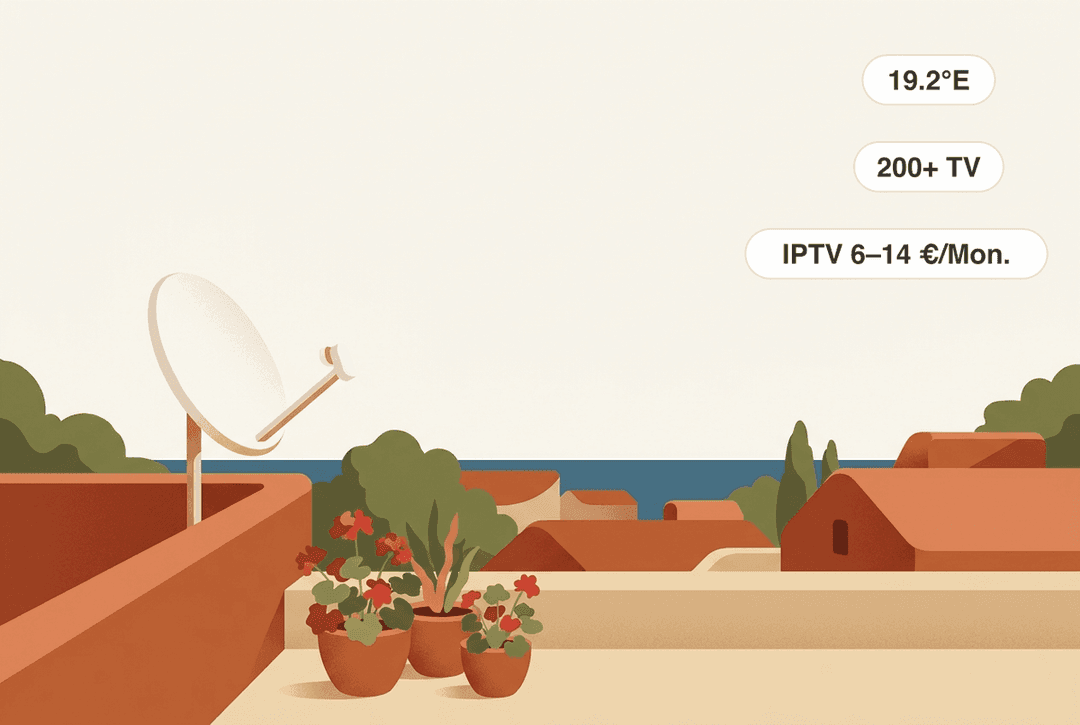
The classic and most stable solution is a satellite dish aligned to Astra 19.2° East. This satellite broadcasts virtually the entire German free-to-air TV line-up – independent of your internet connection.
| Channel group | Available via Astra 19.2°? | Additional costs |
|---|---|---|
| ARD, ZDF, Arte, 3sat, Phoenix, regional channels | Yes, free in HD | None |
| RTL, ProSieben, Sat.1, VOX, Kabel eins (SD) | Yes, free | None |
| RTL HD, ProSieben HD & Co. | Yes, with HD+ card | approx. €70/year |
| Further international channels (FR, ES, IT) | Yes, additionally | None |
Here's generally how to go about the installation:
- Check with your landlord or homeowners' association (Comunidad de Propietarios) whether mounting a dish on the balcony or roof is permitted.
- Choose an installer or dish with a clear line of sight to the southeast; a professional on-site signal measurement will show whether the standard dish size is sufficient at your location.
- Have the system aligned precisely to Astra 19.2° East; a signal meter makes fine-tuning considerably easier.
- For private HD channels, you additionally order the HD+ card directly from the provider.
- Public broadcasters run in HD from the very first signal, without any further activation.
Note: Once installed, there are no ongoing costs for free-to-air TV – ideal for anyone who wants to watch TV permanently and independently of the internet. Also check your internet connection in Mallorca beforehand if you're planning to use IPTV as a supplement.
IPTV streaming providers: Waipu.tv, Zattoo & Co.
Anyone who isn't allowed or doesn't want to install a satellite dish can turn to IPTV services such as Waipu.tv or Zattoo. These transmit the TV signal via the internet – so you'll need a stable connection with at least 15 Mbit/s.
| Criterion | Typical value |
|---|---|
| Monthly cost | 6–14 euros |
| Number of channels | 100–250 |
| Picture quality | HD up to Full HD |
| Minimum internet speed | 15 Mbit/s |
| Usable devices | Smart TV, stick/box, smartphone, tablet, laptop |
One advantage of such services: they run equally on smartphone, tablet and smart TV apps, without any installation effort on the roof. Waipu.tv explicitly advertises that you can also use your packages (such as "Perfect Plus" or "Comfort") in other EU countries – more on that shortly in the section on EU portability.
Media libraries & live TV apps: what works without extra cost
Before investing in technology, it's worth taking a look at the free media libraries of ARD and ZDF. News programmes and many in-house productions are often accessible even with a Spanish IP address – feature films, licensed series and live sport, however, generally are not.
- ARD media library and ZDF media library: news and in-house productions often free, licensed content usually blocked
- RTL+, Joyn: mostly blocked, as they are licensed purely under private broadcasting rights
- For live sport (Bundesliga, Champions League), geoblocking applies almost across the board
Attention: Don't rely solely on open media library content for important dates (e.g. a football highlight) – test the specific programme beforehand instead of experiencing a nasty surprise in the evening.
VPN for German television: opportunities and legal limits
A VPN (Virtual Private Network) routes your internet traffic through a server in Germany, so that streaming services detect a German IP address. This is the technically simplest method of unlocking blocked media library content, and costs from around 3 euros a month.
- Choose a reputable VPN provider with server locations in Germany.
- Install the app on the device you use to watch TV (laptop, Fire TV Stick, Smart TV box).
- Connect to a German server before opening the media library or app.
- Check the connection speed – for smooth streaming, the minimum values mentioned at the outset are usually sufficient.
Note: Using a VPN yourself is not prohibited. However, the terms of use of many streaming providers prohibit deliberately disguising your actual location, especially in the case of a permanent residence abroad. For short trips, the legal situation is more relaxed than for a permanent move – read the following section on EU portability for more details.
EU Portability Regulation: what really applies for emigrants
Within the EU, there is a regulation that expressly safeguards streaming subscriptions for temporary stays in another EU country – for example, on holiday or a business trip. Waipu.tv itself points out that customers with the "Perfect Plus" or "Comfort" packages can also use their content abroad within the EU, as long as it is a temporary stay.
| Situation | Does EU portability apply? | Practical consequence |
|---|---|---|
| Holiday or business trip in Spain | Yes | Subscription continues as normal, mind the length of stay |
| Permanent residence in Spain | Not clearly covered | Providers may restrict use |
Note: Anyone who permanently emigrates to Spain moves, when using media libraries/apps alone, outside the portability rule originally intended for short stays. In practice, many emigrants therefore additionally turn to satellite or IPTV in order to be independent of individual providers' terms.
Cost comparison at a glance
| Solution | One-off costs | Ongoing costs | Independent of the internet? |
|---|---|---|---|
| Satellite + HD+ card | Purchase of dish/receiver | approx. 70 euros/year for HD+ (≈ 5.83 euros/month) | Yes |
| IPTV subscription | None | €6–14/month | No |
| Streaming/catch-up services (Mediatheken) | None | €0 | No |
| VPN (in addition to streaming/catch-up services) | None | from approx. €3/month | No |
Football, Bundesliga & live sport on Mallorca
Live sport is the biggest geoblocking hurdle, because broadcasting rights are almost always strictly tied to the German market. Besides satellite, IPTV or VPN, there's a simple analogue solution on Mallorca: for major events such as a World Cup match of the German national team, numerous German pubs and sports bars on the island show the broadcast on a big screen – no equipment of your own required.
Most common mistakes with TV reception in Spain
- Installing a satellite dish without prior agreement with the landlord or Comunidad de Propietarios
- Booking IPTV without first checking your own internet speed
- Relying solely on open streaming/catch-up content for live sport
- Using a VPN permanently in everyday life without knowing the terms and conditions of the respective streaming provider
- Forgetting the HD+ card and then being puzzled by SD quality on private channels
What comes next? Maintenance, contracts and moving house
After the initial installation, you should renew the HD+ card every year if you want to keep using private HD channels permanently. With IPTV subscriptions, it's worth checking package changes and prices once a year, as channel packages occasionally change. If you move within Mallorca, check again for a clear line of sight to the south-east for satellite systems – a balcony with a view blocked by neighbouring buildings can completely prevent reception. Your internet connection should also remain permanently stable for IPTV, not just at the time of testing.
Checklist: setting up German TV in Spain
- Check your living situation: is a balcony/roof allowed for a satellite dish?
- Test your internet speed (at least 5 Mbit/s for streaming/catch-up services, at least 15 Mbit/s for IPTV)
- Decide: satellite for independence from the internet, or IPTV for flexibility across multiple devices
- If needed, order an HD+ card for private HD channels
- For streaming/catch-up special cases: read the provider's terms and conditions regarding permanent residence abroad
- For live sport events: keep an alternative such as a German sports bar on Mallorca in mind
Conclusion
Receiving German television in Spain is straightforward with the right preparation: satellite via Astra 19.2° East delivers over 200 free-to-air channels permanently and independently of the internet, IPTV services such as Waipu.tv or Zattoo offer flexibility for 6 to 14 euros a month, and on-demand media libraries cover at least the news for free. A VPN can help in specific situations, but it doesn't replace any of the three basic solutions and should be used consciously with the providers' terms of use in mind – especially if you're living in Spain permanently rather than just temporarily.
Official sources
- Waipu.tv – Streaming TV abroad in the EU: https://www.waipu.tv/fernsehen-im-ausland
- Mallorca-Plus – Receiving German television on Mallorca (satellite, IPTV & media libraries): https://www.mallorca-plus.de/themen/alltag/deutsches-tv
- Mallorca-Plus Blog – Receiving German television on Mallorca: https://www.mallorca-plus.de/blog/deutsches-fernsehen-mallorca-empfangen