
Where to find affordable housing on Mallorca, including Palma
Affordable living on Mallorca is possible – but it requires planning, local knowledge and a realistic budget. Anyone guided by glossy photos from Portixol or Santa Ponsa will quickly end up paying rents well above €2,000. Yet the island does have genuine alternatives for expats on a modest or moderate budget: villages in the interior, small towns in the north and east, and mixed residential neighbourhoods in Palma itself where locals and expats live side by side. This guide shows you what living on Mallorca costs in 2026, which municipalities are significantly cheaper than Palma, what to watch out for in a tenancy agreement – and where the typical pitfalls lie that can quickly derail your savings plan. You will also learn how to save several hundred euros a month compared with an unplanned move, by using an intermodal travel card, shopping smartly at the supermarket and getting your utility costs right.
- Cost of living on Mallorca in detail — full figures on electricity, groceries and more
The rental market on Mallorca: what you need to know in 2026
The rental market on Mallorca is structurally tight. International demand and a chronically limited supply have been pushing prices upward for years – by around 6 to 8 per cent per year according to market observers. There is no rent cap in the Balearic Islands; instead, regional policy relies on tax incentives for landlords who voluntarily forgo increases.
For long-term tenancy agreements, Spanish law stipulates a minimum term of 5 years for private landlords and 7 years for companies acting as landlords. After that, the contract renews automatically unless either party gives notice. Important: the deposit is legally capped at 1 month's net rent; in addition, landlords may request up to 2 further months' rent as a security deposit. Estate agent fees for long-term rentals are the landlord's responsibility as a matter of principle – you pay nothing as the tenant.
| Key figure | Value (2026) |
|---|---|
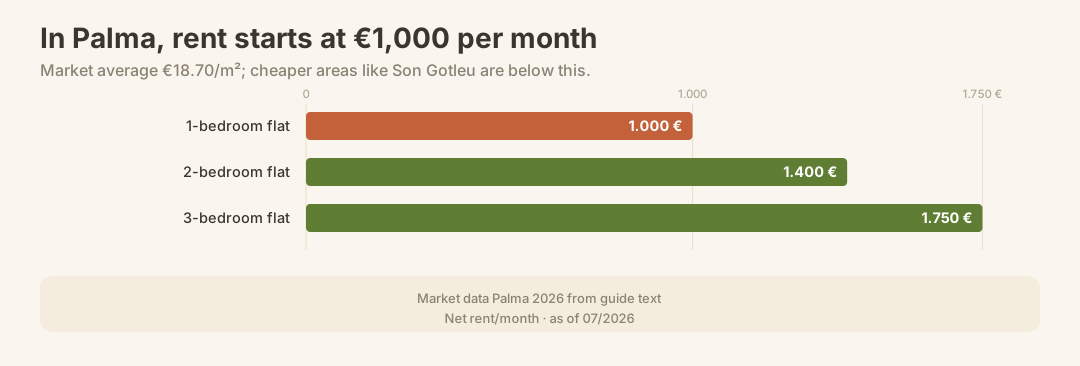
| Avg. rental price Palma (market average) | 18.70 €/m² |
| 1-bedroom flat, Palma | approx. €1,000/month |
| 2-bedroom flat, Palma | approx. €1,400/month |
| 3-bedroom flat, Palma | approx. €1,750/month |
| Annual rent increase | approx. 6–8 % |
| Statutory minimum deposit | 1 month's net rent |
| Max. additional security deposit | 2 months' rent |
| Minimum rental period (private landlords) | 5 years |
| Minimum rental period (companies) | 7 years |
Please note: Without a NIE number and a Spanish bank account, most landlords will not even invite you to a viewing. Obtain both before you begin your property search – more on this in the guide to Residencia.
Palma: an overview of affordable neighbourhoods
Palma is not just Palma. There is a world of difference – including in rental prices – between the old town quarter of Calatrava with its restored town palaces and a working-class area such as Son Gotleu. Those who want to live in Palma without a premium budget should take a closer look at the following neighbourhoods:
| Neighbourhood | Character | Relative price level |
|---|---|---|
| El Terreno | Mixed neighbourhood, slightly hilly | moderate |
| Son Gotleu / La Soledat | Local working-class area, few expats | affordable |
| Pere Garau | Vibrant market, lots of locals | moderate–affordable |
| Foners | Quiet, well-connected area | moderate |
| Santa Catalina | Trendy, market, nightlife | moderate–expensive |
| Portixol / Molinar | Former fishing quarter, highly sought-after | expensive |
| Old Town / Calatrava | Historic, city palaces | very expensive |
| Son Vida | Villa district, golf | very expensive |
In Son Gotleu and La Soledat you can still find flats that are noticeably below Palma's market average of 18.70 €/m². Pere Garau is lively, has a well-stocked weekly market and good connections to the bus network. Santa Catalina attracts young professionals and restaurateurs – lovely, but no longer cheap.
Warning: In some of the more affordable neighbourhoods, the building stock is older. The typical winter problem on Mallorca – high humidity (regularly above 80 %) meeting the porous local Mares stone – will reliably lead to mould without active heating and regular cross-ventilation. Ask to see the walls before signing any contract.
The most affordable places outside Palma: the island's interior and the east
Those who don't need to commute to Palma every day – remote workers, retirees, or the self-employed – have a genuine choice on Mallorca. The interior and the less touristy east offer significantly lower rents than the coastal towns or the island's capital.
Island interior (Pla de Mallorca)
Places such as Sineu, Petra, Porreres, Montuïri or Sant Joan are authentic Mallorcan village communities. The residents are predominantly locals, village life runs in Catalan and Spanish, and rental listings tend to appear through local networks and noticeboards rather than on international portals. Rental prices are noticeably below the island average.
North and east
Inca is the third-largest town on the island, easily reached by train (direct rail link to Palma) and considerably more affordable than the coast. Sa Pobla and Muro in the north are likewise agricultural in character, quiet and inexpensive. In the east, Manacor (the island's second-largest town) and the nearby Porto Cristo worth considering: Porto Cristo is right on the sea, yet still has substance beyond tourism.
| Town / Region | Character | Rent trend vs Palma | Train connection to Palma |
|---|---|---|---|
| Inca | Urban feel, market, commerce | considerably cheaper | Yes, direct line |
| Manacor | Largest inland town, pearl industry | cheaper | No (bus) |
| Sineu / Petra | Village, authentically Mallorcan | considerably cheaper | No (bus/car) |
| Porreres / Montuïri | Small towns in the island's interior | considerably cheaper | No (car) |
| Sa Pobla / Muro | Northern coastal hinterland | cheaper | Partial (bus) |
| Porto Cristo | Small coastal town, harbour | cheaper than the west coast | No (bus/car) |
| Alcúdia / Port d'Alcúdia | North, touristic but liveable | moderate, seasonal | No (bus) |
Note: Anyone wishing to live in Mallorca without their own car is dependent on the Palma–Inca–Manacor rail corridor or the bus network. In the interior of the island and many smaller coastal towns, a car is practically essential — and this has a direct impact on your overall budget.
What living in Mallorca really costs: overall budget examples
Rent is only part of the equation. Utility bills, heating and transport add up quickly. Two examples from our research:
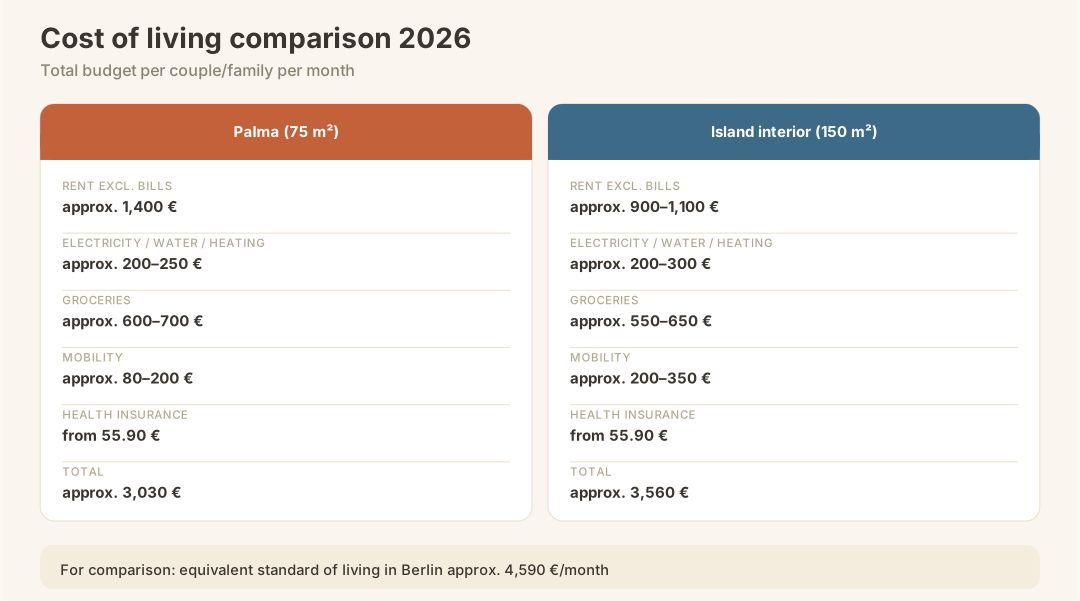
Couple in Palma (approx. 75 m²): Overall budget approximately 3.030 €/month
Family in the island's interior (approx. 150 m²): Overall budget approximately 3.560 €/month
How is that broken down?
| Cost item | Palma (75 m²) | Island interior (150 m²) |
|---|---|---|
| Rent (excluding bills) | approx. 1.400 € | approx. 900–1.100 € |
| Electricity, water, heating (reference figure for 85 m²: approx. 193 €) | approx. 200–250 € | approx. 200–300 € |
| Refuse collection charge (can be passed on to tenants) | 50–150 €/year | 50–150 €/year |
| Groceries (couple) | approx. 600–700 € | approx. 550–650 € |
| Transport (public transport/car) | approx. 80–200 € | approx. 200–350 € |
| Health insurance (private, from) | from 55.90 € | from 55.90 € |
For comparison: a comparable standard of living to Berlin (approximately 4,590 €/month there) costs around 3,400 €/month on Mallorca according to available data – a saving of approximately 26 %. The biggest levers are rent (up to 24 % cheaper than in major German cities), basic utilities (around 42 % cheaper), and groceries (18–23 % cheaper).
Public transport: the most affordable lever
If you live in Palma or in a well-connected municipality, you can save considerably on mobility. The Intermodal Card of the Balearic transport network is free for residents in 2026 – meaning: buses and trains at no cost, provided you have registered your primary residence (Empadronamiento) on Mallorca.
The Empadronamiento is a legal requirement for residents – and you benefit directly through free public transport. In the island's interior and in more rural municipalities, however, getting by without a car is barely feasible; budget realistically there for the costs of purchasing, ITV, and insuring a vehicle.
Groceries and shopping: where to shop affordably
Groceries on Mallorca are on average 18–23 % cheaper than in Germany – but only if you shop strategically. The major discounters and full-range supermarkets on the island differ considerably in their price levels:
- Mercadona is the most widely used supermarket among locals and offers solid everyday supplies at fair prices.
- Lidl and Aldi are also present and often cheaper for processed products.
- Eroski and Hiperco are slightly more expensive but have a better selection of fresh produce.
- Weekly markets (e.g. in Sineu every Wednesday, in Inca on Thursdays) often offer local vegetables, fruit, and cheese more cheaply than supermarkets – and you know exactly where it comes from.
Please note: Imported German or northern European products (dark rye bread, certain cheese varieties, specialist muesli) cost considerably more in specialist expat shops. Those who embrace local cuisine will save significantly.
Heating on Mallorca: an underestimated cost factor
Mallorca has mild winters – but not no winters at all. Between December and March, temperatures regularly drop at night, and humidity often exceeds 80%. Most Mallorcan properties are not built for these conditions; insulation and central heating are the exception, not the rule.
Heating costs vary considerably depending on the system:
| Heating system | Monthly costs (approximate) |
|---|---|
| Air conditioning (heat pump) | cheapest option |
| Electric fan heaters | moderate |
| Central heating (gas/oil) | approx. 60–300 €/month |
Air conditioning units with heat pump functionality are the most efficient and cost-effective heating solution on Mallorca. When viewing a property, check whether the unit also works in heating mode – not all older models can do this. Find out more in the guide Heating on Mallorca.
Rental contracts and legal matters: what you absolutely must check
The Spanish tenancy law framework (Ley de Arrendamientos Urbanos, LAU) offers good protection for long-term tenants – but only if you have a proper contract. The following points must be clarified before you sign:
- Tenancy duration: At least 5 years (private landlords) or 7 years (companies) – you are entitled to this term even if the contract text suggests otherwise.
- Deposit: Legally exactly 1 month's rent, to be lodged with the IBAVI (Institut Balear de l'Habitatge). Up to 2 additional months' rent as extra security is permitted.
- Utility and service charges: Ask explicitly who pays the IBI (council tax), Comunidad de Propietarios (service charge) and waste collection fee. The Comunidad and IBI are generally the landlord's responsibility; waste charges (50–150 €/year) are sometimes passed on to the tenant.
- Inventory list: Ask for a signed list of all included furnishings and their condition – in writing, with a date.
- Energy Performance Certificate (Certificado de Eficiencia Energética): The landlord is required to provide this. A low rating means higher heating costs.
- Agency fees: For long-term rentals, the landlord is responsible for these as a matter of principle. If anyone requests fees from you, this is not permissible.
The most common mistakes when trying to live affordably on Mallorca
1. Only looking at property portals
A large proportion of affordable long-term rental listings – particularly in the island's interior – circulate through personal networks, local Facebook groups and notices in supermarkets. Anyone who only searches Idealista or Fotocasa is seeing an expensive slice of the market.
2. Seasonal traps
Many coastal towns have hardly any long-term rental listings because properties are let as holiday apartments in summer. What stands empty in October is no bargain – check whether the landlord is willing to sign a proper 5-year contract.
3. Underestimating winter costs
Low rent plus poor insulation plus no heating can end up costing more than a better-equipped flat with a slightly higher rent. Always view in winter, or at the very least ask specifically about the heating system and any signs of mould.
4. Moving in without Empadronamiento
Without registering with the local council (Empadronamiento) you have no entitlement to the free Intermodal card, you make enrolling children in school more difficult, and you lose access to municipal services. Register immediately after moving in.
5. Leaving the NIE and bank account too late
Many landlords immediately reject applicants without these documents. The rental market is tight – quick decisions are essential.
6. Not negotiating additional costs
Whether the rubbish charge, Comunidad fees, or minor repairs are passed on to the tenant is often negotiable – but only before the contract is signed.
Checklist: Living affordably on Mallorca – before you move in
- NIE number applied for and received
- Spanish bank account opened
- Empadronamiento registered at the Ayuntamiento of the new place of residence
- Energy certificate of the property seen and energy rating noted
- Heating system of the property checked (heat pump installed?)
- Walls inspected for signs of mould (particularly the north-facing side and corners)
- Inventory list signed with the landlord
- Deposit lodgement with IBAVI confirmed
- Additional costs (IBI, Comunidad, rubbish) agreed in writing
- Tenancy duration checked for a minimum of 5 years
- Intermodal card applied for after Empadronamiento
- Health insurance taken out (private or via S1 form)
- Water and electricity supply transferred into your own name
How to register for water is explained in the guide Registering water supply on Mallorca. You can find everything about health insurance in the guide Health insurance Spain.
What comes next? Registration, taxes, everyday life
Living costs
Check the conditions
- In each scenario you receive the same regular cash salary in all twelve months, fully subject to tax and contributions: no one-off payments, benefits in kind, salary conversion or tax-free pay components.
- In the German year you are subject to unlimited German income tax throughout the year, with statutory health and long-term care insurance and general pension and unemployment insurance.
- In the Spanish year you are tax-resident in the Balearics throughout the year and hold a permanent full-time job under Régimen General (Spain’s general social-security system), with regular monthly contributions, no overtime or special schemes. Monthly contributory pay is constant, including prorated pagas extraordinarias (extra salary payments).
- One social-security system applies per scenario: German in the German year, Spanish in the Spanish year. No posting, A1, work in several states or S1.
- You are single, have no children, other income, church-tax liability or individual deductions or reliefs.
- Remaining budget / month · Germany
- €829.25
- Remaining budget / month · Mallorca
- €1,154.04
- Mallorca − Germany
- €324.79
Before individual reliefs; monthly amounts: annual average after modelled annual tax.
Legal status: 1 January 2026
This calculation is provided for guidance only and is not a substitute for tax or legal advice in specific cases.
After moving in, the administrative side of life on Mallorca begins. The most important next steps:
- Applying for Residencia – anyone living on the island permanently is required to register after 3 months: Residencia Spain
- Check tax liability – from 183 days of residence per year you are liable for tax in Spain (IRPF). What this means is explained in the guide Taxes as a Resident
- Mobile and internet – a local contract makes life considerably easier: Mobile contract Spain
- Learning Spanish – particularly in the interior of the island and in the villages, flat-hunting without language skills is hard going: Learning Spanish on Mallorca
- Waste separation – the system on Mallorca differs from Germany: Waste separation Mallorca
Conclusion: Affordable living on Mallorca is achievable – but not without a plan
The island has two faces: the expensive coastal and Palma Mallorca that dominates the glossy property portals – and the more affordable, more authentic Mallorca of inland towns, working-class neighbourhoods, and small towns such as Inca or Manacor. Anyone who wants to live cheaply must actively seek out this second face: make use of networks, look for listings on the ground, speak at least basic Spanish, and get all the bureaucratic requirements (NIE, bank account, Empadronamiento) sorted in good time.
The good news: anyone who does this lives on Mallorca for around 3.400 €/month at a standard that would cost roughly 4.590 € in Berlin. Basic living costs are around 42 % cheaper, groceries are 18–23 % less expensive, and public transport is free for residents. This is not a tourism promise, but documented reality – for all those who see the island as home, not as an extended holiday.
Official sources
- IBAVI – Institut Balear de l'Habitatge (deposit, tenancy law Balearic): https://www.ibavi.caib.es
- Ley de Arrendamientos Urbanos (LAU) – tenancy law framework Spain: https://www.boe.es/buscar/act.php?id=BOE-A-1994-26003
- Govern de les Illes Balears – Habitatge: https://www.caib.es/sites/habitatge/ca/inici-54823/
- Consorci de Transports de Mallorca (intermodal card): tib.org
- AEAT – Agencia Estatal de Administración Tributaria (tax liability, NIE): https://www.agenciatributaria.es
- Padró Municipal / Empadronamiento – Ayuntament de Palma: https://www.palma.es