Registering a yacht in Spain: matriculation tax, flag and charter licence
Anyone wishing to register their yacht in Spain faces a web of maritime law, tax law, and licensing procedures that can seem bewildering at first glance — but is entirely manageable once you know the rules. The crucial point: it is not the flag alone that determines your tax liability, but above all who uses the vessel and where. The registration tax (Impuesto Especial sobre Determinados Medios de Transporte) of 12% on the current market value is the largest cost item, yet under certain conditions it can be avoided entirely. This guide explains step by step how registration works, when the tax applies, how to avoid it legally, and what you need in order to charter your yacht commercially in the Balearic Islands.

Are you planning to buy or register a yacht in Mallorca and want to avoid any nasty tax surprises?
- 📩 Submit a personal enquiry — We'll connect you with specialist maritime lawyers and gestorías in Mallorca
- Recreational Boating Licence Spain — Which licences you need before you can set sail
Who is required to register a yacht in Spain?
Spanish law obliges owners to register all vessels of 2.5 metres in length or more in the Registro de Buques y Empresas Navieras of the Dirección General de la Marina Mercante. The registry has local offices in all coastal cities, including Palma de Mallorca. Upon request, the registry provides information about vessels and their owners — it is therefore a public instrument.
Important: A vessel may only sail under a single flag. Anyone wishing to re-flag a vessel currently registered under a foreign flag to Spain must first have the existing registration in the country of origin fully cancelled before the Spanish registration process can begin.
Open doors: Who may register under the Spanish flag?
Contrary to a widely held assumption, Spanish registration is not restricted to Spanish nationals. Persons of any nationality may register under the Spanish flag — the only requirements are a correspondence address in Spain and the appointment of a representative resident in Spain.
| Requirement | Details |
|---|---|
| Owner's nationality | No restriction — any nationality is eligible |
| Correspondence address | A Spanish address is required |
| Representative | A representative resident in Spain must be appointed |
| Minimum length for registration | From 2.5 metres |
| Existing foreign flag registration | Must be fully settled beforehand |
The Registration Tax (Impuesto de Matriculación) in Detail
The registration tax is the key financial consideration when purchasing a yacht in Spain. It amounts to 12% of the current market value of the yacht at the time of registration and applies in principle to:
- Yachts registered in Spain
- Yachts used by resident natural or legal persons in Spain
- Yachts operated in Spanish waters – regardless of the flag
Please note: The flag of the vessel is not decisive for tax purposes. What matters is the use in Spain by a person or company liable to tax in Spain. Even a boat sailing under a Maltese or Cypriot flag may be subject to Spanish registration tax if it is regularly used by a Spanish resident.
The length threshold for private boats
For privately used yachts the 12% tax only applies from a length of more than 8 metres. Boats under 8 metres in length that are used privately and are not registered in Spain are generally not subject to the tax.
| Type of use | Length | Tax liability |
|---|---|---|
| Private, not registered in Spain | up to 8 m | generally not liable |
| Private, registered in Spain or used by a resident | from 8 m | 12% on current market value |
| Commercial (charter), any flag | any length | generally 12% – suspension possible |
When is one exempt from the matriculation tax?
This is the crux of tax planning: under certain conditions, the matriculation tax can be completely suspended There are two scenarios:
Scenario 1: Exclusively commercial use
If the yacht is used exclusively commercially – i.e. chartered, without any private use by the owner or closely related persons – a suspension of the tax may be applied for with the Spanish tax authorities prior to the commencement of charter operations.
Please note: Prior approval must be obtained before the start of charter operations. Anyone who begins chartering first and then applies for approval risks the full tax liability plus interest and penalties.
Scenario 2: Partial private use with tax exemption
Under strict conditions, it is possible to use a yacht privately and still remain exempt from the matriculation tax:
- The owner must be an EU citizen or a company registered in another EU country
- The owner must not be tax resident in Spain
- A further condition is that no permanent establishment exists in Spain
For non-residents without a Spanish permanent establishment, private use may be permissible under strict documentation requirements – with demonstrable market-rate charter terms.
Consequences of non-compliance
The Spanish tax authorities actively monitor compliance with the conditions. Violations may result in:
| Consequence | Details |
|---|---|
| Back-assessment of the tax | 12% on the full current market value, retrospectively |
| Interest and penalties | In addition to the tax demand |
| Confiscation | Possible in serious cases |
| Abuse classification | In cases of repeated incorrect private use |
Buying a new or used yacht: what changes from a tax perspective?
When purchasing a yacht in Spain – whether in Palma de Mallorca or elsewhere – there is an important tax distinction to be aware of:
- New boat: Here, 21% IVA (VAT) applies to the purchase price.
- Used boat: Depending on the circumstances, either transfer tax (ITP) or IVA applies, depending on whether the seller is a business or a private individual.
In addition to IVA or ITP, the registration tax applies, provided the above-mentioned conditions are met. This means that when purchasing a new vessel, IVA (21%) and registration tax (12%) may both be due simultaneously.
Tip: Have the tax situation clarified in writing before purchase by a solicitor specialising in yacht law or a gestoría. You can find an overview of the overall tax structure under Taxes & Finances.
Charter licence: how to turn your yacht into a source of income
The charter market in the Balearic Islands has grown steadily over recent years. For many owners, chartering during unused periods is an attractive way to cover ongoing costs and offset depreciation.
The licensing process from 2023/2024
Spain has replaced the former bureaucratic system of explicit individual charter licences with a simplified procedure. The key point: yachts engaged in commercial activity or with professional crew on board may commence operations as soon as they submit a sworn declaration of responsibility together with a captain's declaration and the crew list.
Important exception: Yachts applying for a charter licence for the first time – regardless of whether they fly an EU or third-country flag – must still go through the traditional procedure so that their details are recorded in the maritime authority's IT systems.
The simplified procedure (sworn declaration) applies, in accordance with the regulation issued, from 1 July 2024 for all subsequent charter operations of the already registered yacht.
Initial Application: Required Documents
| Document | Note |
|---|---|
| Valid Ship Certificates | Current class certificates / safety certificates |
| Crew List | With proof of qualifications |
| Captain's Declaration | Form issued by the competent maritime authority |
| Proof of Insurance | Adequate liability coverage |
| Ship Registration Document | Current certificate of registration |
| Valid Skipper's Licence | Must be recognised by Spain |
IVA on Charter Fees
When a charter departs from a Spanish port, the full charter fee is subject to 21 % IVA — regardless of the destination or the flag the vessel flies. This is a cost factor that is often underestimated in price calculations.
Inspection Requirements and Ongoing Costs
A frequently cited advantage of the Spanish flag: inspection fees are significantly lower than those of other flag states. The official inspection intervals are:
| Type of Use | Inspection Interval |
|---|---|
| Private vessel (non-commercial) | every 4 years |
| Commercial vessel (charter) | every 2.5 years |
Inspections are carried out by an official body and are subject to an official fee.
In addition, Spain recognises foreign skippers' licences — a further practical advantage of Spanish registration over certain other flags. According to specialist sources, the recognition process is comparatively straightforward.
Step by Step: Bringing a Yacht under the Spanish Flag
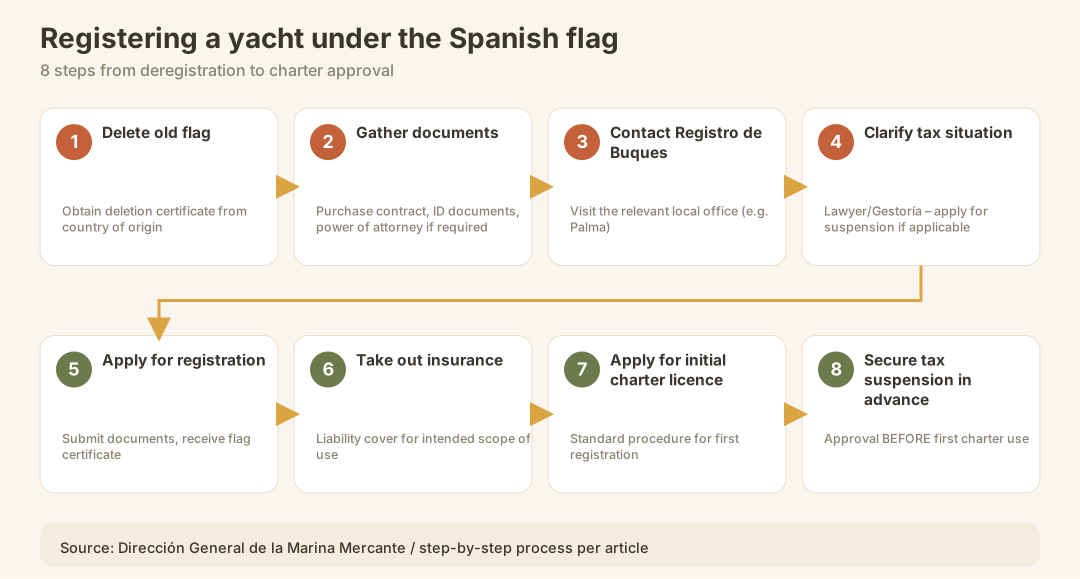
- Cancelling an existing flag: Apply for the full deletion of the previous registration in the country of origin and obtain a deletion certificate.
- Gathering documentation: Purchase contract or proof of ownership, identification documents of the owner, and where applicable a power of attorney for a representative in Spain.
- Contacting the Registro de Buques: Visit the relevant branch of the Dirección General de la Marina Mercante — this can be done in person directly in Palma de Mallorca.
- Clarifying the registration tax situation: Before submitting the application, obtain a tax assessment from a lawyer or gestoría; where applicable, apply for a suspension of the tax.
- Applying for registration: Submit all required documents to the Registro, and receive the registration number and flag certificate.
- Taking out insurance: Third-party liability insurance appropriate to the intended scope of use.
- If chartering is intended: Submit an initial charter licence application via the classic procedure; for yachts already licensed from July 2024 onwards, use the simplified declaration procedure.
- Registration tax pre-approval: For exclusive charter use, apply for a tax suspension before the first charter deployment.
Anchoring in the Balearen: what you also need to know
According to ADAC Skipper, the Balearen are among the best-developed water sports areas in the Mediterranean. The infrastructure is highly developed; however, during the summer months there are regularly bottlenecks with berths — planning and booking early is advisable.
When anchoring off Mallorca and the neighbouring islands, strict protection rules apply to Posidonia seagrass meadows: anchoring is prohibited in designated areas. Infringements are penalised with substantial fines.
Find out everything about the perfect berth in our guide Liegeplatz Mallorca Marina.
Do you already have a foreign flag? Here's how the switch works
Many owners who move to Mallorca or rent a permanent berth there eventually find that their foreign flag — be it British, Maltese, or Caymanian — is no longer optimal from a tax or practical standpoint. Changing flag follows a clear sequence:
- Apply for deletion of the old registration and wait for it to be processed (which can take weeks depending on the country)
- Obtain the deletion certificate
- Open a Spanish registration with the Registro de Buques
- Obtain a new certificate of registry and ship's certificate
- Update insurance, licences and charter status
Caution: During the re-flagging process, the vessel must not fly two flags simultaneously. Allow sufficient time to avoid any interruption to operations.
Anyone who would prefer not to navigate the entire bureaucratic process alone can find support through a Relocation Service Mallorca or a gestoría specialising in maritime law – more on this in the guide Gestoría Spanien.
The most common mistakes when registering a yacht in Spain
In practice, the same costly pitfalls come up time and again:
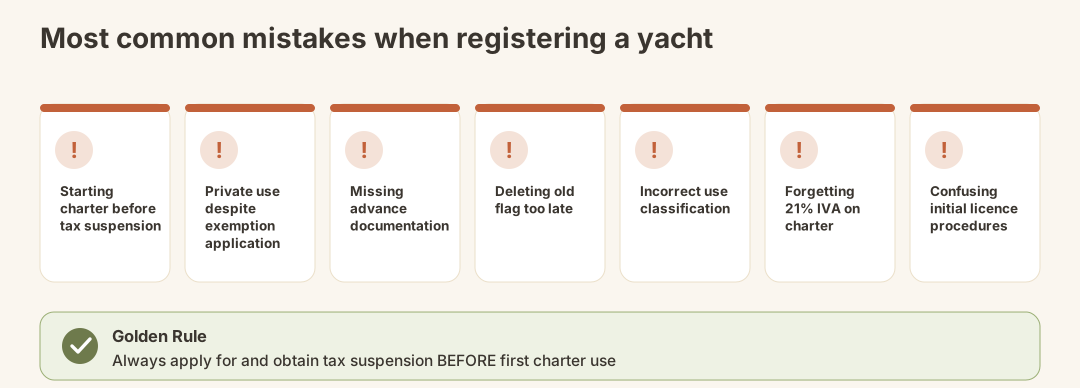
- Chartering before tax suspension: Anyone who begins chartering before the matriculation tax suspension has been approved loses their entitlement to it retrospectively.
- Private use despite exemption application: Even occasional private use by the owner or close family members can invalidate the entire tax exemption – particularly risky for Spanish residents.
- Missing prior documentation: Market-standard charter terms must be documented in writing before the owner uses the vessel personally.
- Delayed deletion of the previous flag: Anyone who fails to deregister the old flag in time cannot complete registration in Spain within the required deadline.
- Incorrect use classification: Declaring a private matter as a commercial voyage – or vice versa – can have serious consequences during inspections.
- Forgetting IVA: For every charter commencing in Spain, 21 % IVA on the charter fee must be remitted. Overlooking this results in back payments with interest.
- Confusing the initial licence procedure: The simplified declaration procedure applies only to already registered charter yachts. Initial registrations require the full classic procedure.
What comes next? An overview of ongoing obligations
After successful registration and charter approval, ongoing obligations remain:
| Obligation | Interval / Deadline |
|---|---|
| Technical inspection (private) | every 4 years |
| Technical inspection (commercial) | every 2.5 years |
| Renew insurance | annually |
| Submit IVA on charter income | quarterly (Modelo 303) |
| Update documents for simplified clearance | upon every change (crew, certificates) |
| Check licences/certificates | renew upon expiry |
Charter income must be recorded correctly for tax purposes. VAT returns arising as an autónomo or through a company are filed via the Modelo 303. Anyone resident in Spain who earns income should also be familiar with IRPF deductions in the Balearic Islands.
Checklist: registering a yacht in Spain
- Previous registration cancelled and deregistration certificate obtained
- Tax situation (resident/non-resident, private/commercial) clarified with a lawyer
- Application for matriculation tax suspension submitted and approved where applicable (BEFORE first charter use)
- Registro de Buques – documents submitted in full
- Spanish registration certificate and flag document received
- Third-party liability insurance taken out
- Initial charter licence applied for via the standard procedure (for new registrations)
- IVA obligation (21 %) on charter fees organised
- Simplified clearance procedure (from July 2024) established for ongoing charter operations
- Next inspection appointment noted
Conclusion
Registering a yacht in Spain is no dark art – but it is a process in which the order of steps and advance tax planning are absolutely decisive. The matriculation tax of 12 % on the current market value may sound off-putting at first, but under the right conditions it is entirely avoidable: either through exclusively commercial use with timely advance approval, or through the non-resident strategy for EU citizens with no Spanish tax liability. Anyone wishing to charter their vessel benefits from the simplified clearance procedure – but must still complete the initial registration via the standard route. Palma de Mallorca, with its first-class network of marinas, its international superyacht ecosystem, and its dense infrastructure, remains one of the most attractive home ports in the Mediterranean.
Official sources
- Dirección General de la Marina Mercante (Registro de Buques y Empresas Navieras): https://www.mitma.gob.es/marina-mercante
- Ley 38/1992 on Special Taxes (Registration Tax / Impuesto Especial sobre Determinados Medios de Transporte): https://www.boe.es/buscar/act.php?id=BOE-A-1992-28741
- Agencia Estatal de Administración Tributaria (AEAT) – Registration Tax: https://www.agenciatributaria.es
- ADAC Skipper – Cruising Area Spain/Balearic Islands: https://skipper.adac.de/revier/revier-spanien