
Gestoría in Mallorca: what it does and what it costs
If you’re moving to Mallorca, you’ll soon come across a word that’s unfamiliar in Germany: Gestoría. It’s a Spanish administrative agency that handles dealings with public authorities, tax returns and bureaucratic procedures on your behalf – and often becomes a newcomer’s most important point of contact during the first few months. In this guide, you’ll learn how a Gestoría in Spain differs from a tax adviser or lawyer, what it actually does, how much it costs, when you also need an Asesor Fiscal and how to find a German-speaking professional in Mallorca who understands both legal systems.

What is a gestoría – and what isn’t it?
A gestoría is a private company specialising in administrative and bureaucratic tasks. To officially call itself a Gestoría in Spain, the business must be registered in the commercial register (Registro Mercantil). Its staff must have relevant qualifications – usually a degree in law or economics.
It’s important to distinguish it from two other professions:
| Term | Main role | Typical uses |
|---|---|---|
| Gestoría / Gestor | Handles dealings with public authorities and administrative formalities | NIE, residency, vehicle re-registration, empadronamiento, straightforward tax returns |
| Asesoría / Asesor Fiscal | Strategic tax and financial advice, optimisation | IRPF optimisation, double taxation agreements, wealth planning |
| Abogado (lawyer) | Legal advice, contract law, litigation | Property purchases (due diligence), inheritance law, court disputes |
Note: In practice, the boundaries are blurred. Many firms in Mallorca offer gestoría services and tax advice under one roof – particularly at German-speaking firms specialising in international clients.
A Gestoría is liable for its work. If you hire a licensed Gestor, you are not on your own if something goes wrong – that sets a Gestoría apart from an unlicensed service provider who merely helps fill in forms.
When do you need a Gestoría in Mallorca?
Almost every step of moving abroad involves dealing with the authorities. The following overview shows when a Gestoría is typically used:
| Task | Is a Gestoría worthwhile? | Why |
|---|---|---|
| Apply for an NIE number | Yes | Secure a Cita Previa quickly, ensure all documents are complete |
| Residencia (TIE/Certificado) | Yes | Knowledge of the forms; a power of attorney is possible |
| Empadronamiento (registration certificate) | Optional | Usually manageable yourself, but a Gestor saves time |
| Re-register a car | Yes | Numerous DGT forms, deadlines and tax calculations |
| Exchange a driving licence | Yes | Translations, DGT procedures |
| Tax return (IRPF) | Recommended | Spanish-German tax law, DBA issues |
| Register as an autónomo | Yes | Alta in RETA, Modelos, quarterly payments |
| Register a domestic worker | Recommended | Social security obligations, correct payment of contributions |
| Digital certificate (Cl@ve/Certificado Digital) | Optional | Inexpensive, saves future trips |
Note: The gestoría can use a power of attorney (poder notarial) to handle many administrative procedures entirely on your behalf – you do not need to attend in person. This is particularly useful at the outset, when you are not yet living on the island permanently.
Specific tasks: what does the gestoría handle in detail?
For private individuals
- Applying for and preparing the NIE number – including booking a Cita Previa appointment with the National Police or consulate
- Registration in the foreigners’ register (Residencia, EU citizens: Certificado de Registro de Ciudadano de la Unión; non-EU citizens: TIE)
- Empadronamiento at the Ayuntamiento (municipal registration of residence)
- Re-registering a vehicle with the DGT and calculating the applicable taxes
- Applying for the Certificado Digital / setting up Cl@ve
- Filing straightforward income tax returns (Modelo 100 / IRPF)
- Non-resident tax (Modelo 210) for property owners who are not resident in Spain
- Modelo 720 – reporting obligation for foreign assets worth more than €50,000
For companies and self-employed people
- Registration as an Autónomo with Social Security (RETA) and the tax authority (AEAT)
- Ongoing bookkeeping and preparation of quarterly tax returns (303, 130, 111 …)
- Company formation (S.L.), registration with the Companies Register
- Payroll accounting and employment contract law
- Support with a property purchase (tax aspects; the lawyer handles legal due diligence)
Gestoría vs. tax adviser: who handles which tax matters?
For straightforward tax matters – such as filing an annual IRPF return as an employee or paying non-resident tax – a good gestoría is perfectly sufficient. When things get more complex, you need a tax adviser or a firm that offers both:
| Tax matter | A gestoría is sufficient | Tax adviser / firm required |
|---|---|---|
| Standard IRPF return | ✓ | |
| Non-resident tax (Modelo 210) | ✓ | |
| Taxation of a German pension in Spain | Borderline case | ✓ double taxation treaty |
| Modelo 720 foreign assets | ✓ | ✓ for complex cases |
| Beckham Law (special regime) | ✓ | |
| Inheritance / gifts | ✓ Germany–Spain double taxation agreement | |
| Property purchase through an S.L. / tax structure | ✓ | |
| Autónomo contribution ongoing | ✓ |
Note: Particularly when German and Spanish tax law intersect – under the double taxation agreement, with inheritances involving property in both countries, or with foreign investments – a German-speaking tax adviser in Mallorca is essential. They need to understand both legal systems and be able to weigh them against each other.
Costs: How much does a gestoría cost in Mallorca?
Prices vary by firm, complexity and whether you are enquiring as an individual or a business. The following figures are based on available market data (as of 2026):
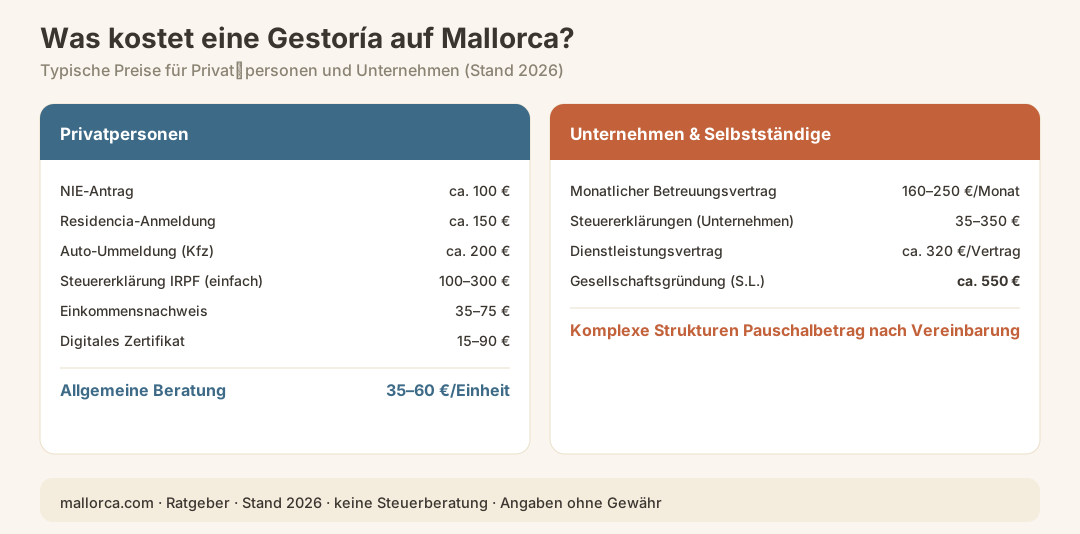
Costs for individuals
| Service | Price range |
|---|---|
| NIE application | approx. 100 € |
| Residencia registration | Car re-registration (motor vehicle) |
| approx. 200 € | Tax return (IRPF, straightforward) |
| 100–300 € | Proof of income |
| 35–75 € | €35–€75 |
| Preparation / filing of individual tax returns | 30–35 € |
| Digital certificate | 15–90 € |
| General administrative procedures and advice | 35–60 €/unit |
Costs for companies (e.g. purchasing a property through an S.L.)
| Service | Price range |
|---|---|
| Monthly business support retainer | 160–250 €/month |
| Preparation / filing of company tax returns | 35–350 € |
| Service contract / commercial contract | approx. 320 €/contract |
| Company formation (S.L.) | approx. 550 € |
| Complex tax structure / company structuring | Flat fee by agreement |
Tip: For larger projects – setting up a company or creating a tax-efficient structure for a property – always agree a fixed fee in writing. Hourly fees can quickly add up if the process takes longer than planned.
Gestoría fees for tax returns are generally tax-deductible as income-related expenses.
German-speaking Gestorías and tax advisers on Mallorca
Mallorca has a considerable number of firms that specifically serve German-speaking clients. Three options identified during the research:
| Firm | Address / contact | Specialism |
|---|---|---|
| Gestoría Palma | Carrer de Joan Lluís Estelrich, 12, 1º C, 07003 Palma · +34 637 08 98 26 · gestoriapalma.com | Tax, administration, businesses, private individuals |
| Joan Cerdà Associats | info@joancerda.com · +34 971 764 242 · joancerda.com | German-speaking tax advice, international investors, inheritance |
| Januar Consulting | +34 971 49 58 35 / +34 971 55 31 61 · januarconsulting.com | Tax law, property law, company formation, German-speaking clients |
Other firms such as Garcia Elsener (garciaelsener.com) or De Micco & Friends / LAWYERS & AUDITORS (palma@demicco.es) specialise in advising German clients and combine tax and legal advice.
Note: This list is based on publicly available information gathered during research and does not constitute a recommendation. Always obtain several quotes before appointing a firm.
Gestoría when buying property: what does it do?
When buying property in Mallorca, the gestoría and lawyer work hand in hand, with clearly separate roles:
- The lawyer (Abogado): Legal due diligence, contract review, land registry checks, checking for charges and any disputes
- The gestoría / tax adviser: The tax structure of the purchase (individual vs. S.L.), calculating and paying ITP (property transfer tax), advice on ongoing taxation and inheritance planning
When non-residents buy property, Spanish and German tax law and the double taxation agreement between the two countries must be carefully weighed against each other. A Spanish-speaking gestoría without knowledge of Germany is generally not enough in this situation.
Important: When buying property, a gestoría is not a legal substitute for a lawyer. It handles the administrative and tax aspects, not the legal safeguards.
How to find a good gestoría: 7 criteria
- German-speaking staff – not just an information sheet in German, but genuine, direct communication in your language
- Registration with the Registro Mercantil – an essential requirement for officially calling itself a gestoría
- Clear pricing structure – fixed prices for standard services and written fixed-price quotes for projects
- Experience with international clients – ideally with a proven track record of working with German, Austrian or Swiss clients
- Google reviews and recommendations – expat groups and forums on Mallorca are a good source
- Accessibility – quick responses by email or phone, without having to wait months for an appointment
- Network – a good gestoría knows when to bring in a lawyer or notary and actively puts you in touch with one
Most common mistakes when working with a gestoría
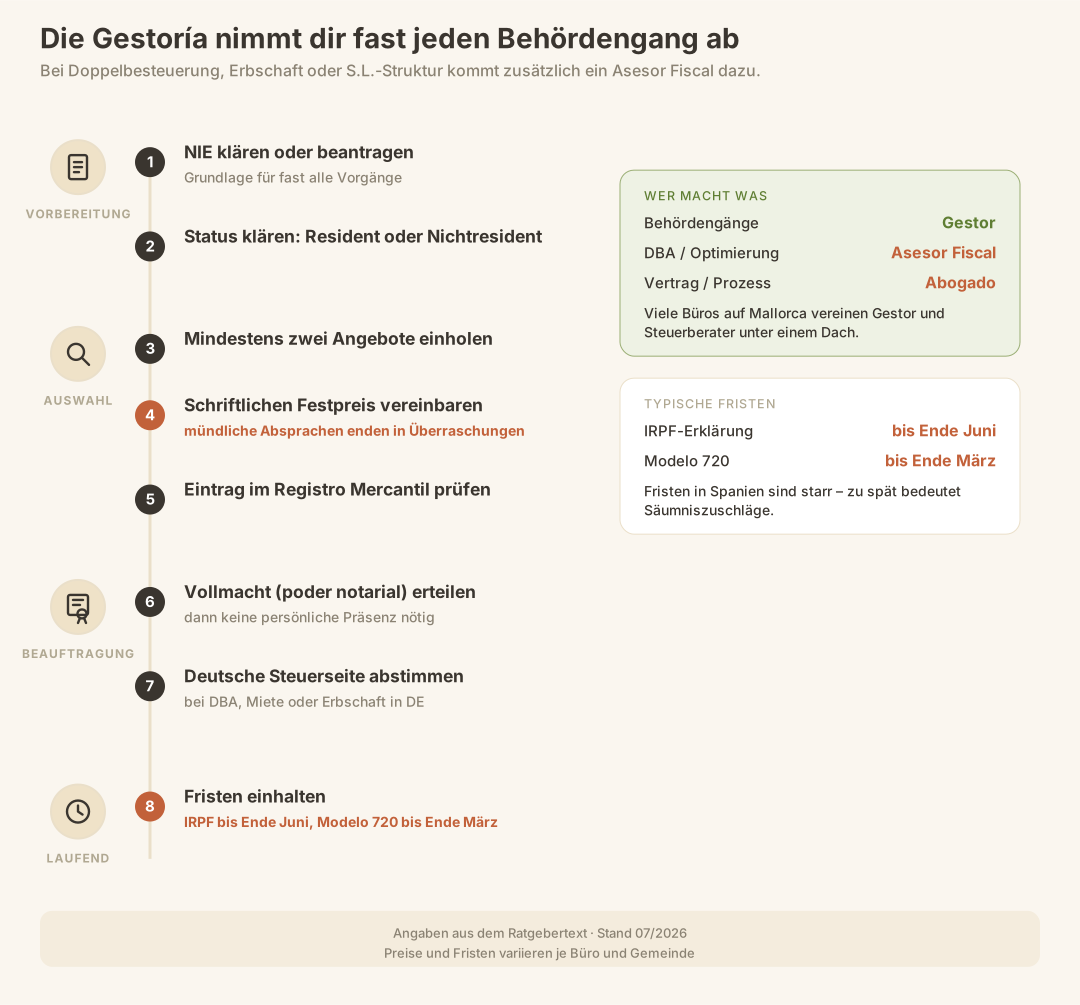
- Not getting a written quote: Verbal agreements on price often lead to surprises. Always get confirmation in writing.
- Trying to do everything yourself in Spanish: Mistakes on Residencia forms or NIE applications cost you time and require new appointments – and Citas Previas are hard to get.
- Using a gestoría instead of a lawyer when buying property: A gestoría is the right choice for tax matters; to protect your legal interests in the purchase contract, you need a lawyer.
- Forgetting about your German tax obligations: If you remain liable for tax in Germany (e.g. because you have rental income there), you need a gestoría familiar with both tax systems.
- Not granting power of attorney: Without a poder notarial you have to attend many appointments with the authorities in person – with power of attorney, the gestor can handle everything for you.
- Leaving it too late to appoint one: Tax return deadlines in Spain are strict. File late and you’ll pay late-filing penalties.
What comes next? The next steps after hiring a gestoría
With the right gestoría by your side, everyday bureaucracy usually runs smoothly. Here’s what to keep an eye on next:
- Annual tax return (IRPF): As a resident, you file one every year – usually from May to the end of June for the previous year. Details on Income tax for residents
- Modelo 720 – once, and when there are significant changes: Reporting overseas assets
- Sort out health insurance: Once you have residency, you’ll need to establish whether you’re covered by the public system or need private cover. Health insurance in Spain
- Register your car: If you’re bringing your German car with you, contact a gestoría in good time, as deadlines and procedures can vary. Registering a car in Spain
- Pensioners: If you move here as a pensioner, you must declare your German pension correctly in Spain. Paying tax on your pension in Spain
Checklist: hiring a gestoría – how to go about it
- NIE number obtained or application prepared (NIE number Mallorca)
- Clarify: Will I be a resident or non-resident? (Residency)
- Obtained at least two quotes from gestorías / tax advisers
- Written confirmation of costs for all planned services
- Power of attorney (notarial power of attorney) granted before a notary if you cannot attend in person
- Tax position in Germany agreed with a German tax adviser
- Documents prepared: passport / identity card, tenancy agreement or purchase contract, registration confirmation, pension statement if applicable
- Deadlines noted: IRPF (usually by the end of June), Modelo 720 (usually by the end of March), non-resident tax (Modelo 210: rental income from 2026, between 1 and 20 April of the following year; gains on property sales, within around four months of the sale)
Conclusion
A Gestoría is not a luxury in Spain – it is a practical way to avoid months of frustration, queues and mistakes on forms. Mallorca has a large German expat community, and several well-established firms speak German and understand both legal systems. It is worth knowing the difference between a Gestoría and a tax adviser: a good Gestor can handle straightforward dealings with the authorities and routine tax matters. Once double taxation, property ownership structures or inheritance come into play, you need a firm that offers both services. Always ask for written quotes – and appoint someone early, before the deadlines are upon you.
Official sources
- AEAT – Agencia Estatal de Administración Tributaria (Spanish tax authority, forms, Modelos, deadlines): sede.agenciatributaria.gob.es
- ATIB – Agència Tributària de les Illes Balears (Balearic tax authority, ITP, inheritance tax): https://www.atib.es
- DGT – Dirección General de Tráfico (vehicle registration changes, driving licences): https://www.dgt.es
- Policía Nacional – Oficinas de Extranjería (NIE, Residencia, TIE): https://www.interior.gob.es
- Registro Mercantil Central (registration of Gestorías and companies): https://www.rmc.es
- BOE – Boletín Oficial del Estado (laws, regulations): https://www.boe.es