
Life Insurance in Spain: The Complete Guide for Expats
You're planning your move to Spain and wondering what will happen to your German life insurance policy, whether you need a new one, and how accident insurance works on the island. The good news is that the Spanish insurance market offers suitable products for life insurance in Spain for expats and German-speaking brokers know the pitfalls. The less good news: an existing German policy can become a source of problems — through residency clauses or tax shifts — without you noticing straight away. This guide explains what happens to existing policies when you move, what products the Spanish market offers, how accident insurance works here, what you need to be aware of from a tax perspective, and where the most common mistakes lie.

Would you like a thorough review of your insurance situation before you move?
- 📩 Submit a personal enquiry — We connect you with German-speaking specialists on Mallorca
- All insurance topics for expats at a glance
What happens to your German life insurance when you emigrate?
The first instinct of many expats is: "I'll simply keep everything as it is." With life insurance, this sometimes works — but not always. The crucial point is the residency clause in the policy. Many German policies require the policyholder to have their habitual residence in Germany, the EU, or at least the EEA. Since Spain is an EU member state, an existing policy generally remains valid when you move from Germany to Mallorca — but you should have the exact wording in your policy terms checked carefully.
Two scenarios become more critical:
- Endowment life insurance policies with a savings component — different tax rules apply as soon as you are liable to tax in Spain (→ see "Tax implications" below for more details).
- Income protection insurance (Berufsunfähigkeitsversicherung) — strictly speaking, this is not a life insurance policy, but it is often combined with one; the conditions for claiming benefits may change if the occupational profile no longer applies abroad.
Please note: Anyone who is considered tax-resident in Spain (generally after more than 183 days of residence per calendar year) must pay Spanish tax on payouts from a German endowment life insurance policy. The German rules on half-taxation after twelve years no longer apply automatically.
Term life insurance in Spain: products and providers
In the Spanish market, term life insurance is known as "seguro de vida de riesgo" or simply "seguro de vida temporal". It works in essentially the same way as in Germany: you pay a monthly or annual premium, and in the event of death — or, with certain policies, disability — the nominated beneficiary receives the agreed lump sum.
German-speaking insurance brokers have been active on Mallorca and throughout Spain for many years, comparing the offerings of the major Spanish insurers on your behalf. Among the providers on Mallorca known for specialising in expats are the following:
| Broker / Provider | Specialisation | Contact point |
|---|---|---|
| Iberia Versicherungsmakler | Mallorca / Balearic Islands | Palma de Mallorca |
| Bohemia Mallorca | Term life & accident insurance Mallorca | Mallorca |
| C1 Broker | All of Spain, expat specialist | Canary Islands / nationwide |
| Göring Versicherungsmakler | Spain, multilingual | Spain |
| INOV Expat | All of Spain, multilingual | Barcelona and others |
Important: These brokers operate independently and compare multiple insurers — this is generally preferable to taking out a policy directly through a bank (more on that shortly).
Typical cover components of a Spanish term life insurance policy
| Component | Meaning |
|---|---|
| Muerte (Tod) | Core benefit: lump-sum payment to beneficiaries upon death |
| Invalidez absoluta y permanente | Payout in the event of total and permanent incapacity to work |
| Enfermedades graves | Early payout upon diagnosis of a serious or terminal illness |
| Doble capital accidente | Double the sum insured in the event of accidental death |
| Repatriation | Coverage of costs for repatriation of the deceased |
Mortgage protection insurance: compulsory when buying property in Spain?
If you are buying a property in Mallorca or elsewhere in Spain with a mortgage, the financing bank will in practice frequently require proof of a term life insurance policy as additional loan security. This is not a statutory requirement, but many banks impose it as a contractual condition.
Please note: In Spain you are not obliged to take out the insurance with the bank itself. You can take out a separate policy with an independent broker — this is generally cheaper and offers better terms. The bank must accept it, provided the sum insured and the term meet their requirements.
According to German-speaking expat brokers in Spain, taking out a policy directly with an independent insurance broker is in many cases cheaper than the bank's own product. Specific premium examples can vary considerably depending on age, state of health, and the sum required — make sure you obtain several quotes.
Accident insurance in Spain: what it covers and who needs it
Accident insurance (in Spanish: seguro de accidentes) is voluntary in Spain — but it is particularly relevant for certain groups:
- Self-employed individuals (autónomos): Anyone working in Spain as self-employed does have access to the social security system, but the statutory benefits in the event of an accident are limited depending on contribution status. A private accident insurance policy can close this gap.
- Retirees and older emigrants: Those who are no longer in employment frequently have no automatic cover for everyday accidents outside of working life.
- Sports enthusiasts and active leisure users: Mallorca is well known for cycling, water sports, and hiking — all activities with an elevated risk of accident that some basic policies exclude.
Typical areas of cover under a Spanish accident insurance policy
| Area of cover | Explanation |
|---|---|
| Death by accident | Lump-sum payment to beneficiaries |
| Permanent disability due to accident | Lump-sum payment according to degree of impairment |
| Hospitalisation following an accident | Daily allowance or reimbursement of costs |
| Rescue and recovery costs | Air rescue, mountain rescue (particularly relevant on Mallorca) |
| Repatriation | Repatriation to the home country |
Bohemia Mallorca, Iberia Versicherungsmakler and other locally based brokers offer accident insurance policies specifically for expats resident in Spain – with German-speaking contacts and claims handling in German.
Tax implications: what you need to know as a resident
This is the area that catches most expats off guard – and it can have significant tax consequences.
Term life insurance: inheritance and gift tax
If the policyholder dies and the policy pays out to a beneficiary, Spain levies inheritance and gift tax (Impuesto sobre Sucesiones y Donaciones). The Balearic Islands have their own specific rules in this regard, which may differ from those of other regions.
Please note: In Spain, the death benefit from a life insurance policy forms part of the taxable estate or gift tax base – this differs from Germany, where a death benefit is often tax-free. Have this assessed by a tax adviser on a case-by-case basis.
Whole-of-life / endowment insurance: IRPF relevance
Anyone who, as a resident in Spain, receives a payout from a German endowment or whole-of-life insurance policy – whether as a lump sum or as an annuity – must declare this in the Spanish income tax return (IRPF). The precise tax treatment depends on the structure of the contract and the date it was taken out. Be sure to clarify this with a tax adviser who specialises in expats before you accept the payout.
More on IRPF deductions and tax particularities in the Balearic Islands: IRPF-Abzüge Balearen
Modelo 720: reporting obligation for foreign policies?
Endowment or whole-of-life insurance policies with a surrender value held with a foreign company may fall within the Modelo 720 reporting obligation if the total value of foreign assets exceeds 50,000 euros. The precise rules have changed in recent years – check the current position with a tax adviser.Modelo 720 Meldepflicht
Taking out term life insurance through your bank: a costly mistake?
Many expats, when purchasing a property with a mortgage, simply take out the life insurance policy directly through the bank – because it is convenient and the bank insists on it. This has two drawbacks:
- Price: According to expat brokers in Spain, bank-tied life insurance policies are in many cases more expensive than freely negotiated contracts with independent insurers.
- Flexibility: A bank contract is often linked to the mortgage; you cannot simply continue it upon repayment or remortgaging, nor adapt it to new needs.
The alternative: you ask an independent broker to put together a quote that meets the bank's minimum requirements — and the bank must accept it. In many cases, this can save a considerable amount over the term of the loan.
Funeral expense insurance: the underestimated aspect
Alongside traditional term life insurance, German-speaking brokers in Spain also offer what is known as funeral expense insurance (seguro de decesos). It covers the specific costs of a burial — in Spain often including repatriation to the home country, funeral arrangements, and bureaucratic assistance for the bereaved.
This type of insurance is culturally very widespread in Spain and is expressly recommended by many expat brokers — particularly when the family still lives in Germany and would have to travel a long way in the event of death.
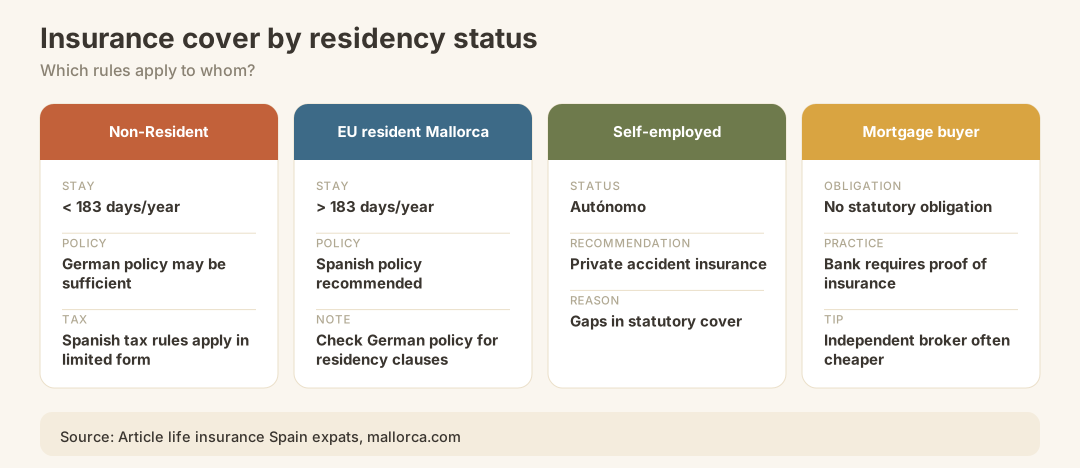
Insurance cover by residency status: resident vs. non-resident
| Situation | Key consideration |
|---|---|
| Non-resident (generally fewer than 183 days per year) | German policy may be sufficient; Spanish tax rules apply in a limited capacity |
| EU resident on Mallorca | Spanish policy recommended; check German policy for residency clauses |
| Self-employed (autónomo) | Private accident insurance particularly worthwhile for closing coverage gaps |
| Retiree with S1 form | Health insurance covered via S1; life/accident cover required separately |
| Mortgage buyer | Term life or mortgage protection insurance often contractually required |
More on residencia and residency status: Residencia Spain
More on the S1 form for retirees: S1 form Spain
Most common mistakes regarding life insurance and relocating to Spain
The same mistakes come up time and again in the experience of German-speaking insurance brokers:
- Never read the residency clause – The policy continues until problems arise when a claim is made.
- Banco policy signed blindly – Simply took the bank's product when arranging the mortgage, without any comparison.
- Capital life insurance not reviewed for tax implications – Payout occurs without any preparation, followed by a tax back-payment.
- No update of beneficiaries – The ex-partner was listed in Germany; this continues to apply in Spain.
- Modelo 720 forgotten – Policies with a high surrender value not declared.
- Accident insurance dismissed as a luxury – Autónomos in particular underestimate the risk of loss of income due to an accident.
- Funeral cost insurance overlooked – In the event of death, costs arise on Mallorca that can overwhelm bereaved relatives in Germany.
What comes next? Your insurance package for Mallorca
Life and accident insurance are just two building blocks. A complete insurance package for emigrants on Mallorca typically includes:
- Private health insurance – Required for the Residencia as a non-employed person
- Motor insurance – Compulsory for all vehicles registered in Spain
- Buildings and contents insurance – Strongly recommended for property owners
- Liability insurance – In Spain often included in motor or home insurance, but worthwhile as a standalone policy
- Term life insurance – For those with a mortgage or family responsibilities
- Accident insurance – Particularly for active individuals and the self-employed
- Funeral cost insurance – Particularly relevant for emigrants with family in Germany
Further guides:
→ Health Insurance Spain
→ Private Health Insurance Spain Comparison
→ Liability Insurance Spain
→ Taxes as a Resident
Checklist: Life & Accident Insurance When Moving to Spain
Go through these points before your final move:
- Have your existing German life insurance policy checked for residency clauses
- Have your endowment life insurance checked with a tax adviser for IRPF/inheritance tax implications
- Check whether the surrender value falls under the Modelo 720 reporting obligation
- Update the beneficiaries on all policies
- When purchasing with a mortgage: obtain an independent quote before signing the bank's contract
- Take out accident insurance for autónomo work or active leisure pursuits
- Consider funeral cost insurance (particularly if family remains in Germany)
- Have your German tax adviser and Spanish tax adviser coordinate with each other
Conclusion
Life insurance when emigrating to Spain is not something that sorts itself out — but it is far from an insurmountable problem. Anyone who checks in good time which German policies can continue, who keeps an eye on any tax shifts, and who does not blindly sign the bank's policy when taking out a mortgage is in a strong position. The Spanish insurance market offers suitable products for every life situation — and thanks to German-speaking brokers on Mallorca and throughout Spain, you do not have to navigate this alone.
Do you need a personal assessment of your specific situation?
📩 Submit an enquiry now — we will connect you with the right contact on Mallorca.
Official Sources
- Bundesverwaltungsamt – Information for emigrants to Spain: https://www.bva.bund.de/DE/Das-BVA/Aufgaben/A/Auswanderer_Auslandstaetige/_documents/Laenderauswahl/Laender_Spanien_Inhalt.html
- Agencia Tributaria (AEAT) – IRPF and foreign income: https://www.agenciatributaria.es
- ATIB – Agència Tributària de les Illes Balears (inheritance and gift tax Balearic Islands): https://www.atib.es
- Dirección General de Seguros y Fondos de Pensiones (DGSFP) – Insurance Supervisory Authority Spain: https://www.dgsfp.mineco.es
- BOE – Ley 50/1980, de 8 de octubre, de Contrato de Seguro (Spanish Insurance Contract Act): https://www.boe.es/buscar/act.php?id=BOE-A-1980-22501