
Cita Previa Extranjería: How to Get Your Appointment for NIE, TIE and Huellas
The Cita Previa Extranjería is the mandatory appointment you need in Spain before you can deal with any immigration authority procedure in person: NIE assignment, initial TIE issuance, fingerprints (Huellas), Residencia certificates for EU citizens, work permits, and more. Walk-ins are virtually non-existent for residency and visa matters — the system runs entirely on pre-booked appointments. If you're not aware of this, you'll quite literally find yourself facing closed doors. In this guide, you'll learn which portal you need to use, which appointments cover which procedures, what documents to bring, how to secure a slot in heavily loaded provinces such as Mallorca/Illes Balears — and which mistakes can cost you weeks.

Are you facing a specific visit to the authorities in Mallorca and don't know where to start?
- 📩 Submit a personal enquiry — we'll refer you to experienced Gestorías and lawyers on the ground
- Everything about Residencia in Spain — the next step after the NIE
What is the Cita Previa Extranjería — and why is it mandatory?
Cita previa simply means "prior appointment". For everything related to immigration status in Spain, you need this appointment before you can even submit or collect documents. This applies to two different authorities, each handling different procedures:
| Authority | Responsible for | Booking system |
|---|---|---|
| Oficina de Extranjería (Delegación del Gobierno) | NIE assignment, residence permits, family reunification, EU certificates (Zertifikat) | Sede Electrónica – ICP portal |
| Policía Nacional | Fingerprints (Huellas) for TIE, collection of the TIE card, return authorisation | Sede Electrónica – ICP portal (same interface, different Trámite type) |
Both offices are generally accessible via the same booking portal of the Sede Electrónica de la Administración General del Estado — you simply select different procedures. In Mallorca, the Extranjería office falls under the Delegación del Gobierno en Illes Balears.
Please note: A Cita Previa is not the application itself. It is simply the appointment at which you appear in order to submit documents, provide fingerprints, or collect paperwork.
Which procedures require an appointment?
Not every visit to the authorities necessarily requires a personal Cita. Some procedures can be completed entirely online via the system Mercurio (telematic submission) can be used. Check this in advance – it saves time.
| Process | Personal appointment required? | Responsible authority |
|---|---|---|
| NIE assignment (initial application) | ✅ Yes | Extranjería or Policía Nacional (depending on the province) |
| EU certificate / residencia confirmation (EU citizens) | ✅ Yes | Extranjería |
| Huellas (fingerprints) for TIE | ✅ Yes | Policía Nacional |
| TIE collection | ✅ Yes | Policía Nacional |
| TIE renewal | ✅ Yes | Policía Nacional |
| Work permit (initial application, by employer) | ✅ Yes | Extranjería |
| Family reunification (by the main applicant) | ✅ Yes | Extranjería |
| Return permit (Autorización de Regreso) | ✅ Yes | Policía Nacional |
| Certain renewal applications | ⚠️ Where applicable, telematically via Mercurio | Online or Extranjería |
If your procedure is Mercurio-eligible, you do not need to book an in-person appointment. Check this on the Sede Electrónica under the relevant Trámite.
The official portal: a step-by-step guide
The only official booking address is the Sede Electrónica de la Administración General del Estado, procedure "Cita previa de extranjería" (ICP system):
🔗 https://sede.administracionespublicas.gob.es/pagina/index/directorio/icpplus
How to book your appointment:
- Open the portal – go to the ICP page (link above). No login is required simply to book an appointment.
- Select your province – choose "Illes Balears" for Mallorca, Menorca, and Ibiza/Formentera.
- Select your Trámite – choose the appropriate procedure from the drop-down list (e.g. "Asignación de NIE", "Policía – Toma de Huellas", "Certificado de Registro de Ciudadano de la Unión").
- Enter your personal details – passport number or NIE (depending on the stage of your application), name, date of birth, and email address.
- Choose your appointment – select an available slot from the calendar. If "No hay citas disponibles" appears, there are currently no free slots (more on this below).
- Note down your confirmation – you will receive a booking reference number. Print the confirmation or save a screenshot – you will need it on the day of your appointment.
Important: Book the appointment in your correct name, exactly as it appears in your passport. Any discrepancies may result in you being turned away at the counter.
Booking by telephone and alternative channels
In addition to the online portal, there are other ways to book:
| Channel | Details |
|---|---|
| Telephone 060 | General information about official procedures; appointment booking also available in some provinces |
| Gestoría / Abogado | Can legitimately book on your behalf in most cases – costs vary depending on provider and procedure |
| Oficina de Extranjería directly | Some offices offer limited walk-in slots for urgent cases (e.g. expired permits) – call ahead to enquire |
Note: For booking an appointment online you do not need a Certificado Digital or Cl@ve. However, for the telematic submission of applications (Mercurio procedure) you do – make sure you obtain the certificate in good time. Find out how to do that here.
Huellas and TIE: What you need at the Policía Nacional
The fingerprinting process (Toma de Huellas) is the final step for non-EU citizens on the path to obtaining the TIE card, making it one of the most important appointments of all. Process and deadlines:
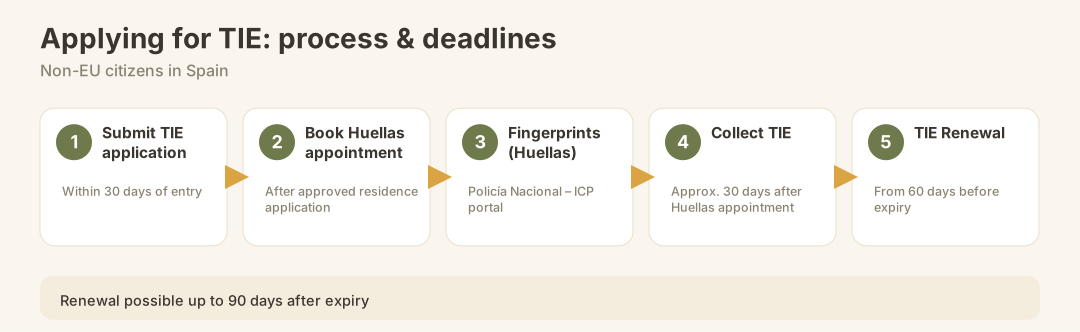
| Step | Deadline / Detail |
|---|---|
| Submit TIE application after entry | Within 30 days of arriving in Spain |
| Huellas appointment at Policía Nacional | After residence application has been approved; book a cita via the ICP portal |
| Collect TIE card | Typically approx. 30 days after the Huellas appointment; keep the collection slip safe |
| Apply to renew TIE | From 60 days before expiry; still possible up to 90 days after expiry |
Documents for the Huellas appointment (Policía Nacional):
- Valid passport (original + copy)
- Form EX-17 (for initial TIE issue) – bring completed
- Paid Tasa 790, Código 012 (fee form, complete online in advance and pay at a Spanish bank)
- Dissolution notice / proof of approval of the residence application
- Proof of entry (entry stamp in passport or visa)
- Passport photo (recent, biometric)
- Empadronamiento certificate (depending on the procedure)
Please note: Without a paid Tasa 790/012 and completed EX-17 you will be turned away at the counter – even if you have a valid appointment.
Cita Previa on Mallorca: Special considerations for the Balearic Islands
The Extranjería office for Mallorca falls under the Delegación del Gobierno en Illes Balears. In the ICP portal, select the province "Illes Balears". The Comisarías on the island are responsible for Huellas appointments (Policía Nacional).
Key contact points:
| Authority | Address / Contact |
|---|---|
| Delegación del Gobierno en Illes Balears – Extranjería | Carrer de Cecili Metel, 5, 07003 Palma de Mallorca |
| Policía Nacional Palma (Comisaría) | Carrer de Simó Ballester, 3, 07009 Palma |
| Booking portal (online) | sede.administracionespublicas.gob.es → Illes Balears |
Waiting times in the Balearic Islands vary considerably depending on the season. During the summer months and following special administrative campaigns, slots are snapped up particularly quickly. Anyone looking for an appointment in the second half of 2026 should expect increased pressure on the system.
"No hay citas disponibles" – What to do when no appointments are available?
This message is the most common frustration for all newcomers. Slots are generally released daily – often early in the morning. The following strategies can help:
- Try early in the morning – according to user experience, new slots frequently appear around 8:00 on the Sede Electrónica. Refresh the page shortly after 8.
- Weekdays, not Mondays – demand is particularly high on Mondays.
- Check multiple provinces – if you live near a border province, it may be worth checking neighbouring offices (not relevant on Mallorca, but as a general principle).
- Call 060 – the helpline can advise whether alternative quotas exist for your particular application.
- Engage a gestoría – an experienced administrative assistant can book on your behalf entirely legally, saving you considerable stress when slots are scarce.
- Check Mercurio – some renewals can be submitted entirely online, in which case you do not need an in-person appointment at all.
Warning: Third-party websites that claim to secure an appointment for a fee operate in a legal grey area. Use only the official portal or engage a reputable gestoría.Everything about gestorías on Mallorca
Documents required for different appointment types at a glance
Depending on the process, you will need different paperwork. The table below provides a structured overview:
| Process | Key forms | Fee | Additional required documents |
|---|---|---|---|
| NIE assignment (initial application) | EX-15 | Tasa 790/012 | Passport (original + copy), covering letter, proof of reason for stay |
| EU residency certificate | EX-18 | No Tasa | Passport or national identity card (original + copy), Empadronamiento, proof of reason for residence (employment, pension, sufficient funds + health insurance) |
| Huellas / TIE first issue | EX-17 | Tasa 790/012 | Passport, proof of authorisation, entry stamp, photo |
| TIE renewal | EX-17 | Tasa 790/012 | Old TIE, passport, recent photo, Empadronamiento |
| Family reunification | EX-02 | Tasa 790/052 | Proof relating to the main applicant, proof of relationship, proof of accommodation |
| Return authorisation (Autorización de Regreso) | Autorización de Regreso form | Tasa 790/012 | TIE / residence permit, passport |
Note: The forms EX-17, EX-18, EX-19 and the Tasa forms can be downloaded free of charge from the Sede Electrónica of the Policía Nacional. Complete them before your appointment in full.
The most common mistakes – and how to avoid them
Almost one in three people at the Extranjería is turned away or asked to provide additional documents at their first appointment. These are the most common pitfalls:
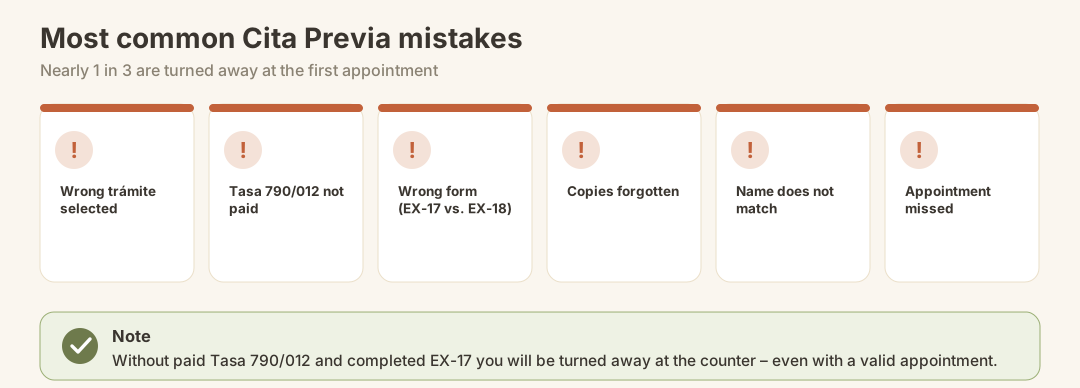
- Wrong Trámite selected – EU citizens do not need a TIE but rather a "Certificado de Registro de Ciudadano de la Unión". Many people mistakenly book the Huellas appointment intended for non-EU nationals.
- Tasa not paid – the Tasa 790/012 must be paid before the appointment at a Spanish bank (or online). The form alone is not sufficient.
- Wrong form – EX-17 (TIE initial application) and EX-18 (EU certificate) are often confused.
- Forgetting copies – Spanish authorities generally require the original and a copy of every document. Bring both.
- Name mismatch – the name used when booking the appointment must match your passport exactly.
- Missing the appointment – rebooking means additional waiting time depending on the province. If you cannot attend, cancel as early as possible.
- Missing empadronamiento – for many procedures (EU certificate, TIE renewal) the registration confirmation is mandatory. Apply for empadronamiento in Mallorca
What comes next? The road after the Cita Previa
A successful Extranjería appointment is rarely the end of the process – it is usually the beginning:
- After NIE assignment: You can now open a Spanish bank account, sign contracts, and tackle the next steps with the authorities. Opening a bank account in Spain
- After the EU certificate (Residencia): As a tax resident you must register for Spanish income tax (IRPF). Taxes as a resident in Spain
- After the Huellas: The TIE card is generally ready for collection approximately 30 days after the appointment. Bring the collection slip and your passport.
- Securing health insurance: For the EU certificate you will often already need proof of insurance. Health insurance in Spain
- Registering your vehicle: After receiving your Residencia you must re-register your German car with Spanish number plates. Importing and re-registering a car
Checklist: preparing for your appointment
Go through these points before attending your appointment:
- Correct Trámite selected in the ICP Portal (EU citizens ≠ non-EU citizens)
- Confirmation email / booking number saved or printed
- Correct form downloaded and fully completed (EX-15, EX-17, EX-18 or similar)
- Tasa 790/012 completed online and paid at a bank (proof of payment brought along)
- Passport: original + at least 1 copy (data page)
- Passport photo (biometric, recent)
- Empadronamiento certificate (original + copy, no more than 3 months old)
- All additional supporting documents depending on the application (employment contract, proof of pension, proof of health insurance, etc.)
- Arrive on time – many offices do not admit anyone after the appointed hour
Conclusion
The Cita Previa Extranjería is not plain sailing, but it is not rocket science either – as long as you know which portal to use, select the correct Trámite, and bring all your documents in full. The biggest time drain is not the authority itself, but the wait for a free slot. Those who check early in the morning, keep checking regularly, and bring in a gestoría if slots remain scarce will, in our experience, reach their goal considerably faster. On Mallorca the rule is: select the province "Illes Balears" in the portal and monitor appointments well in advance – especially during the summer months.
Official sources
- Sede Electrónica de la Administración General del Estado – ICP Portal (Cita Previa): https://sede.administracionespublicas.gob.es/pagina/index/directorio/icpplus
- Mercurio (online submission Extranjería): https://sede.administracionespublicas.gob.es/pagina/index/directorio/mercurio2
- Sede Electrónica de la Policía Nacional (Extranjería, TIE, Huellas): https://sede.policia.gob.es/portalCiudadano/_es/tramites_extranjeria_tramite_tarjeta_residencia_residenciaytrabajo.php
- Delegación del Gobierno en Illes Balears – Extranjería: https://mptmd.gob.es/portal/delegaciones_gobierno/delegaciones/illesbalears/servicios/extranjeria
- Localizador Comisarías Policía Nacional (Extranjería): https://www.policia.es/_es/dependencias_localizador_accesible.php#li_extranjeria
- Frequently asked questions Extranjería – Sede Electrónica: https://sede.administracionespublicas.gob.es/ayuda/faq/extranjeria/26