
Empadronamiento: registering with the town hall in Mallorca (Padrón)
Anyone arriving in Mallorca and making it their primary place of residence cannot avoid the Empadronamiento — registration with the town hall of your municipality, referred to in Spanish simply as the Padron. It is the first administrative step you should complete after moving — because without an entry in the Padron Municipal you cannot access the things that matter: a health card, a school place for your children, registering your car, and often your residency application as well. In this guide we walk you through step by step which documents you need, how the cita previa at the Ayuntamiento works, what the difference between a volante and a certificado is, and what to watch out for in municipalities such as Palma, Calvià or Andratx.

Are you planning your move to Mallorca and would rather not navigate the bureaucracy on your own?
- 📩 Submit a personal enquiry — we'll connect you with German-speaking contacts for property searches, registration and more
- All emigration guides at a glance
What is the Padron — and what do you need it for?
The Empadronamiento is the entry into the Padron Municipal de Habitantes, the residents' register of your municipality. Under law (Ley 7/1985, Art. 15), every person living in Spain is required to register with the municipality in which they have their habitual residence (residencia habitual). Anyone living across several municipalities registers in the one where they spend the majority of the year.
You will frequently come across the rule of thumb online — 'from six months onwards' — but this is not a statutory threshold, merely a simplified generalisation from unofficial sources. What counts is habitual residence, not a fixed number of months. For foreign nationals, the more relevant marker in practice is the 90-day / three-month point, because it is from this point that the registration requirement with the immigration authority (NIE-verde) also applies. Lawyers generally advise registering as soon as you move in.
Important: the Padron only confirms where you live — it says nothing about your residency status. Even people without regularised documentation are both permitted and encouraged to register; the town hall does not check legality but simply maintains the residential register.
Your entry is your gateway to Spanish administrative life. Without it, almost nothing is possible:
| What you need the Padron for | Context |
|---|---|
| Healthcare | The Tarjeta Sanitaria (health card) is generally not issued without an empadronamiento; for those not legally resident, registration of 90+ days is frequently required |
| School / nursery | When enrolling children in school, proof of residence within the catchment area is required — normally via the Padron |
| Residencia / residency | Lawyers advise registering immediately upon arrival, as the Padron is required for many residency applications |
| NIE / Certificado de Registro (EU) | The immigration authority frequently requires the empadronamiento as a supporting document |
| Car / driving licence | Proof of residence is required for re-registration, purchase and driving licence exchange |
| Voting rights & social benefits | Municipal voting rights and access to social assistance are tied to your entry in the register |
Note on healthcare: The strict empadronamiento requirement for people without legal residency status is being partially relaxed under more recent national and regional regulations (proof of actual residence also possible by other means, such as a declaración responsable). Check the current position before your appointment with IB-Salut (Servei de Salut de les Illes Balears), as requirements may change at short notice.
A word on the order of padrón and NIE: This is one of the most common stumbling blocks. In principle, in many cases you can register using just your passport — EU citizens in particular do not necessarily need to obtain their NIE first. In practice, however, some offices in Mallorca do require specific documents. You can read more about the NIE in our guide to the NIE number in Mallorca.
Which documents do you need? (Overview)
The logic is the same everywhere: you must prove your identity, your use of the property and submit the completed registration form (hoja padronal). What is accepted in detail depends on your nationality and your living arrangements.
| Proof | Spanish nationals | EU citizens | Non-EU citizens |
|---|---|---|---|
| Identity | DNI, passport or driving licence | Passport or national identity card; if available, also Certificado de Registro (NIE-verde) | Passport or TIE (foreigner's identity card with NIE) |
| Children under 14 without identity document | Libro de familia or birth certificate | Passport / identity card; alternatively an officially translated birth certificate | Passport / TIE; alternatively a certified translated birth certificate |
| Proof of residence for owners | Escritura (title deed), nota simple or most recent IBI notice | as Spanish nationals | as Spanish nationals |
| Proof of residence for tenants | Tenancy agreement + proof of payment for the current month | as Spanish nationals | as Spanish nationals |
| If you are living at someone else's property | autorización del propietario (signed authorisation) + copy of identity document + proof of ownership/tenancy from the owner | as Spanish nationals | as Spanish nationals |
Three points that most commonly go wrong in practice:
- The tenancy agreement must match the person registering. Calvià actively checks the agreement and additionally requires the Proof of payment for the current month. A contract without proof of payment is frequently not sufficient.
- If you are subletting or staying with friends you will need the autorización del propietario (the town hall provides a form for this), a copy of the owner's ID and their proof of ownership or tenancy. Three documents, not one.
- The "NIE blanco" (paper NIE) is not accepted in Palma as an identity document for the padrón. A document without a photograph is not sufficient for identification purposes; EU citizens must therefore present their passport or national ID card, and the NIE is evidenced via the green Certificado de Registro.
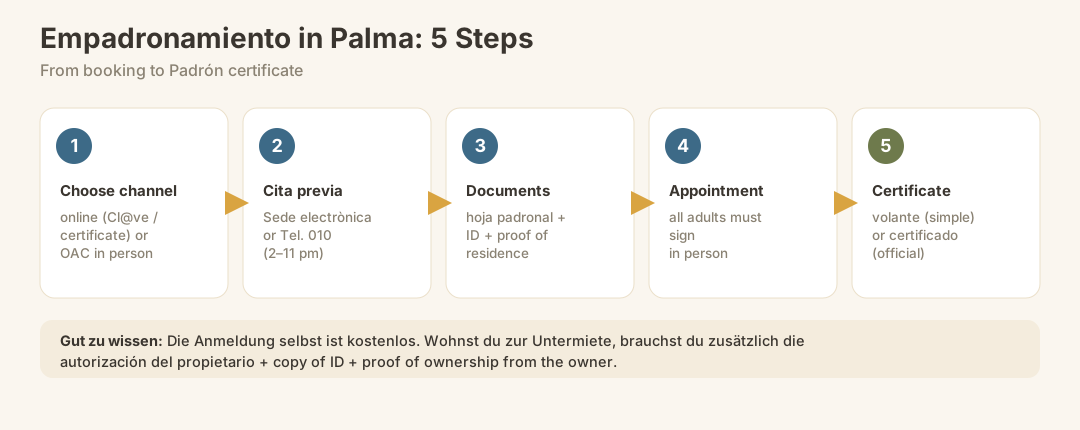
How the cita previa at the Ayuntamiento works
For initial registration (alta) and change of address (cambio de domicilio) you will need an appointment (cita previa) in the larger municipalities. Here is the typical process using Palma:
- Choose your channel. Palma allows registration online (with a digital certificate or Cl@ve) or in person at an OAC (Oficina de Atención a la Ciudadanía).
- Book an appointment. You book the cita previa via the official cita previa page or the Sede Electrónica of Palma. By phone you can call the 010 (from 14:00 to 23:00, for recognised emergencies only). Check the exact, up-to-date booking address directly on the official Palma website (see sources).
- Prepare your documents. Read the official "Hoja informativa sobre el empadronamiento en Palma" in advance and check that everything is complete and in the correct format — this will save you having to provide additional documents later.
- Attend your appointment. All adults registering must sign the hoja padronal in person. Representation is only possible for minors or by notarised power of attorney. (This is officially confirmed for Palma and Calvià.)
- Receive your certificate. At the end you will be issued with a volante or certificado de empadronamiento.
| Municipality | Appointment channel | Address / Contact |
|---|---|---|
| Palma | Cita previa online (Sede Electrónica) · Tel. 010 | Main padrón office: Plaza de Santa Eulàlia 9, 07001 Palma; decentralised OAC offices in the districts |
| Calvià | Sede Electrónica · from 24.09.2025 by appointment only | Ajuntament, c/ Julià Bujosa Sans, Batle 1, Calvià; Tel. 971 139 188 |
| Andratx | cita previa obligatory (SAC) | Avenida de la Cúria 1, 07150 Andratx; Tel. 971 62 80 00 |
Without an appointment, access in Palma is only possible in exceptional cases: For births, deregistrations (bajas) and the renewal of expired entries, no cita is required. And people aged over 65 can register in Palma without an appointment directly at the OAC Son Moix (8.30–13.30) . For genuine emergencies there is a fast-track option — but only if you can substantiate the urgency with documents.
Volante vs. certificado de empadronamiento: What is the difference?
After registering, you can obtain official confirmation of your place of residence — and there are two variants that are often confused with each other. Choosing the wrong one can slow down an administrative procedure.
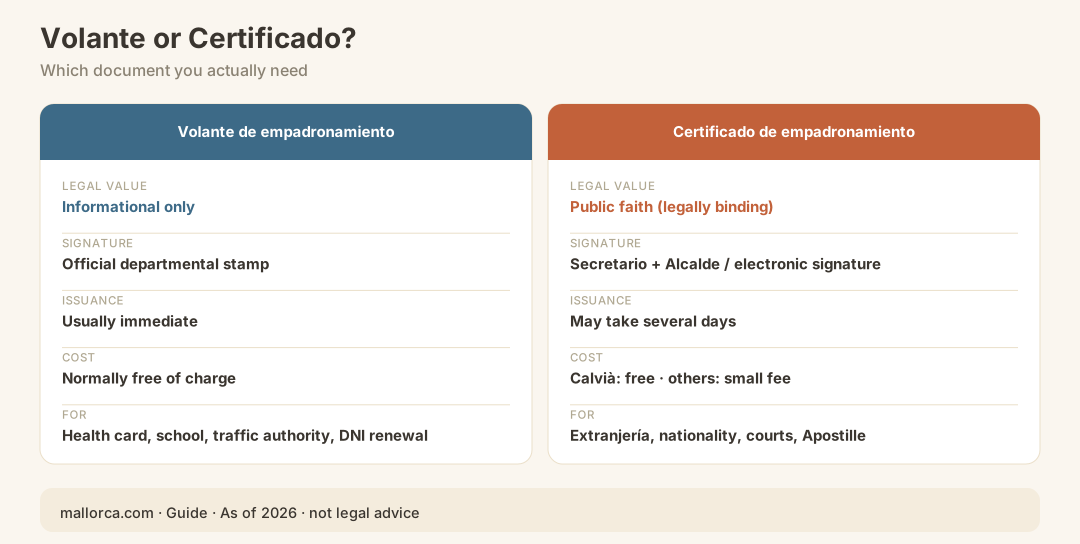
| Feature | Volante de empadronamiento | Certificado de empadronamiento |
|---|---|---|
| Legal standing | informational only | public faith (legally binding proof) |
| Signature | Official stamp of the department | Signature of the town clerk (Secretario), confirmed by the Alcalde or via the electronic signature of the Secretario |
| Issuance | usually immediate | may take several days |
| Cost | generally free of charge | free of charge depending on the municipality (e.g. Calvià) or with a small fee |
| Typical use | Everyday matters: health card, school, Bono Social, vehicle registration office, DNI renewal | Immigration authority, nationality, courts, international adoption, apostille, Ingreso Mínimo Vital |
Rule of thumb: For everyday purposes the volante is almost always sufficient — it is quicker and usually free of charge. The certificado is only needed for "serious" procedures with legal effect, such as matters at the Extranjería, nationality proceedings, or when an apostille / legalisation is required. Important: Always state the purpose when applying, and the office will then issue the correct document.
How long the certificate remains valid depends on the municipality or the requesting authority. Many authorities accept it for around three months from the date of issue — Calvià, by contrast, explicitly states a validity of six months for its own certificado. There is no nationally uniform standard; the statutory requirement concerns only a minimum level of verifiability, not a maximum period of validity. If in doubt, apply for the document close to the time of the procedure and ask the authority requesting it about the accepted period of validity.
In Palma you can obtain the personal certificado without a cita previa at any OAC, or electronically via the Sede Electrónica (identification via Cl@ve / digital certificate). In Calvià the certificado is delivered to your notification inbox within around ten minutes when applying electronically, and issued immediately in person — the service there is free of charge.
EU citizens vs. non-EU citizens
The padrón itself treats EU and non-EU citizens equally — the difference lies in the identity document and in the renewal obligation.
| Topic | EU / EEA / Switzerland | Non-EU (third country) |
|---|---|---|
| Identity document | Passport or national ID card; Certificado de Registro (NIE-verde) if available | Passport or TIE (foreigner's card with NIE) |
| Certificado de Registro required? | Mandatory after >3 months of residence — but at the foreigners' office/police station, not at the town hall | not applicable; residence permit/TIE required instead |
| Padrón renewal | no fixed 2-year obligation | every 2 years obligation for third-country nationals without permanent residency (residencia de larga duración) — otherwise the entry lapses |
For EU citizens: the Certificado de Registro de Ciudadano de la Unión (colloquially known as the "NIE-verde") is a paper document that you apply for within the first three months at the Oficina de Extranjería or the Policía Nacional — not at the town hall. It contains your name, nationality, place of residence, NIE number, and date of registration. Do not confuse it with the NIE number itself (merely a reference number) or the TIE (the card for non-EU citizens).
For third-country nationals without permanent residency the two-year renewal (renovación / confirmación) of the padrón is crucial: if you miss it, the municipality declares the entry lapsed (caducidad) and deregisters you. In Palma the office sends out a preaviso (advance notice) around two months before the deadline. A missed renewal can hold up other processes — such as renewing your health card.
Particularities of the municipalities on Mallorca
Mallorca operates the padrón very much on a per-municipality basis. The underlying logic is the same everywhere, but appointments, forms, and the rigour of checks differ. Someone living in Palma uses a different online portal from someone in Calvià.
- Palma: Registration online or at the OAC, cita previa required for alta/cambio. Over-65s without an appointment at the OAC Son Moix. Padron main office at Plaza de Santa Eulàlia 9.
- Calvià (incl. Santa Ponça, Magaluf, Palmanova, Portals): Since 24. September 2025 only with cita previa in person. Calvià actively checks the tenancy agreement and requires proof of payment for the current month; for foreigners who have never previously been registered in Spain, additional declarations are required. Online processing with a digital certificate/DNIe, statutory resolution period 3 months. The certificado is free of charge here and valid for six months.
- Andratx (incl. Port d'Andratx): cita previa at the SAC is mandatory, opening hours 8.30–13.30, Avenida de la Cúria 1.
- Other municipalities (Llucmajor, Manacor, Sóller, Pollença and others): their own Sede Electrónica, their own appointment logic. Always check your specific municipality's website first before applying generic Spain guides.
In the premium locations in the south-west — from Andratx and Port d'Andratx through Portals to the municipalities of the Serra de Tramuntana (Deià, Valldemossa, Sóller) — the most common bottleneck is not the authority itself, but clean proof of residence. For a new property purchase, the escritura is required; for a rental, the contract plus current proof of payment. Those who have the right documentation with them are usually done within a few minutes.
Most common mistakes
- Confusing the volante and the certificado. For the Extranjería, take the (slower) certificado — not the volante, which is often not accepted there. Conversely, don't wait unnecessarily for the certificado when the volante will suffice.
- Tenancy agreement without proof of payment. Mandatory in Calvià in particular: current proof of payment for the ongoing month.
- Bringing only your own contract in the case of a subletting arrangement. You need the autorización del propietario plus the owner's ID and proof of ownership.
- Using the "NIE blanco" as identification. The paper NIE is not accepted as an identity document for the Padron in Palma.
- Letting an appointment lapse without cancelling. In Palma, around one in five people fail to show up for their booked appointment — cancel in good time so that no one is left waiting and you can get a new appointment more quickly yourself.
- Not stating the purpose of the certificate. Without specifying the intended use, the office may issue the wrong type of document.
- Forgetting the 2-year renewal (third-country nationals without permanent residency) — the entry expires automatically.
- Misjudging the validity of the certificate. Three months does not apply everywhere — Calvià, for instance, states six. If in doubt, check with the requesting authority.
- Not all adults are present. When registering in person, all adult co-registrants must sign the hoja padronal themselves.
Checklist for your appointment
- Cita previa booked (via the Sede Electrónica of your municipality; Palma additionally Tel. 010 for emergencies)
- Valid identity document in the original (passport / DNI / TIE) for every person to be registered
- For children under 14 without an identity document: libro de familia or (translated) birth certificate
- Proof of residence: escritura / nota simple / IBI or rental agreement + proof of payment for the current month
- If living as a subtenant: autorización del propietario + copy of identity document + proof of ownership from the owner
- Completed hoja padronal (or fill it in on the spot)
- All adult co-registrants attend in person
- For a certificate: state the purpose and decide whether a volante or certificado is required
What comes next?
With the Padron in hand, the next steps become considerably easier. Natural follow-ons:
- Apply for a health card — the Padron is a prerequisite. Details in the guide to health insurance in Spain.
- NIE / Certificado de Registro — sort this out if you haven't already — see NIE number on Mallorca.
- Property purchase or subsequent rental — document everything properly — market and location insights in the Mallorca market report and in the property guide.
- A comprehensive overview of all expat topics can be found in the expat guide.
Conclusion
Empadronamiento is no bureaucratic monster — as long as you come prepared to your appointment. Book the cita previa via your municipality's portal, bring a valid identity document and a clean proof of residence (ownership or rental agreement plus proof of payment), and make a conscious choice between volante (everyday use) and certificado (legal proceedings). Non-EU nationals should bear in mind the 2-year renewal, and EU citizens the separate Certificado de Registro at the foreigners' office. This gives you the foundation for your health card, schooling, car registration, and residency.
Official sources
- Ayuntamiento de Palma — Alta en el Padrón (Población.02)
- Ayuntamiento de Palma — Hoja informativa sobre el empadronamiento (PDF)
- Ayuntamiento de Palma — Sede Electrónica (Cita previa & Trámites)
- Ajuntament de Calvià — Empadronamiento
- Ajuntament de Calvià — Certificado de empadronamiento (valid for six months)
- Ajuntament d'Andratx — Citizen Services (SAC)
- Policía Nacional — Certificate of Registration for EU Citizens
- IB-Salut — Individual Health Card
This guide provides general, carefully researched information and does not replace legal or official advice. Procedures, fees, deadlines, and required documents may change and can vary depending on the municipality and individual circumstances. The only binding information is that provided by your relevant Ayuntamiento and the official sources linked above. Always check the latest information from your municipality before your appointment.