
Applying for Residencia in Spain: Certificado de Registro for EU Citizens
If you want to live on Mallorca for more than three months as an EU citizen, the Residencia is unavoidable. This refers to the Certificado de Registro de Ciudadano de la Unión Europea — the green certificate with which you register in the Registro Central de Extranjeros and are officially recognised as a legal resident. It is not a residence permit in the traditional sense (you do not need one as an EU citizen), but rather proof that you are registered in Spain and hold your NIE number. It is applied for using form EX-18 at the Oficina de Extranjería or the Policía Nacional. This guide takes you through every category, the required documentation, the IPREM reference values for 2026, and the cita previa process in Palma.

Are you planning your move to Mallorca?
- 📩 Submit a personal enquiry — we will connect you with vetted gestoría and government contacts for your Residencia.
- All emigration topics at a glance
NIE, Residencia and TIE — what is what?
These three terms are constantly confused. For EU citizens, the distinction is straightforward once you have understood it:
| Term | What it is | For whom | Format |
|---|---|---|---|
| NIE | Tax identification number for foreigners | Any foreigner (even without residency) | Number — no separate document required |
| Certificado de Registro (Residencia) | Entry in the foreigners' register as a legal resident | EU/EEA/Swiss citizens staying for more than 3 months | Green A6 paper document (contains the NIE) |
| TIE | Plastic card with photo and fingerprints | Third-country nationals (non-EU) | Credit-card format |
Important: as an EU citizen you will receive no TIE. The plastic card is reserved for third-country nationals. You will receive the green paper certificate, on which your NIE is already printed. If you already have a NIE (for example, obtained for a property purchase), it will be carried over during registration and will not be reissued. Full details about the NIE itself — how to apply, and the difference between a NIE for non-residents and residents — can be found in the guide to the NIE number on Mallorca.
When the Residencia is compulsory
The rule is clearly set out in Real Decreto 240/2007 (in conjunction with the Ley Orgánica 4/2000): anyone who, as a citizen of the EU, the EEA (Norway, Iceland, Liechtenstein) or Switzerland, wishes to reside in Spain for more than three months must personally register in the Registro Central de Extranjeros.
- Trigger: planned stay of more than three months.
- Deadline: Registration must be completed within three months of entry to apply for.
- Location: Oficina de Extranjería of the province in which you reside — on Mallorca, the Policía Nacional in Palma.
- Result: The certificate is issued immediately (de forma inmediata) according to the official Police Sede, and contains your name, nationality, place of residence, your NIE, and the registration date — provided the documents are complete.
As long as your stay remains under 90 days (for example as a tourist or if you only use a second home sporadically), you do not need the Residencia. However, as soon as you move your primary residence to Mallorca, register with the padrón, work, or live here permanently, the deadline begins to run. If you miss it, sanctions are theoretically possible — in practice, the registration is simply completed retrospectively, but until then you are not registered as a legal resident, which blocks your bank account, health card, and tax status.
Form EX-18 and the Tasa 790-012
Two documents form the foundation of every application:
Form EX-18 is the official application for entry in the foreigners' register. You fill it in, sign it, and bring it printed out (some offices require it in duplicate, so print two copies). It is available free of charge on the website of the Ministerio de Inclusión.
Tasa Modelo 790, Código 012 is the administrative fee. When generating the form, you select the section "Certificado de registro de residente comunitario o TIE de familiar de un ciudadano de la Unión". The fee is 12 Euro and is paid before the appointment at any Spanish bank, savings bank, or credit union (BBVA, Santander, CaixaBank, etc.) — you do not need your own account for this. You include the stamped receipt with your application.
| Item | Detail |
|---|---|
| Form | EX-18 (free of charge, completed and signed) |
| Fee form | Modelo 790, Código 012 |
| Tasa amount | 12,00 Euro |
| Section when completing | "Certificado de registro de residente comunitario…" |
| Payment | At any bank, savings bank, or credit union; no account required; keep the receipt |
| Identity | Valid national identity card or passport + copy |
Note regarding the order of steps: at some locations (e.g. where the NIE is only assigned at the appointment itself), you pay the Tasa after the appointment, once your NIE has been confirmed, and submit the receipt afterwards. If in doubt, clarify this with the relevant office beforehand.
Requirements by category
This is the core of the process. Under Artikel 7 RD 240/2007, you must demonstrate one of several grounds for residence. The documents required depend solely on your category — the four most common are:
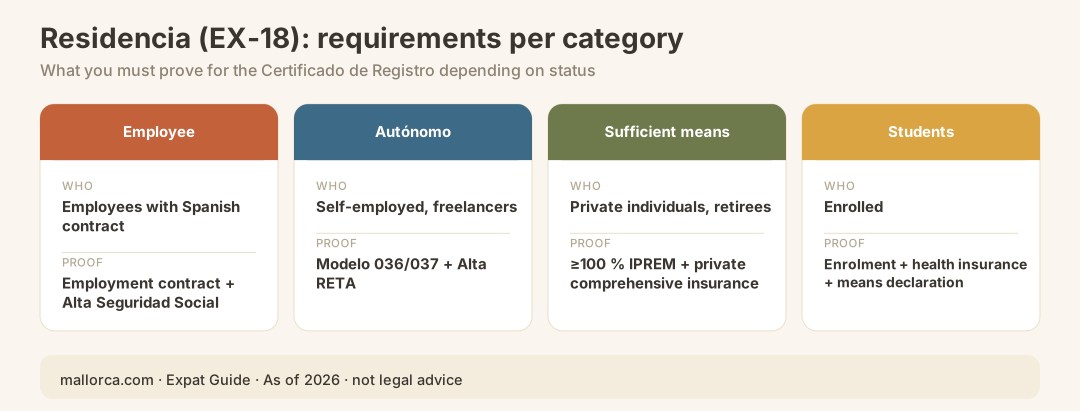
| Category | Who | Required documentation |
|---|---|---|
| Employee (cuenta ajena) | Employees with a Spanish contract | Employment contract + registration with the Seguridad Social (alta) or employer's certificate |
| Self-employed (autónomo) | Tradespeople, freelancers | Tax registration (Modelo 036/037) + alta with the RETA of the Seguridad Social |
| Sufficient means (no laboral) | Private individuals, retirees, financially independent persons | Proof of financial means (min. 100 % IPREM) + private comprehensive health insurance |
| Students | Those enrolled at a recognised institution | Enrolment certificate + health insurance (private or European Health Insurance Card) + self-declaration of sufficient means |
In addition to these four independent grounds for residence, Article 7 recognises the category of family members, who derive their right of residence from the registered EU citizen. For all categories, the following basic requirements also apply: valid passport/national identity card, EX-18, paid Tasa 790-012, and as a rule the proof of padrón registration (Volante de empadronamiento) from your local authority, no more than three months old. The padrón confirms that you are actually resident in the area — on Mallorca this must be applied for at the relevant Ayuntamiento (Palma, Calvià, Andratx, Sóller, etc.).
A common stumbling block: those who are employed or self-employed do not need to provide proof of health insurance, because registration with the Seguridad Social already covers healthcare. The insurance requirement only applies to the categories "sufficient means" and, in some cases, students.
Proof of means and health insurance in detail
The "sufficient means" category is the most common among people relocating to Mallorca who are not in employment — and at the same time the one with the highest rate of rejections, because two strict requirements must be met simultaneously.
1. Financial means — the IPREM benchmark for 2026
The reference figure used is the IPREM (Indicador Público de Renta de Efectos Múltiples), Spain's official benchmark for income thresholds. For the residencia of an EU citizen, the authorities typically require a minimum of at least 100 % of the IPREM for a single person; the amount increases for accompanying family members. The figure has been frozen since 2023 because no new national budgets (Presupuestos Generales del Estado) have been passed, and remains unchanged for 2026:
| IPREM 2026 | Amount |
|---|---|
| Monthly | €600.00 |
| Annually (12 payments) | €7,200.00 |
| Annually (14 payments) | €8,400.00 |
| Daily | €20.00 |
In practical terms: you should be able to demonstrate at least around €600 per month or the annual equivalent — for each family member relocating with you, a further share is typically required. Accepted documents include bank statements, pension notices, payslips, proof of ownership, bank certificates, or a combination thereof. Important: the IPREM for the Residencia (100 %) is considerably lower than for the non-gainful residence permit for third-country nationals (residencia no lucrativa, where 400 % IPREM = approx. €2,400/month). Do not confuse the two thresholds — the stricter one applies to non-EU citizens.
2. Health insurance — the minimum cover requirement
Anyone registering on the basis of sufficient funds requires comprehensive health insurance in Spain that covers all risks and is equivalent to the public health service (SNS). RD 240/2007 requires in the text of the regulation only a "seguro de enfermedad que cubra todos los riesgos en España"; the following detailed criteria are not explicitly stated in the wording, but are consistently applied in practice by the Extranjería:
- No excess payments (sin copagos): Policies with a co-payment per doctor's visit are regularly rejected.
- No waiting periods (sin carencias): Cover must take effect from day one.
- Full cover: GP, specialists, diagnostics, hospital, surgery, emergencies around the clock.
- Valid throughout Spain, taken out with an insurer authorised in Spain.
A travel insurance policy is not sufficient — a genuine health insurance policy is required. The European Health Insurance Card (TSE/EHIC) only provides access to the Spanish health system during temporary stays and is not a valid document for establishing residency in Spain — when transferring your place of residence, form S1 is the relevant document, not the EHIC. Private residents' policies without a copago typically cost around €40 to €50 per month for young, healthy applicants, but rise considerably with age.
Alternatively, for already registered residents without other cover, there is the Convenio Especial with the public system: around €60/month under the age of 65, approx. €157/month from age 65, with no copagos for the covered services within the cartera común básica. Please note: the Convenio generally requires at least one year of prior residence in Spain (previous periods in the EU/EEA/Switzerland/UK may be counted) and does not cover outpatient medication (you pay 100 % of that yourself) — it is therefore rarely suitable as initial proof of cover for registration purposes. More on this in the guide to health insurance in Spain.
The cita previa process in Palma
On Mallorca, the competent authority for the Certificado de Registro is the Oficina de Comunitarios of the Policía Nacional in Palma. Here is the process step by step:
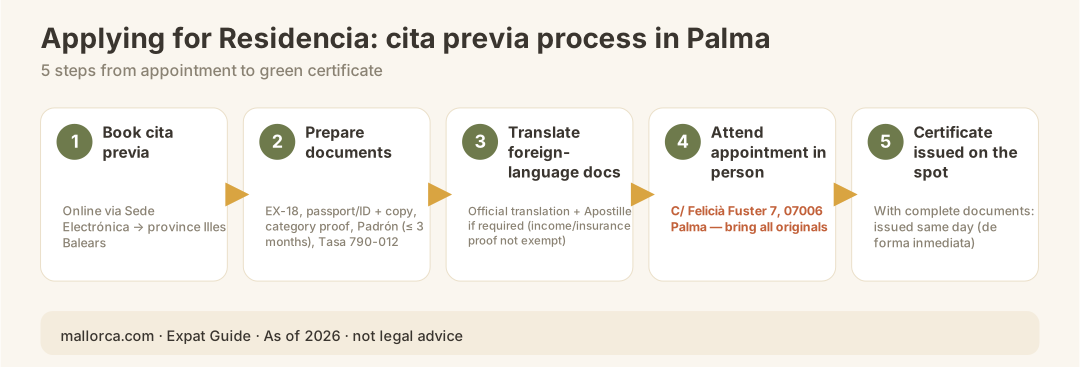
- Book a cita previa. Appointments are allocated online via the Sede Electrónica of the Administraciones Públicas (Procedure "Policía Nacional → Certificado de Registro de Ciudadano de la UE", Province Illes Balears). Appointments are often scarce — check daily for cancellations.
- Prepare your documents. EX-18 completed and signed, passport/identity card plus copy, category-specific supporting documents, Empadronamiento (less than 3 months old), Tasa 790-012. Everything in original plus copy.
- Have foreign-language documents translated. Documents in a language other than Spanish (or Catalan) must be officially translated and, depending on their country of origin, either apostilled (Hague Convention) or diplomatically legalised. For public documents from EU countries, the apostille requirement is waived for a limited, explicitly listed group of documents under Regulation (EU) 2016/1191 — such as birth, marriage, residence, or criminal record certificates. Not exempt, however, are proof of income, assets, and insurance, which you will need precisely for the category "sufficient means" (see the section "Translation and Legalisation" below).
- Attend your appointment. In person, punctually, with all originals. If the documents are complete, the green certificate will be issued immediately on the same day.
- Submit the Tasa afterwards if necessary. If the NIE is only assigned at the appointment, you pay the 12 Euro afterwards and bring back the receipt.
Contact details for the relevant office on Mallorca:
| Office | Address / Contact |
|---|---|
| Oficina de Comunitarios (Policía Nacional) | C/ Felicià Fuster 7, 07006 Palma |
| E-Mail Régimen Comunitario | mallorca.ouecomunitarios@policia.es |
| Oficina de Extranjería (Delegación del Gobierno) | C/ Felicià Fuster 7, 07006 Palma |
| Telephone Extranjería Illes Balears | 971 989 170 |
| E-Mail Info | infoextra.illesbalears@correo.gob.es |
According to the Policía Nacional's official website, the standard procedure is in-person application at the appointment. Depending on the province and the availability of Cl@ve, a telematic application may now also be offered — in the Balearic Islands via the Cl@ve system (Cl@ve Móvil including Cl@ve PIN, a qualified electronic certificate including DNIe, or Cl@ve Permanente), which requires prior registration. However, this online route is not an officially guaranteed standard for everyone and presupposes an existing electronic identification. Since you generally cannot obtain a digital certificate without a NIE, the first application is usually made in person on-site.
Translation and Legalisation of Documents
For your supporting documents to be accepted, foreign-language materials must be translated into Spanish and, depending on the type of document, officially certified. It is worth taking a close look here, as the rules are document-type specific:
- Official translation: Documents in a language other than Spanish (or Catalan) must be translated by a traductor jurado (a translator authorised by the Spanish Ministry of Foreign Affairs).
- Civil registry EU documents: For an enumerated list of public documents from EU countries — including birth, marriage, civil status, residence, and criminal records — the Regulation (EU) 2016/1191 removes the requirement for an apostille or legalisation.
- Proof of income, assets, and insurance: These are not covered by the 2016/1191 exemption. For the exact documents you submit under the "sufficient resources" category (bank certificates, pension notices, insurance policies), an apostille or official translation may still be required depending on the format — clarify this with the relevant authority or a gestoría.
- Third-country documents: Documents from non-EU countries generally require an apostille (Hague Convention) or, where the Convention does not apply, diplomatic legalisation.
The full residencia: permanent status after 5 years
The initial certificate is effectively valid indefinitely — your NIE remains the same for life in any case. There is, however, an important milestone: after five years of uninterrupted legal residence in Spain, you acquire under Article 10 RD 240/2007 the right to permanent residence (residencia permanente).
Upon application, the Oficina de Extranjería will then issue you a Certificado del derecho a residir con carácter permanente. The key advantage is that this permanent residence right is no longer tied to the conditions set out in Chapter III — meaning you no longer need to demonstrate employment, sufficient resources, or health insurance. In addition, as a permanent resident you are automatically entitled to healthcare within the public SNS at public expense and no longer need a Convenio Especial.
| Stage | Requirement | Consequence |
|---|---|---|
| Initial certificate (EX-18) | One of the four categories (Art. 7) | Legal resident, NIE registered |
| Permanent residence | 5 years of uninterrupted legal residence (Art. 10) | No further conditions, SNS access at public expense |
Important: "Uninterrupted" does allow for shorter absences, but extended periods abroad (more than six months per year or twelve months consecutively) can break the qualifying period. Anyone who lives cleanly for five years on Mallorca, remains registered on the padrón, and avoids lengthy spells abroad will transition into permanent status without further hurdles.
If the application is refused
If the authority rejects your application, two avenues of appeal are open to you — note the short deadlines:
- Recurso de reposición: Within one month you can lodge an objection with the authority that issued the decision.
- Recurso contencioso-administrativo: Within two months you can bring a claim before the competent administrative court (Juzgado de lo Contencioso-Administrativo).
The most common reason for rejection is missing or incomplete documents — in most cases the application can simply be resubmitted after the shortcomings have been remedied, without any need for a formal legal remedy.
Common mistakes
- Missing the deadline. Registration must take place within three months of arrival — many people wait too long and end up blocking their own bank account and health card.
- Travel insurance instead of a health policy. A travel insurance certificate or the EHIC/TSE card will be rejected. What is needed is a genuine resident health insurance policy with no copayment and no waiting period.
- Empadronamiento too old. The padrón certificate must be no more than three months old and the address must match the EX-18 exactly.
- IPREM confused. Anyone who applies the 400 % threshold of the residencia no lucrativa (third-country nationals) to their own EU application is vastly overestimating the requirement — for EU citizens 100 % IPREM is sufficient.
- Proof of income without translation/apostille. German bank certificates or insurance policies are not covered by the 2016/1191 exemption and should be submitted with an official translation — and, depending on the form, also apostilled.
- Wrong tasa category. Make sure to tick the correct option on Modelo 790-012, otherwise the payment receipt will not be valid.
- Arrived without a cita previa. In Palma, nobody is seen without a pre-booked appointment.
What comes next
With the green certificate in hand, the next administrative steps are open to you: registering your health card (Tarjeta Sanitaria) at your Centro de Salud, opening a Spanish bank account as a resident, registering your car, exchanging your driving licence, and — once you are tax-resident — filing your annual tax return. If you are looking to buy or let a property in Mallorca, it is worth consulting the property guide and the latest market report. All further emigration topics — from the NIE to health insurance — are brought together in the emigration section.
Checklist for your application
- Stay of more than 3 months planned → residencia is mandatory
- EX-18 completed and signed (print two copies if necessary)
- Tasa 790-012 generated, correct category ticked, 12 Euro paid at the bank
- Valid passport/national identity card + copy
- Category proof: employment contract / autónomo alta / funds + health insurance / university enrolment
- For "sufficient funds": at least 600 Euro/month (100 % IPREM) evidenced
- For "sufficient funds"/students: health insurance with no copayment, no waiting period, valid throughout Spain
- Empadronamiento (Volante), no more than 3 months old, address matches EX-18
- Foreign-language documents officially translated; proof of income/assets apostilled where required
- Cita previa booked online (Province of Illes Balears)
Conclusion
The Certificado de Registro is a comparatively straightforward process for EU citizens: one form (EX-18), a €12 fee (Tasa 790-012), proof of category, and the padrón — that is all you need, and provided your documents are complete, the certificate is issued on the same day. The two genuine sticking points are the correct category with the appropriate supporting documents and, for those of independent means and retirees, the correct health insurance with no co-payment. Anyone who respects the three-month deadline, does not confuse the IPREM benchmark of €600 with the threshold that applies to non-EU nationals, and has their documents properly translated (and apostilled where required) can have their legal resident status on Mallorca sorted in a single morning in Palma. After five years, the door opens to unconditional permanent residency.
Official sources
- Policía Nacional — Certificado de Registro de Ciudadano de la UE (procedure EX-18)
- Form EX-18 (Ministerio de Inclusión)
- Tasa 790 Código 012 (Sede Electrónica Policía)
- Real Decreto 240/2007 (BOE — full legislative text)
- Convenio Especial de asistencia sanitaria (Ministerio de Sanidad)
- Extranjería Illes Balears — Oficina de Extranjería Palma (Delegación del Gobierno)
Disclaimer: This guide is intended for general information purposes only and does not replace individual legal, tax, or official advice. Administrative practice, fees, and IPREM values are subject to change, and individual Oficinas de Extranjería may require different or additional documents. Only the competent Spanish authorities and the applicable legislative text are binding. Check the official sources before your appointment and, in complex cases, consult a gestoría or a solicitor specialising in Extranjería.