Apostille Spain Documents: How to Legalise Certificates Correctly
Anyone who emigrates to Spain, gets married, works there, or deals with inheritance matters will sooner or later encounter the same obstacle: German authorities do not simply accept Spanish documents — and Spanish authorities do not accept German ones. The solution is called an Apostille Spain documents: an international certificate of authenticity under the Hague Convention of 1961, which is recognised in all contracting states. Spain joined this Convention in 1978. In this guide you will find out which documents require an apostille, which authorities in Germany and Spain are responsible, when an additional certified translation is required, what both cost — and what typical mistakes cause your application to sit gathering dust at the office.
Do you have specific documents you would like to legalise for Spain — and don't know where to begin?
What is an apostille — and what does it actually certify?
An apostille is not a review of the content of your document. It certifies exclusively three things:
the authenticity of the signature of the issuing official
the capacity in which they acted
the authenticity of a seal or stamp
What the document contains — whether a court judgement is substantively correct or a diploma was genuinely awarded — is expressly not examined by the apostille. This limitation is important: Spanish authorities may still challenge an apostilled document on its merits, but can no longer refuse to recognise it solely on the grounds of missing legalisation.
Apostille vs. legalisation: the difference
Procedure
Who issues it?
When is it required?
Hague Apostille
Competent authority of the issuing state
Between two Hague contracting states (e.g. Germany → Spain)
Consular legalisation
Consulate of the receiving country in the issuing country
When no Hague Convention applies
No formality required
–
Within the EU for many civil status documents (Regulation EU 2016/1191)
Note: Since the entry into force of EU Regulation 2016/1191 (from 16 February 2019), certain public civil status documents (birth certificates, marriage certificates, death certificates, etc.) are exempt from apostille requirements between EU member states. In practice on Mallorca, this means: a German civil registry document submitted to the Spanish Registro Civil does not require an apostille in many cases — though it may still require a certified translation into Spanish.
Which documents require an apostille for Spain?
Whether your document needs to be apostilled depends on which authority issued it and how you intend to use it in Spain. The table below shows the most typical cases for German–Spanish emigrants:
Document
Apostille required?
Certified translation required?
Typical purpose
Birth certificate
Often no (EU Regulation 2016/1191), otherwise yes
Yes
NIE, Residencia, Registro Civil
Marriage certificate
Often no (EU Regulation 2016/1191), otherwise yes
Yes
Change of name, Residencia
Death certificate
Often no (EU Regulation 2016/1191), otherwise yes
Yes
Inheritance proceedings
Divorce decree
Yes (court document)
Yes
Marital status, remarriage
Certificate of good conduct / criminal record extract
Yes
Yes
Work permit, visa
Educational diploma / university degree
Yes
Yes
Professional recognition, Homologación
Power of attorney (notarised)
Yes (if issued abroad)
Yes
Property purchase, banking transactions
Court judgment
Yes
Yes
Enforcement, Exequatur
Company documents
Yes
Yes
Company formation, commercial register
Please note: Whether EU Regulation 2016/1191 applies in any individual case is determined by the receiving authority. Do not rely on this as a blanket assumption — check with the relevant Registro Civil or notary in Spain in advance.
Competent authorities in Germany: Where do you apply for the Apostille?
In Germany, the Apostille is not regulated at federal level, but at state level. Which authority is responsible depends on the type of document and the federal state in which it was issued.
Document type
Competent German authority (depending on federal state)
Court documents, certified notarial copies
President of the Regional Court / Higher Regional Court
Civil registry documents (birth, marriage, death)
Regional Government Authority / District Administration
Police clearance certificate
Federal Criminal Police Office or regional authority (depending on where it was issued)
Notarially certified documents
President of the competent Regional or Higher Regional Court
School and university diplomas
Regional Schools Authority or Ministry of Education and Cultural Affairs
Specific examples by federal state:
Bavaria: Bavarian State Ministry of the Interior (for civil registry documents), Courts of Appeal (for court documents)
Baden-Württemberg: Regional Government Authorities of Stuttgart, Karlsruhe, Freiburg or Tübingen
NRW: District Administrations (e.g. Düsseldorf, Köln, Arnsberg)
Hamburg: Senate Chancellery / Finance Authority depending on document type
Berlin: Senate Department for the Interior
Please note: German representations in Spain (Embassy Madrid, Consulate General Barcelona, Consulate Palma) are in principle unable to issue apostilles or legalisations for German documents. This can only be done through the competent German interior authority.
Apostille for Spanish documents: who is responsible in Spain?
If you wish to have a Spanish document apostilled for use abroad – or need a document issued in Spain for a German authority – this is handled through Spanish bodies.
Document type
Competent Spanish authority
Notarial documents
Territorial Deanery of the Notaries' Chamber (Colegio Notarial)
Court documents
Supreme Court of the respective Autonomous Community (Tribunal Superior de Justicia)
Civil registry documents
Registro Civil (coordinated via the Ministry of Justice)
Commercial registry documents
Territorial Deanery of the Notarial Chamber
University diplomas (Spanish)
Rectorate of the issuing university + Ministry of Education
For Mallorca / Balearen the Tribunal Superior de Justicia de las Islas Baleares (TSJIB) is the central judicial apostille authority; for notarial documents the Colegio Notarial de las Islas Baleares is responsible.
Step by step: the process of apostilling a German document for Spain
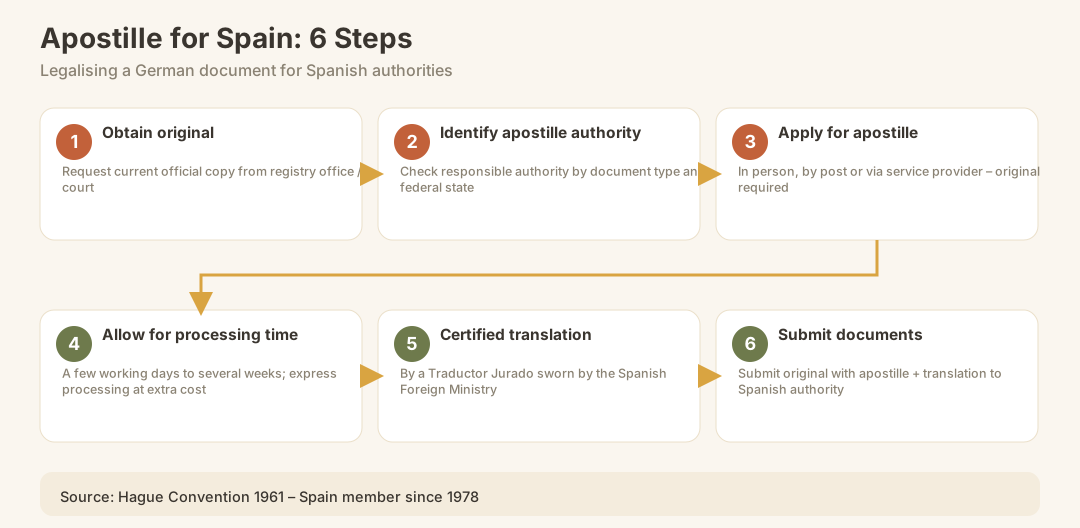
Obtain the original document – Request a current official copy from the issuing German registry office, court, or authority. Older copies are frequently rejected.
Identify the competent apostille authority – Depending on the type of document and federal state (see table above).
Apply for the apostille – In person, by post, or via an authorised service provider. Most German authorities require the original document.
Allow for processing time – Typically a few working days to several weeks depending on the authority and its workload; express processing is sometimes available for an additional fee.
Have a certified translation into Spanish prepared – By a sworn translator authorised by the Spanish Ministry of Foreign Affairs (Traductor Jurado), not by just any translator.
Submit both documents (original with apostille + translation) to the Spanish authority.
Please note: The apostille is affixed to the original document or securely attached to it as a separate sheet. It is never sufficient to have a simple copy apostilled – the original must be presented.
Certified Translation for Spain: What You Need to Know
In most cases, an apostille alone is not enough. Spanish authorities additionally require a translation into Spanish – and not just any translation, but one carried out by a Traductor Jurado (sworn translator).
Who is authorised to translate for Spain?
In Spain, certified translations for official purposes may only be produced by translators who have been formally authorised by the Ministerio de Asuntos Exteriores, Unión Europea y Cooperación de España (Spanish Ministry of Foreign Affairs). The translation bears their signature and stamp and is therefore recognised by all Spanish authorities.
For the reverse direction – a Spanish document to be used in Germany – you will need an authorised translator (court interpreter) appointed by the competent Landgericht or OLG.
How do you identify a genuine Traductor Jurado?
The translator is listed in the official register of the Spanish Ministry of Foreign Affairs
The translation includes the translator's personal stamp and handwritten signature
It is securely attached to a copy of the original document
Please note: Online services without verifiable registration with the Spanish Ministry of Foreign Affairs are not acceptable to Spanish authorities – even if they include the words "certified translation" in their name.
Costs and Processing Times: What Should You Budget For?
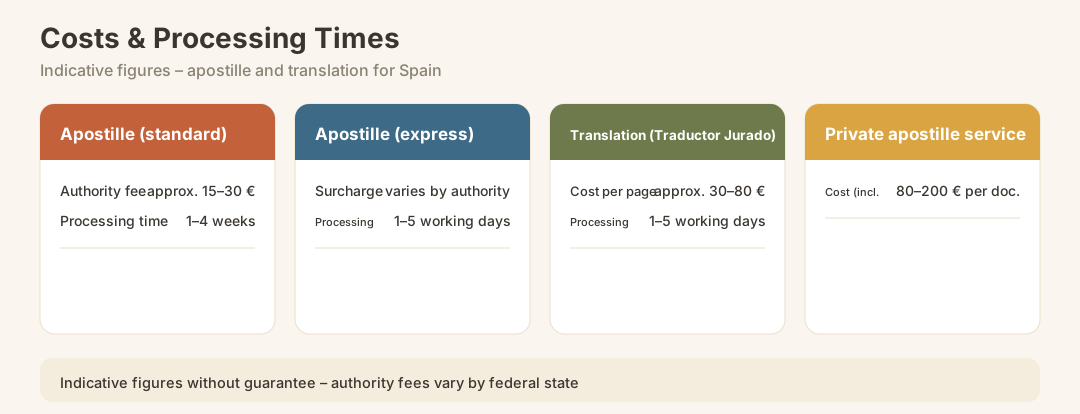
Costs vary considerably depending on the authority, the length of the document, and the service provider. The following figures may serve as a rough guide:
Service
Approximate Cost
Processing Time
Apostille from a German state authority
approx. 15–30 € official fee
1–4 weeks (standard)
Express apostille (where available)
Surcharge depending on the authority
1–5 working days
Certified translation (Traductor Jurado), per page
approx. 30–80 € depending on scope
1–5 working days
Apostille service via private provider (incl. authority fees)
80–200 € per document
variable
Please note: These figures are indicative estimates without guarantee. Authority fees vary depending on the federal state. Always request a written cost breakdown before commissioning any service.
Exceptions: When do you not need an apostille?
Not every cross-border document needs to be apostilled. The most important exceptions in the German context:
1. EU Regulation 2016/1191 (from 16 February 2019)
For certain public documents between EU member states, the apostille requirement no longer applies. This covers in particular:
Birth certificates
Death certificates
Marriage certificates
Name change certificates
Certificates of descent
In these cases, instead of an apostille, a multilingual EU standard form is used, which simplifies or replaces the need for translation.
2. Bilateral agreements
Some countries have concluded bilateral agreements with Spain or Germany that partially replace the apostille requirement.
3. Internal notarial certifications
Notarially certified copies between EU notaries are sometimes subject to their own rules — clarify this with the receiving notary in Spain in advance.
4. Documents relating to diplomatic communications
Diplomatic and consular documents are exempt from the Hague Convention.
Typical mistakes with apostilles and certified translations
The following mistakes repeatedly result in applications being rejected or proceedings being delayed by weeks:
Having simple copies apostilled – this will not work; an official original must be provided.
Uncertified translation – a "standard" translation without the stamp and signature of a Traductor Jurado will not be accepted by Spanish authorities.
Wrong apostille authority contacted – e.g. apostille requested from the local court when the document was issued by the registry office and the regional authority is responsible.
Translation submitted without apostille – some applicants have the document translated but forget to have the original apostilled.
Expired documents – some authorities require documents that are no more than three or six months old. An old apostille on an old document will not help in such cases.
EU exemption applied incorrectly – assuming that no apostille is needed because one is an "EU citizen" – yet EU Regulation 2016/1191 only applies to certain document types.
Private translator instead of Traductor Jurado – particularly common with online providers who do not clearly state their Spanish accreditation.
Apostille in practice: the documents you need for typical situations on Mallorca
Also bear in mind further tax obligations following registration: as a resident in Spain, you are required, for example, to declare foreign assets via the Modelo 720 and potentially keep an eye on wealth tax in Spain.
Checklist: Apostille and certified translation for Spain
Use this checklist before submitting your documents:
Official original document obtained (no scan, no simple copy)
Checked whether EU Regulation 2016/1191 applies (apostille may not be required)
Competent apostille authority identified in the relevant federal state
Apostille correctly affixed to the original issuing document
Traductor Jurado engaged with valid authorisation from the Spanish Ministry of Foreign Affairs
Translation includes stamp, signature and is firmly attached to the document copy
Currency of the document verified (some authorities require documents no more than 3–6 months old)
Complete document file fully assembled prior to the appointment with the authorities
Most common mistakes at a glance
Mistake
Consequence
Solution
Copy apostilled instead of original
Apostille invalid, application rejected
Request a new official copy from the registry office / court
Non-authorised translator
Translation not recognised
Commission a Traductor Jurado from the official Ministry list
Wrong authority contacted
Delay, possibly requiring a new application
Clarify the document type and federal state beforehand
EU exemption incorrectly applied
Missing apostille at the submitting authority
When in doubt, always have an apostille affixed
Document too old
Authority requires a more recent version
New official copy + new apostille
Conclusion
An apostille and a certified translation are not bureaucratic red tape – they are the foundation that allows your German documents to have any legal effect in Spain at all. The Hague Convention significantly simplifies the process compared to the old consular legalisation route, but it replaces neither the need to choose the correct authority nor the requirement for a genuine Traductor Jurado. Take the time to follow the right procedure – a rejected application costs more time than careful preparation. If you are unsure, seek professional support: an experienced Relocation Service on Mallorca or a tax adviser / expat lawyer will be familiar with the current requirements of the relevant authorities in the Balearic Islands.
What is the difference between an apostille and legalisation?
An apostille is a simplified certificate of authenticity under the Hague Convention of 1961 and is recognised between all signatory states. Legalisation is the older, more involved procedure carried out via the consulate of the country where the document is to be used, and is only necessary when no Hague Agreement exists. As Spain has been a member of the Convention since 1978, an apostille is sufficient between Germany and Spain.
As an EU citizen, do I always need an apostille for Spanish authorities?
Not always. Since 16 February 2019, EU Regulation 2016/1191 has applied, which abolishes the apostille requirement for certain public civil-status documents (e.g. birth certificates, marriage certificates) between EU member states. For other document types (e.g. divorce judgements, criminal record extracts, diplomas), an apostille remains required.
Who issues apostilles in Germany?
There is no central apostille authority in Germany. Responsibility lies with different bodies depending on the document type and federal state: regional government offices (Regierungspräsidien / Bezirksregierungen) for civil registry documents, Higher Regional Courts or Regional Courts (Oberlandesgerichte or Landgerichte) for court documents and notarial certifications, and Ministries of Culture (Kultusministerien) for educational qualifications.
What is a Traductor Jurado and where can I find one?
A Traductor Jurado is a translator officially authorised by the Spanish Ministry of Foreign Affairs (Ministerio de Asuntos Exteriores). Only their translations are recognised by Spanish authorities as certified translations. The Spanish Ministry of Foreign Affairs maintains an official search database on its website; verified translators affix their signature and stamp to every translation.
How long is an apostille valid?
An apostille itself has no legally defined expiry date. However, the receiving Spanish authority may require that the apostilled original document is no more than three or six months old. If in doubt, request a fresh official copy shortly before submission.
Can I submit an apostilled document to any Spanish authority?
Yes, a correctly apostilled and certified translated document is recognised by all Spanish authorities (notaries, Registro Civil, immigration authorities, courts). Whether any additional substantive requirements apply is a matter for the relevant authority to determine.
Does the apostille itself also need to be translated?
Under the Hague Convention, the apostille is drawn up in one of the official languages of the Convention (French or the official language of the issuing state). Some authorities require a translation of the apostille as well. If in doubt, have your Traductor Jurado include the full apostille text in their translation.
Where do I apply for an apostille for a Spanish document that I need to present in Germany?
That depends on the type of document. Notarially executed deeds are apostilled through the competent Spanish notarial association (Colegio Notarial), whilst court documents go through the relevant Tribunal Superior de Justicia of the autonomous community. For the Balearic Islands, this is the Tribunal Superior de Justicia de las Islas Baleares (TSJIB) in Palma.