
Wealth tax in Spain and Mallorca: allowances and Modelo 714
Anyone living in Spain or owning assets here will sooner or later encounter Spanish wealth tax – the Impuesto sobre el Patrimonio, or IP for short. This annual tax is based on net wealth as at 31 December and is declared using Modelo 714. Since 2022, there has also been a national solidarity tax (Impuesto de Solidaridad de las Grandes Fortunas, IGF), which applies throughout Spain to net wealth of €3 million or more; any wealth tax paid is credited against it. This guide explains which tax-free allowances apply, how property is valued, how the rules differ for residents and non-residents, how the Balearic Islands set their rates, when you must file Modelo 714, and how wealth tax and the solidarity tax work together to avoid double taxation.

What is wealth tax – and who does it affect?
Spanish wealth tax (Impuesto sobre el Patrimonio) is an annual direct tax on an individual’s net wealth as at 31 December. It was first introduced in 1977 by the Ley del Impuesto sobre el Patrimonio and took its basic form, which remains in force today, under Law 19/1991.
Calculate wealth tax
Explanation
The value of your taxable assets and rights before deducting debts. Property is valued at the highest of the cadastral value, the purchase price and any value assessed by the authorities.
Explanation
Documented debts and charges attributable to the assets above, such as the outstanding balance of a mortgage on the property.
Explanation
Non-residents may apply the rules of the autonomous community holding the greater part of their Spanish assets (disposición adicional cuarta of Ley 19/1991). This decides both the allowance and the scale.
- Annual tax burden
- €14,571.42
- Wealth tax (Impuesto sobre el Patrimonio)
- €14,571.42
- Solidarity tax after credit
- €0.00
- Allowance (mínimo exento)
- €3,000,000.00
Legal status: 1 January 2024
This calculation is provided for guidance only and is not a substitute for tax or legal advice in specific cases.
Who is liable for the tax?
There are two main groups:
- Tax residents in Spain (those who spend more than 183 days a year in the country or whose centre of economic interests is in Spain) are taxed on their worldwide assets.
- Non-residents who own assets in Spain (such as a holiday property on Mallorca) are taxed only on assets located in Spain.
Note: Wealth tax is a Regional tax (impuesto cedido). This means that the autonomous communities can set their own allowances, tax rates and reductions within certain limits. Non-residents are subject to national rules unless a double taxation treaty limits Spain’s right to tax.
One special case is the Autonomous Community of Madrid: it had effectively reduced wealth tax to zero through a 100% tax credit. The national solidarity tax introduced in 2022 was intended to offset this effect – more on that later.
What counts as taxable wealth?
A person’s total net wealth is taxed as at 31 December. According to the research, this includes the following types of assets:
| Asset type | Examples |
|---|---|
| Property | Full ownership, usufruct, other rights in rem |
| Bank balances & cash | Current accounts, savings accounts, instant-access savings – in Spain and worldwide |
| Investments | Shares, bonds, investment funds, cryptocurrencies |
| Business interests | GmbH shares, S.L. holdings |
| Vehicles, boats, aircraft | Luxury goods with significant market value |
| Jewellery, art, collectibles | Valuables above certain thresholds |
| Life insurance & pension products | Capital value rather than future payout |
From the total value of all assets, deductible debts – such as mortgages on property – are subtracted to calculate the net wealth to be calculated as the tax base.
Please note: Not every debt is deductible. Which liabilities can be taken into account depends on the type of asset and should be checked with a tax adviser.
How are properties valued for wealth tax?
For many Mallorca property owners, real estate is the largest item on their wealth tax return. The valuation follows clear rules:
In principle, the property value is taken as the highest of the following three values:
- Cadastral value (valor catastral)
- Value assessed or accepted by the tax authorities (valor comprobado por la Administración)
- Purchase price (as stated in the notarial deed)
In practice, the purchase price or the value assessed by the authorities is often the relevant figure for properties on Mallorca, particularly those bought recently. The cadastral value is often below market value, but it is not automatically the figure to use.
Note: Since 2022, Spain has had the so-called Valor de Referencia Catastral (VRC), which the Ministry of Finance publishes for properties. Whether and how it applies to wealth tax must be assessed case by case. Discuss this with your tax adviser – the differences can be substantial, especially for prestigious properties on Mallorca.
Tax-free allowances: What is exempt?
General personal allowance
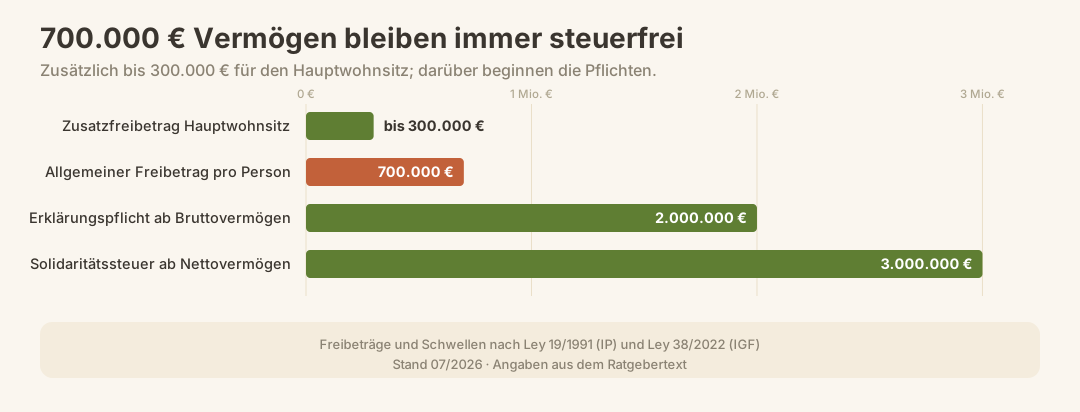
The national allowance is 700,000 euros per person. Only net wealth above this threshold is subject to tax. For Mallorca, however, that is not the relevant threshold: The Balearic Islands raised the minimum tax-free allowance to 3,000,000 euros per person on 1 January 2024 (Ley 12/2023). Where 700,000 euros is mentioned below, it refers to the national rules.
Additional allowance for your main home
For an owner-occupied main home (vivienda habitual), there is an additional allowance of up to 300,000 euros. This is deducted from the property's value before it is included in the tax base.
Regional differences
| Autonomous community | General tax-free allowance | Special provision |
|---|---|---|
| Balearic Islands | €3,000,000 (since 01.01.2024, Ley 12/2023) | Its own tax rates (see below) |
| Madrid | €700,000 | Historically, 100% tax relief; offset by IGF |
| Some other regions | May differ | Depends on regional rules |
| Non-residents | €700,000 (national standard) | Only Spanish assets are taxable |
Note: The exact allowances may vary by autonomous community. The figures given here reflect the position supported by the research for this article. Since 1 January 2024, the Balearic Islands have had a higher minimum tax-free allowance of 3,000,000 euros per person under Ley 12/2023. The national standard of 700,000 euros, plus a main-home allowance of up to 300,000 euros, is therefore no longer the relevant threshold in practice on Mallorca.
Obligation to file regardless of whether any tax is due
Even those who owe no tax must file Modelo 714 if their gross assets exceed €2,000,000 – this is a reporting obligation, resulting in “zero tax due”.
Tax rates: national, Balearic and solidarity taxes
National rates (Impuesto sobre el Patrimonio)
The nationally prescribed rates are progressive, ranging from 0.2% to 3.5%. The autonomous communities may set their own rates; if they do not, the national rates apply.
Balearic rates
The Balearic Islands have set their own tax rates. The research indicates a range of 0.28% to 3.45% on taxable net assets in the Balearic Islands.
Solidarity tax (IGF) – the supplementary national tax
| Tax | Applies from net assets of | Tax rate | Tax base |
|---|---|---|---|
| Impuesto sobre el Patrimonio (IP) | €3,000,000 (Balearic Islands) / €700,000 (national standard) | 0.2–3.5% (national) / 0.28–3.45% (Balearic Islands) | Worldwide net assets (residents) / Spanish net assets (non-residents) |
| Impuesto de Solidaridad de las Grandes Fortunas (IGF) | €3,000,000 in net assets | 1.70–3.50% | Worldwide net assets (residents) / Spanish net assets (non-residents) |
Important: Wealth tax payable to the autonomous community can be offset against the solidarity tax. This avoids full double taxation, but does impose a minimum tax, preventing regional zero rates from eliminating the tax altogether.
Residents and non-residents are equally subject to the solidarity tax if their relevant net assets exceed €3,000,000.
Modelo 714: the tax return form and how to file it
The Modelo 714 is the official form for Spain’s annual wealth tax return. It is filed electronically through the Agencia Tributaria (AEAT) platform.
Who must file?
- Residents whose worldwide net wealth exceeds the applicable allowance (€3,000,000 in the Balearic Islands; the standard national allowance is €700,000), plus any applicable main residence allowance
- Residents with gross assets exceeding €2,000,000 (even if no tax is payable)
- Non-residents whose net wealth located in Spain exceeds the applicable allowance
How do you file?
The return must be filed electronically only, either:
- Using the taxpayer’s own Certificado Digital or Cl@ve PIN
- Through an authorised tax adviser (asesor fiscal) or lawyer
Step by step: filing Modelo 714
- List all assets held on 31 December – property, bank accounts, securities, vehicles, jewellery and business interests
- Determine their values – particularly property values, using the rules set out above
- Compile deductible debts – for example, outstanding mortgage balances
- Calculate net wealth and compare it with the applicable tax-free allowance
- Determine which regional authority is responsible – Which Autonomous Community has jurisdiction over you? (Your place of residence if you are a resident; the location of the assets if you are a non-resident)
- Complete and file Modelo 714 electronically via the AEAT platform or through a tax adviser
- Arrange payment or a direct debit if any tax is due
Note: Modelo 714 is filed during the annual tax return filing season, which in Spain typically runs from April to July – alongside the income tax return (IRPF). The AEAT sets the exact deadlines each year; check the current dates directly at sede.agenciatributaria.gob.es.
Residents vs non-residents: the key differences
| Criterion | Resident (for tax purposes) | Non-resident |
|---|---|---|
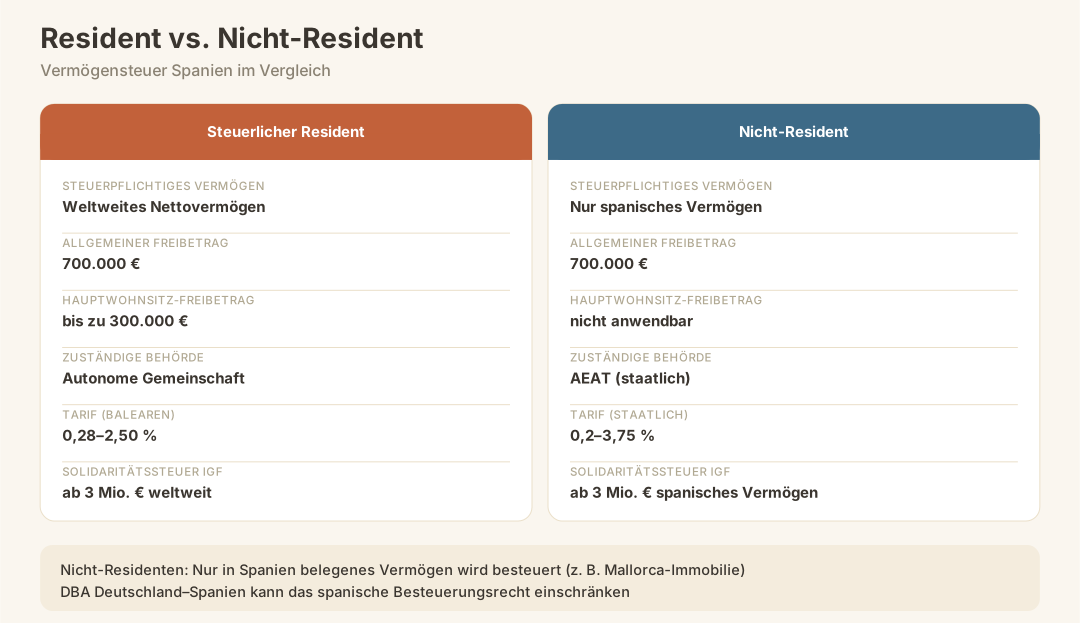
| Taxable assets | Net assets worldwide | Only assets located in Spain |
| Tax-free allowance | €700,000 (subject to regional adjustments) + up to €300,000 for your home | €700,000 (national standard) |
| Responsible tax authority | Autonomous Community where you live | National tax authority / AEAT |
| Applicable tax rates | Regional (e.g. Balearic Islands rates) | National rates |
| Solidarity tax (IGF) | Yes, from €3 million in worldwide net assets | Yes, from €3 million in Spanish net assets |
For German citizens who are not Spanish tax residents and own a property on Mallorca, the following applies: They are non-residents and are taxed only on assets located in Spain. The Germany–Spain double taxation agreement may limit Spain’s right to tax these assets – this should be assessed on a case-by-case basis.
If you’re thinking of moving your tax residence to Spain, first read our guide to taxes for residents (IRPF) and find out about Residencia.
Tax exemptions and what remains tax-free
Not all assets count towards taxable wealth. The research identifies the following relevant exemptions:
- Main residence (vivienda habitual): Up to €300,000 of its value is covered by an additional allowance
- Business assets and company shareholdings: Under certain conditions (such as active involvement, being the main source of income and a minimum ownership stake), company shares may be exempt from wealth tax – the precise rules are complex and require tax advice
- Works of art and cultural assets: Partially exempt in certain circumstances
- Pension products that are not yet paying out: Depending on how they are structured
Please note: The exemption for business assets (empresa familiar) is subject to strict conditions. Anyone using a holding company structure or owning property through an S.L. should seek advice early on from a tax adviser experienced in expatriate matters.
Wealth tax and solidarity tax: how they interact
The Solidarity tax (Impuesto de Solidaridad de las Grandes Fortunas, IGF) was introduced in 2022 as an additional national tax. It applies to net wealth of 3,000,000 euros and is charged at rates of 1.70% to 3.50%.
How does the tax credit work?
Wealth tax (IP) paid to the relevant autonomous community is credited against the solidarity tax. This means:
- Anyone living in a region with standard IP rates (e.g. the Balearic Islands) pays the difference between IGF and IP – or nothing if the IP already equals or exceeds the IGF.
- Anyone living in Madrid who has paid no IP thanks to the regional tax relief pays the full IGF.
Practical example (simplified): Net wealth of 5,000,000 euros, resident in Mallorca:
- IP under the Balearic rates is calculated on the amount above €3,000,000
- IGF is calculated on the amount above €3,000,000
- IP paid is credited against the IGF liability
For residents, the solidarity tax applies to worldwide net wealth; for non-residents, it applies to net wealth located in Spain.
If you also have assets abroad that you must declare on Modelo 720, it is particularly important to plan how these declarations work together.
The most common wealth tax mistakes in Mallorca
- Property valued incorrectly: Using the cadastral value even though the purchase price is higher – this can lead to additional tax payments following an audit.
- Main residence exemption overlooked: The additional exemption of up to 300,000 euros for an owner-occupied home is not claimed.
- Worldwide assets not declared: Residents must declare all assets worldwide – not just those located in Spain.
- Debts not deducted: Outstanding mortgages or other deductible liabilities are overlooked.
- Balearic tax rates not applied: Anyone living in the Balearic Islands is subject to Balearic tax rates – not automatically the national rates.
- Filing requirement ignored when no tax is due: If gross assets exceed 2,000,000 euros, Modelo 714 must be filed even if no tax is due.
- Deadline missed: The filing deadline coincides with the IRPF filing period – filing late can result in surcharges.
- Solidarity tax overlooked: Anyone exceeding the 3 million threshold must consider IGF separately, even if they already pay IP.
What comes next? Related tax obligations
Wealth tax is rarely your only tax obligation. These guides will help you understand the bigger picture:
- Income tax for residents: As a tax resident in Spain, you are liable for income tax on your worldwide income → Taxes for residents (IRPF)
- Non-resident tax: If you are a non-resident with a property in Spain, you are also liable for Impuesto sobre la Renta de No Residentes → Non-resident tax in Spain
- Modelo 720 – reporting foreign assets: Residents with foreign assets above certain thresholds must file Modelo 720 → Modelo 720 reporting requirement
- ETFs and investment funds: If you hold investment products, you should also understand how they are taxed → ETFs & index funds in Spain
- Beckham Law: Newly arrived professionals and entrepreneurs can apply for flat-rate taxation under certain conditions, which can also affect their wealth tax liability → Beckham Law Spain
- Balearic IRPF deductions: Mallorca residents are subject to regional income tax rules → Balearic IRPF deductions
- Luxury goods: Boats, yachts and high-value vehicles form part of taxable wealth → Importing a luxury car to Mallorca | Mallorca marina berth
Checklist: Am I liable for wealth tax in Mallorca?
Work through these points in order:
- Establish your tax residence: Am I tax resident in Spain (> 183 days / centre of economic interests)?
- List your assets: Gather details of all assets held on 31 December – including foreign accounts, funds and property
- List your debts: Record mortgages and other deductible liabilities
- Calculate your net wealth: Assets minus deductible debts
- Apply allowances: €3,000,000 per person in the Balearic Islands (standard national allowance: €700,000) + up to €300,000 for your main home
- Check the regional tax rates: Do you live in the Balearic Islands? → Balearic rates of 0.28–3.45%
- Check your gross wealth: Is it over €2,000,000? → You must file a return even if no tax is due
- Check the solidarity tax: Is your net wealth over €3,000,000? → Check whether IGF applies
- File Modelo 714 by the deadline: During the IRPF/IP filing season (typically April–July)
- Consult a tax adviser: Especially if you have assets abroad, company shares or are close to the threshold
Conclusion
The wealth tax in Spain is not a theoretical issue for many people relocating to Mallorca or buying property there, but a very real annual consideration. The Balearic tax-free allowance of 3,000,000 euros per person (national standard: 700,000 euros), plus up to 300,000 euros for a main residence, means that most people in Mallorca will not have to pay it. But anyone who owns a high-value property, holds financial assets abroad or exceeds the 3 million euro threshold needs to plan carefully.
The Balearic Islands have their own tax rates, ranging from 0.28–3.45%, which differ from the national rates. And the solidarity tax ensures a minimum tax liability even where an autonomous community has effectively abolished IP.
The key is to file Modelo 714 correctly and on time, declare all assets in full and make use of the available offsets between IP and IGF. An experienced tax adviser who understands German and Spanish tax law is essential, particularly if worldwide assets, company shares or luxury goods are involved.
Official sources
- Agencia Tributaria (AEAT) – Modelo 714: https://sede.agenciatributaria.gob.es — forms, deadlines and electronic filing
- Ley 19/1991, de 6 de junio, del Impuesto sobre el Patrimonio (BOE): https://www.boe.es/buscar/act.php?id=BOE-A-1991-14392 — the foundational law governing Spanish wealth tax
- Ley 38/2022 – Impuesto de Solidaridad de las Grandes Fortunas (BOE): https://www.boe.es/diario_boe/txt.php?id=BOE-A-2022-22138 — solidarity tax on large fortunes
- Ley 22/2009 – Finanzierungssystem der Autonomen Gemeinschaften (BOE): https://www.boe.es/buscar/pdf/2009/BOE-A-2009-20375-consolidado.pdf — basis for regional tax powers
- ATIB – Agència Tributària de les Illes Balears: https://www.atib.es — the Balearic Islands tax authority responsible for regional taxes
This guide provides a general overview of the legal position and does not replace legal or tax advice on your individual circumstances. Laws and deadlines may change; the linked official sources are authoritative.