
Renewing Your TIE in Spain: How to Extend Your Residence Permit in Time
The TIE renewal in Spain – it may sound like routine bureaucracy, but for thousands of residents every year it is a genuine ordeal: appointments at the Extranjería are scarce, documents must be current, and a single formal error sends you back to the end of the queue. This guide explains step by step from when you can submit your application, which documents are required depending on your residency type, how to pay the Tasas correctly, and what the Resguardo (the provisional certificate) permits you to do – and what it does not. We also highlight where the most common grounds for rejection lie in 2026, so you can avoid typical mistakes. The guide is equally aimed at EU citizens holding a TIE and at non-EU residents with a time-limited residence permit.

Do you need support with your TIE renewal, or are you wondering which residency option best suits your situation?
- 📩 Submit a personal enquiry — We connect you with vetted lawyers and gestorías in Mallorca
- Everything about residencia in Spain
What is the TIE – and who needs one?
The Tarjeta de Identidad de Extranjero (TIE) is the biometric residence permit for foreign nationals living legally in Spain. It is not the same as the NIE (Número de Identidad de Extranjero): the NIE is simply a tax identification number that remains the same for life. The TIE is the physical card that documents your residency status and carries an expiry date.
| Document | What it is | Does it expire? | Who needs it? |
|---|---|---|---|
| NIE | Tax/identification number | No | All foreign nationals dealing with authorities |
| TIE (non-EU) | Biometric residence permit | Yes | Non-EU nationals as residents |
| Certificado de Registro UE | Residency certificate for EU citizens | No (indefinite) | EU/EEA/Swiss nationals from 3 months onwards |
| TIE for EU citizens | Optional card based on EU certificate | Typically 5 years | EU citizens who wish to have a card |
Please note: EU citizens (Germans, Austrians, Swiss nationals) generally receive the green Certificado de Registro upon registration. They may additionally apply for a TIE card, but are not obliged to do so. Non-EU citizens, on the other hand, are required to hold the TIE.
For residents in Mallorca, the responsible authority is the Brigada Provincial de Extranjería e Inmigración de Baleares (National Police, Comisaría de Palma de Mallorca). Appointments are booked via the platform sede.administracion.gob.es.
When do you need to renew your TIE? The key deadlines
Timing is everything when renewing your TIE in Spain. Too early, too late – both have consequences.
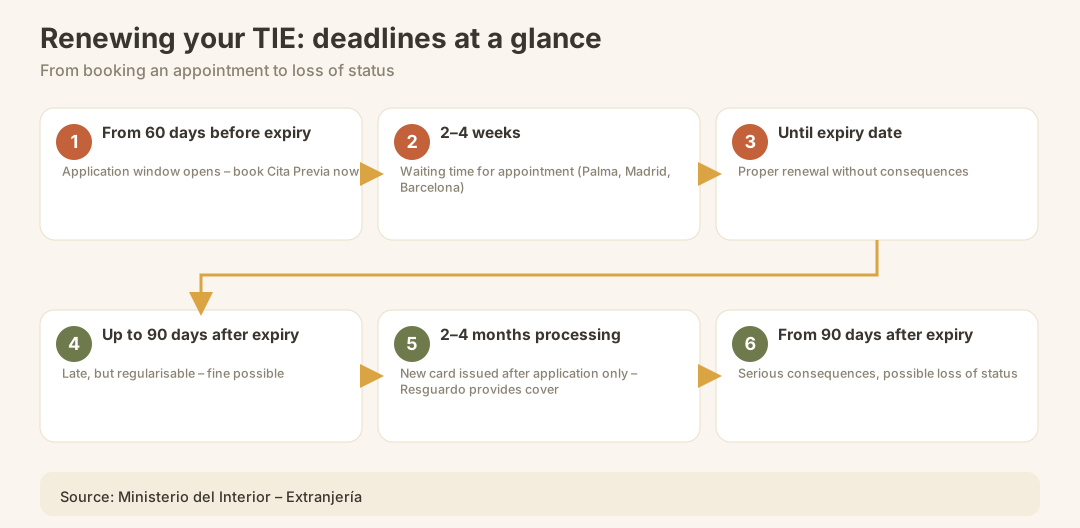
| Point in time | What happens |
|---|---|
| From 60 days before expiry | Application window opens; now book an appointment |
| By the expiry date | Renewal possible in an orderly manner without any consequences |
| Up to 90 days after expiry | Late, but still regularisable – a fine may apply |
| From 90 days after expiry | Serious consequences; possible loss of status |
The rule of thumb is: start looking for an appointment no later than 60 days before expiry. In high-demand provinces and cities (Palma, Madrid, Barcelona, Málaga), it can take 2 to 4 weeks just to secure an appointment through the Plataforma. Anyone who starts looking only 2 weeks before expiry risks a gap in their documentation.
Please be aware: Based on experience, the renewal of the physical TIE card takes, after submission of the application, 2 to 4 months, before the new card can be collected. During this time, the Resguardo (the acknowledgement of receipt from your authority) protects you from any disadvantage regarding your right of residence – but only within Spain.
Residence permit first, then the card: the correct order
A classic mistake: applying directly for the new TIE card without having first renewed the underlying residence or settlement permit (permiso de residencia).
The correct order is:
- Renew your residence permit (e.g. Residencia No Lucrativa, Trabajador por Cuenta Propia, Digital Nomad Visa, etc.) – this is done via the Ministry of the Interior or the Subdelegación del Gobierno
- Renew your TIE – only once the new permit has been granted, or at least applied for and the Resguardo issued, is the TIE card updated at the National Police
Some residence categories combine both steps into a single procedure – including in certain cases of long-term settlement (residencia de larga duración). Seek advice from your gestoría or lawyer as to which route applies to your specific residence status.
Which documents do you need? The complete checklist
The exact requirements vary depending on your residence type. Below are the core documents that generally apply to all categories – plus category-specific extras.
Base documents (all categories)
| Document | Details |
|---|---|
| Completed application form EX-17 | Standard form for TIE renewal |
| Current passport (original + copy) | All relevant pages |
| Existing TIE card (original + copy) | The expiring card |
| Current Empadronamiento certificate | No more than 3 months old; address must match the application |
| Paid Tasa (Modelo 790, Código 012) | Bring the bank's stamped receipt |
| 1 biometric passport photo | White background, recent |
| Proof of residence permit | Extended permiso or Resguardo from the Subdelegación |
Additional documents by residence type
| Residence type | Additionally required |
|---|---|
| Residencia No Lucrativa | Health insurance sin copago for the entire renewal period; proof of income (regular bank statements 3–6 months) |
| Trabajador por Cuenta Ajena (Employed) | Employment contract, payslips, social security proof |
| Autónomo (Self-employed) | Alta de autónomos, most recent tax returns, Modelo 303/130 |
| Digital Nomad / Nómada Digital | Remote work contract, proof of income from a foreign source |
| Reagrupación Familiar | Family status documents, proof from the primary permit holder |
| Long-term residence (5 years) | Proof of 5 years of uninterrupted residence |
Note for 2026: For the income assessment for the Residencia No Lucrativa, a high account balance alone is no longer sufficient. The Extranjería in several provinces requires regular, sustainable income on bank statements from the last 3 to 6 months – not a one-off sum that has since been almost entirely spent. This practice has noticeably tightened in 2026.
Health insurance: Why 'sin copago' is decisive
For all residents who do not have access to public health insurance (that is, primarily Residencia No Lucrativa holders and certain non-EU residents), private health insurance is a mandatory document for the renewal.
What is decisive here: the policy must be without an excess (sin copago). Policies with co-payments are rejected at several immigration offices. In addition, the insurance must cover the entire renewal period – not just the date of the appointment.
It is advisable to have the insurance confirmation issued directly by the provider in Spanish, with explicit reference to the period of validity and the note sin copago.
Further information on suitable cover: Health insurance in Spain and Private health insurance Spain comparison.
Booking a Cita Previa: How to get an appointment
The appointment (cita previa) for the TIE renewal is booked via the official platform of the Spanish administration:
sede.administracion.gob.es/icpplus
There you select:
- Province (e.g. Illes Balears)
- Trámite: "Policía - Toma de Huellas (Expedición de Tarjeta) y Renovaciones"
- Enter personal details (NIE, passport number)
- Select an available appointment and print or save the confirmation
Practical tip: In high-demand cities such as Palma, appointments are sometimes taken within minutes. Try early in the morning and on weekdays. If necessary, enable notifications via appointment-monitoring services – or engage a gestoría that checks regularly.
The Tasas: What you need to pay and how
The fee for the TIE renewal is paid using the Modelo 790, Código 012. The form can be downloaded and completed on the website of the Spanish police or the AEAT.
| Step | Detail |
|---|---|
| Complete the form | Modelo 790 Código 012, complete online and print out |
| Payment | At a bank counter only (no online payment without prior bank validation) |
| Deadline | Within 30 days of the appointment |
| Receipt | Bring the bank stamp — without the stamp, immediate rejection |
Caution: Expired Tasas (proof of payment older than 30 days after the specified date) will result in immediate rejection of the application. Always pay shortly before or directly after the appointment — but within the 30-day deadline.
The Resguardo: What it allows you to do — and what it doesn't
After submitting all documents, you will receive a Resguardo — a confirmation of receipt documenting that your renewal has been applied for. This Resguardo is your most important document during the often lengthy processing period (2 to 4 months).
| Situation | Permitted with Resguardo? |
|---|---|
| Continue living and working in Spain | ✅ Yes |
| Domestic flights / travel within Spain | ✅ Yes (as proof of identity together with passport) |
| Travel to other Schengen states | ❌ No — the Resguardo does not replace the physical TIE |
| Entry into third countries as a resident | ❌ Depends on the country, generally not recognised |
If you wish to travel abroad during the processing period, you should clarify this in advance with your relevant immigration authority or consult a lawyer.
Empadronamiento and address verification: a frequently underestimated issue
The Empadronamiento (municipal registration) is not only required for the TIE renewal — the address on your Empadronamiento certificate must match the address on the application. If you have moved since your last TIE and have not updated your Empadronamiento, the application will be rejected or significantly delayed.
Furthermore, the certificate must be no more than 3 months old — an outdated document will not be accepted.
We explain in detail how to update your Empadronamiento or apply for it for the first time in the guide: Empadronamiento Mallorca.
Most Common Mistakes When Renewing Your TIE
From experience: these are the mistakes most likely to result in rejection or avoidable delays.
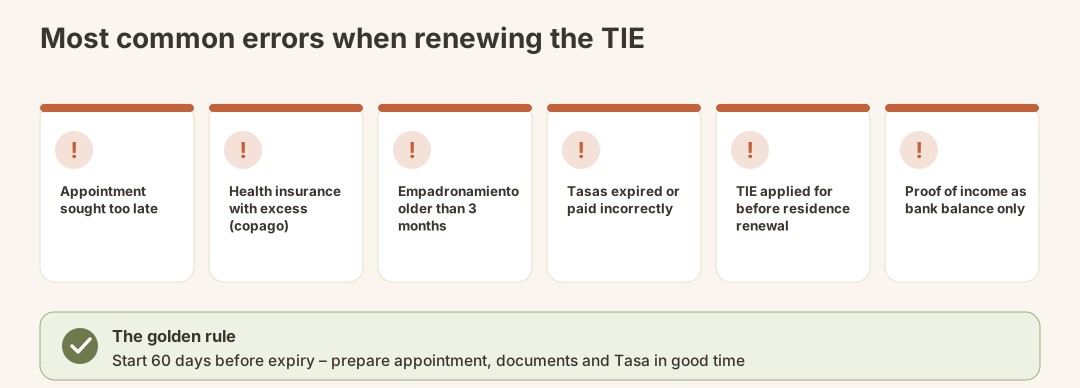
- Starting the search for an appointment too late – The combination of scarce appointment availability and lengthy processing times makes acting early (60 days before expiry) absolutely essential.
- Health insurance with an excess – Policies with co-payments (copago) will be rejected. Make sure you obtain explicit written confirmation that the policy is sin copago.
- Out-of-date empadronamiento certificate – The document must be no more than 3 months old; if you have moved, your address must be updated.
- Tasas that have expired or been paid incorrectly – Only valid receipts stamped at the bank counter will be accepted.
- Applying for the TIE without first renewing your residency permit – You must renew the permiso first, then apply for the card.
- Proof of income provided solely as an account balance – Bank statements must show regular, sustainable income, not merely a single large lump sum.
- Using the resguardo as a travel document – It is not valid for travel within the Schengen area.
- Missing or incorrect forms – The correct form is EX-17; other procedures require different forms.
What comes after renewing your TIE? Long-term residency and citizenship
Those who truly wish to make Spain their home should think beyond the renewal:
- After 5 years of uninterrupted legal residence you can apply for residencia de larga duración (permanent residency). This is open-ended and makes future renewals considerably more straightforward.
- After 10 years (fewer under certain conditions) Spanish citizenship possible. You can find out everything about this in the guide: Applying for Spanish citizenship.
- You should also keep an eye on your tax obligations as a resident – more on this under Taxes as a resident (IRPF) and Modelo 720 reporting obligation.
Checklist: Renewing your TIE in Spain
Use this list as a step-by-step check:
- 60 days before expiry: Book a cita previa at sede.administracion.gob.es
- Residence permit (permiso) renewed or renewal initiated
- Form EX-17 completed
- Passport up to date and fully copied
- Current Empadronamiento certificate (max. 3 months old, correct address)
- Proof of health insurance sin copago, valid for the entire renewal period
- Proof of income: bank statements for 3–6 months showing regular incoming payments
- Existing TIE card (original + copy)
- 1 recent biometric passport photo
- Modelo 790 Código 012 completed and paid at the bank counter (stamped receipt)
- All originals + copies brought to the appointment
- Keep the resguardo after the appointment
Conclusion
Renewing your TIE in Spain is not a complicated process – as long as you know the timeline and have all your documents in order. The 60-day window is not merely a recommendation but a practical necessity, as the combination of limited appointment availability and lengthy card processing times leaves no room for delays. Anyone living on Mallorca should book their appointment via the national police platform for the Illes Balears, pay attention to the sin copago requirement for health insurance, keep their Empadronamiento up to date, and pay the tasas at the bank counter. With good preparation – or the support of a gestoría – the renewal can be handled without any hassle.
Further useful guides: Authorities & registration Mallorca | Visa & Residency | Relocation Service Mallorca
Official Sources
- Sede Electrónica de la Administración General del Estado – Appointment booking (Cita Previa): sede.administracion.gob.es
- Ministerio del Interior – Extranjería – Forms, requirements and current procedural guidance: interior.gob.es/opencms/es/servicios-al-ciudadano/tramites-y-gestiones/extranjeria
- Agencia Estatal de Administración Tributaria (AEAT) – Modelo 790: aeat.es
- Subdelegación del Gobierno en Illes Balears – Competent authority for residence permits in the Balearic Islands: subdelegacion.gob.es/illes-balears
- Gobierno de España – Ley Orgánica 4/2000 (Ley de Extranjería, as amended from time to time): boe.es
- Reglamento de Extranjería (Real Decreto 557/2011): boe.es