
Family reunification Spain: Reagrupación familiar for non-EU nationals
Anyone who is not an EU citizen but lives permanently in Spain does not necessarily have to leave their family behind. Spanish law provides for this through the institution of Reagrupación familiar – family reunification in Spain. It allows legally resident third-country nationals to secure a legal right of residence for their closest family members, provided certain income, housing, and residency criteria are met. At the same time, a parallel route exists for non-EU family members joining an EU citizen who is themselves living in Spain. Both routes differ considerably in terms of procedure, documentation, and rights. This guide explains clearly and without bureaucratic jargon which route applies to you, what documents you will need, how long the process takes, and which mistakes you should absolutely avoid.

Would you like to know whether your specific situation meets the requirements?
- 📩 Submit a personal enquiry — we will assess your individual case and refer you to vetted legal experts
- Visas & Residency at a Glance
The two routes to family reunification: which one applies to you?
Spain essentially operates two legal frameworks when it comes to the reunification of non-EU family members. Which one applies depends solely on the status of the person already living in Spain (the so-called sponsor or principal applicant) — not on the nationality of the family member seeking to join them.
| Principal applicant in Spain | Applicable framework | Name of the permit |
|---|---|---|
| Non-EU citizen with a valid residence permit (e.g. work permit, NLV, DNV) | General immigration law (régimen general) | Autorización de residencia por reagrupación familiar inicial |
| EU citizen (or EEA / Switzerland) with residencia in Spain | EU freedom of movement law (régimen comunitario) | Tarjeta de familiar de ciudadano de la UE |
Please note: If you are yourself an EU citizen — for example German — and wish to bring your non-EU partner to Mallorca, the more favourable EU framework applies. The process is then different, faster, and involves fewer income requirements.
Who may join under the general framework (régimen general)?
Under the general framework, the following family members of a third-country national resident in Spain may apply for reunification:
- Spouse or registered civil partner (the partnership must be legally valid and comparable to marriage)
- Minor children of the sponsor or the spouse
- Adult children, where it can be demonstrated that they are dependent on support and that this dependency already existed in the country of origin
- Parents or parents-in-law, where they are of retirement age and can demonstrably be supported by the sponsor
Please note: Siblings, younger-generation grandparents, or other relatives do not in principle fall within the scope of family reunification in the legal sense — even where a strong dependency exists in individual cases.
Requirements for the sponsor: what you need to demonstrate
The crux of the process lies not with the family member seeking to join, but with the sponsor — the person already living in Spain. Anyone wishing to apply for family reunification must meet the following conditions:
| Requirement | Details |
|---|---|
| Minimum period of residence | At least 1 year of lawful residence in Spain prior to the application |
| Valid residence permit | Must still be valid for at least 1 further year (or be renewable) |
| Adequate housing | The accommodation must be suitable for the entire family joining (size, facilities); demonstrated by, for example, a rental agreement or land registry extract |
| Sufficient income | Proof of regular means; the precise threshold is based on the IPREM value |
| No criminal record | No entries in Spanish or country-of-origin criminal registers |
Regarding income: the IPREM (Indicador Público de Renta de Efectos Múltiples) is Spain's reference figure for social benefits and residence law. For the year 2026 it amounts, according to available sources, to €600 per month. The Non-Lucrative Visa (NLV) requires 400% of the IPREM for the main applicant, i.e. around €2,400 per month, plus an additional 100% of the IPREM (€600/month) for each further dependent family member. Similar benchmarks apply to family reunification under the general regime, which are assessed on a case-by-case basis by the competent Delegación del Gobierno.
Step by step: the application process
The procedure takes place in two phases — first in Spain, then in the country of origin of the family member who is joining:
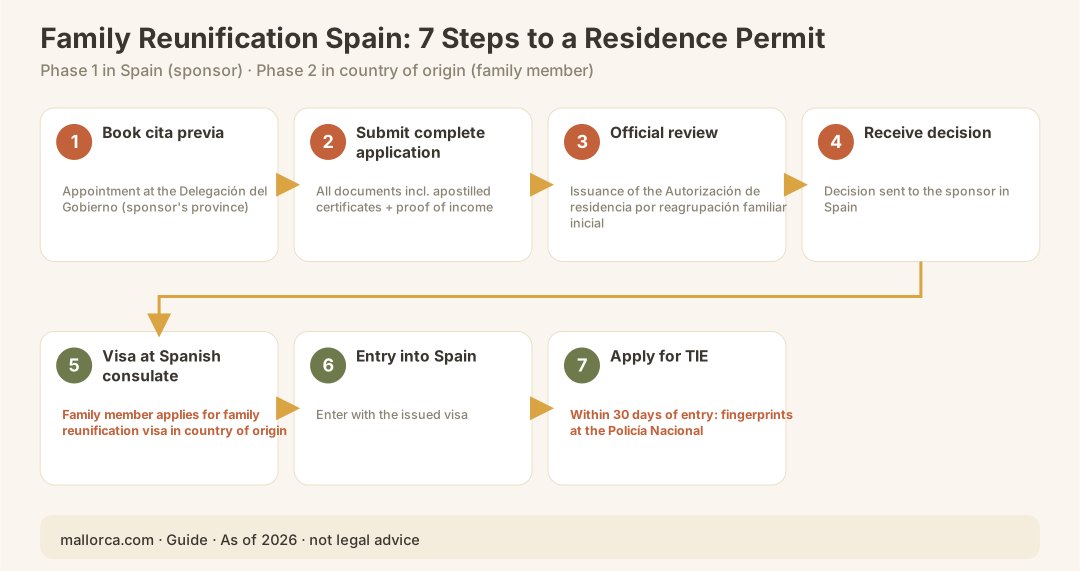
Phase 1: Spain (application by the sponsor)
- Cita previa (appointment booking) with the competent Delegación or Subdelegación del Gobierno in the province where the sponsor resides
- Submission of the complete application with all supporting documents (see the documents section)
- Official assessment and issuance of the Autorización de residencia por reagrupación familiar inicial
- Notification of the decision to the sponsor
Phase 2: Country of origin (application by the family member)
- The family member applies, using the authorisation granted, for the family reunification visa at the competent Spanish consulate
- Entry into Spain with the visa
- Within 30 days of entry: application for the TIE (Tarjeta de Identidad de Extranjero) at the Policía Nacional
Please note: Since new implementing regulations came into force on 20 May 2025, Spain has been building a centralised digital platform for residence procedures. From 2026 onwards, applications, renewals, and document submissions are increasingly to be handled online — which may represent a considerable simplification, particularly for applicants outside Spain.
Which documents do you need?
The precise list of documents varies depending on the family relationship. The following table provides an overview of the documents that are regularly required:
| Document | Sponsor | Family member joining |
|---|---|---|
| Completed application form (EX-02) | ✓ | ✓ (consular) |
| Valid passport (copy + original) | ✓ | ✓ |
| Current residence permit (TIE) | ✓ | — |
| Proof of family relationship (marriage certificate, birth certificates) | ✓ | ✓ |
| Proof of residence / property size | ✓ | — |
| Proof of income (payslips, tax return, pension notice) | ✓ | — |
| Police clearance certificate from country of origin | — | ✓ |
| Biometric passport photo | ✓ | ✓ |
| Apostilled and certified translations where required | ✓ | ✓ |
Please note: All foreign documents must generally be apostilled (Hague Apostille) and translated into Spanish by a sworn translator. Missing apostilles are one of the most common grounds for rejection.
The EU route: family member of an EU citizen
If you are an EU citizen (for example German or Austrian) living in Spain and wish to bring over your non-EU partner or children, a considerably more favourable regime applies — the régimen comunitario under Royal Decree 240/2007.
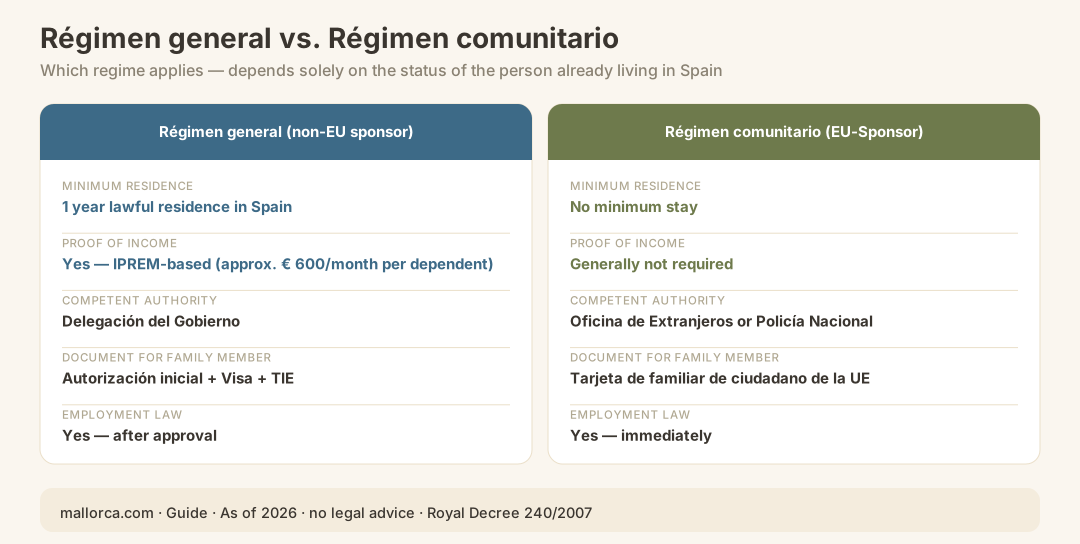
The joining person then does not apply for the family reunification visa under the general regime, but instead for the Tarjeta de familiar de ciudadano de la UE. The key differences are:
| Feature | Régimen general (non-EU sponsor) | Régimen comunitario (EU sponsor) |
|---|---|---|
| Minimum period of residence for the sponsor | 1 year | No minimum period of residence |
| Proof of income | Yes, IPREM-based | Not generally required |
| Cita previa / application | Delegación del Gobierno | Oficina de Extranjeros or Policía Nacional |
| Document for family member | Autorización inicial + visa + TIE | Tarjeta de familiar de ciudadano de la UE |
| Right to work upon joining | Upon approval | Yes, immediately |
Before the family member can submit the application, however, the EU citizen must themselves hold Residencia (Certificado de Registro de Ciudadano de la Unión). Find out more in the guide to Residencia Spain.
Rights of family members who have joined
A common misconception: the person who has joined is not limited to a mere residence status. Once permission has been granted, they have the following rights:
- Residence in Spain for the duration of the permission granted
- Work or study (expressly permitted under both the general and the EU regime)
- Access to the healthcare system – once padrón registration has been completed; find out more under Health insurance Spain
- Access to schooling for children – on equal terms with Spanish nationals
- Route to an independent residence permit after several years of residence
The family member's residence permit is initially derived – it depends on the sponsor's status. If the sponsor loses their right of residence, this can in principle also jeopardise the derived permission. After a certain period of residence, however, the family member may apply for an independent permit.
Housing: the underestimated sticking point
Spain requires the sponsor to demonstrate that they have suitable accommodation for the whole family. What "suitable" means is determined by the competent authority on a case-by-case basis – as a rule, it takes comparable housing conditions for Spanish nationals as its benchmark. In practice, this means:
- Sufficient floor space for the number of people in the family (a 30-m² studio for four people will generally not be accepted)
- Proof of right to occupy the property: tenancy agreement, land registry entry or notarially certified agreement
- Empadronamiento (municipal registration of residence) is helpful as additional proof, but is not strictly required in advance
On Mallorca there is a well-known bureaucratic catch: in some municipalities the Residencia is required in order to complete the Empadronamiento, and vice versa. In such cases, a certified rental or purchase contract can serve as a transitional solution when presenting proof of address to the authorities. More on registration in the guide Empadronamiento Mallorca.
The most common mistakes in family reunification
The following mistakes crop up time and again in practice – any one of them can lead to rejection or significant delays:
- Missing Apostille: foreign documents without a Hague Apostille are not accepted as a matter of principle.
- Out-of-date documentation: proof of income, police clearance certificates and health documentation must be current – as a rule, no more than three months old at the time of application.
- Wrong regime: applying under the general regime as an EU citizen (or vice versa) results in wasted time and fees.
- Incomplete translations: not all pages of a document have been translated, or the translator is not sworn.
- Application submitted too early: anyone who has not yet met the 1-year qualifying period as a sponsor will be turned down – even if only a few weeks are missing.
- Insufficient proof of accommodation: no tenancy agreement in your own name, subletting without the owner's written consent, or floor space not plausible for the family size.
- Failure to apply for the TIE: after the family member's entry, fingerprints for the TIE must be submitted within 30 days. This deadline cannot be extended.
What happens next? Renewal and independent status
The first residence permit granted under family reunification is time-limited – generally for the remaining duration of the sponsor's permit. After that:
- Renewal: as long as the sponsor retains their status and the conditions continue to be met, renewal is generally straightforward.
- Independent permit: after a certain period of residence – which varies depending on the circumstances – the reunited family member may apply for a residence permit independent of the main applicant.
- Permanent residence: after five years of lawful residence in Spain, there is a general entitlement to a long-term residence permit (residencia de larga duración).
- Tax implications: anyone who spends more than 183 days a year in Spain is treated as a tax resident. This has implications for income tax liability (IRPF). More on this in the guide Taxes as a Resident.
Family reunification checklist for Spain
Use this checklist before submitting your application:
- Sponsor has been lawfully resident in Spain for at least 1 year
- Sponsor's residence permit is still valid for at least 1 year (or is renewable)
- Suitable accommodation available and evidenced by a contract
- Proof of income current and complete (last three months)
- Sponsor's empadronamiento is in place
- Proof of family relationship (marriage certificate / birth certificate) apostilled
- Sworn translator engaged for all foreign-language documents
- Police clearance certificate for the joining family member (no older than 3 months)
- Cita previa booked at the relevant Delegación del Gobierno
- Family member informed about the 30-day TIE deadline after entry
- Health insurance for the joining person clarified (→ Health Insurance Spain)
Conclusion: Reagrupación familiar is worth it – if you are prepared
Family reunification in Spain is clearly regulated by law and, with careful preparation, perfectly manageable. The most common problems arise not from complex legal questions but from missing apostilles, incorrectly chosen procedures, and underestimated deadlines. The crucial first step is to establish early on which of the two regimes – general immigration law or EU freedom of movement – applies to your situation. A clear process then follows: application in Spain, visa in the country of origin, TIE after entry.
With the expansion of the digital platform from 2026 onwards, parts of the procedure should become simpler and more predictable. Until then, the rule is: good documentation is half the battle.
Official Sources
- Spanish Ministry of Foreign Affairs – visa for family reunification (régimen general): exteriores.gob.es
- Royal Decree 240/2007 (EU freedom of movement in Spain, basis of the régimen comunitario): boe.es
- Ley Orgánica 4/2000 (Immigration Act, LOEx) with subsequent amendments: boe.es
- ATIB – Agència Tributària de les Illes Balears (for tax matters in the Balearic Islands): atib.es
- Subdelegación del Gobierno en Illes Balears (competent authority for residence applications in Mallorca): interior.gob.es
- Policía Nacional – Extranjería (TIE application): sede.policia.gob.es
- IPREM figures (Ministerio de Hacienda): hacienda.gob.es