
Vida Laboral: Access your Spanish insurance history online
The Vida Laboral is the official record of all your registrations and deregistrations with Spanish social security – whether as an employee, Autónomo or domestic help. Anyone who lives or has worked in Spain will need this document sooner or later: for a mortgage, an application for unemployment benefit with the SEPE, the pension calculation by the INSS, or simply to prove how long you were registered with the Seguridad Social. Via the Import@ss portal, the report can usually be retrieved free of charge as a PDF within a minute. In this guide, we'll show you step by step how to identify what alternatives exist without Cl@ve or a digital certificate, exactly what the report contains – and what it deliberately does not show.

What is the Vida Laboral and what do you need it for?
The Vida Laboral (officially: Informe de tu vida laboral) is maintained by the Tesorería General de la Seguridad Social (TGSS). It lists chronologically all the periods during which you were registered under one of the Spanish social security schemes – as an employee under the Régimen General, as an Autónomo under the RETA, or, for example, under the Sistema Especial Empleados de Hogar. It includes the total number of days in Alta as well as the respective schemes under which you were insured.
The document is therefore far more than a mere formality: the INSS uses it to calculate pensions, the SEPE uses it to check entitlement to unemployment benefit, and banks frequently require it for mortgage applications as proof of a stable employment history.
| Purpose | Who typically requires the document |
|---|---|
| Pension calculation | INSS (Instituto Nacional de la Seguridad Social) |
| Applying for unemployment benefit | SEPE (Servicio Público de Empleo Estatal) |
| Mortgage or loan application | Banks |
| Proof of RETA membership | Autónomos, e.g. for subsidies or Tarifa Plana applications |
| Proof of professional experience | Employers, authorities, gestorías |
Note: If you have never been registered with Spanish social security, you will not receive a Vida Laboral. In this case, the "Acreditación de no tener Número de la Seguridad Social" is available instead via the same portal.
Vida Laboral vs. Informe de bases de cotización: the difference
A common point of confusion is the difference between the Vida Laboral and the Informe de bases de cotización. Both can be retrieved via Import@ss, but they answer different questions.
| Document | What it shows | Typical purpose |
|---|---|---|
| Vida Laboral | Periods of Alta/Baja, employers, schemes, total days of cotización | Proof of employment periods (pension, Paro, mortgage, Residencia) |
| Informe de bases de cotización | Monthly contribution assessment bases (salaries) | Exact calculation of the assessment base (base reguladora) for benefits |
| Informe de situación actual del trabajador | Current employment situation | Immediate proof that you are currently registered |
| Informe de actividades de trabajo autónomo | Registered activities as a self-employed person (autónomo) | Proof for autónomos when dealing with authorities |
The Vida Laboral therefore answers the question "How long and where have I worked?", while the Informe de bases de cotización clarifies the question "How much was earned and contributed each month?"
Requirements: Who can request the Vida Laboral?
The basic requirement is that you were registered at some point in your life under one of the Spanish social security schemes – whether currently or in the past. The report can be requested at any time; the information it contains is always current as of the date it is retrieved.
Important for anyone who has moved from Germany or Austria: periods completed abroad do not appear in the Spanish Vida Laboral not. Also not included are periods of military service or the equivalent substitute service (prestación social sustitutoria).
Note: For the later pension calculation in Spain, foreign insurance periods must be proven separately – for example, via the German pension insurance record. You can read more about this in our guide on German pensions in Spain.
Step by step: retrieving the Vida Laboral online via Import@ss
The fastest route is via the TGSS's Import@ss portal. With an electronic identification method, the report is usually available within a minute.
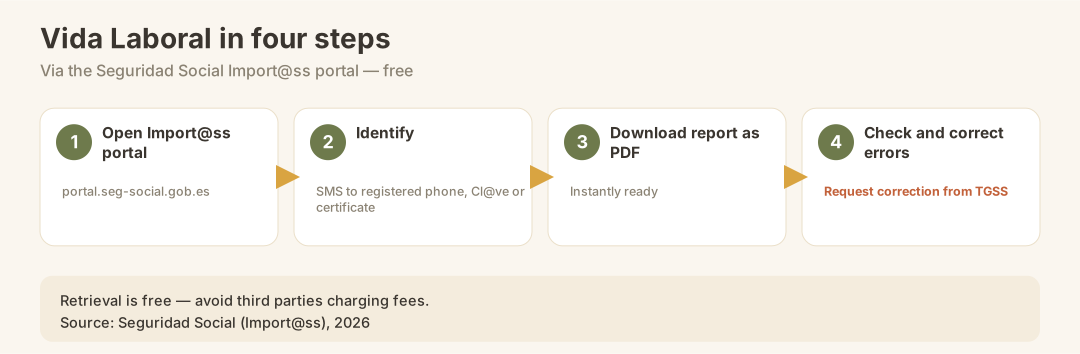
- Go to the Import@ss portal at portal.seg-social.gob.es and select the "Vida laboral e informes" section.
- Click on "Informe de tu vida laboral" and then on "Consultar vida laboral".
- Identify yourself with Cl@ve Permanente, Cl@ve Móvil, DNIe, an electronic certificate (Certificado Electrónico), or SMS verification.
- The report is displayed immediately as a PDF document showing the status as of the retrieval date and can be downloaded.
- If you notice an error – such as a missing period – you can request the correction or addition of the data directly within the portal.
| Identification method | Requirement |
|---|---|
| Cl@ve Permanente / Cl@ve Móvil | Prior registration in the Cl@ve system |
| DNIe (electronic ID card) | Card reader or NFC-enabled smartphone |
| Certificado Electrónico | Digital certificate installed on the device |
| Vía SMS | Mobile number registered with the TGSS |
Without Cl@ve or a digital certificate: these alternatives are available
Not everyone has one of the electronic identification methods mentioned – this is often the case for foreigners who have just moved to the area. For this situation, Import@ss offers two practical options.
Option A – Online application without electronic ID: You fill in your personal details, take a selfie and attach a photo of your identity document. Your identity is verified on this basis.
Option B – Postal delivery to your home: Using the "Recibir informe en mi domicilio" service, you can request the report by post. For this you need the following details, which must match exactly the data held by the TGSS:
| Detail | Note |
|---|---|
| First name, first and second surname | Second surname optional |
| DNI or NIE | Must match the TGSS registration |
| Date of birth | Day/month/year |
| Full address (street type, street, number, floor/door if applicable) | Must be identical to the address on file with the TGSS |
| Postcode and town | – |
| Email address | For status notifications |
Note: If your current address does not match the one stored with the TGSS, the postal delivery will fail. In this case, you must first have your address details updated. Anyone who does not yet have a fixed registered address in Spain should first complete the Empadronamiento.
Anyone who does not have any of the electronic methods can also register their mobile number with the TGSS via the "Te Ayudamos" service, in order to be able to access it by SMS in future. For this, a DNI/NIE and proof of ownership of the phone number are required.
You can check the processing status of a report requested by post at any time using the "Consulta de estado de solicitud de informes" function in the portal.
What exactly does the report contain?
The Vida Laboral gives you a complete overview of your recorded employment situation at the time of the download. Specifically, it includes:
- the total number of days you were in Alta
- all social security regimes you were registered under
- the exact dates of each Alta, Baja or data change
- any applicable Coeficiente de Parcialidad (part-time factor)
- the Cotización group you were classified in at each point
To make the numerous technical terms understandable, the report itself includes a section with explanatory notes – a kind of glossary of the terms used.
| Included | Not included |
|---|---|
| All Alta/Baja periods in Spanish regimes | Insurance periods completed abroad |
| Companies/employers per period | Military service periods |
| Cotización group and part-time factor | Prestación social sustitutoria |
| Total number of days in Alta | Salary details (see Informe de bases de cotización) |
For Autónomos: the Vida Laboral and proof of RETA registration
As a self-employed person, the Vida Laboral serves as official proof of how long you were registered under the RETA (Régimen Especial de Trabajadores Autónomos). This becomes relevant when applying for reduced contributions, for subsidies, or when a bank or authority wants to check your business continuity. In addition to the Vida Laboral, Import@ss offers, specifically for Autónomos, the Informe de actividades de trabajo autónomo (proof of registered activities) as well as the Acreditación de alta, baja o modificaciones en trabajo autónomo (copies of the respective registration/deregistration documents).
If you're just starting out as an Autónomo or want to organise your accounting, it's worth taking a look at our guides on accounting as an Autónomo, on the Tarifa Plana for Autónomos and on the topic of Falso Autónomo, which becomes relevant in cases of bogus self-employment. Anyone working remotely for a foreign employer and needing to register as an Autónomo will find details under Autónomo with a foreign employer.
For ongoing tax support, it's also advisable to engage an tax adviser in Spain or a suitable Gestoría in the Directory: Tax advisors & Gestorías to help you.
Most common mistakes
- Confusing the reports: The Vida Laboral is often confused with the Informe de bases de cotización – for pension calculations, you usually need both documents, not just one.
- Outdated address at the TGSS: For postal delivery, the address provided must match the TGSS records exactly – otherwise delivery will fail.
- Forgetting periods worked abroad: Anyone who worked in Germany before moving to Mallorca won't find these periods in the Spanish Vida Laboral and must prove them separately.
- Errors in the report are not corrected: Small gaps or incorrect periods should be reported early via the correction request in the portal – ideally well before applying for a pension.
- No electronic ID, but unaware of alternatives: Those who think they can't get the document at all without a Cl@ve often overlook postal delivery and selfie verification.
What comes next?
Once you've downloaded your Vida Laboral, you should check it for completeness: if periods are missing or details are incorrect, you can request correction or completion of the data in the same portal. If you're planning your retirement in Spain, you should also document your German insurance periods – details on this can be found in the guide Taxing German pensions in Spain. If you've just moved and don't yet have health insurance, also find out about the S1 form, which regulates the transition between healthcare systems. Anyone who, after checking their Vida Laboral, realises they don't yet have employment or want to change jobs, will find support at Finding a job on Mallorca.
Checklist: Retrieving the Vida Laboral
- Check whether you were ever registered with Spanish social security
- Determine your identification method: Cl@ve, DNIe, certificate, or SMS available?
- If not: choose selfie verification or postal delivery as an alternative
- For postal delivery: match your current address with the TGSS records (update beforehand if necessary)
- Download the report and check the periods for completeness
- Report errors directly in the portal for correction
- Document periods worked abroad separately if relevant for pension or residencia
- If needed, also retrieve the Informe de bases de cotización
Conclusion
The Vida Laboral is one of the most unassuming yet most important documents for anyone who works, has worked, or intends to apply for a pension, mortgage or official benefit in Spain. Thanks to Import@ss, obtaining it is usually straightforward and free of charge – provided you have one of the accepted identification methods to hand, or use the alternatives via selfie verification or postal delivery. It's important not to confuse this report with the Informe de bases de cotización, and to keep track of periods worked abroad separately, as these become relevant later when it comes to pensions or social benefits.
Official sources
- Tesorería General de la Seguridad Social – Informe de tu vida laboral: https://portal.seg-social.gob.es/wps/portal/importass/importass/Categorias/Vida+laboral+e+informes/Informes+sobre+tu+situacion+laboral/Informe+de+tu+vida+laboral
- Tesorería General de la Seguridad Social – Vida laboral e informes (overview of all reports): https://portal.seg-social.gob.es/wps/portal/importass/importass/Categorias/Vida+laboral+e+informes
- Tesorería General de la Seguridad Social – Informe de vida laboral a domicilio (postal delivery): https://portal.seg-social.gob.es/wps/portal/importass/importass/tramites/enviovidalaboraldomicilio
- Revista Seguridad Social – Cómo obtener el informe de vida laboral: https://revista.seg-social.es/-/c%C3%B3mo-obtener-el-informe-de-vida-laboral
- Import@ss Portal (main access): https://portal.seg-social.gob.es/wps/portal/importass/importass