
Falso Autónomo Spain: When Bogus Self-Employment Gets Costly
Anyone working in Spain as a self-employed person (autónomo) or employing people under this status operates in a legal grey area that has kept the authorities busy for years. The term falso autónomo – in English: bogus self-employment – refers to a person who is registered on paper with the RETA (Régimen Especial de Trabajadores Autónomos) but is treated in practice like a directed employee. Spain regards this as social security fraud, and the penalties are considerable: back payments, fines per person, and employment law claims from the affected individual themselves can hit a company hard. This guide explains how inspectors identify bogus self-employment, what specific consequences are at stake, what the Labour Statute (Estatuto de los Trabajadores) has to say on the matter – and how to structure your relationship with clients or contractors in a legally sound way.

- Tax adviser Spain expat — How to find the right asesor
What is a falso autónomo? Definition and legal basis
A bogus self-employed person works formally as an autónomo – they are registered with the RETA, issue invoices, and pay their own social security contributions – but in practice fulfils all the hallmarks of an employment relationship. The decisive legal basis is Article 1 of the Estatuto de los Trabajadores (ET): an employment relationship exists when someone works voluntarily, for remuneration, on behalf of another party, and under the direction of an employer.
Where this combination is present, the type of contract chosen is no longer relevant. Spanish employment courts and the Inspección de Trabajo y Seguridad Social look at the lived reality, not the wording of the contract.
Note: Bogus self-employment not only harms the individual concerned, who loses their employee rights (paid holiday, minimum wage, severance pay, employer sick pay). It is also costly for the company – and the Glovo case, in which a fine of nearly €79 million was imposed for bogus self-employment, brought this into the national headlines.
Four core hallmarks of an employment relationship under Art. 1 ET
| Hallmark | Genuine autónomo | Falso autónomo (indicator) |
|---|---|---|
| Remuneration | Performance-based, variable, per project | Fixed monthly fee regardless of output |
| Voluntariness | Free to choose whether and when to accept work | Permanent presence expected, refusals unwelcome |
| External control (assumption of risk) | Bears own entrepreneurial risk | Risk and profit lie with the client |
| Bound by instructions | Determines method, time, and location independently | Client stipulates location, time, and process |
The indicators inspectors look for
The Inspección de Trabajo follows a catalogue of indicators during audits. As a rule, no single characteristic is sufficient — the overall picture is what counts. Here are the most important warning signs known from practice:
Organisational dependency
- The client dictates start time, finish time, and place of work.
- The supposed freelancer receives internal circulars, operational instructions, or notices in exactly the same way as permanent employees.
- They use exclusively the client's tools, software, or equipment — no infrastructure of their own.
- The flow of information is controlled centrally by the company.
Economic dependency
- The person has only a single client or generates more than 75 % of their income from that client (also relevant to the TRADE status — more on this below).
- The fee is effectively a monthly salary, no fluctuating project fees.
- The client bears all material costs; the freelancer has no business expenses of their own.
Personal performance of services
- The individual must perform the work personally and cannot delegate to third parties – they must be present in person.
- There is an implicit expectation of exclusivity towards the client.
Caution: Even if the contract explicitly designates the arrangement as self-employment and the autónomo provides their RETA certificate, these indicators can trigger a reclassification. Spanish courts follow the principle of Realidad sobre la forma – substance prevails over form.
Falso Autónomo vs. Autónomo TRADE: The Distinction Matters
Anyone who is economically heavily dependent on a single client may under certain circumstances be classified as a TRADE (Trabajador Autónomo Económicamente Dependiente) – a special status enshrined in the Self-Employment Act (Ley del Estatuto del Trabajo Autónomo).
| Criterion | Genuine Autónomo | TRADE | Falso Autónomo |
|---|---|---|---|
| Share of income from one client | under 75 % | ≥ 75 % | irrelevant (de facto employee) |
| Own entrepreneurial risk | yes | yes | no |
| subordination/direction | no | limited | effectively complete |
| social security system | RETA | RETA (with additional protection) | should be in the Régimen General |
| entitlement to paid leave | no | 18 working days / year | unlawfully withheld |
| entitlement to severance pay | no | upon dismissal by the employer | unlawfully withheld |
TRADE status is not a free pass — it merely protects against the worst gaps. Anyone who does not meet the TRADE conditions yet works under complete subordination remains a falso autónomo.
What does the company face? Concrete consequences
The consequences of a reclassification by the Inspección de Trabajo are multi-layered and costly.
Back payments to social security
The company must pay all social security contributions retrospectively from the start of the actual employment relationship — that is, both the employer's and the employee's contributions due under the Régimen General, plus late-payment interest and surcharges.
Fines issued by labour inspectors
For each person affected, a fine of up to €12,000 may be imposed. Where multiple employees are affected, this amount is multiplied accordingly.
Employment law claims by the affected party
Once a worker has their bogus self-employment status established by a court, they become entitled to:
- Back payment of paid holiday
- Compliance with the applicable collective bargaining agreement for the sector
- Severance pay upon termination of the relationship
- Remuneration at the minimum wage rate, where the fee paid fell below it
Restricted access to public contracts
Companies found to have committed social security violations may be excluded from public procurement tenders.
| Consequence | Party liable | Amount / Scope |
|---|---|---|
| Social security Régimen General (backdated) | Employer | Employer's + employee's contributions from day 1 |
| Fine – Inspección de Trabajo | Employer | up to 12.000 € per person |
| Back payment of holiday, overtime, wages | Employer | individual (employee's claim) |
| Severance pay upon dismissal | Employer | pursuant to ET |
| Exclusion from public contracts | Company | for a limited period |
Note: The Glovo case – a fine of nearly 79 Millionen Euro for the bogus self-employment of thousands of delivery riders – demonstrates that the authorities, when faced with systematic practice, do not merely penalise individual cases but call the entire business model into question.
What consequences does the affected party themselves face?
The falso autónomo is not automatically off the hook either. Anyone who knowingly and actively participated in the arrangement may be held jointly liable – for instance if they issued invoices that gave the impression of genuine self-employment. In practice, the harsher sanction almost always falls on the company, as it is the economically stronger party that controls the arrangement.
What the person in question does lose, however: during the period of bogus self-employment, they pay their own RETA-Cuota (2026: typically between around €206 and around €623 per month, depending on income bracket), even though they would actually have been entitled to an employee position under the Régimen General — with an employer contribution. That is real money, gone for good.
In addition, contribution periods in the correct scheme are missing from the pension record. This can have a long-term impact on the level of pension received. More on this in the guide Claiming a pension in Spain.
How does an inspection by the Inspección de Trabajo proceed?
The Inspección de Trabajo y Seguridad Social typically examines bogus self-employment in several stages:
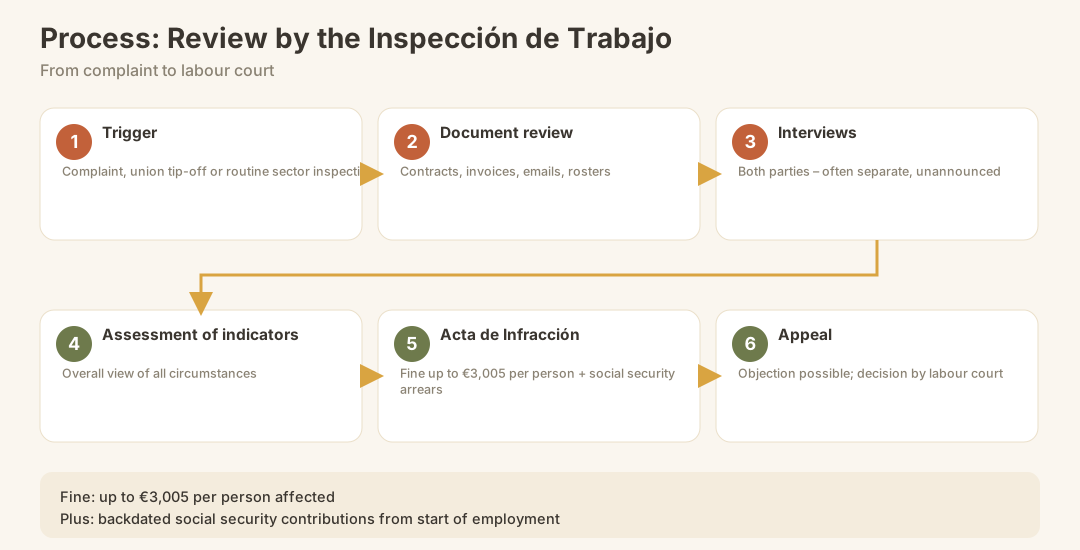
- Trigger: A complaint from an affected worker, a tip-off from a trade union, or an unprompted sector-wide audit (e.g. platform economy, hospitality, construction, IT services).
- Document review: Submission of contracts, invoices, proof of payment, internal communications (emails, chat messages), and duty rosters.
- Interviews: Inspectors question both the purported self-employed person and other members of staff at the company — often separately and without prior notice.
- Assessment of indicators: An overall assessment of all the circumstances. No single characteristic is decisive on its own.
- Acta de infracción: Formal notice of a fine, along with a demand to pay back the outstanding social security contributions.
- Right of appeal: The company may lodge an objection; ultimately, the decision rests with the employment tribunals.
Please note: Internal communications (WhatsApp groups with employees in which the "freelancer" also receives group notifications) are considered strong evidence of organisational integration.
The most common sectors and constellations
Bogus self-employment is not a niche phenomenon. The Inspección de Trabajo intervenes with particular frequency in the following areas:
| Sector | Typical constellation | Particular risk |
|---|---|---|
| Platform / Gig Economy | Delivery services, ride-hailing, tradesperson apps | Algorithm-driven scheduling = strong degree of instruction-dependency |
| IT / Software Development | Programmer working exclusively for one client | Long-term deployment within the company, fixed workplace |
| Hospitality / Tourism | Waiters, chefs on an "invoice basis" | Fixed shift rotas, uniform, company tools |
| Construction | Tradespeople without their own tools | On-site presence under supervision |
| Media / Creative Professions | Journalists, graphic designers working permanently for one publisher | Editorial meetings as a salaried member of staff |
| Sales | Field sales representative with a fixed bonus | Quota targets, company car, internal CRM systems |
The most common mistakes – and how to avoid them
Mistake 1: Having only one client (and that for years on end)
If, as an autónomo, you permanently derive almost all of your income from a single client, you are at the very least in the TRADE zone – or worse, a falso autónomo. The solution: actively build a second or third client relationship, even if your main client provides the bulk of the work.
Mistake 2: A fixed monthly fee with no link to performance
A fee that is transferred to the penny every month, regardless of how many hours were worked or which projects were invoiced, looks like a salary. Solution: invoices must itemise specific services rendered, and the remuneration should at least vary slightly.
Mistake 3: Working exclusively with the client's resources
Anyone who has no laptop of their own, no software of their own, no office of their own – and receives everything from the client – can hardly credibly demonstrate entrepreneurial independence. Your own equipment is not a luxury; it is a legal safeguard.
Mistake 4: No freedom to make your own decisions about method or working hours
If you are required to appear at the client's office at a fixed time every morning, there is very little room for argument. Genuine autónomo status means you can decline or reschedule assignments.
Mistake 5: No entrepreneurial risk of your own
A self-employed person wins and loses with their projects. Someone who receives a fixed monthly fee, never bears any expenses, and never declines an assignment carries no entrepreneurial risk – and that is a core characteristic of an employment relationship.
Mistake 6: Being treated the same as permanently employed staff in day-to-day working life
If the supposed freelancer is added to the same internal distribution list as the regular workforce, attends the Christmas dinner and holds a company card – by that point at the latest, the distinction has broken down.
How to structure a clean autónomo relationship
For businesses and self-employed individuals who want to set up the arrangement correctly, there are clear recommendations:
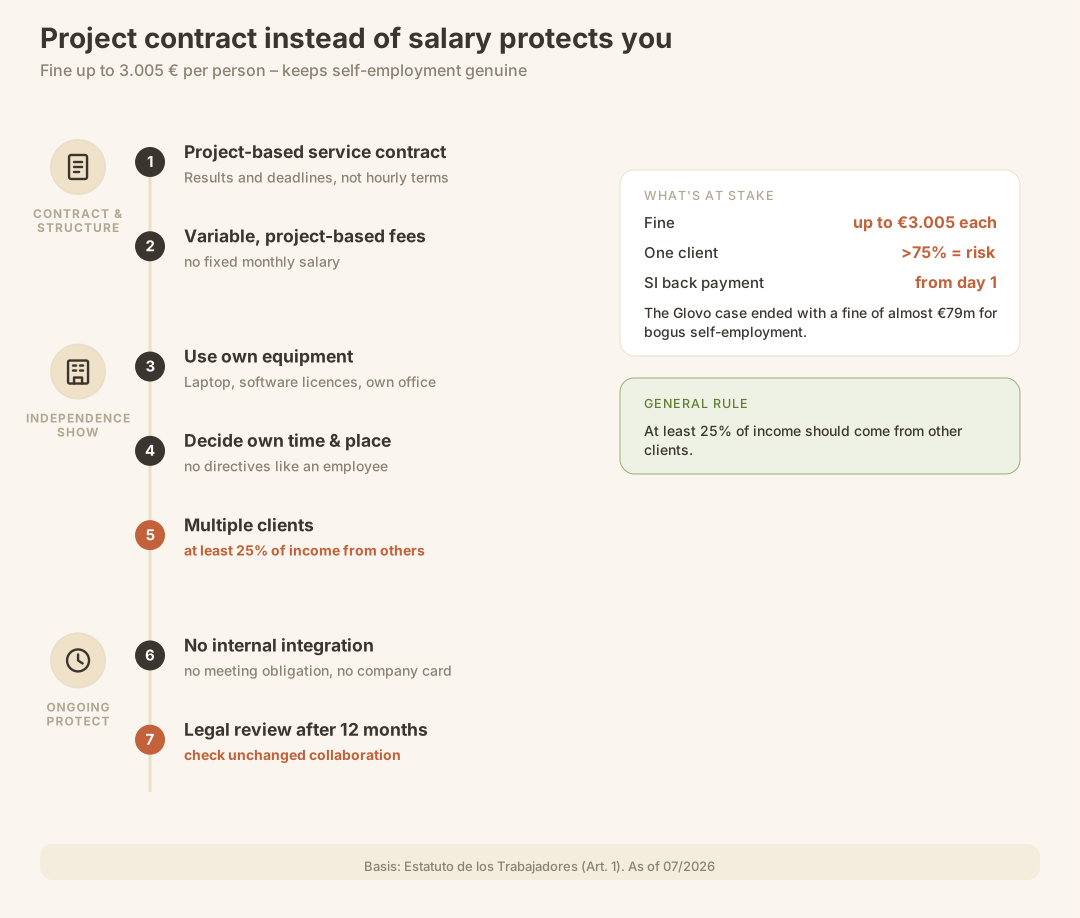
- Draw up a written service agreementthat describes specific projects, deliverables and deadlines – not hourly arrangements as found in employment contracts.
- Document independent scheduling: the autónomo decides for themselves when and where they work.
- Use own equipment: the freelancer's own laptop, software licences, office or co-working space.
- Aim for multiple clients: at least 25 % of income should come from other sources.
- Variable fees and project-based invoicing: invoices should always include a specific description of the services provided.
- No internal integration: no entry on internal distribution lists, no mandatory attendance at staff meetings, no company card.
- Regular legal review: at the latest, once a working relationship has lasted longer than 12 months without any structural change, a consultation is worthwhile.
Those who want additional peace of mind will find everything about tax compliance as a genuine autónomo in the guide on Modelo 303 & 130.
What comes next? When reclassification has already happened
Anyone who has received an Acta de Infracción or suspects that an inspection is under way should act immediately:
- Seek legal advice straight away: deadlines for lodging objections are short; without a specialist employment lawyer, they typically expire unused.
- Secure your documents: retain all contracts, invoices, correspondence and rotas.
- Do not make amendments without advice: retrospective changes to documents can heighten suspicion.
- Speak with the person concerned: an amicable solution can often be reached before an employment tribunal decides the matter.
- Consider regularisation: If the relationship effectively amounts to an employment arrangement, a voluntary switch to an employment contract can de-escalate the situation and reduce penalty surcharges.
Tax back-payments may also arise – for an overview we recommend reading Taxes as a Resident.
Checklist: Am I (or is my contractor) a falso autónomo?
Answer the following questions honestly with Yes or No. The more Yes answers, the higher the risk.
| Question | Yes = Risk |
|---|---|
| Does the client dictate daily working hours and location? | ✓ |
| Is there a fixed monthly fee regardless of services delivered? | ✓ |
| All or almost all income comes from a single client? | ✓ |
| Work is carried out exclusively using the client's tools/equipment? | ✓ |
| The autónomo cannot decline assignments or delegate them? | ✓ |
| Internal company communications are sent as if to employees? | ✓ |
| No entrepreneurial risk of one's own (no possibility of making a loss)? | ✓ |
| The working relationship has continued unchanged for more than 12 months? | ✓ |
| The autónomo has no client base of their own or other projects? | ✓ |
0–2 Yes: Probably a clean autónomo arrangement. 3–5 Yes: Grey area – legal review recommended. 6+ Yes answers: Serious risk of reclassification – legal advice strongly recommended.
Conclusion
The falso autónomo is no minor offence in Spain – it is social security fraud, and the Inspección de Trabajo takes it seriously. For businesses, reclassification means: backdated social security contributions, fines of up to €12.000 per person affected, and employment law claims. For the freelancers concerned, it means lost employee rights and unnecessarily paid RETA contributions.
The good news: anyone who gets the right structures in place from the outset – multiple clients, their own equipment, project-based remuneration, no organisational integration – is on safe ground. And anyone already caught in a problematic situation should act now, before an inspector comes knocking.
Official Sources
- Estatuto de los Trabajadores (Real Decreto Legislativo 2/2015): https://www.boe.es/buscar/act.php?id=BOE-A-2015-11430
- Ley del Estatuto del Trabajo Autónomo (Ley 20/2007): https://www.boe.es/buscar/act.php?id=BOE-A-2007-13409
- Seguridad Social – RETA (Régimen Especial de Trabajadores Autónomos): https://www.seg-social.es/wps/portal/wss/internet/Trabajadores/Afiliacion/10548
- Inspección de Trabajo y Seguridad Social: https://www.mites.gob.es/itss/web/
- Agencia Tributaria (AEAT) – Tax obligations for autónomos: https://www.agenciatributaria.es
- Real Decreto-ley 13/2022 (Reform of income-based autónomo contributions): https://www.boe.es/buscar/doc.php?id=BOE-A-2022-11281