
Autónomo with a Foreign Employer in Spain: Working Remotely the Legal Way
Working as an autónomo with a foreign employer in Spain sounds straightforward – and yet, legally speaking, it is anything but. Anyone working remotely from Mallorca or the mainland for a German, Austrian or Swiss company is simultaneously subject to Spanish tax and social security law, European coordination law, and the provisions of bilateral double taxation agreements. Get it right, and you benefit from the favourable Tarifa Plana, the Balearic Cuota-Cero bonus, and a clearly structured tax system. Get it wrong, and you risk back payments, permanent establishment liability for your client, and hefty fines from the Agencia Tributaria. This guide walks you through the registration process step by step, explains what you will actually pay each month, which contractual structure works, and which mistakes you should avoid at all costs.

- Remote work on Mallorca: an overview — visas, infrastructure, practical tips
Why the autónomo status is the right framework
If you are tax-resident in Spain and provide services to a foreign company – meaning you issue invoices, work on your own responsibility, and have no regular Spanish employment contract – you are, in most cases, a trabajador por cuenta propia, or autónomo for short. This is the Spanish equivalent of a sole trader or freelancer in the German-speaking world: no separate legal personality, with unlimited personal liability.
The key difference from employment: your foreign client does not pay you a salary with tax withheld at source – instead, you invoice them. You fulfil your tax and social security obligations independently in Spain. This also means you are the only one keeping track of deadlines – no employer HR team will remind you.
Please note: The autónomo status offers no liability shield. Business debts are personal debts. Anyone dealing with project risks, warranties, or liability issues should discuss with a tax adviser whether a Sociedad Limitada (SL) might be more appropriate.
An SL provides limited liability and can be more tax-efficient at higher profit levels – newly established companies pay 15 % corporation tax in their first two profitable years, then generally 25 % (or 23 % for SMEs with turnover below 1 million €) – compared with IRPF top rates of up to 47 %. However, it involves considerably more administrative overhead. For those just starting out, or with net income below approximately 60.000 €, autónomo status is generally the more pragmatic choice.
Requirements: what you need before registering
Before you submit the first Modelo, three things must be in place:
| Document / Status | Required for | Where to apply |
|---|---|---|
| NIE (Número de Identificación de Extranjero) | Tax ID, mandatory prerequisite | National Police, Comisaría; or consulate abroad |
| Residencia (TIE / EU certificate) | Proof of tax residency in Spain | Oficina de Extranjería or National Police |
| Empadronamiento | Municipal registration of residence, often a prerequisite for Residencia | Ayuntamiento of your municipality |
| Certificado Digital / Cl@ve PIN | Electronic communication with the tax office & social security | AEAT / Cl@ve portal |
| Spanish bank account | SEPA direct debit for Seguridad Social, tax refunds | Spanish bank |
You can find more information about the first steps with the authorities in the guide to Residencia in Spain as well as to Empadronamiento on Mallorca. You will need the Cl@ve PIN at the latest for your first digital dealings with the authorities.
Please note: EU citizens can become autónomo without requiring a special entrepreneur visa. Non-EU nationals, on the other hand, need an appropriate residence permit — either a self-employment authorisation or a specific visa. The process is considerably more involved.
Step by step: Registering as autónomo
The registration consists of two parallel procedures that must be coordinated in terms of timing:
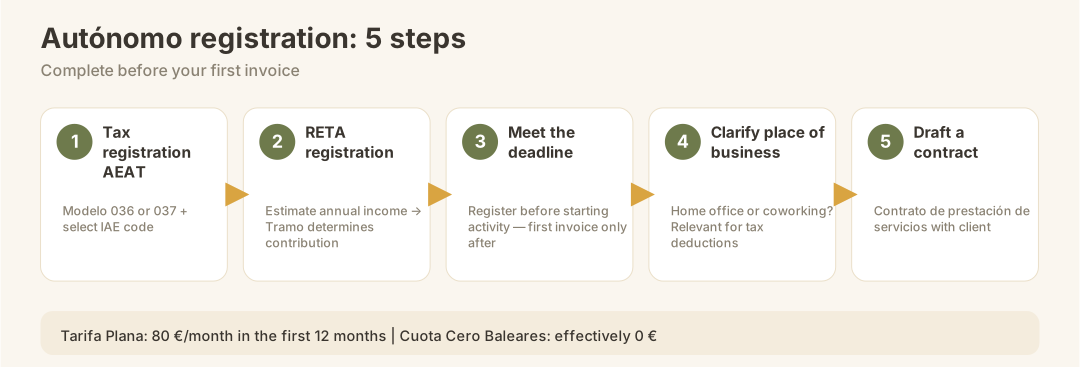
Tax registration with the tax office (AEAT): Submission of the Modelo 036 (full version) or the Modelo 037 (simplified version for individuals without VAT complexities). You select your IAE code (Impuesto sobre Actividades Económicas), which classifies your activity. Choosing the correct IAE code is not straightforward – an incorrect code can lead to problems with VAT obligations or during audits.
Registration with Social Security (RETA): The Régimen Especial de Trabajadores Autónomos is the mandatory insurance scheme for the self-employed. Registration is completed online via the Seguridad Social portal or at one of the local INSS offices. You will provide an estimate of your annual net income – this forms the basis of your monthly contribution.
Mind the deadline: Registration must be completed before commencing your activity – ideally several weeks in advance to avoid delays. The first invoice may only be issued once registration is fully complete.
Clarify your place of work and business premises: Are you working exclusively from home? Do you use an office or coworking space? This question is relevant for the subsequent deduction of operating costs and the question of permanent establishment (more on this below).
Establish a contractual basis with the client: A written service agreement (contrato de prestación de servicios) between you as an autónomo and the foreign company is strongly recommended – more on this in the next section.
The contract with the foreign client: what matters
Between you as a Spanish autónomo and the foreign company, there is no employment relationship in the legal sense – but rather a civil-law service contract. This may sound like a formality, but it is significant: neither the Spanish Employment Act (Estatuto de los Trabajadores) nor collective bargaining agreements apply to this relationship.
A well-drafted contract includes:
- Description of the service (Scope of Work), not of a post or role
- Fee structure (hourly rate, day rate, or project fee) and invoicing interval
- Intellectual property clause – who owns the work product?
- Duration and termination provisions
- Applicable law and jurisdiction – German law is frequently agreed upon, which provides security for the German client; Spanish tax rules apply nonetheless
- No exclusivity clauses that could effectively constitute an employment relationship
Warning – bogus self-employment (falso autónomo): The Spanish labour inspectorate (Inspección de Trabajo) actively investigates whether an autónomo is in reality a disguised employee. Criteria: Do you work exclusively for a single client? Are you fully integrated into their processes and working hours? Do you use exclusively the client's equipment? The more criteria that apply, the greater the risk of reclassification as an employment relationship – with backdated social security contributions for both parties.
Social security contributions 2026: the tramos system in detail
Since 2023, monthly social security contributions have no longer been based on a flat rate but on actual net income. The system comprises 15 income brackets (tramos) that determine the level of contributions. The key figures below apply to 2026; you should verify the precise amounts per tramo with the Seguridad Social or your gestoría, as they may be adjusted annually:
| Net annual income (tramo) | Minimum monthly contribution | Maximum monthly contribution |
|---|---|---|
| Up to €670 | 200 € | 260 € |
| 670 – 900 € | 220 € | 280 € |
| 900 – 1.166,70 € | 260 € | 320 € |
| 1.166,70 – 1.300 € | 290 € | 350 € |
| 1.300 – 1.700 € | 294 € | 350 € |
| 1.700 – 1.850 € | 310 € | 374 € |
| 1.850 – 2.030 € | 325 € | 390 € |
| 2.030 – 2.330 € | 340 € | 420 € |
| 2.330 – 2.760 € | 380 € | 480 € |
| 2.760 – 3.190 € | 435 € | 530 € |
| 3.190 – 3.620 € | 490 € | 590 € |
| 3.620 – 4.050 € | 530 € | 630 € |
| 4.050 – 6.000 € | 590 € | 680 € |
| 6.000 – 8.000 € | 660 € | 760 € |
| Over €8,000 | 720 € | 850 € |
Please note: At the start of the year you submit an estimate of your income. At the end of the year the social security authority reconciles whether you have paid too much or too little. Overpayments are refunded; underpayments are collected retrospectively. A realistic estimate is therefore very much in your own interest.
Tarifa Plana and Cuota Cero in the Balearic Islands
Anyone registering as an autónomo for the first time – or who has not been registered as an autónomo in the past two years – pays only €80/month for the first 12 months (Tarifa Plana), regardless of income. The Balearic Islands additionally offer the "Cuota Cero", which fully offsets this amount, meaning the net amount during this period is €0. This benefit is tied to the Balearic branch and must be actively applied for.
Important: The Tarifa Plana is forfeited immediately and permanently if the conditions are not correctly met – for example, if registration is late or an error is made in estimating income.
Taxes: IRPF, IVA and the Particularities of Foreign Clients
As a tax-resident Autónomo in Spain, you are subject to unlimited income tax liability in Spain on your worldwide income (IRPF – Impuesto sobre la Renta de las Personas Físicas). This applies even if your only client is a German company and you never receive a single euro into a Spanish account from a Spanish source.
IRPF: Advance Payments and Annual Declaration
You must make quarterly advance payments via Modelo 130:
| Quarter | Submission Deadline |
|---|---|
| Q1 (Jan–Mar) | by 20 April |
| Q2 (Apr–Jun) | by 20 July |
| Q3 (Jul–Sep) | by 20 October |
| Q4 (Oct–Dec) | by 30 January of the following year |
The advance payment is generally 20% of the cumulative net profit for the quarter, minus advance payments already made. At the end of the year, the actual annual tax return (Declaración de la Renta) follows, against which the advance payments are offset.
Note: Set aside at least 20% of your turnover as an IRPF reserve from the very first euro. Those who fail to do so face unpleasant surprises when filing their annual return. You can find more information on deductible expenses in the guide on IRPF deductions in the Balearic Islands.
IVA (VAT) with foreign clients
This is one of the most important particularities for autónomos with foreign clients: if your client is a company (B2B) based in another EU member state, you will generally issue your invoices without Spanish IVA. Instead, the reverse-charge mechanism applies — the client accounts for VAT in their own country. The invoice must include the note "Inversión del sujeto pasivo – Art. 69 LIVA".
| Client situation | IVA on invoice? | Modelo 303 still required? |
|---|---|---|
| EU company (B2B, with VAT ID) | No (Reverse Charge) | Yes, with nil balance; Modelo 349 additionally |
| Non-EU company (B2B) | No (Export) | Yes, with nil balance |
| Private individual in EU | Yes, 21 % Spanish IVA | Yes |
| Spanish company (B2B) | Yes, 21 % IVA | Yes |
For EU B2B transactions you must also submit the Modelo 349 (recapitulative statement of intra-Community services) on a quarterly basis. Details on Modelo 303 and 130 can be found in our guide on Modelo 303 & 130 for autónomos.
The double taxation agreement: your most important protective instrument
The DTA between Germany and Spain (agreement of 3 February 2011, in force since 2012) governs which state has the right to tax. For autónomos who are resident in Spain and carry out their activity there, the basic rule is: Spain taxes the income.Germany has no right to tax your fees, provided you do not maintain a permanent establishment in Germany and do not physically carry out your work there.
The practical implications:
- The German client is not permitted to withhold German withholding tax
- You will generally need to provide the client with a certificate of tax residence (certificado de residencia fiscal) issued by the AEAT – this confirms that you are liable to tax in Spain
- You can apply for the certificate of tax residence via the AEAT online portal or using your Certificado Digital
Please note: If you are physically working in Germany for your client on a part-time basis – for instance, travel, meetings, or project phases – Germany may acquire the right to tax that portion of your income. The DBA contains precise rules on when a permanent establishment is deemed to exist. Be sure to clarify this with a tax adviser who is familiar with both systems.
The permanent establishment risk: what it means for your client
The permanent establishment risk is the underestimated danger in this setup – and it affects not only you, but also your German client. A permanent establishment (establecimiento permanente) in Spain arises when a foreign company has a fixed place of business in Spain from which it carries out its activities in whole or in part.
In practice, this becomes a concern when:
- You, as an Autónomo, work on a permanent and exclusive basis for a single foreign client
- You hold powers of attorney to conclude contracts on behalf of the foreign company
- You effectively perform the role of an employee despite being formally registered as an Autónomo
- The foreign company is officially registered at your Spanish address
If the Spanish tax authorities determine that a permanent establishment exists, the consequences for the German company are severe: it would be required to pay corporate tax in Spain on the profits attributable to the permanent establishment and to register for tax purposes there.
How to minimise the risk:
- Multiple independent clients (no exclusivity)
- Clear contractual structure: own entrepreneurial risk, own working tools, no obligation to follow instructions
- No powers of attorney on behalf of the client
- Professional advice from a tax adviser with expat experience
Social security: Where do you pay in — and what do you get for it?
As an autónomo in Spain, you pay into the Spanish RETA system. This means:
- You are no longer contributing to the German pension insurance scheme (except under existing special arrangements or ongoing postings)
- You are entitled to Spanish healthcare through the Seguridad Social (the public system)
- You build up Spanish pension entitlements — contribution periods from EU member states are aggregated when calculating your pension
We have separate, in-depth guides on claiming a pension in Spain and on health insurance in Spain.
What about German health insurance?
Anyone working as an autónomo in Spain will generally leave the German statutory health insurance system. The Spanish Seguridad Social covers basic healthcare. Many expats supplement this with private health insurance — for more on this, it is worth taking a look at our private health insurance comparison for Spain.
Note for employees in transitional arrangements: If you are temporarily posted to Spain by a German employer (under EU Regulation 883/2004), you remain within the German social security system. In that case, however, you are not an autónomo but continue to be an employee — which is an entirely different situation.
Beckham Law: Is the special scheme worth it for you?
Compare the Beckham regime
Explanation
Annual gross pay from Spanish employment. The Beckham branch taxes this gross amount without deductions.
Explanation
Seguridad Social is Spanish social security. Enter the employee contribution; it reduces only ordinary IRPF, not the Beckham branch.
- Annual Beckham-regime advantage
- €13,734.00
Effective rates on gross pay: Beckham 24%, ordinary 35.45%.
Legal status: 1 January 2024
This calculation is provided for guidance only and is not a substitute for tax or legal advice in specific cases.
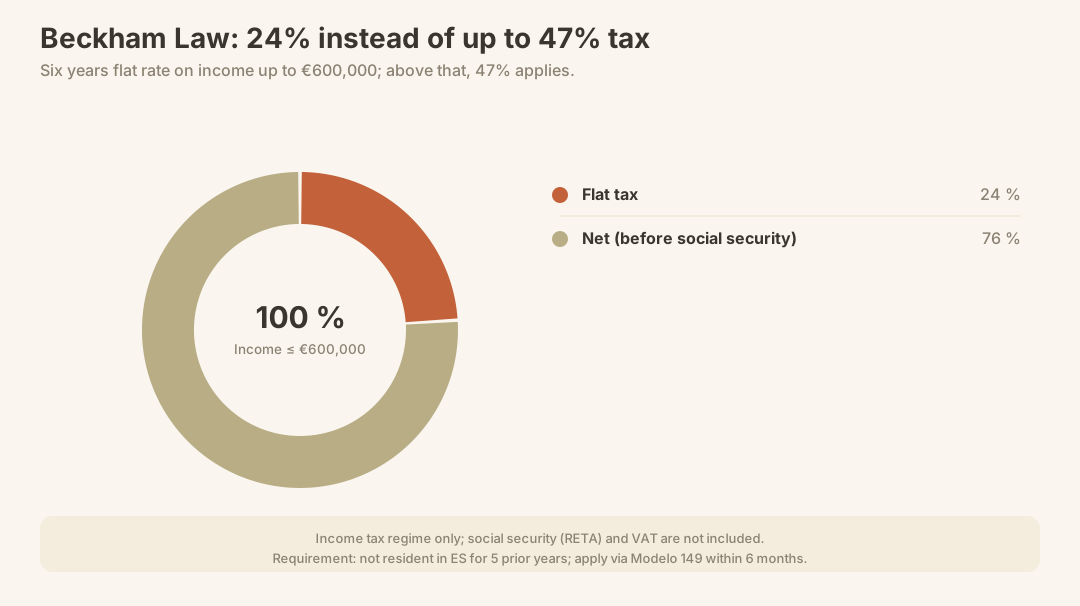
The so-called Beckham Law (Régimen especial para trabajadores desplazados) allows newcomers to Spain, under certain conditions, to pay a flat tax rate for six tax years of 24 % on income up to €600,000 to pay, instead of being subject to the progressive IRPF rate (up to 47 %). Income above €600,000 is taxed at 47 %.
Requirements (simplified):
- Not been tax resident in Spain during the last 5 years
- Relocation to Spain for professional reasons (taking up employment, setting up a business, innovative entrepreneurial activity)
- Application within 6 months of commencing activity in Spain (Modelo 149)
Since the Startup Law 2023, remote workers, innovative entrepreneurs and digital nomads can also use the scheme – so it is in principle of interest to autónomos with foreign clients as well. Read our comprehensive guide on the Beckham Law Spain.
Please note: Under the Beckham Law you are treated as a non-resident for tax purposes. This has side effects: you cannot use Spanish personal allowances, no income-splitting benefits for families, and certain foreign income falls outside Spanish taxation. Whether this is advantageous depends on your specific income structure.
Ongoing obligations: calendar for autónomos with foreign clients
Once registered, your administrative calendar runs reliably. Here is an overview of the most important deadlines:
| Deadline | Modelo / Obligation | Content |
|---|---|---|
| Monthly (direct debit) | RETA contribution | Social security contribution according to tramo |
| 20 April | Modelo 130 (Q1) | IRPF advance payment |
| 20 April | Modelo 303 (Q1) | VAT advance return |
| 30 April | Modelo 349 (Q1) | EC Sales List for EU services |
| 20 July | Modelo 130 (Q2) | IRPF advance payment |
| 20 July | Modelo 303 (Q2) | VAT advance return |
| 31 July | Modelo 349 (Q2) | EC Sales List for EU services |
| 20 October | Modelo 130 (Q3) | IRPF advance payment |
| 20 October | Modelo 303 (Q3) | VAT advance return |
| 31 October | Modelo 349 (Q3) | EC Sales List for EU services |
| 30 January | Modelo 130 (Q4) | IRPF advance payment |
| 30 January | Modelo 303 (Q4) | VAT advance return |
| 31 January | Modelo 349 (Q4) | EC Sales List for EU services |
| April–June | Modelo 100 | Annual income tax return |
| 31 March | Modelo 720 | Declaration of foreign assets exceeding €50,000 |
You can find further guides from us on tax obligations as a resident and on the Modelo 720.
Most common mistakes made by autónomos with clients abroad
In practice, gestoría offices and tax advisers see the same mistakes time and again. These are particularly costly:
1. Registering too late Anyone who issues their first invoice before the Modelo 036/037 and RETA registration have gone through risks fines and may lose the Tarifa Plana.
2. Incorrect income estimate for the RETA An estimate that is too low results in back payments. An estimate that is too high ties up liquidity unnecessarily. Estimate realistically and adjust the figure during the course of the year if your income deviates significantly.
3. Forgetting IVA on B2B invoices to EU companies Anyone who accidentally includes 21 % Spanish IVA on a B2B invoice to a German company creates difficulties for both themselves and the client. The correct approach is: zero rate with a reverse charge note.
4. No written contract with the client Without a contract, distinguishing the arrangement from bogus self-employment is harder to demonstrate. Always draw up a contrato de prestación de servicios — ideally bilingual.
5. Forgetting Modelo 349 The recapitulative statement for intra-Community services is overlooked by many autónomos. Missing Modelos result in automatic penalty notices.
6. No certificate of residence provided to the client Without this, the German client may, out of caution, make deductions or hesitate to make payments. Apply for it from the AEAT in good time.
7. Missing the Beckham Law deadline Anyone who does not submit the application within 6 months of commencing their activity (Modelo 149) loses the right permanently. No retrospective application is possible.
What comes next? Growth, financial security, and retirement planning
With an active Autónomo status and growing income, further questions arise that you should address early on:
Occupational pension provision and retirement: The RETA pension is generally considerably lower than a comparable employee pension, because Autónomos have historically opted for minimum contributions. The new Tramos system improves this in the long term, but the gap remains. Find out early about applying for a pension in Spain and private pension products.
Tax on investment income and overseas assets: Anyone who has savings in Germany, or holds ETFs or funds, must declare these correctly in Spain. The guides on ETFs & index funds in Spain and on the Modelo 720 are essential reading here.
Growth beyond the SL threshold: From a net income of approx. 60.000–80.000 € (depending on deductions), a Sociedad Limitada may become more tax-efficient. The switch is possible, but comes with costs and administrative effort. Have the figures run well in advance.
Wealth tax: Spain levies a wealth tax (Impuesto sobre el Patrimonio). In the Balearen, the current regional regulations should be checked. Details can be found in the guide on wealth tax in Spain.
Checklist: starting out as an Autónomo with overseas clients
Use this list as a progress check – tick off every point before you issue your first invoice:
- NIE obtained and valid
- Residencia / TIE applied for or already in place
- Empadronamiento completed
- Certificado Digital or Cl@ve PIN activated
- Spanish bank account opened
- IAE code for your activity researched and confirmed
- Modelo 036 or 037 submitted to the AEAT
- RETA registration completed with a realistic income estimate
- Applied for Tarifa Plana / Cuota Cero (Balearic Islands)
- Written service contract signed with the client
- Invoice template created with correct reverse-charge notation
- Certificate of residence (AEAT) submitted to the client
- Calendar set up for Modelo 130, 303, 349, 720
- Gestoría or tax adviser engaged
- Eligibility for Beckham Law checked (deadline: 6 months from commencement of activity!)
Conclusion
Working as an autónomo with a foreign employer in Spain is entirely lawful — provided you take the registration process seriously, understand the contractual structure, and consistently meet the ongoing deadlines. The new tramos system makes social-security contributions fairer, but also more complex: estimate your income realistically and set aside reserves in good time. The IVA rule for EU B2B services (no Spanish VAT rate, reverse charge) spares you unnecessary complexity in many cases — but only if the invoice is issued correctly. The permanent-establishment risk for your client is real and should be minimised through well-crafted contract terms and a genuinely independent way of working. And: no autónomo with complex cross-border relationships should operate without an experienced gestoría or tax adviser — the typical 50–100 € per month for this is the most sensible investment the whole setup can offer.
Official sources
- Seguridad Social – RETA registration: portal.seg-social.gob.es
- AEAT – Modelo 036/037: agenciatributaria.gob.es
- AEAT – Modelo 130 (IRPF advance payment): agenciatributaria.gob.es/Modelos
- AEAT – Modelo 303 (IVA): agenciatributaria.gob.es
- AEAT – Modelo 349 (recapitulative statement): agenciatributaria.gob.es
- AEAT – Modelo 720 (assets held abroad): agenciatributaria.gob.es
- Double taxation agreement Germany – Spain (BOE): boe.es — Agreement of 3 February 2011
- EU Regulation 883/2004 (social-security coordination): eur-lex.europa.eu
- Gobierno de España – Régimen especial trabajadores desplazados (Beckham Law): agenciatributaria.gob.es
- RDL 3/2026 (contribution system autónomos 2026): boe.es