
Alcanada

Places to stay near Alcanada
AdTo load the accommodation map by our partner Stay22, we need your consent for marketing cookies. Your consent applies to all marketing content on mallorca.com.
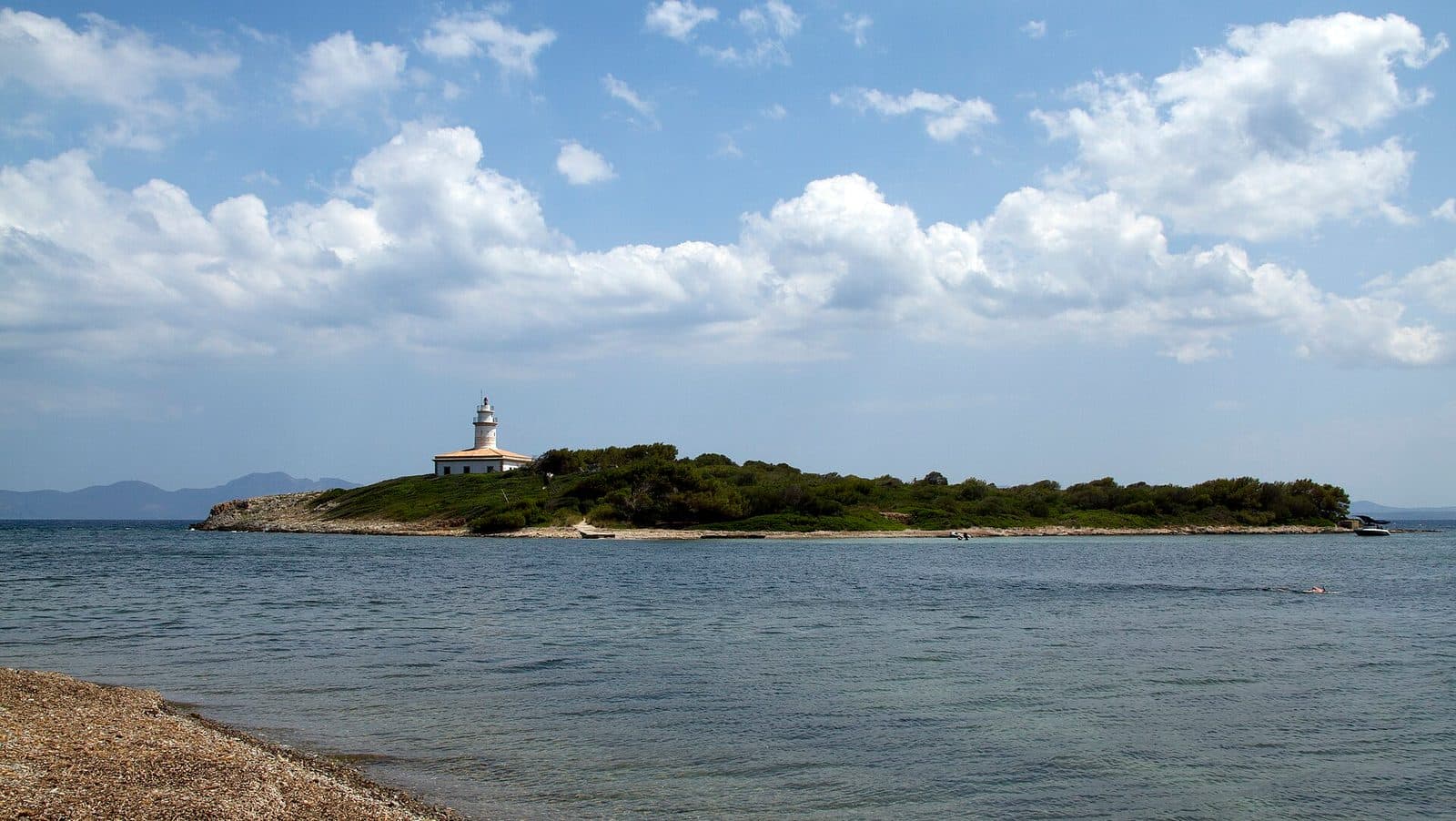
Alcanada is not a classic sandy beach for a day on a sun lounger. The roughly 700-metre stretch of coastline near Port d’Alcúdia consists of pebbles, some sand and washed-up Posidonia. Instead of an unbroken row of parasols, majestic pine trees stand close to the shore. Between them, you will find natural shade and unobstructed views of the small Illa d’Alcanada with its lighthouse. This particular combination sets the beach apart from the more developed sections of the Bay of Alcúdia.
The water is shallow by the shore, but the ground is not comfortable everywhere. Water shoes are therefore among the most useful things to pack. Alcanada is visited by local families as well as holidaymakers who want to swim, snorkel or go kayaking. It is not completely secluded during the season: the Balearic beach catalogue rates visitor numbers as high, and the crowds are particularly noticeable on summer weekends. Even so, the atmosphere remains more natural than at a beach with sun lounger hire, showers and a beach bar.
Where is Alcanada beach and what is it like?
Alcanada lies on Mallorca’s north coast, east of Port d’Alcúdia in the Bay of Alcúdia. It is about 3.5 kilometres along the coast from the centre of the port town. The beach forms part of the Cap des Pinar peninsula and is overlooked inland by the 151-metre-high Puig de sa Madona.
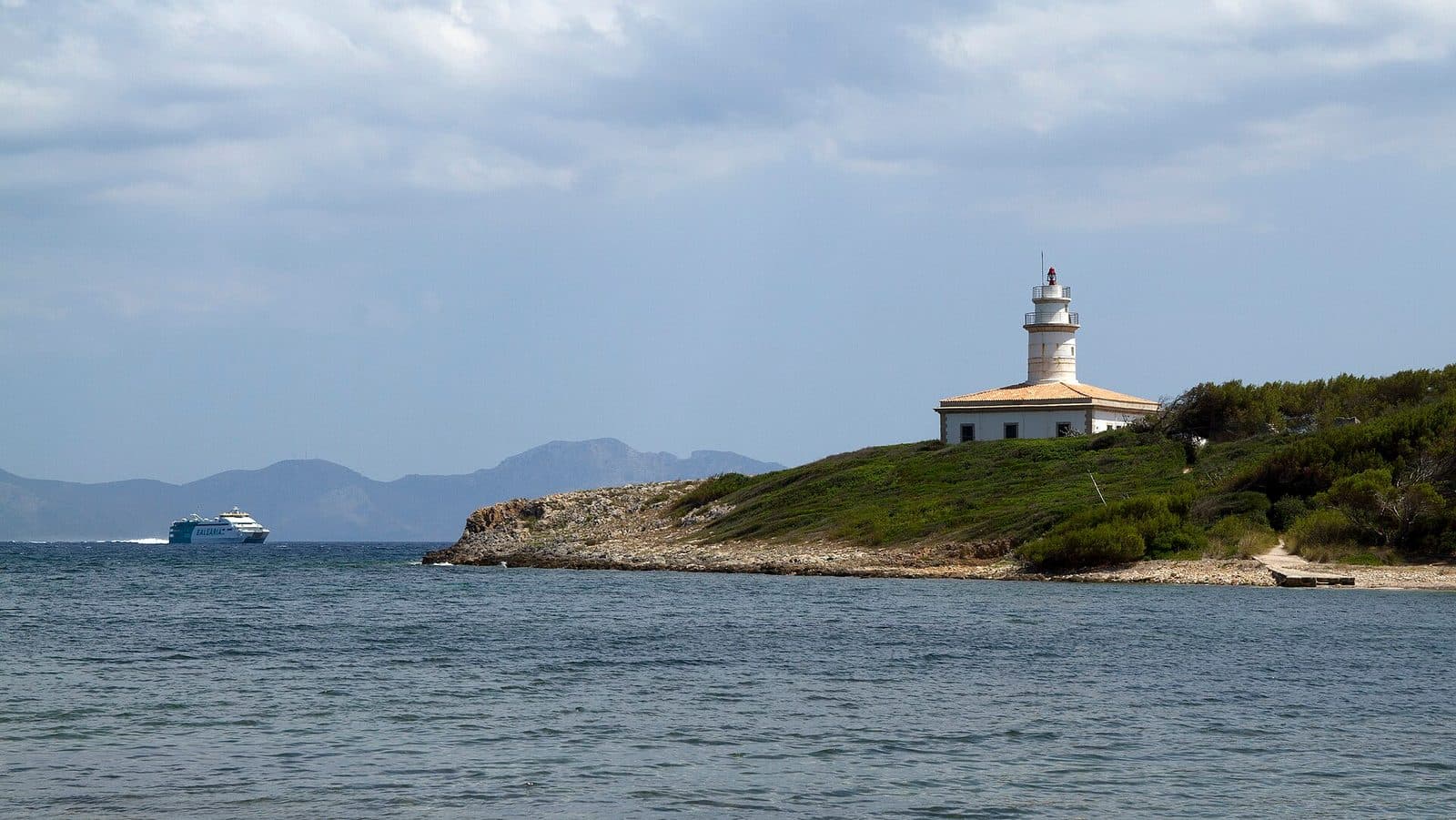
The defining landmark is Illa d’Alcanada immediately off the coast. A lighthouse stands on the small island and remains in view from almost everywhere on the beach. This stretch of coastline is not densely developed with tourist infrastructure. In places, pine trees reach close to the water, while pebbles, small sandy areas and dry Posidonia shape the shoreline.
The Balearic beach catalogue formally lists Alcanada as a sandy beach. Its detailed description, however, mentions little sand, numerous pebbles and Posidonia. The key point when planning your visit is therefore not to expect an uninterrupted beach of fine, soft sand. A thicker mat and sturdy water shoes will be more useful here than expecting a typical beach lined with sun loungers.
| Feature | Details |
|---|---|
| Municipality | Port d’Alcúdia |
| Distance from Port d’Alcúdia | about 3.5 km |
| Length | 700 m |
| Width | 20 m |
| Official beach type | Sand |
| Actual shoreline | little sand, many pebbles and Posidonia |
| Visitor numbers during the season | high |
| Accessible according to the Balearic beach catalogue | yes |
| Protected natural area according to the Balearic beach catalogue | yes |
| Height of Puig de sa Madona | 151 m |
At 20 metres wide, Alcanada is a relatively narrow strip of coastline. This means that the shaded areas, pebble zone, path and water are close together; on busy days, the beach feels full more quickly than the broad sandy beaches around the bay.
How do you get to Alcanada?
You can reach Alcanada by car or bus, as well as on foot or by bicycle from Port d’Alcúdia. By car, follow the Ma-3460 from Port d’Alcúdia towards the commercial port, then continue along the coast to the end of the access road. The beach and lighthouse island are easy to spot from there.
A flat walking and cycling path also runs along the coast from the port to Alcanada. The route is approximately three kilometres long. This option is particularly suitable if you do not want to look for a parking space and would like to include a walk or ride by the sea in your beach day.
TIB route 356 connects Alcúdia with the Alcanada area several times a day. The walk from the bus stop to the beach takes about ten minutes. The service runs only at limited intervals. Before setting off, check both your outbound journey and the last suitable return service, especially outside the main season.
Alcanada is also regularly approached or passed from the water. There is a sheltered anchorage in front of the lighthouse island. The Balearic beach catalogue identifies Port d’Alcúdia, 1.8 nautical miles away, as the nearest harbour facility.
Note: Boats must not anchor on Posidonia seagrass meadows. Because of the shallows east of the beach, the Balearic beach catalogue recommends anchoring closer to the middle of this stretch of coastline.
Where can you park at Alcanada beach?
A free public car park lies directly opposite the beach, with additional spaces available along the access road. The Alcanada Clavijo car park is located at the end of the road and is divided into three zones. Only a few trees provide shade over the parking spaces.
Spaces fill up quickly in summer, especially at weekends and during July and August. Arriving before 10 a.m. is a useful guideline. If the car park is already full, you can find additional spaces along the roadside and in the streets of the neighbouring residential area. The farther away you park, the longer the walk to the beach will be.
The Balearic beach catalogue describes access as easy and mentions a large car park directly beside the beach. The Mallorca.com business directory also lists the entrance and car park as accessible. The beach itself is likewise classified as accessible in the Balearic catalogue. At the same time, the shoreline consists of pebbles, Posidonia and uneven surfaces. These conditions can make moving beyond paved areas more difficult.
Note: During the high season, do not rely on finding a parking space immediately beside the water. The car park is generally less busy on weekdays and outside the main season.
Camping is prohibited in the surrounding area. The Balearic beach catalogue explicitly notes that people nevertheless occasionally camp there. A beach car park is therefore not automatically an authorised place to stay overnight.
What are the water, seabed and swimming conditions like?
The water off Alcanada is shallow and often calm by the shore, while pebbles, rocks and Posidonia make entering the sea more difficult in places. Directly along the coast, the seabed is predominantly sandy and slopes gently. Rocky areas appear a few metres farther out.
Water shoes protect your feet on the pebbles and sharp-edged stones. They are especially useful for children and when walking through washed-up Posidonia. When snorkelling, the transitions between sand, rocks and seagrass offer a variety of underwater habitats. Depending on conditions, you may see fish, sea urchins and starfish there.
The offshore island shelters parts of the swimming area from wind and waves. Calm conditions are not guaranteed, however: the weather, currents and boat traffic can change. Alcanada does not have a regular lifeguard service.
Alcanada is generally suitable for families who appreciate shallow water and supervise their children consistently. However, the stony shoreline is less comfortable than a fine sandy beach. Rocks and sea urchins farther out are additional reasons not to enter the water barefoot.
Warning: There is no regular lifeguard service at the beach. Do not go unnecessarily far out when there are waves, poor visibility or uncertain conditions, and keep children under direct supervision.
Can you walk or swim to the lighthouse island?
When the sea is completely calm, Illa d’Alcanada can be reached by swimming or kayak and, under suitable conditions, by wading. The Balearic beach catalogue gives a water depth of about 1.5 metres for the crossing. The island looks very close from the beach, but you will still be crossing open water.
The seabed alternates between sand and rocks, while currents and visibility may worsen depending on the sea conditions. The area is also used by boats, kayaks and other watercraft. The Balearic beach catalogue additionally mentions personal watercraft being launched at the island.
The crossing is safest when the sea is smooth, visibility is good and there is no apparent boat traffic. You are more visible on a kayak or paddleboard than as a lone swimmer, but you must still pay attention to the wind and other vessels. There is neither shade nor tourist infrastructure on the island itself.
Warning: Abandon the crossing as soon as the wind, waves or boat traffic increase. Do not swim across alone, and do not underestimate the short apparent distance.
The lighthouse on Illa d’Alcanada is the small island’s most distinctive structure. It is now automated. The island is a popular destination for swimmers and kayakers, especially for its views across the bay and back towards the pine-fringed beach.
What facilities are available?
Alcanada has only limited beach facilities and does not offer sun loungers or parasols for hire. There is also no beach bar or showers listed for the beach. Public picnic tables and benches stand beneath the pine trees in the area near the entrance.
You can find natural shade beneath pine trees and tamarisks, although it is not guaranteed to be directly beside your preferred swimming spot. When visitor numbers are high, these shaded areas are particularly sought after. Bringing your own sun protection remains advisable, especially if you plan to spend a long time on the open shoreline.
You should not count on public toilets being available. Mallorca Touristguide lists neither showers nor a lifeguard for Alcanada, while Alcudia Sea Trips likewise states that there are no public toilets directly at the beach. Park4Night does mark public toilets on Camí d’Alcanada, but their availability cannot be reliably assumed for a beach day.
There are no restaurants directly on the beach. The residential area of Alcanada includes La Terraza, Alcanada 35 Restaurante and the restaurant at Club de Golf Alcanada. Depending on where you start from on the beach, the walk may take only a few minutes or may be longer. If you want to stay for several hours, bring enough water and food with you.
The Balearic beach catalogue classifies the beach as accessible. The public car park is also listed as having an accessible entrance. Nevertheless, pebbles, Posidonia and rocky sections can make direct access to the water more difficult.
When is Alcanada at its best and how busy does it get?
Alcanada is usually quietest on weekdays, early in the morning and outside July and August. During the summer months, many local families and visitors come to the beach, especially at weekends. Both the shaded areas and parking spaces then fill up early.
During the season, you should generally expect strong demand: the Balearic beach catalogue rates seasonal visitor numbers as high. At the same time, visitors spread out differently than at the bay’s large tourist-oriented sandy beaches. Many people come specifically for the shade, shallow water, picnic areas and views of the lighthouse island.
Spring and early autumn are generally quieter than midsummer. For swimming and a possible crossing to the island, the actual conditions on the water matter more than the month or time of day. Early mornings are often considered calmer, but you should still check the wind, waves and boat traffic.
Anyone hoping to use the natural shade should also arrive early. Although the pine trees create a long green backdrop along the beach, the usable spaces beneath them are limited. On busy days, many families bring their own chairs, tables and picnic equipment.
What can you do around Alcanada?
Around Alcanada, you can snorkel, kayak, walk along the coastal path and explore historic sites in the surrounding area. The paved path behind the beach is suitable for a short walk beside the water. If you continue, you will reach smaller coastal coves and sections with rocks and Posidonia.
For snorkelling, the rocky areas and waters around the lighthouse island are particularly interesting. Depending on visibility and sea conditions, you may see fish, sea urchins and starfish. Water shoes are also advisable when entering the water with snorkelling equipment. You can paddle around the island by kayak, and in calm conditions visitors also explore the adjacent coastline.
The Torre Major, a defensive structure dating from the 17th century, stands nearby. It was used to protect the area from corsair attacks. Behind the coastal area is Club de Golf Alcanada, with an 18-hole course designed by Robert Trent Jones Jr.
For longer hikes, routes lead to Sa Cova Tancada, Coll Baix beach and Atalaya d’Alcúdia. The route to Sa Cova Tancada is considered challenging and is recommended only for experienced hikers. There are no reliably documented shops or supply points along these routes, so sturdy footwear and sufficient water are essential.
If you want to combine culture with a beach visit, Alcúdia and its walled old town lie within the wider area. There you will find the Porta de Xara and Porta de Sant Sebastià town gates, as well as the Roman theatre of Alcúdia.
What practical points should you consider before visiting?
For Alcanada, you should pack water shoes, water, food and your own sun protection. The beach offers natural shade but has no sun lounger hire, showers, beach bar or lifeguard service. A padded mat will make sitting on the pebbles and dry Posidonia more comfortable.
Leave washed-up Posidonia in place whenever possible. It belongs to the natural coastal environment, and the seagrass meadows in the water must not be damaged by anchors. Boats must use the marked anchoring areas; east of the beach, the Balearic beach catalogue warns of shallows.
Particular care is required if you bring a dog. The Balearic beach catalogue refers generally to municipal regulations prohibiting pets on beaches. However, a dog-friendly section is mentioned at the far end or along the continuing coastal path. If you visit with a dog, use only clearly signposted areas and follow the current signs on site.
The shallow water is an advantage for families, but it is no substitute for supervision. Pebbles, rocky areas, sea urchins and the absence of lifeguards require attention. A crossing to Illa d’Alcanada should only be considered when the sea is calm and visibility is good.
Note: Pack so that you can manage without an open toilet, restaurants or rental services. Alcanada is deliberately not a fully serviced beach.
How do I get from Port d’Alcúdia to Alcanada?
Can I park directly at Alcanada beach?
Is Alcanada suitable for children?
Is there natural shade at the beach?
Are dogs allowed at Alcanada beach?
When is Alcanada least crowded?
What facilities are available in Alcanada?
What is an alternative to Alcanada?
Weather
Currently in Port d'Alcúdia: 23°C · Partly cloudy
Getting there by bus
Platja d'Alcanada (3066) · 0.1 km as the crow flies
- 323Alcanada - Es Mal Pas · Daily
Cala en Poncet 1 (3024) · 0.5 km as the crow flies
- 323Alcanada - Es Mal Pas · Daily
Cala en Poncet 2 (3067) · 0.5 km as the crow flies
- 323Alcanada - Es Mal Pas · Daily
Timetable data: official GTFS feeds (TIB/EMT), no real-time — check with the operator before travelling.
Food & drink nearby
Restaurante Golf Alcanada
Restaurant· 421 m· 4.5(1433)
Restaurante Coralian
Restaurant· 475 m· 4.3(31)
Restaurant La Terraza
Restaurant· 533 m· 4.2(2166)
El Café de Aucanada
Café· 623 m· 5.0(2)
ALCANADA 35 Restaurante
Restaurant· 1.2 km· 4.6(1033)
Restaurante Mediterráneo
Restaurant· 1.2 km· 4.7(38)
Run a business near this beach?
Add your business to the directory for free and reach visitors right on this page.
.jpg)