
Mallorca Water Temperature: Month by Month Overview
Anyone wanting to know when the sea off Mallorca is truly inviting should look not at the air thermometer but at the water temperature itself. It follows its own, distinctly more sluggish rhythm than the air temperature, which means the best time for a swim falls differently than one might assume from looking at the sunshine. This article traces the course of the year, ranks the months by swimming suitability, and explains why the sea lags so stubbornly behind the air.
Water temperature through the year
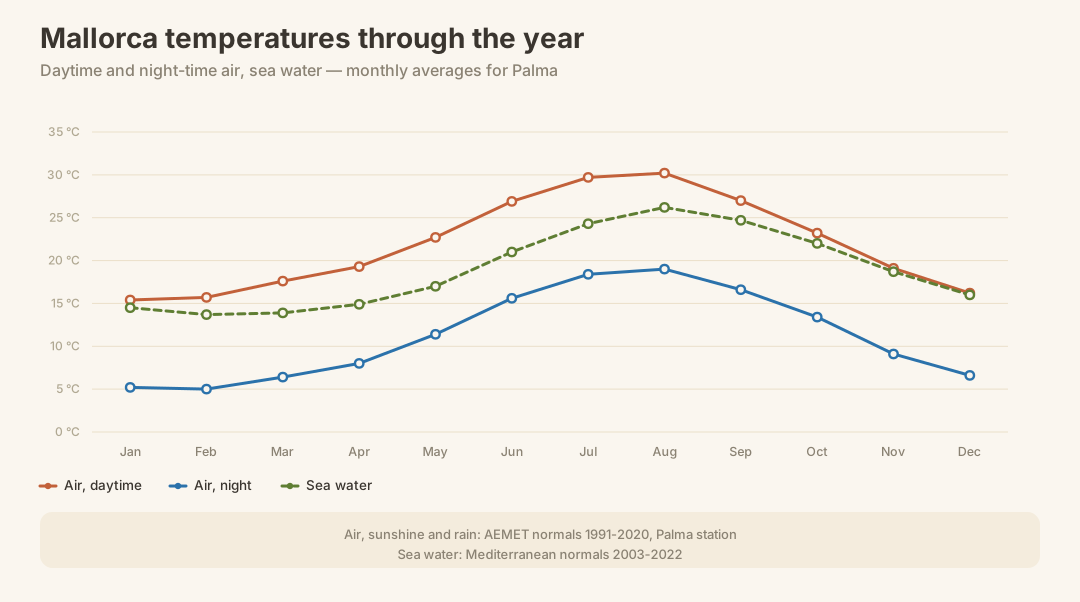
The sea around Mallorca follows a markedly calmer curve over the year than the air above it. The annual mean water temperature is 18.9 °C, but this figure conceals just how wide the gap between the extremes really is. The sea is coldest not in the depths of winter but in February, when it drops to 13.7 °C. Only after that does a long, unhurried warming begin: March, at 13.9 °C, brings barely a turnaround, by May the figure already stands at 17.0 °C, and in July the sea reaches 24.3 °C. Yet its peak comes not at the height of summer but only in August, at 26.2 °C — and it holds nearly this level into September, at 24.7 °C. Only after that does the decline begin, tentatively at first in October at 22.0 °C, more noticeably in November at 18.7 °C, and finally in December at 16.0 °C.
The key finding for trip planning lies precisely in this delay: while the air reaches its low point as early as January and its peak in July, the sea lags around two months behind both extremes. The coldest water is found in February, the warmest in August. Anyone choosing their travel dates purely by air temperature can easily miss the actual high point of the swimming season, which only sets in once the summer heat over the island has already passed its peak. This sluggishness is no Mallorcan quirk but a physical property of the sea that shapes the entire annual course, and which is explained in more detail in the following section.
From when the sea is suitable for swimming
For the practical question of when one actually wants to go into the water, it is worth dividing the year into sensation levels. In the winter months and well into spring, the water temperature sits in a range best described as cool to cold — suitable for a short, refreshing dip, but hardly inviting for lingering. This phase runs from January into April, with its low point in February. May marks the start of a transitional period: the water becomes noticeably milder, though for many it remains more refreshing than genuinely warm. Only in June, when the water temperature reaches 21.0 °C, do most people go in without much hesitation — for the majority, this month marks the real beginning of the swimming season.
From July to September the water temperature sits consistently in a range one can unreservedly call warm, peaking in August and dropping only marginally in September. What stands out is just how long this pleasant level persists: October does not cool nearly as much as one might expect given the noticeably cooler air. At 22.0 °C, the water temperature in October is even higher than in June at 21.0 °C — an effect that surprises many travellers who mistakenly consider autumn the poorer time for swimming. So anyone seeking warm water while wanting to avoid the summer heat and the crowds of peak season will actually find October the smarter alternative to June. Only in November does the sea cool noticeably, gradually leaving the range most people still find pleasant. This extended autumn swimming season is one of the practical benefits that follow directly from the sea's thermal inertia.
Why the water lags behind the air
The reason for this delay lies in a simple physical property: water stores heat far better than air and also releases it much more slowly. While the air temperature over a landmass adjusts to a new weather pattern within hours or days, a large body of water like the Mediterranean needs months to absorb or release heat. The sea therefore responds not to today's weather but to the sum of the sunshine received over the preceding weeks and months.
This inertia can be traced clearly through specific pairs of months. The mean air temperature in January, at 10.3 °C, is on a similar order to the water temperature only reached in March, at 13.9 °C — so the sea takes a good two months to catch up with the air's winter cooling. The same offset appears in reverse during summer: the mean air temperature in July reaches 24.0 °C, while the water only reaches a comparable degree of warmth in September, at 24.7 °C, having already passed its own peak in August. Both the warming and the cooling phase of the sea thus systematically lag around two months behind the air.
This delay explains two phenomena typical of Mallorca at once. First, the strikingly mild coastal winters, since the sea continues releasing the warmth it stored over summer well into the winter, tempering the cold along the coast. Second, it explains why the swimming season only begins late in spring, even though the air reaches summery values much earlier — the water simply lags behind the warming and needs its own time to catch up.
Differences around the island
Even though measurement series for the sea are usually compiled as an island-wide average, the water temperature around Mallorca is by no means identical everywhere. Shallow, sheltered bays generally warm up faster than open, deep water, because a smaller volume of water with less exchange with the open sea responds more quickly to sunshine. This applies above all to the coastal stretches in the south and east of the island, where shallow, wide bays and sandy, gently shelving beaches predominate. Here, the feeling of warm bathing water often sets in earlier in the year, and in autumn too the warmth tends to linger a little longer in these sheltered waters.
The situation in the north-west, along the steep coastline of the Tramuntana, is quite different. There, the seabed often drops away quickly to greater depths, the water is in more direct exchange with the open sea, and it is also more frequently mixed by wind and current. This combination means the water there warms noticeably more slowly and often remains cooler even in summer than in the sheltered bays of the south and east.
An important caveat applies to how these differences should be understood: no dedicated, verified measurement series exist for individual beaches or bays, so no reliable figures can be given for specific locations. The differences described here reflect a general tendency shaped by location and coastal form, valid for the region as a whole, but not an exact statement for any particular stretch of beach.
Sea temperature month by month
- Sea temperature in January
- Sea temperature in February
- Sea temperature in March
- Sea temperature in April
- Sea temperature in May
- Sea temperature in June
- Sea temperature in July
- Sea temperature in August
- Sea temperature in September
- Sea temperature in October
- Sea temperature in November
- Sea temperature in December
Frequently asked questions
When does the swimming season start in Mallorca?
Which month has the warmest sea in Mallorca?
Until when can you still swim comfortably in Mallorca?
When is the sea coldest in Mallorca?
How big is the gap between air and sea temperature in spring?
What's on in Mallorca in September
- Day Ø 21.8 °C
- Sea 24.7 °C
- Rain days 4
- Sun 7.9 h
- Daylight 12.2 h
Events
- Multihull Cup RegattaCalvià
- Rata Market
- Concert Cançons per a la vidaSanta Eugènia
- Notice of the ordinary plenary sessionPorreres
- Let’s Talk About Suicide: Breaking the TabooBanyalbufar
- Exhibition by Jaime Colorao at the Fundació Cultural Coll BardoletValldemossa
Worth doing now
- Time a beach-focused trip for the June-October swimming season, when the sea is genuinely warm.
- Book snorkelling or watersports for the peak months of July and August, when the water is at its warmest.