
Cap Andritxol Viewpoint and Watchtower above Camp de Mar
.jpg)
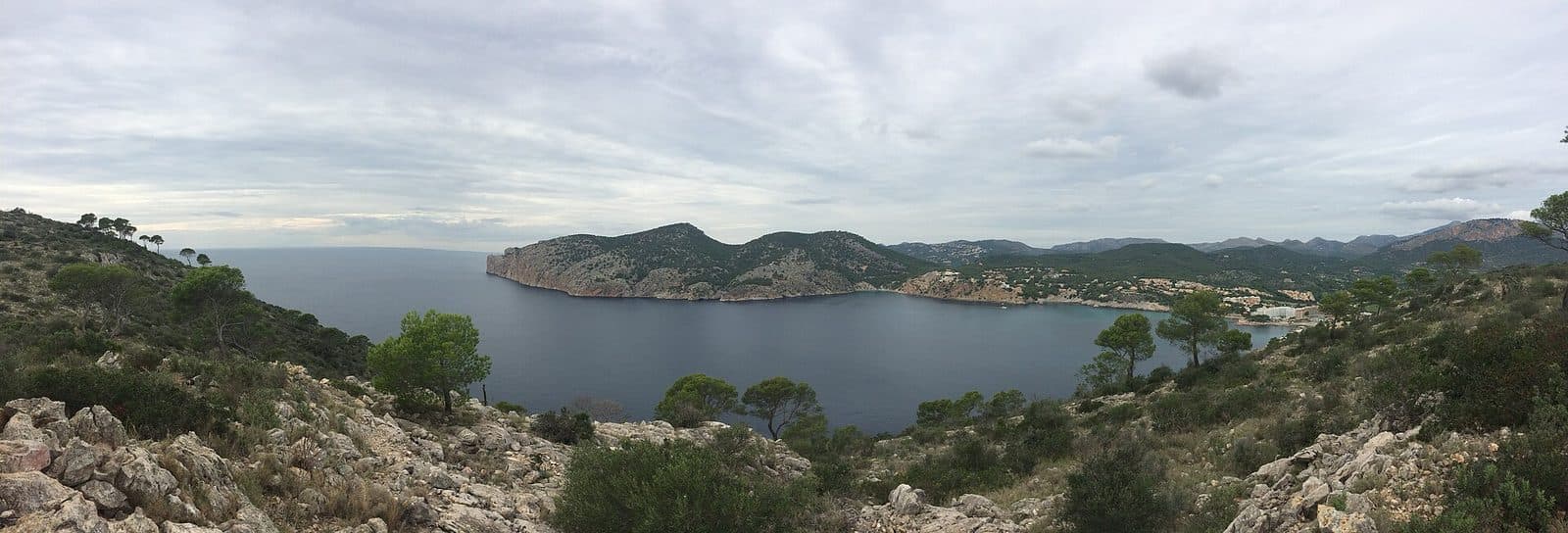
High above the coast, a squat, round tower stands among pines and rocks. Cap Andritxol near Es Camp de Mar is not a viewpoint where you simply step out of the car, but the destination of a short hike. That is precisely what makes it so appealing: With each stage of the ascent, the coastal landscape opens up a little more until the view extends across Camp de Mar, Cala Fornells and large parts of southwestern Mallorca.
At its heart is the Torre des Cap Andritxol, a coastal watchtower from the late 16th century. Its elevated position was once part of a defense system against pirates and corsairs; today it provides the setting for one of the most rewarding short hikes between Andratx and Calvià. The tower is more than a picturesque silhouette: Its masonry still reveals how functionally these observation posts were designed.
The usual approach begins on the Cala Fornells side and leads through pine forest onto the ridge. Alternatively, the hike can begin in Camp de Mar. The trails are not a promenade: Depending on the chosen route, expect rocky sections, steeper climbs and places where careful navigation is required. Those who wear sturdy shoes and take their time are rewarded with ever-changing perspectives of coves, rocky coastline and sea.
Cap Andritxol suits travelers who enjoy combining views and history with physical activity. It is less suitable for a quick photo stop, but ideal for a compact half-day experience featuring a hike, the tower and a possible swim in a neighboring cove.
History and significance
When the tower was built between 1580 and 1582, the rugged coastline of southwestern Mallorca was not only scenically impressive but also vulnerable. Coves and rocky headlands provided shelter for ships, while pirates and corsairs repeatedly threatened the coastal region. Observation and defense towers were constructed in response, several of which have survived in the areas of Andratx and Calvià.
Torre des Cap Andritxol
The purpose of the Torre des Cap Andritxol was to spot approaching enemy ships as early as possible and warn of danger. For this reason, it was not built directly beside the water, but at a prominent, highly visible location with extensive views. Its position on the ridge between Camp de Mar and Cala Fornells allowed several stretches of coastline to be monitored at once. What offers visitors a panorama today was primarily a strategic advantage for the guards of the time.
The tower remained in use during the 16th, 17th and 18th centuries. By the middle of the 19th century, it was in poor condition and urgently needed repairs. Later work remains visible in the structure today: The masonry contains repairs from different periods, including traces of a more recent restoration. Its present condition is therefore not an unchanged image of the original building, but the result of a long history of use and preservation.
Coastal surveillance and landscape
Cap Andritxol illustrates particularly clearly why lookout towers along Mallorca's coast were built in precisely such locations. The site overlooks the transition between the municipality of Andratx and the coast of Calvià. From the area around the tower, the view extends across Camp de Mar, parts of Andratx and Calvià and as far as sections of the Bay of Palma. Cap des Llamp, Peguera, Santa Ponça and the offshore islands of Malgrats and El Toro are also visible from different points along the route.
Its military function has disappeared, but the relationship between the structure and the terrain remains easy to understand. The tower does not feel like an isolated monument placed randomly on a hill, because only the extensive view explains why it was built here. Those who make the ascent themselves experience the historical logic of the location step by step: At first, the forest reveals only isolated glimpses, but on the ridge these expand into a comprehensive view of the coast.
What to see
Even before the final climb, the Torre des Cap Andritxol appears among the pines. From a distance it looks simple and compact; up close, the details of a defensive structure designed for visibility and resilience become apparent. The viewpoints around the tower are just as important as the tower itself. The full experience is therefore spread across several stops.
The round tower
The Torre des Cap Andritxol has a circular floor plan and a cylindrical structure. Its diameter is approximately 6,7 meters. The rubble masonry was bonded with mortar and repaired in different places at different times. This irregular surface in particular shows that the tower was exposed to weather, use and repairs over the centuries.
A main chamber was built inside, with an upper terrace above it. These structural elements were also altered over time. It is functional defensive architecture whose proportions are best appreciated up close.
The elevated entrance
The original entrance was located about four meters above the ground. The rectangular doorway was framed by sandstone elements; the old access staircase has not survived. The unusually elevated entrance is one of the most revealing details of the structure. It makes clear that access was intended to be controlled and that the tower was not entered from ground level like an ordinary house.
This principle is easier to understand from close outside than from a greater distance. The eye moves from the rocky ground across the solid wall surface to the doorway and then up to the upper terrace. The historical value lies in the surviving structure and its position within the landscape.
View of Camp de Mar
On the Camp de Mar side, the view opens across the sheltered bay and resort. The pale strip of beach, the water and the buildings lie well below the ridge. A small offshore island stands out in the bay, visually dividing the beach and accessible by a wooden footbridge. From above, the shape of the coastline is much easier to appreciate than from the shore.
The contrast is remarkable: Below lies a resort that developed primarily during the 20th century; above stands a tower from an era when this same coastline had to be guarded. This juxtaposition gives the viewpoint its distinctive narrative quality. It is not just about a sea view, but about two very different uses of the same landscape.
View toward Cala Fornells and Peguera
On the other side, the panorama extends across Cala Fornells toward Peguera. Depending on your position along the trail, coves, wooded slopes and rocky coastlines appear one after another. The route therefore offers photo opportunities beyond the tower itself: Even during the ascent, views of the sea and the beaches near Peguera open between the pines.
Those who continue beyond the tower toward the actual cape reach a considerably more exposed coastal landscape. There, any sense of a comfortable forest trail disappears completely; rocky terrain and areas dropping steeply toward the sea demand attention. For a standard visit, the tower is a sufficient destination. Continuing to the cape is more of an extension for sure-footed hikers than a necessary part of the visit.
The coastal landscape
Aleppo pines characterize the lower and middle sections of the usual approach from Cala Fornells. The forest provides shelter in places but initially obscures part of the view. Higher up, the vegetation becomes more open and the coastal wind is more noticeable. This progression makes the hike more varied than its manageable length might suggest. Around the tower, a rocky coast shaped by the sea meets the dry vegetation of the southwest.
Visiting Cap Andritxol
On the usual route from Cala Fornells, the first steps lead past a barrier and gently uphill into the pine forest. At first, the trail is broad and pleasant to walk. Later, narrower paths branch off; wooden posts and signposts help with navigation at important points. As the elevation increases, the ground becomes rockier and individual sections grow noticeably steeper.
Ascent from Cala Fornells
The official tourist information describes the route to the cape as approximately 2 kilometers and allows around 2 hours for the outward and return journey. This timing suits a visit with enough opportunity at the tower to enjoy the views, take photos and pause. Anyone extending the route, choosing a circular hike or descending to Caló des Monjo will need correspondingly more time.
Several route options lead uphill. Some descriptions follow a clearly visible, moderate path, while others choose steeper and rougher sections. The short distance alone should therefore not determine how demanding the hike is considered. At junctions, it is worth looking carefully at the signposts and markers. A saved map can provide additional help, as some paths are less obvious on the ground than the broad trail at the beginning.
Ascent from Camp de Mar
A route also leads from Camp de Mar to the Torre des Cap Andritxol. Approximately 2 hours are again allowed for the outward and return journey. This option is convenient if the visit is to be combined directly with time at the beach or in the resort. However, the more commonly described approach begins in Cala Fornells and runs through the pine forest.
The two starting sides should not be combined thoughtlessly into a circular hike. As soon as a route crosses the actual cape or follows less distinct paths, navigation can become more demanding. One hiking report describes places where the trail was barely visible or practically nonexistent. Those who simply want to experience the views and the tower are better off staying on the established route and returning the same way.
Time of day and weather
The time of day mainly affects the heat and light. A documented visit in June became considerably more strenuous due to high temperatures, despite the route initially appearing easy. The ascent should therefore not be underestimated when the sun is strong. An early start or a hike in milder conditions allows more time to enjoy the views and reduces the strain on the exposed upper sections.
For photographers, the subject changes along the route: Camp de Mar lies on one side of the ridge, with Cala Fornells and Peguera on the other. Rather than taking photos only at the tower, it is worth noticing the clearings between the pines. In strong winds or poor visibility, however, the exposed upper area loses some of its appeal and requires additional caution.
Getting there and parking
The road journey does not end directly at the viewpoint. All stated distances and driving times refer to Es Camp de Mar; from there, or from Cala Fornells, the tower must be reached on foot. Driving directly to the Torre des Cap Andritxol is not part of the usual visit.
From Palma Airport
The road distance from Palma Airport to Es Camp de Mar is 40 kilometers. The drive takes around 39 minutes and initially follows the Ma-20, then the Ma-1 into southwestern Mallorca. After leaving the motorway, the local road continues to Es Camp de Mar. Those choosing the usual hiking start in Cala Fornells must begin on the other side of the ridge rather than at the beach in Camp de Mar and plan the onward road route accordingly.
From Palma
From central Palma, the road distance to Es Camp de Mar is 29 kilometers. The drive via the Ma-1 takes around 38 minutes. The same applies here: This travel time ends in the resort, not at the tower. The final section is a hike over ascending, partly rocky terrain and requires additional time.
Parking near Cala Fornells
Cala Fornells is used as the starting point for the frequently walked route. A designated parking area is located in the resort; from there, a short stretch along the road leads toward the beginning of the hike. Another basic hikers' parking area is described above or behind Hotel Cala Fornells. The trail begins there at a barrier and climbs into the pine forest.
Parking arrangements may change, so local signs and access regulations take priority. It is particularly important not to block entrances or narrow roads. The parking area is only the starting point: Even when the tower seems close, the ascent remains a distinct part of the excursion.
By bus
The “Camp de Mar” stop is listed for Camp de Mar. However, the most commonly described ascent from Cala Fornells does not automatically begin there. Anyone arriving by public transport should therefore decide in advance whether to choose the route from Camp de Mar or also travel to the starting point on the Cala Fornells side. Allowing sufficient time for the return journey is advisable, as the walk from the tower and navigation during the descent should not be underestimated.
Bus lines to Cap Andritxol at a glance
| Line | Route | Departures/day | First | Last |
|---|---|---|---|---|
| 122 | Port d'Andratx - Santa Ponça | 140 | 06:32 | 23:40 |
| A11 | Peguera - Aeroport | 103 | 00:35 | 23:55 |
| 102 | Peguera - Palma | 71 | 06:42 | 23:19 |
| 101 | Port d'Andratx - Palma | 37 | 06:22 | 23:35 |
| 131 | Santa Ponça - Banyalbufar | 8 | 10:25 | 17:15 |
From the official GTFS feeds (TIB/SFM), no real-time data. The figures cover all stops in the town; weekend and holiday services differ — check with the operator before travelling.
Getting there by bus
Camp de Mar (5001) · 1.8 km as the crow flies
- 101Port d'Andratx - Palma · Daily
- 122Port d'Andratx - Santa Ponça · Daily
- 131Santa Ponça - Banyalbufar · Daily
- A11Peguera - Aeroport · Daily
Bulevard - Garrovers 1 (11138) · 2.1 km as the crow flies
- 101Port d'Andratx - Palma · Daily
- 102Peguera - Palma · Daily
- 122Port d'Andratx - Santa Ponça · Daily
- 131Santa Ponça - Banyalbufar · Daily
- A11Peguera - Aeroport · Daily
Bulevard - Garrovers 2 (11137) · 2.1 km as the crow flies
- 101Port d'Andratx - Palma · Daily
- 122Port d'Andratx - Santa Ponça · Daily
- 131Santa Ponça - Banyalbufar · Daily
- A11Peguera - Aeroport · Daily
Timetable data: official GTFS feeds (TIB/EMT), no real-time — check with the operator before travelling.
Nearby places
After the descent, the scenery changes quickly. While rock, wind and an old watch post dominate above, bathing coves and the resorts of the southwest lie below. The visit can therefore be combined especially well with a relaxed beach stay without creating an overloaded day trip.
Es Camp de Mar
Es Camp de Mar belongs to the municipality of Andratx and developed primarily as a resort from the 1980s onward. Its historical counterpart is the Torre des Cap Andritxol above the coast. A small natural island stands out by the beach and can be reached by a wooden footbridge. The clear water and sheltered bay make the resort an obvious stop after the hike.
A visit to the beach also shows the landscape from the opposite perspective: From the shore, you look up toward the surrounding heights, while the entire shape of the bay is visible from the tower. Restaurants and other visitor facilities are available in the resort.
Cala Fornells
Cala Fornells is the classic starting point for the ascent. The small cove lies on the Peguera side and marks the transition from the developed coastal area to the pine forest of Cap Andritxol. Those who start here can combine the hike and a swim without a significant additional drive.
The trail begins unobtrusively behind the buildings and quickly enters the forest. This transition is precisely what makes the route appealing: Only a few steps separate the resort coast from terrain where the historic tower is initially visible only between the tree trunks.
Caló des Monjo
Caló des Monjo is an unspoiled cove near Cala Fornells that is also used as a naturist beach. A walking time of about 10 minutes from Cala Fornells is given. The cove can be visited as an addition to the hike; on a circular route across more difficult paths, however, greater sure-footedness is required than for a simple walk to the beach.
A curiosity from film history is also associated with the location: Scenes for the Agatha Christie adaptation “Das Böse unter der Sonne,” in which Peter Ustinov played Hercule Poirot, were filmed at Caló des Monjo. The detour therefore combines a swimming break, coastal scenery and a brief glimpse into Mallorca's film history.
Peguera and Port d’Andratx
Peguera lies on the Cala Fornells side and makes a suitable base for further walks along the southwest coast. Port d’Andratx lies west of Camp de Mar and provides a striking contrast to the quiet tower site. Both places are better regarded as stops after the hike rather than part of the same visit. Combining Cap Andritxol with a cove and one of the coastal resorts already fills the day without long additional journeys.
The place it belongs to
Es Camp de Mar in the place guidePractical information for your visit
The tower looks close from the resort, but forest paths, loose stones and changes in elevation lie between the beach and the viewpoint. Good preparation need not be elaborate, but it determines whether the route is remembered as an enjoyable short hike or an arduous climb.
Footwear and sure-footedness
Sturdy shoes with grippy soles are the most sensible choice. Although the usual trail begins broad and easy to walk, it later becomes narrower, rockier and steeper in places. The more demanding variants are particularly unsuitable for inexperienced hikers. Those who are uncertain should choose the more moderate, marked trail and return along the same route.
Sure-footedness becomes more important if the tour continues beyond the tower to the exposed viewpoint on the cape or follows a circular route. Steeply dropping terrain is part of the natural coastline and requires keeping a safe distance from the edge.
Sun, water and shade
The pine forest offers shaded sections, but the terrain becomes more open higher up. Sufficient water and sun protection should therefore be carried even on a short tour. High temperatures can make the ascent considerably more strenuous than the distance and walking time might suggest. A bathing cove is no substitute for a supply of drinking water along the way.
After rain or in strong winds, rocky and exposed sections can become less comfortable. The view is the main reason for the ascent; in poor visibility, it is better to wait for improved conditions than to force the hike in unfavorable circumstances.
Hiking with children
The official description classifies the usual route as straightforward and marked. Nevertheless, this is a hike rather than a paved walking path. Children should be able to handle rocky climbs confidently and must be supervised closely at open viewpoints.
A motivating progression emerges naturally: first the path through the forest, then the tower drawing visibly closer and finally the view. The additional walk to exposed rocky areas should only be attempted if everyone is sure-footed.