
Mirador de les Malgrats: Mallorca Southwest Coast Views
.jpg)
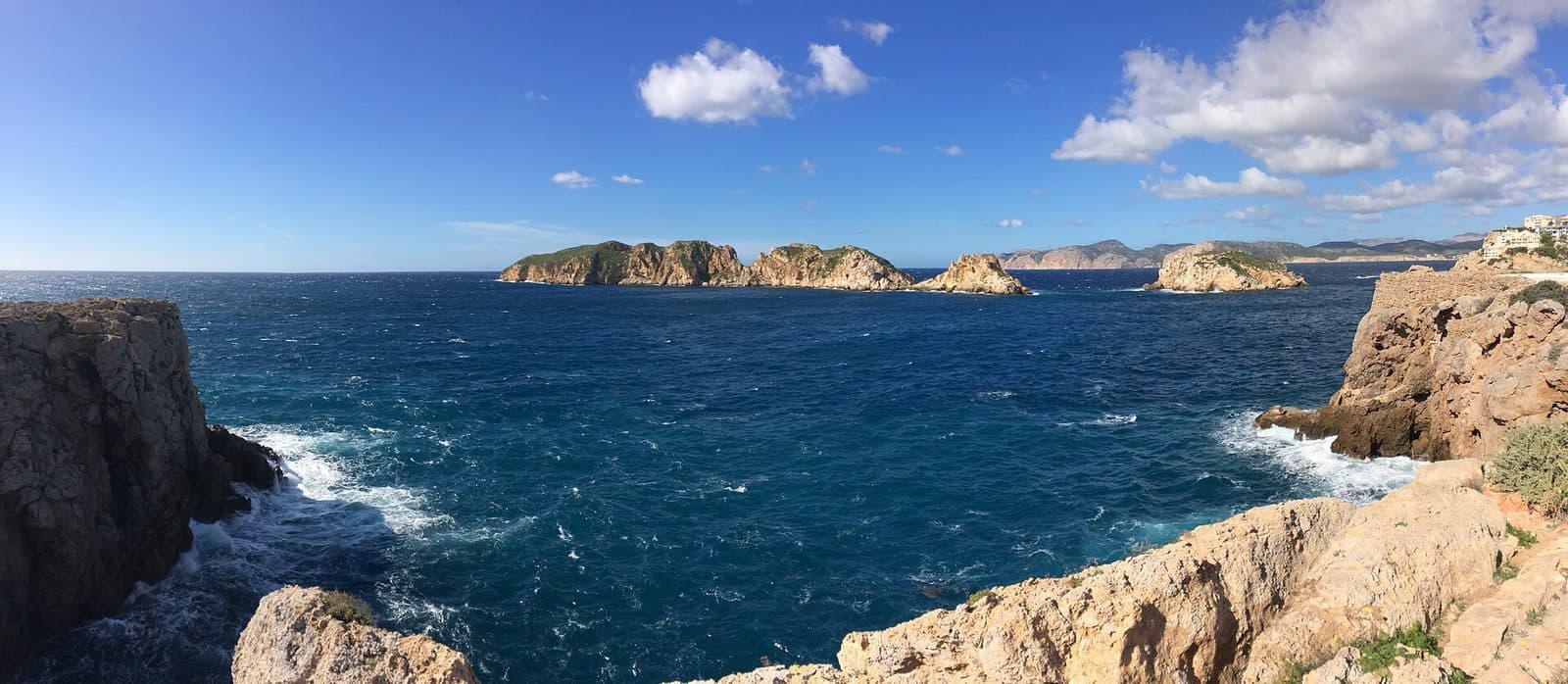
At Mirador de les Malgrats, southwest Mallorca opens up in a single step: the Illes Malgrats lie in the sea off the rocky coast of Santa Ponça, with little but the horizon beyond. Its appeal comes from the unobstructed view, the coastal relief and the light over the water.
The spot is especially impressive in the evening. The sun then moves across the open sea, the islands become dark silhouettes and the rocks along the coast stand out ever more clearly. That is precisely why Mirador de les Malgrats is popular not only with travelers but also with locals and photographers. Anyone arriving at dusk, however, should not expect complete solitude.
The viewpoint fits well into a day around Santa Ponça: as a peaceful break after the beach, as the destination of a walk through the residential areas along the coast or as a short evening trip in its own right. Families will find an uncomplicated nature experience here, while photographers have several layers for their compositions – rock in the foreground, the island group in the middle and the vast sky above. Anyone who enjoys looking out to sea for a while, watching the changing light or experiencing Mallorca’s southwest coast beyond the main beach scenery will find a remarkably clear view of the landscape here.
What to See
The Illes Malgrats
The view first turns toward the island group that gives the Mirador its name. The Illes Malgrats lie off the coast and stand out clearly from the open water with their rugged, largely undeveloped contours. From the elevated shore, they appear not as incidental points on the horizon but as the dominant subject. Depending on the light, rocky surfaces and clefts are visible, or the islands merge into a dark silhouette.
Their position off the mainland creates an unusually clear layering of the panorama: the rocky coast begins directly below the viewpoint, the islands lie farther out and the Mediterranean opens up beyond them. This spatial depth in particular distinguishes the Mirador from viewpoints where only an enclosed bay or a built-up shoreline can be seen.
The waters around the Malgrats are recognized as a marine protected area, giving the view added significance. Although the underwater life cannot be observed from land, the largely natural island scenery explains why this place is more than a pretty photo spot. The viewpoint draws attention to a part of the coast whose value lies precisely in its undeveloped rocks and surrounding sea.
The Rocky Coast of Santa Ponça
The Illes Malgrats are the main subject, but not the only one. To the side, the rugged southwestern coastline stretches across the scene. Rocky headlands project into the sea, while small inlets and the varying height of the shore create new overlaps depending on the vantage point. Toward Peguera, the coastline continues and gives the panorama a much broader frame than the island group alone.
Anyone looking out from one of the seats already gets the essential view. For more varied perspectives, some visitors move onto the rockier areas toward the sea. There, the foreground changes, and the Malgrats can be framed together with the coastal rocks. The terrain away from the more comfortable viewpoint is rough, however; secure footwear and a cautious position are more important than a supposedly perfect camera angle.
When the sea is calm, the expanse of water appears vast and almost empty. In windy conditions, the scene changes: the surface becomes more restless, the light breaks into smaller patches and the exposed setting is more noticeable. The appeal of the Mirador therefore depends on more than the position of the sun. Cloud cover, wind and visibility also give the same view a different character.
The Cannon
A striking detail at the site is the historic cannon. It stands so prominently at the viewpoint that the place is also known as Mirador del Canó de les Illes Malgrats. Set among rocks, sea and islands, it forms a fixed point of reference and distinguishes the Mirador from many other coastal viewpoints around Santa Ponça.
Its exact origin and placement should not prompt hasty stories based on appearance alone. On site, it is primarily the object that gives the viewpoint its alternative name and a popular visual element. By including the cannon in a composition, the vastness of the sea can be structured with a distinctive foreground. Many visitors immediately focus on the islands and notice this detail only when walking around.
Seating and Natural Vantage Points
Several seats make it possible to enjoy the view without a longer walk around the site. They are particularly pleasant for anyone who does not want to climb over the rocks or who wants to wait peacefully for sunset. The natural rock surfaces are also used as vantage points. They offer different angles but require greater care while walking and sitting.
The Mirador does not depend on one precisely marked photo position. Even small changes in location shift the islands in relation to the coastline. Sometimes the cannon is in the foreground, sometimes a rocky section frames the sea, and sometimes the view remains almost entirely open. It is therefore worth calmly surveying the site before choosing a position for dusk.
Evening Light Over the Sea
The best-known scene begins as the sun sinks lower. The light then falls more obliquely across the water, warm tones appear in the sky and the Illes Malgrats stand out increasingly as dark shapes. In suitable conditions, the transitions range from bright gold through muted pastel shades to stronger colors near the horizon.
The view does not suddenly end after the actual sunset. The islands remain visible as outlines while the colors in the sky continue to change. Those who do not leave immediately after the sun disappears often experience the quieter part of the evening – although the return through the residential streets and across uneven areas should still be safely manageable.
Visiting the Viewpoint
Arriving and Getting Oriented
Access leads through a residential area on the coast of Santa Ponça. The approach initially feels unremarkable because residential streets dominate the final stretch. Only at the end does the view open across the rocks and sea. This abrupt change is part of the place’s appeal – just a few steps separate the built-up surroundings from the open coastal perspective.
At the viewpoint itself, there is no need to follow a set direction. It makes sense to begin near the seating and the cannon, taking in the island group and coastline from there. Safe, dry rocky areas can then be chosen for additional perspectives. A path down to the water is not necessary for the visit and should not be considered part of a normal circuit around the viewpoint.
A Short Stop or a Long Evening
There is no fixed amount of time required for the Mirador. Anyone who simply wants to see the panorama and take a few photos can plan it as a short stop. Those who want to experience the sunset need considerably more time: the light starts changing before the sun disappears and often continues to change for a while afterward. The seating makes the wait more comfortable.
The appropriate duration therefore depends less on the size of the site than on the purpose of the visit. Nature watchers and photographers usually stay longer because clouds, reflections on the water and the silhouettes of the islands continually create new scenes. For families, however, a shorter stay may be more practical, especially on hot days and when children do not want to remain still on the rocks for long.
Sunset as the Main Time to Visit
The Mirador is most popular in the evening. This is understandable: its open orientation across the sea and islands creates a clear sunset setting without buildings blocking the horizon. On beautiful days, several visitors therefore arrive with the same idea. Weekends and the summer travel season can be noticeably busier.
Anyone seeking a quieter experience should choose a weekday if possible and avoid arriving at the last moment. Coming a little earlier also makes it easier to find parking in the residential area and leaves time to select a safe position. Outside the evening peak, the Mirador is often visited by fewer people with sunset specifically in mind, although the famous play of colors is then absent.
Photography at the Mirador
Several clearly distinct subjects are available for photographs. The classic image sets the Illes Malgrats against the open sea. Another option includes the rocky coast and conveys greater spatial depth. The cannon works well as a striking foreground, while including more of the sky is especially effective in the evening.
A very low camera position or one far out on the rocks is not necessary to capture the landscape convincingly. The view is already wide open from the easily accessible areas. Anyone moving onto the rocks should inspect the position in daylight and avoid walking backward while searching for a composition. After sunset, uneven ground quickly becomes harder to see.
Visiting in Hot Weather
In summer, the exposed location can become very hot because there is no natural shade at the viewpoint. Midday may offer clear views of the sea and islands, but it is often less pleasant for sitting for an extended period. Later in the day, softer light combines with the place’s main attraction.
Getting There and Parking
From Palma Airport
From Palma Airport, the route first follows the Ma-20 and then the Ma-1 toward the southwest. Santa Ponça is 31 kilometers away by road, and the drive takes around 28 minutes. These figures expressly apply only as far as Santa Ponça, not directly to Mirador de les Malgrats.
From there, continue through the town toward the western coastal residential areas. The final stretch runs through built-up streets and ends near the viewpoint. Navigation should remain active until the actual viewpoint is reached rather than being stopped upon arrival in Santa Ponça.
From Palma
From central Palma, Santa Ponça is 20 kilometers away by road via the Ma-1. The drive takes around 27 minutes. Here too, the distance and driving time refer to the town; the onward journey through Santa Ponça to the coast must be added.
The Ma-1 covers most of the journey and makes the viewpoint easy to combine with an excursion through southwest Mallorca. Within Santa Ponça, the character of the route changes: the main road gives way to local and residential streets. Slow traffic, turns and pedestrians should be expected on the final section, especially in the evening.
The Final Stretch Through the Residential Area
The access road approaches the Mirador through a residential area and along a street with no through route. On a first visit, the location can therefore seem inconspicuous until the coast opens up at the end of the built-up area.
Anyone arriving on foot from Santa Ponça also reaches the viewpoint via local streets. The walk is more a route through the resort and residential area than a coastal hike. For the return after sunset, keep in mind that dusk at the Mirador quickly leads to poorer visibility on uneven surfaces.
Parking at the Viewpoint
Parking is available nearby, but the situation can vary depending on the time of the visit. Around sunset in particular, many visitors arrive within a narrow time window. It is therefore advisable to arrive a little earlier and park only where access roads and property entrances remain clear.
If there are no spaces directly at the viewpoint, a short additional walk through the residential area is usually more sensible than waiting at the end of the street. The site is also accessible by motorcycles and other two-wheeled vehicles, which must likewise be parked considerately and in accordance with regulations. Bus stops in the surrounding area offer an alternative; from the stop, a walk through the residential streets remains.
Bus lines to Mirador de les Malgrats at a glance
| Line | Route | Departures/day | First | Last |
|---|---|---|---|---|
| 123 | Santa Ponça - Cas Català | 360 | 00:06 | 23:41 |
| 106 | El Toro - Palma | 202 | 06:20 | 22:54 |
From the official GTFS feeds (TIB/SFM), no real-time data. The figures cover all stops in the town; weekend and holiday services differ — check with the operator before travelling.
Getting there by bus
Malgrats 1 (11082) · 0.6 km as the crow flies
- 106El Toro - Palma · Daily
- 123Santa Ponça - Cas Català · Daily
Malgrats 2 (11081) · 0.6 km as the crow flies
- 123Santa Ponça - Cas Català · Daily
Gran Via Penyes Roges 1 (11075) · 0.8 km as the crow flies
- 106El Toro - Palma · Daily
- 123Santa Ponça - Cas Català · Daily
Gran Via Penyes Roges 2 (11074) · 0.9 km as the crow flies
- 106El Toro - Palma · Daily
- 123Santa Ponça - Cas Català · Daily
Club Nàutic Santa Ponça 1 (11084) · 1.2 km as the crow flies
- 106El Toro - Palma · Daily
- 123Santa Ponça - Cas Català · Daily
Club Nàutic Santa Ponça 2 (11083) · 1.2 km as the crow flies
- 123Santa Ponça - Cas Català · Daily
Av. Santa Ponça - Shakespeare (11180) · 1.2 km as the crow flies
- 106El Toro - Palma · Daily
Ctra. Magaluf - Santa Ponça 2 (11072) · 1.6 km as the crow flies
- 106El Toro - Palma · Daily
- 123Santa Ponça - Cas Català · Daily
Ctra. Magaluf - Santa Ponça 1 (11073) · 1.6 km as the crow flies
- 106El Toro - Palma · Daily
- 123Santa Ponça - Cas Català · Daily
Caló d'en Pellicer 1 (11086) · 1.8 km as the crow flies
- 106El Toro - Palma · Daily
- 123Santa Ponça - Cas Català · Daily
Caló d'en Pellicer 2 (11085) · 1.8 km as the crow flies
- 123Santa Ponça - Cas Català · Daily
Av. Santa Ponça - Gran Via del Port (11181) · 1.8 km as the crow flies
- 106El Toro - Palma · Daily
Timetable data: official GTFS feeds (TIB/EMT), no real-time — check with the operator before travelling.
Nearby
Santa Ponça
Santa Ponça combines a large bathing bay with residential neighborhoods, tourist infrastructure and several elevated coastal sections. Mirador de les Malgrats reveals a different side of the town from the main beach: instead of a broad stretch of sand and a sheltered bay, the scene here is defined by rock, open sea and offshore islands.
This proximity makes the viewpoint particularly easy to include in a stay in the area. A beach day can be combined with an evening detour without turning it into a long drive around the island. The Mirador can also form the endpoint of a walk through Santa Ponça. Anyone coming for sunset should, however, assess the return route and parking situation before dusk begins.
Beach and Coastal Coves
The large beach at Santa Ponça is the most obvious combination. Swimming and the sheltered bay take center stage there; at the Mirador, the perspective shifts to the open sea. The two places reveal very different coastal forms within the same resort area.
Farther along the coastal zone are smaller rocky inlets such as Es Racó de ses Àguiles. Such destinations are better suited to visitors accustomed to rougher terrain who deliberately want to explore beyond a classic sandy beach. They should not be regarded as a casual extension of the comfortable viewpoint visit. Sturdy footwear and an independent assessment of access are even more important there.
Puig de sa Morisca
Anyone wishing to combine views and landscape with another destination in Santa Ponça can include the Puig de sa Morisca area in the day’s plans. Mirador de les Malgrats remains the maritime part of the excursion, centered on islands, coastal rocks and the horizon.
This combination is best suited to the cooler parts of the day. Saving the Mirador itself for the evening makes the best use of its light. Anyone visiting several places in succession should not plan too tightly, however, because finding parking and selecting a suitable position around sunset can take additional time.
Peguera and the Southwest
The coastline toward Peguera forms part of the panorama from the viewpoint. Peguera and other places in the southwest can therefore be geographically combined with Santa Ponça without the Mirador losing its role as a peaceful landscape stop. It is particularly suitable as the conclusion to a day previously devoted to the region’s beaches, towns or walking routes.
For such a route, the order matters more than the number of destinations. The Mirador develops its best-known atmosphere only later in the day, so other activities should not be scheduled in a way that delays arrival until after the colors on the horizon have faded. At the same time, it is worth leaving enough time before the last light to avoid walking across the rocks under pressure.
The place it belongs to
Santa Ponça in the place guidePractical Information for Your Visit
Shoes for Rocks Rather Than a Promenade
No hike is required to reach the easily accessible central part of the viewpoint. As soon as the surrounding rock surfaces are explored, however, the terrain changes. Uneven ground and loose sections make closed shoes with good grip the better choice. Sandals or smooth soles do not restrict the view, but they do limit the safe choice of positions.
Footwear becomes even more important after sunset. Ground contours become harder to see while many visitors leave their positions at the same time. Anyone who has been sitting on the rocks should not wait until the route back is only faintly visible. There is no need to go far toward the sea for the view itself; the main subjects are already visible from the nearer areas.
Sun, Shade and Water
The Mirador is exposed. In summer, there is no reliable shade, so a hat, sun protection and sufficient water are essential for a longer stay. This is especially true when the viewpoint is visited before evening. The reflective water and exposed setting can make the sun feel more intense than it seemed when setting out from built-up Santa Ponça.
Anyone planning to wait for sunset should bring what they need and take all packaging away afterward. Precisely because the place derives its appeal from rock and sea, discarded bottles or food waste are especially intrusive here.
Visiting with Children
The viewpoint is generally suitable for a family outing because no long approach is required and the attraction is immediately understandable: see the islands, discover the cannon and experience sunset. A short stay is easier to adapt to the patience of younger children than an extensive walk around the area.
Constant attention is required on the uneven rocky surfaces, however. Children should not run ahead unsupervised or move between vantage points in low light. For families, the area around the seating is usually the more relaxed choice. Those who stay until after sunset should ideally organize their departure before darkness and simultaneous visitor traffic make the return confusing.
What Defines the Place
The cannon is a striking feature, but the real reason to visit remains the view of the Illes Malgrats, the rocky coast and the open sea. A secluded natural setting without other people cannot be guaranteed at the most popular time of the evening. The viewpoint is well known and easy to reach, so photographers, families and walkers gather here at sunset. Anyone seeking complete peace should come outside the evening peak; anyone wanting to experience the famous light accepts a livelier atmosphere in return.
Check Current Conditions
As no reliable opening hours or admission details have been recorded, current access conditions should be checked before visiting. This is particularly important in the event of short-term local restrictions or unusual weather conditions. Travel plans should not rely solely on older entries in map and review services.
Regardless, it is worth checking the weather, cloud cover and wind. A completely clear sky is not necessarily the only favorable condition: clouds can add structure to the evening light. Strong winds or unsafe conditions on the rocks, however, are good reasons to remain at the more comfortable vantage points or postpone the visit.