
Coves de Son Verí de Baix – Prehistoric Caves near S'Arenal
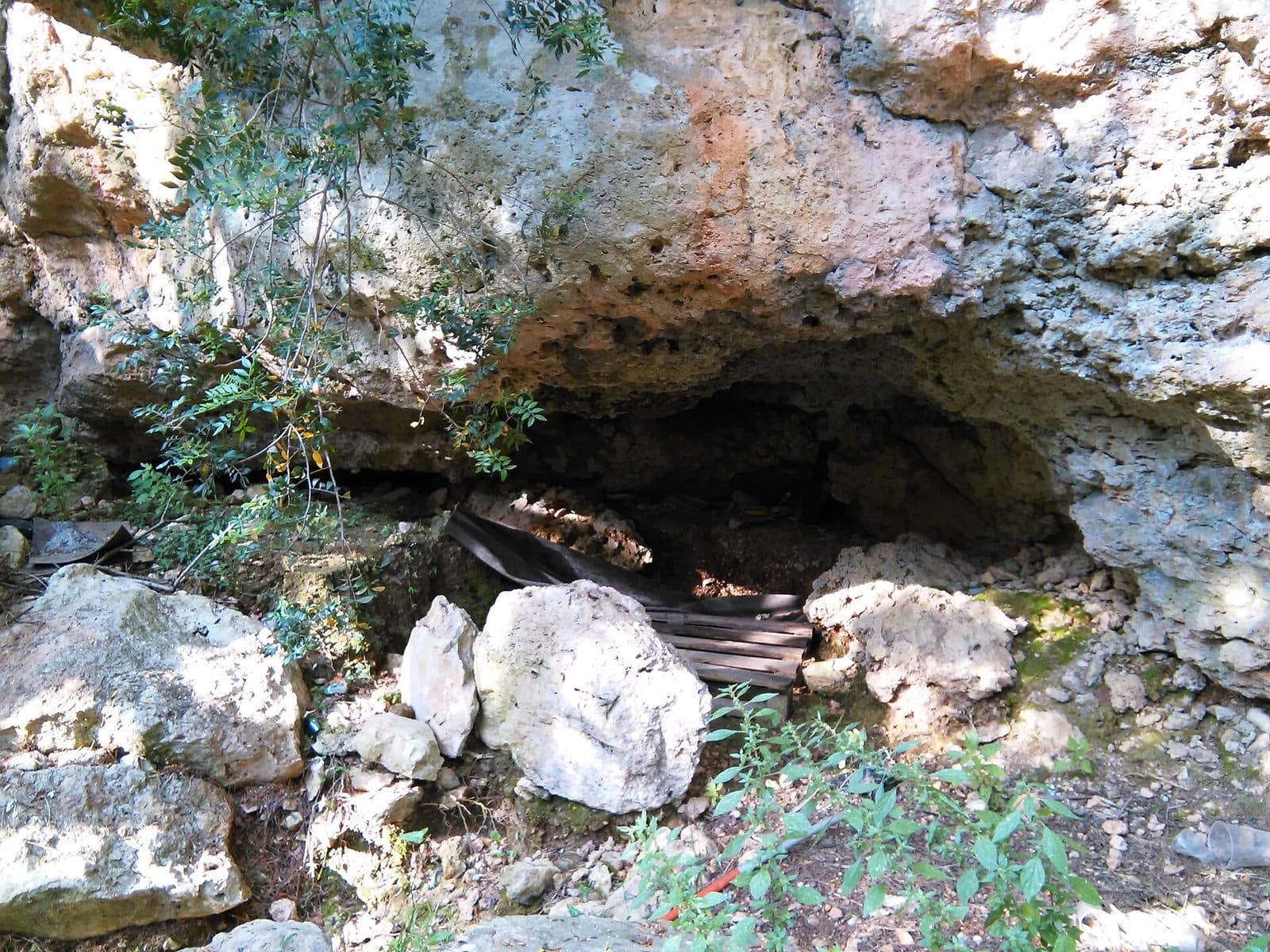

Few names reveal as clearly how many layers of history lie beneath today's resort of S'Arenal. The Coves de Son Verí de Baix are a group of four small natural caves that were already used in prehistoric times. They are located at Torrent de na Clot in the area known as sa Torrentera, on the Llucmajor side of S'Arenal.
This is an archaeological look at natural cavities that people visited and used long before the modern coastal town emerged. Anyone wishing to discover Mallorca's prehistory beyond the large Talaiotic settlements will find a small but revealing archaeological site here. Its significance becomes clear through the connection between the landscape, prehistoric use, and its later preservation as archaeological heritage.
The contrast with the surroundings is particularly interesting. Today, S'Arenal is primarily associated with its beach, harbor, and dense development. The four caves are a reminder that the coastal area on the Bay of Palma has a much older history, one that did not begin with hotels and promenades.
History and significance
Long before Son Verí appeared in written records as an estate, the natural caves at Torrent de na Clot were already part of a landscape used by people. Their use in prehistoric times is documented. The surviving brief description of the site does not allow us to determine with certainty what specific purpose each cave served or whether its use changed over the course of prehistory. For this very reason, the site should not be hastily described as a burial place, dwelling, or storage area.
Prehistoric use
The four cavities were not constructed as buildings. People found natural caves and incorporated them into their lives. This distinction is important: what can be seen is not planned architecture with regularly laid walls, but a natural formation whose cultural and historical significance arose from its use.
Small caves could serve many different purposes in prehistoric communities. For Son Verí de Baix, however, only their use during that period is certain. The site therefore tells its story less through a fully reconstructed spatial plan than through its location and continued survival. The terrain helps visitors understand how closely the natural environment and human activity were connected on Mallorca.
The plural in the Catalan name is no coincidence either: Coves refers to several caves, while Son Verí de Baix distinguishes the location from other sites and names in the historic Son Verí area. Searches for the name may also produce Son Verí de Dalt, prehistoric remains, and coastal caves with similar-sounding names. These should not be confused with this group of four small cavities at Torrent de na Clot.
Son Verí de Baix
The current name preserves the memory of the former estate landscape. The site belonged to the possessió Son Verí de Baix, a Mallorcan country estate. Son Verí itself appears in written records in 1476 as Alqueria d'en Verí. This medieval reference dates neither the caves nor their prehistoric use; rather, it explains the later place name by which the archaeological site is known today.
Baix means lower or the lower part and distinguishes it from Dalt, the upper part. Such additions are often extremely helpful in Mallorcan field and estate names. In the case of the caves, they prevent different sites in the wider Son Verí area from being combined into a single complex.
Protection as cultural heritage
On 10 September 1966, the Coves de Son Verí de Baix were granted the status of Bé d'Interès Cultural. The registered identifier is RI-51-0002293. This protection emphasizes that even a spatially small group can be an important source of information about Mallorca's prehistory.
The designation also changes the visitor's perspective: a cave opening here is not merely a geological feature in a streambed or cut in the terrain, but part of a protected archaeological site. Altering the rock, removing material, or leaving objects behind would damage the historical context. Its value lies precisely in preserving the site, natural cavities, and landscape together.
What to see
The site consists of four small natural caves. They are understood as a single group because they lie close together in the same terrain and were used in prehistoric times.
The group of four caves
The number four is the key organizing feature at the site: several small cavities together form the attraction. Visitors should therefore shift their attention between the individual openings and the surrounding terrain: Where does the natural rock begin, where does it open up, and how are the caves positioned in relation to one another? The group itself is significant, because several usable cavities in a confined area offered prehistoric people different possibilities from a single isolated crevice.
No individual historical names for the four caves or reliably documented assignments of different functions have survived. It would therefore be misleading to label them as chambers, sanctuaries, or tombs. What remains visible and certain is the essential fact: these are small natural caves that became an archaeological site through human use.
The natural cavities
The caves provide a particularly clear view of the relationship between the existing landscape and cultural history. Their shape developed naturally; their archaeological significance came from their use. Visitors are therefore not standing before a structure whose stones were set according to a plan, but before a piece of geology that entered human history.
The transitions are therefore crucial to observing the site: the opening between the exterior and the cave, the sheltered areas behind the entrance, and the way each cavity is embedded in the rock. Even without speculative reconstructions, it is easy to understand why natural cavities could have appealed to people. They create enclosed spaces distinct from the open terrain without requiring a building to be constructed first.
Torrent de na Clot
The site is located at Torrent de na Clot. On Mallorca, a torrent is a watercourse whose appearance can vary greatly depending on rainfall. This connection to the terrain is more important for understanding the caves than viewing their openings in isolation. It shows that the Coves de Son Verí de Baix belong to a specific landscape and should not be understood as detached individual objects.
The Torrent also explains the name sa Torrentera for the local area. When viewing the terrain, it is therefore worth looking for more than just cave entrances. The course of the waterway, the cut in the land, and the natural boundaries all help visitors read the site. Its archaeological significance arises from the combination of the four cavities and this exact location.
Sa Torrentera
Sa Torrentera refers to the small local area within S'Arenal where the caves are located. This field name helps distinguish the attraction from the historic possessió Son Verí and from other archaeological sites with Son Verí in their names. The caves are within the municipality of Llucmajor, even though S'Arenal is perceived as one continuous coastal town.
At the site, this administrative boundary is less striking than the transformation of the landscape. The modern town extends close to a place whose history reaches back into prehistory. This juxtaposition is precisely what makes the Coves de Son Verí de Baix so vivid: an inconspicuous natural cut in the terrain can be protected evidence of an era that predates modern development by many centuries.
Visiting the caves
The Coves de Son Verí de Baix are an archaeological cave site within today's urban area of S'Arenal.
How to interpret the site
On reaching the site, visitors should first take in the group as a whole. Four small caves are easier to overlook than one monumental opening in the rock. It helps to keep their relationship with Torrent de na Clot in mind and not automatically assume that every similar-looking cavity in the area belongs to the protected site. The insight comes from close observation, as the natural form of the cavities, their proximity to one another, and their position in the terrain are the defining features.
No regular opening hours or admission price have been recorded.
Time required and when to visit
No official duration for touring the caves has been documented. There is also no reliable information about typical peak times. Anyone seeking a quiet visit should incorporate the site into an already planned stay in S'Arenal rather than assuming that a particular time is guaranteed to be empty.
Photography can help capture the relationship between the openings and the surrounding terrain. The best position is not necessarily directly beside the rock, as stepping back makes it easier to see that this is a group of caves.
What the site is not
The Coves de Son Verí de Baix are neither the Coves del Drach nor the Coves d'Artà, and they are not Sa Cova Baixa on the coast.
Visitors interested in prehistory, cultural landscapes, or inconspicuous archaeological traces will get the most from the site. The small group is less suitable as the sole focus of a full-day excursion. Combined with a walk through S'Arenal or time on the coast, however, it offers an appealing change of perspective.
Getting there and parking
The stated driving information leads to S'Arenal, not directly to a designated entrance to the caves. This distinction is essential when planning a visit. The destination lies at Torrent de na Clot in the sa Torrentera area.
From Palma Airport
The road distance from Palma Airport to S'Arenal is 11 kilometers. The drive takes around 15 minutes. No specific road number is listed for this connection in the available travel information, so one should not be added. Depending on the airport exit and current traffic arrangements, navigation may select different routes into the town.
The measured driving information ends upon arrival in S'Arenal. Separate navigation to Torrent de na Clot is then required to reach the caves.
From Palma
The documented route from central Palma follows the Ma-19 to S'Arenal. The road distance is 17 kilometers, and the drive takes around 26 minutes. Here too, the distance and travel time refer to S'Arenal. The search for the archaeological site and the final section within the town must be added.
The Ma-19 is the key road connection from the direction of Palma. After leaving the main route, the surroundings become more urban. Torrent de na Clot is the more important reference point for precise navigation.
Parking and bus travel
For parking, S'Arenal should be regarded as the arrival point. Where the car can actually be left depends on current signage and how busy the town is.
Avinguda Europa serves as a reference point for arrival by public transport. Several bus stops are located there in the S'Arenal area. From the stop, visitors must independently navigate the final section toward Torrent de na Clot and sa Torrentera.
Bus lines to Coves de Son Verí de Baix at a glance
| Line | Route | Departures/day | First | Last |
|---|---|---|---|---|
| 504 | Tolleric - Palma | 217 | 06:00 | 23:26 |
| A51 | Campos - Aeroport | 76 | 04:59 | 23:47 |
| 23 | s'Arenal / Parc Aquàtic - Pl. Espanya | 7 | 08:45 | 13:45 |
| A2 | Aeroport - S'Arenal | 6 | 07:55 | 08:35 |
| 508 | Sa Ràpita - Palma | 1 | 07:07 | 07:07 |
From the official GTFS feeds (TIB/SFM), no real-time data. The figures cover all stops in the town; weekend and holiday services differ — check with the operator before travelling.
Getting there by bus
Av. Europa 1 (31121) · 0.1 km as the crow flies
- 504Tolleric - Palma · Daily
- A51Campos - Aeroport · Daily
Av. Europa 2 (31130) · 0.1 km as the crow flies
- 504Tolleric - Palma · Daily
- 508Sa Ràpita - Palma · Daily
- A51Campos - Aeroport · Daily
888-Europa - Antoni Galmés · 0.2 km as the crow flies
- 23s'Arenal / Parc Aquàtic - Pl. Espanya · 06:27–21:50 · Daily
- A2Aeroport - S'Arenal · 08:00–08:00 · Daily
S'Arenal (31122) · 0.4 km as the crow flies
- 504Tolleric - Palma · Daily
- A51Campos - Aeroport · Daily
622-s'Arenal-Parc aquatic · 0.4 km as the crow flies
- 23s'Arenal / Parc Aquàtic - Pl. Espanya · 06:27–21:50 · Daily
- A2Aeroport - S'Arenal · 08:00–08:00 · Daily
889-Europa - Sant Bartomeu · 0.4 km as the crow flies
- 23s'Arenal / Parc Aquàtic - Pl. Espanya · 06:27–21:50 · Daily
- A2Aeroport - S'Arenal · 08:00–08:00 · Daily
625-Sant Bartomeu - Europa · 0.4 km as the crow flies
- 23s'Arenal / Parc Aquàtic - Pl. Espanya · 06:27–21:50 · Daily
- A2Aeroport - S'Arenal · 08:00–08:00 · Daily
887-Dragonera - Sant Bartomeu · 0.5 km as the crow flies
- 23s'Arenal / Parc Aquàtic - Pl. Espanya · 06:27–21:50 · Daily
- A2Aeroport - S'Arenal · 08:00–08:00 · Daily
Dragonera 1 (31128) · 0.5 km as the crow flies
- 504Tolleric - Palma · Daily
- A51Campos - Aeroport · Daily
886-Dragonera - Sant Bartomeu · 0.5 km as the crow flies
- 23s'Arenal / Parc Aquàtic - Pl. Espanya · 06:27–21:50 · Daily
- A2Aeroport - S'Arenal · 08:00–08:00 · Daily
903-Trencadors - Oficina de Turisme de s'Arenal · 0.6 km as the crow flies
- 23s'Arenal / Parc Aquàtic - Pl. Espanya · 06:27–21:50 · Daily
- A2Aeroport - S'Arenal · 08:00–08:00 · Daily
902-Dragonera-Sant Cristòfol · 0.7 km as the crow flies
- 23s'Arenal / Parc Aquàtic - Pl. Espanya · 06:27–21:50 · Daily
- A2Aeroport - S'Arenal · 08:00–08:00 · Daily
Timetable data: official GTFS feeds (TIB/EMT), no real-time — check with the operator before travelling.
Nearby
The contrast could hardly be clearer: on one side is a small cave site used in prehistoric times, and on the other is the lively coastal town of S'Arenal. Combining both impressions makes the visit especially worthwhile. The caves reveal a depth of history that is easily overlooked among modern buildings, beach activities, and the harbor.
S'Arenal
S'Arenal is the practical starting point. The town lies in southern Mallorca on the Bay of Palma and extends across municipal boundaries; the Coves de Son Verí de Baix are located in the area belonging to Llucmajor. To visitors, however, S'Arenal appears as a continuous urban area where the coast, residential neighborhoods, and tourist infrastructure meet closely.
After the archaeological detour, the change in setting can be appreciated consciously. At the cave site, natural cavities and prehistoric use are the focus, while closer to the sea the promenade, beach, and harbor dominate the view. In this way, a small archaeological site becomes an introduction to the long history of human activity in the same coastal region.
The coast of Son Verí
East or southeast of the center lie the coastal areas of Son Verí. These include small coves and rocky stretches, among them Sa Cova Baixa and Playa de Son Verí. Despite the similar name, Sa Cova Baixa should not be confused with the Coves de Son Verí de Baix: one is a small coastal cove, while the other is the prehistoric cave complex at Torrent de na Clot.
This similarity in names can easily cause confusion when navigating. Anyone wishing to combine both places should save them as separate destinations and not assume that the archaeological caves are located directly beside the similarly named cove.
Playa de Palma and Cala Blava
Playa de Palma lies in the direction of Palma, while Cala Blava is one of the coastal destinations on the other side of S'Arenal. Both can be included in a day in southern Mallorca without turning the cave site itself into a lengthy excursion.
A well-balanced itinerary begins with the archaeological context and then continues to the sea. Alternatively, the site can add a brief cultural and historical stop to a beach day. The Coves de Son Verí de Baix are evidence of prehistory.
Local insider tips
Use the Torrent as your landmark
When searching for the site, Torrent de na Clot is a more precise reference point than the coast. The four caves are located in the area known as sa Torrentera and should not be confused with the similarly named cove Sa Cova Baixa.
View the group first
Do not immediately focus on just one opening. The site's archaeological character lies in the relationship between four small natural caves and their location at the Torrent. Stepping back makes this connection easier to recognize.
Combine it with prehistory
The site is most effective as a cultural and historical contrast to S'Arenal. View the caves first, then visit the coast, harbor, or beach: this makes the transformation from a natural space used in prehistoric times to today's resort especially vivid.
Check the names carefully
Son Verí de Baix, Son Verí de Dalt, and Sa Cova Baixa refer to different places. Before navigating, it is worth checking the full name Coves de Son Verí de Baix and its connection with Torrent de na Clot.