
Creu dels Montcada – Historic Memorial near Galatzó
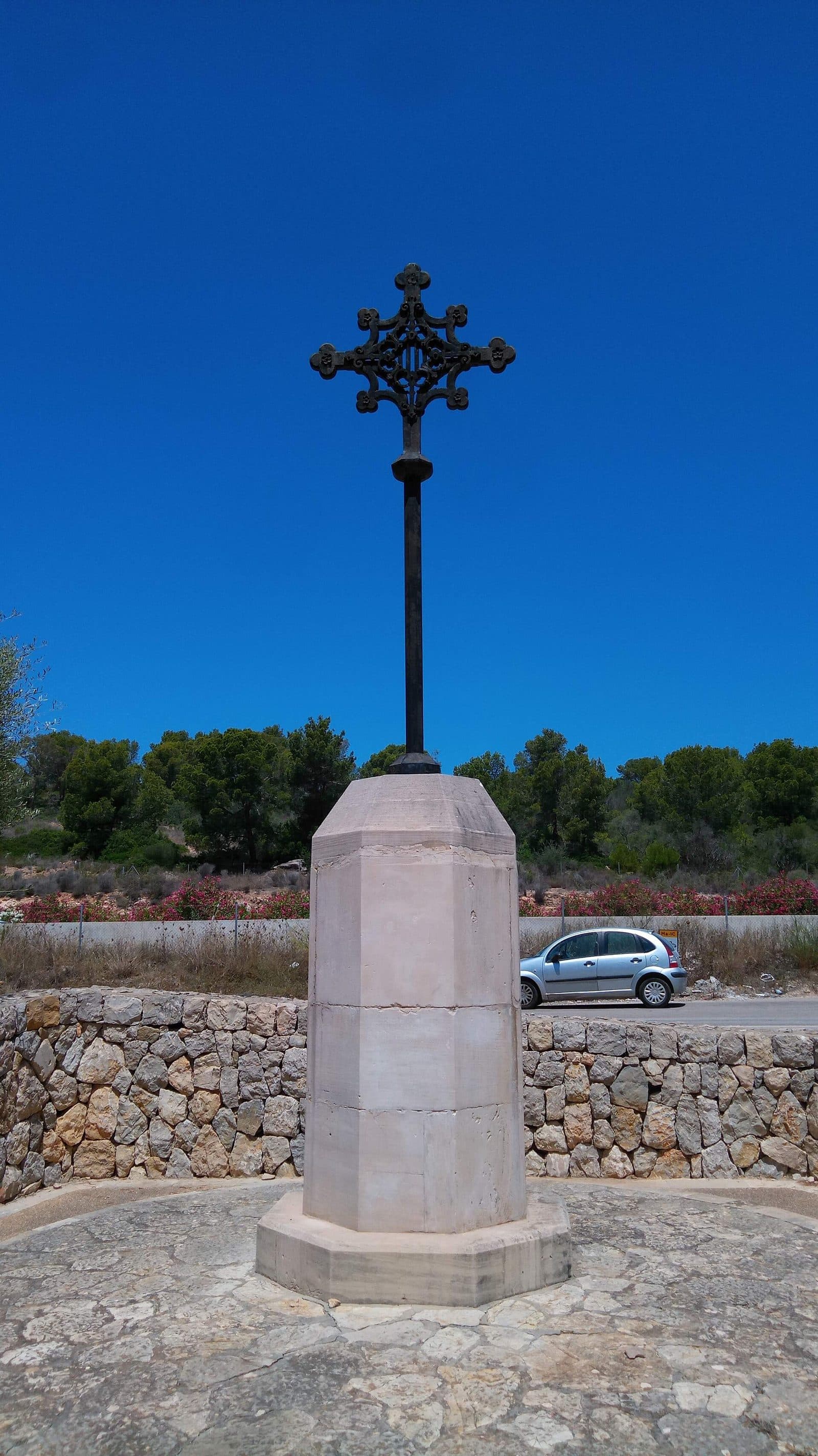

The Creu dels Montcada is not a tomb, although it was long believed to be one. The historic monument near Galatzó commemorates Guillem II de Montcada i de Bearn, Ramon II de Tortosa, and other members of the family who died during the Battle of Portopí. Tradition placed Guillem’s death at this exact spot.
The Creu dels Montcada is a quiet memorial whose significance becomes clear only through the connection between monument, landscape, and history. That is precisely what makes this brief stop interesting: An inconspicuous point in the southwest of present-day Mallorca leads directly back to the conquest of the island by Jaume I.
The site lies within the municipality of Calvià, near the access road to Palmanova and beside the Puig de Saragossa. The location is given as Galatzó; it must not be confused with the Puig de Galatzó or the finca of the same name in the Serra de Tramuntana. This page is exclusively about the historic Montcada memorial and the traditional site near Portopí.
The site is particularly rewarding for travelers who want to explore Mallorca’s history beyond its churches, museums, and old-town streets. The Creu shows how a medieval military event was later anchored in the landscape—with a cross, a ceremonial inauguration, and a folk tradition that linked historical facts with legend.
History and Significance
The Battle of Portopí
At the heart of the commemoration is the Battle of Portopí during Jaume I’s campaign in Mallorca. Medieval accounts describe a fierce clash between the Christian army and the island’s Muslim defenders. Bernat Desclot recounts how the forces met on a ridge and a violent battle began. A hill lying ahead of them appeared to be a strategically important position: Whoever captured it would gain a decisive advantage.
Several high-ranking followers of Jaume I died in this confrontation. Guillem II de Montcada i de Bearn is singled out in particular. The memorial also associates Ramon II de Tortosa with him; local tradition additionally included a nephew and sons of the family in the commemoration. The loss affected the king in more than military terms. The chronicle of Jaume I has his companions explicitly remind him that Guillem and other prominent men who had fallen were especially loyal vassals.
The texts therefore describe not a minor skirmish, but a traumatic moment during the campaign of conquest. The military defeat of individual leaders also created a call for revenge and for the advance to continue. Anyone standing before the Creu dels Montcada is therefore looking at a memorial to a battle whose consequences reached far beyond the history of a single noble family.
Guillem II de Montcada and Ramon II de Tortosa
The name of the monument preserves the memory of the Montcada family. The family belonged to the army’s leadership, and the status of its fallen members explains why their deaths were treated so powerfully in the major medieval chronicles. Guillem de Montcada appears there as a close and highly valued follower of the king. His death became a symbol of the campaign’s heavy cost.
The Creu is therefore more than a general war memorial. It draws attention to individuals remembered by name and to the bonds between king, nobility, and army. In the chronicles, grief is not described in isolation: The fallen are portrayed as men whose service must now be answered by continuing the fight. The monument translates this medieval memory into an enduring symbol from a later period.
Construction and Inauguration
The present monument does not date from the Middle Ages. It was erected in 1886 and inaugurated in 1887 by Archduke Ludwig Salvator. The two dates refer to different stages: first the installation of the monument, followed by its formal dedication as a place of remembrance. This distinction explains why different dates are sometimes given for the Creu dels Montcada.
The cross gave local tradition a permanent, visible focal point. An event that had previously survived in chronicles and stories was now marked directly in the landscape. Archduke Ludwig Salvator inaugurated the monument in 1887.
Tradition and Historical Evidence
According to popular belief, Guillem de Montcada died at the exact spot where the cross now stands. It was also believed that the fallen lords had been buried there. In the public imagination, this idea made the site almost a burial ground. Historically, however, that is incorrect: The Montcada were buried at Santes Creus monastery.
This very contradiction is part of the Creu’s significance. The monument does not mark a verified burial site, but a traditional place of death and remembrance. That does not make the story worthless; rather, it shows how historical memory functions spatially. People associate an event with a particular point, give it a visible marker, and continue telling its story—even if individual elements later need to be corrected.
What to See
The Creu dels Montcada
The focus of the visit is the cross itself. It is classified as both a sculptural work and a memorial and was deliberately made the bearer of the family name. Its impact comes from this solitary marker: It commemorates the Montcada who died in the Battle of Portopí.
It is worth viewing the monument first without the widespread burial story in mind. The Creu marks neither a crypt nor a documented medieval burial site. It is a late 19th-century memorial structure referring to a much older event. Centuries of oral and written tradition lie between the battle and the monument’s construction. This layering of time is the site’s most important characteristic.
The Catalan name is itself part of the message. “Creu” means cross; “dels Montcada” identifies the family being commemorated. Spanish-language accounts also use the name Cruz de los Montcada. Both names refer to the same monument in Calvià.
The Traditional Place of Death
The location was chosen because tradition placed the death of Guillem de Montcada here. This gives the surroundings a role that extends beyond being a mere backdrop. The monument was not intended to commemorate the battle just anywhere, but at a place that local memory directly associated with its tragic climax.
The site therefore reveals an important distinction: The commemoration of the fallen and their burial at Santes Creus are historically documented; the precise place of death at the cross is traditional. Those who separate these two levels do not have to choose between “true” and “meaningless.” The site tells both of a medieval event and of how later generations understood that event.
The Puig de Saragossa
Beside the monument rises the Puig de Saragossa, whose height is given as 160 meters. The hill is particularly useful for understanding the historical setting because Bernat Desclot’s chronicle emphasizes the importance of elevated ground during the battle. This does not mean that every detail of the battle can be reconstructed with certainty from the cross. The topography does, however, make it clear why elevated positions feature so prominently in the accounts.
Rather than looking only at the monument, it is therefore worth taking a moment to observe the terrain. Hills, ridges, and passes were not minor details in medieval warfare. They determined which forces gained an overview and where an advance could be stopped. The cross thus becomes a starting point for reading the landscape: The chronicles and the shape of the terrain begin to speak to one another.
The Pi dels Montcada
Until a few years ago, a large pine known as the Pi dels Montcada stood directly beside the monument. The tree was so closely associated with perceptions of the site that it had its own name. It was not part of the stone monument, but it was part of the site’s traditional appearance.
Today, the pine is important primarily as a memory. Anyone familiar with older images of the site might otherwise wonder why the familiar tree is missing. The Pi dels Montcada also shows that historic places consist of more than buildings. A single prominent tree can become a landmark, a namesake, and part of local memory.
A Monument as a Symbol of Remembrance
What visitors see is the memorial, its setting, and the neighboring topography. The experience is therefore similar to reading a historical waymarker. Its value lies in understanding the site’s context.
Anyone familiar with the names Guillem II de Montcada i de Bearn and Ramon II de Tortosa, the Battle of Portopí, the incorrect burial tradition, and the vanished Pi dels Montcada will notice considerably more. A roadside cross then becomes a multilayered place: a memory of a medieval battle, a 19th-century monument, and an example of how storytelling gives historical meaning to a landscape.
Visiting the Creu dels Montcada
From First Impressions to Historical Context
The most sensible place to begin is directly at the monument. First, take in the Creu as a solitary symbol of remembrance; then turn your attention to the neighboring Puig de Saragossa and the shape of the terrain. This sequence helps prevent the site from being misread as a supposed tomb. The cross commemorates the fallen, but their actual resting place is at Santes Creus.
It is then worth consciously separating the two periods. The event belongs to the Middle Ages, while the monument visible today was not erected until 1886 and was inaugurated the following year by Archduke Ludwig Salvator. The site therefore does not preserve the unchanged state of a battlefield. It shows how a historical event was marked and publicly commemorated many centuries later.
How Long to Visit and What to Expect
The Creu dels Montcada does not require a long stay. Simply viewing the monument makes for a brief stop; the visit gains depth only by reading about the history and observing the terrain. Anyone who only takes a photograph will finish quickly. Those who relate the chronicles to the Puig de Saragossa and the site’s traditional associations can explore the place in greater depth.
A fixed duration would therefore be of little help. It depends on your own interest in history. For planning purposes, the Creu works better as a focused stop during a drive through the southwest than as the sole destination of a long excursion.
Best Time to Visit and Crowds
No documented peak times or regular visitor flows are listed for the monument. The time of day should therefore primarily suit the rest of your itinerary. Since the visit centers on observing the cross and the surrounding terrain, good visibility is more useful than a tightly scheduled timetable.
Getting There and Parking
From Palma and the Airport
From central Palma, the drive to Galatzó follows the Ma-1. The road distance is 16 kilometers, and the journey takes around 22 minutes. From Palma Airport, Galatzó is 26 kilometers away and the drive takes around 23 minutes; the route initially follows the Ma-20 and then the Ma-1.
These directions explicitly end in Galatzó, not directly at the foot of the monument. For final navigation, the Creu dels Montcada itself should be entered as the destination. Historical sources describe its location near the entrance to Palmanova and beside the Puig de Saragossa. This helps distinguish the correct monument from Finca Galatzó and the Puig de Galatzó in the mountains.
Journey times can naturally be affected by traffic in the greater Palma area and on the Ma-1. The main roads are nevertheless decisive when choosing the route: from Palma via the Ma-1, and from the airport initially via the Ma-20 before also joining the Ma-1. Detailed navigation to the memorial begins only in the destination area.
The Final Approach
In the surrounding area, do not search only for the word “Galatzó.” In Mallorca, the name refers to several different destinations and can easily lead to the wrong place if navigation is imprecise. The correct reference points are Calvià, the area near Palmanova, the Puig de Saragossa, and the full name Creu dels Montcada.
Before setting out, check where stopping or parking is legally permitted. A safe parking place in the surrounding area is preferable to stopping as close to the cross as possible.
By Bus
Bus stops are located in the Palmanova and Cas Saboners area. Public transport therefore takes visitors first to the vicinity of the monument; the final section must be planned using the current connection and a walking route. The stop information shown on the page is more precise for this purpose than a general route description, as bus routes and timetables may change.
Before departure, check the entire connection, including the walking route. The cross is not a central transport hub and should not be sought using the place name Galatzó alone. For orientation, its relationship to the entrance to Palmanova and the Puig de Saragossa remains essential.
Bus lines to Creu dels Montcada at a glance
| Line | Route | Departures/day | First | Last |
|---|---|---|---|---|
| 104 | Magaluf - Palma | 750 | 00:01 | 23:51 |
| 123 | Santa Ponça - Cas Català | 146 | 06:12 | 23:52 |
| A11 | Peguera - Aeroport | 104 | 00:02 | 23:24 |
From the official GTFS feeds (TIB/SFM), no real-time data. The figures cover all stops in the town; weekend and holiday services differ — check with the operator before travelling.
Getting there by bus
Pinzons 2 (11032) · 0.5 km as the crow flies
- 104Magaluf - Palma · Daily
- 123Santa Ponça - Cas Català · Daily
- A11Peguera - Aeroport · Daily
Pinzons 1 (11033) · 0.6 km as the crow flies
- 104Magaluf - Palma · Daily
- 123Santa Ponça - Cas Català · Daily
Platja de Palmanova 1 (11031) · 0.7 km as the crow flies
- 104Magaluf - Palma · Daily
- 123Santa Ponça - Cas Català · Daily
- A11Peguera - Aeroport · Daily
Platja de Palmanova 2 (11030) · 0.7 km as the crow flies
- 104Magaluf - Palma · Daily
- 123Santa Ponça - Cas Català · Daily
- A11Peguera - Aeroport · Daily
Punta Marroig 2 (11028) · 0.9 km as the crow flies
- 104Magaluf - Palma · Daily
- 123Santa Ponça - Cas Català · Daily
- A11Peguera - Aeroport · Daily
Timetable data: official GTFS feeds (TIB/EMT), no real-time — check with the operator before travelling.
Nearby Places
Galatzó and Calvià
Galatzó is the location given for the attraction, while the monument belongs to the municipality of Calvià. The site lies in southwest Mallorca.
The name Galatzó nevertheless requires attention. Finca Galatzó and the Puig de Galatzó are separate destinations and are not part of the monument. Their histories, hiking routes, and legends must not be applied to the Creu dels Montcada. Anyone planning a route should therefore always use the memorial’s full name.
Palmanova
The historical location description mentions its proximity to the entrance to Palmanova. This makes it easy to include the Creu as a brief cultural stop during a day along the southwestern coast. The contrast is striking: Near a modern holiday resort, a 19th-century monument recalls a medieval battle and men whose deaths were recorded in the chronicles of Jaume I and Bernat Desclot.
Combining the stop with other activities does not require an elaborate themed route. A stay in Palmanova or a drive through Calvià already provides a suitable framework for the visit. The Creu remains the historical highlight.
Puig de Saragossa
The landscape feature most directly associated with the site is the Puig de Saragossa. Because of its proximity to the cross and its traditional role in the terrain, it is more useful for understanding the historical context than more distant excursion destinations. The chronicle describes how important a hill appeared during the fighting; looking at the elevation provides at least an impression of why the topography was so crucial to those involved.
Climbing the hill or following a particular hiking trail is not necessary to understand the Creu. Simply observing the hill from the monument enriches the visit. The monument commemorates individuals, while the Puig evokes the military logic of the terrain.
The place it belongs to
Galatzó in the place guidePractical Visitor Information
What to Expect at the Site
The Creu dels Montcada is a single memorial. The burial place assumed in popular tradition does not exist here: The fallen were buried at Santes Creus.
Preparation therefore improves the visit. The names of the Montcada, the Battle of Portopí, the construction in 1886, the inauguration in 1887, and the story of the Pi dels Montcada are the keys to understanding the site. Without this background, it remains primarily a cross; with it, the Creu becomes a concentrated piece of historical evidence.
Clothing and Conduct
Since the visit takes place outdoors and includes looking at the surrounding terrain, weather-appropriate clothing and secure footwear are practical. This should not be taken as a recommendation for elaborate hiking equipment: Visiting the monument must not be confused with a tour of the Puig de Galatzó.
Care is particularly important when approaching the site. The memorial is not located within an enclosed museum complex, but in surroundings shaped by roads and settlements. Safe routes and legal stopping places should take priority over getting as close to the monument as possible.
Visiting with Children
For children, the Creu works best as a brief history stop. The difference between legend and historical evidence can be explained vividly: For a long time, people believed that the Montcada were buried at the cross; their actual burial place is at Santes Creus. The vanished Pi dels Montcada and the strategic importance of a hill also provide tangible points of reference.
For families, the site therefore makes the most sense as part of a larger day’s itinerary. As with any stop near a road, careful supervision is more important here than within an enclosed attraction.
Do Not Confuse It with the Puig de Galatzó
The most common planning mistake arises from the name. The Creu dels Montcada is neither the well-known Puig de Galatzó mountain nor the Finca Pública de Galatzó. Information about mountain hikes, the estate, or the legends of the Comte Mal refers to other destinations. For this monument, the relevant points are the Montcada, the Battle of Portopí, the Puig de Saragossa, and the location near Palmanova.
Local insider tips
Read the Hill as Part of the Story
Do not look only at the cross: The neighboring Puig de Saragossa helps explain why elevated ground plays a key strategic role in Bernat Desclot’s account of the battle.
Two Dates, Two Stages
The monument was erected in 1886 but was not inaugurated by Archduke Ludwig Salvator until 1887. The occasionally differing dates therefore refer to two separate stages in its creation.
Remember the Pi dels Montcada
A large pine with its own name once stood beside the Creu: the Pi dels Montcada. Anyone familiar with older images will understand from this detail why the site looks different today.
No Tomb Beneath the Cross
Popular tradition regarded the site as the burial place of the Montcada. In fact, the fallen were buried at Santes Creus; the Creu is a memorial at the traditional place of death.
Choose the Right Galatzó
When navigating, use the full name as well as Palmanova and the Puig de Saragossa as reference points. Puig de Galatzó and Finca Galatzó are different destinations and lead in the wrong direction.