
Naveta Alemany – Bronze Age house near Sol de Mallorca
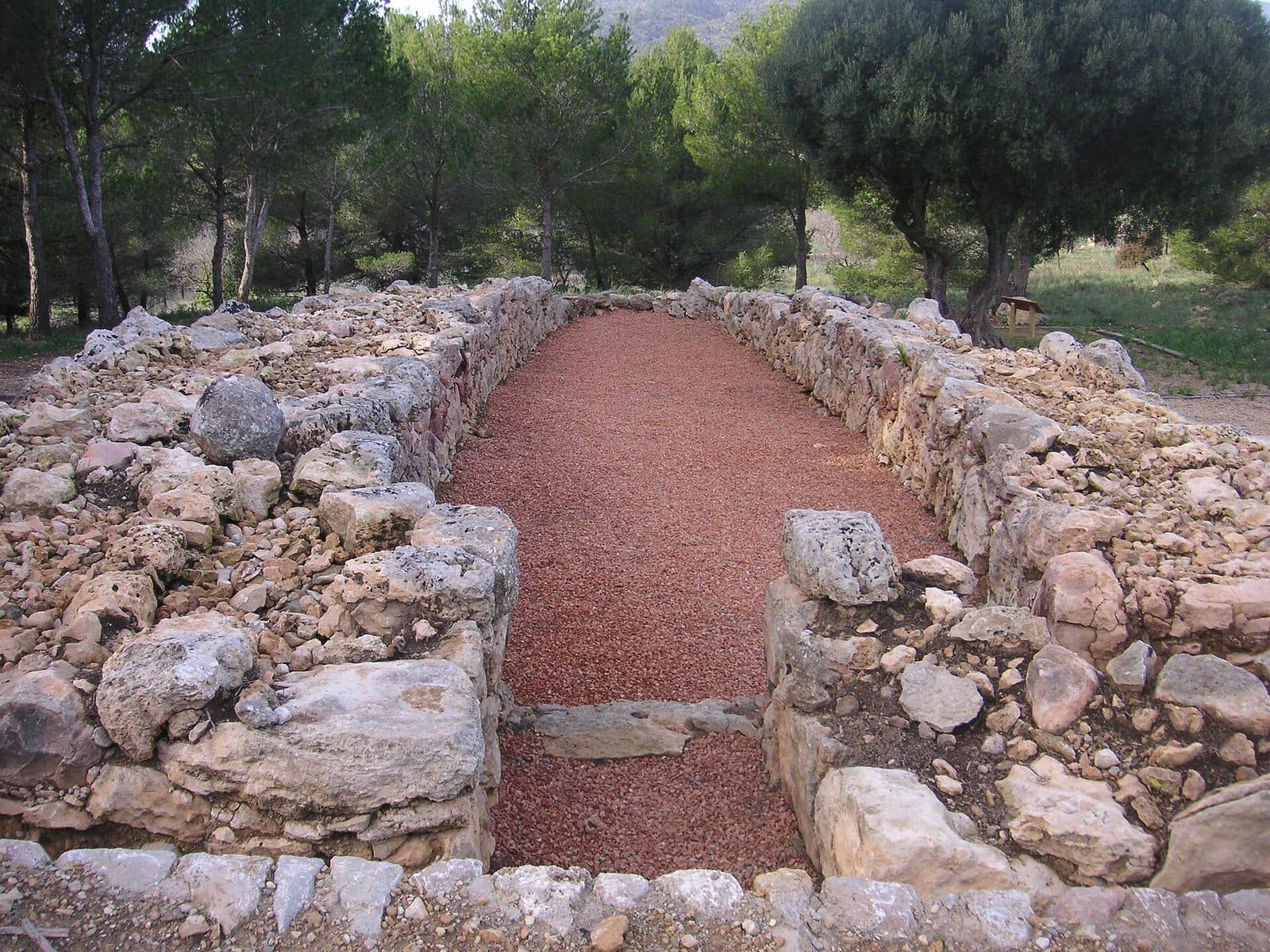

Between Sol de Mallorca, Cala Vinyes and Magaluf stands a structure that is easy to overlook yet leads far back into Mallorca’s prehistory. The Naveta Alemany is the surviving remains of a Bronze Age dwelling. Its elongated shape, reminiscent of an upturned boat, gave this type of building the name “navetiform.”
The appeal of the site does not lie in any grand presentation. What you see is a single stone ruin on a small hill near the road to Cala Vinyes. However, anyone who takes time to study the floor plan, the unusually substantial walls and the accompanying information panels will recognize more than a collection of old stones: people lived here, lit fires, worked with tools and prepared food.
The Naveta Alemany is especially rewarding for anyone wishing to explore Mallorca’s past beyond the better-known talayots. The structure belongs to an earlier phase of the island’s history and clearly demonstrates how carefully Bronze Age communities planned their living spaces. Families, too, can use the distinct boat shape and visible wall lines to understand how stone, wood, reeds and clay were combined to create a house.
The Naveta is not a museum with display cases and reconstructed rooms. A visit depends on close observation: the position in the landscape, the stepped platforms, the entrance and the realization that a closed plant-covered roof once rose above the walls that now stand open to the sky.
History and significance
The Naveta Alemany was not discovered during a planned search, but in the course of roadworks. When the road to Cala Figuera was built in the sixties of the twentieth century, the prehistoric structure came to light. This discovery also explains its present location close to the modern road network: the ruin is not a monument moved here later, but a remnant of the ancient settlement landscape that more recent coastal development brought back into view.
The early settlement phase
An even older trace lies beneath the house itself. Finds from the platforms created to level the site point to a phase around 1800 to 1550 BC. The hill was therefore apparently already in use before the navetiform structure visible today was built. The Naveta itself is dated to around 1650 BC, during the Bronze Age.
The municipality of Calvià regards navetiform buildings as characteristic evidence of its Bronze Age history. These were elongated, horseshoe-shaped houses that predated the later talayot structures. The Naveta Alemany should therefore not be understood as a talayot, nor as a burial chamber. It was a place to live.
A house for everyday life
The excavations provided the clearest evidence of its function. The remains of two hearths were documented inside. Bones from sheep, goats and cattle were also found, together with pottery and bronze tools. Taken together, these finds create a picture of a household where people cooked, ate and worked. They do not allow any firm conclusions about the precise number or composition of the inhabitants; its use as a residential building, however, is well established.
The location was chosen sensibly. The house stood on a small hill near the coast and not far from the former Albufera of Magaluf. The surrounding land, which was at little risk of erosion, was suitable for agriculture. The site therefore combined a slightly elevated building plot with accessible farmland.
Excavation and restoration
The first excavation began in 1968 under the direction of Catalina Enseñat. Following this early investigation, the site was studied again in 1997 and 1998 by a team from the Consell de Mallorca. Between 2010 and 2012, the municipality of Calvià carried out further work during which the Naveta was investigated, consolidated, restored and made easier for visitors to understand.
What can be seen today is therefore not simply an untouched section of wall. The visible site preserves archaeological fabric while also bearing the traces of professional stabilization. Such interventions prevent loose stones and weakened walls from deteriorating further. The site thus tells two stories: that of a Bronze Age house and that of its rediscovery within the greatly transformed coastal landscape of modern Calvià.
What to see
The first striking feature is the length of the structure. At 22 metres, the Naveta Alemany is one of the longest known constructions of its type on Mallorca. Its outer line curves to a rounded end on one side and opens towards the façade on the other. Viewed from above, the floor plan resembles the hull of an upturned boat—hence the term “navetiform.”
The outer walls
Large stone blocks form the substantial walls. Additional reinforcement was built into the interior of the walls. This detail in particular shows that the builders did not simply pile up stones, but took the structural requirements of an unusually large house into account.
The surviving walls no longer reach their original height. According to the municipality’s reconstruction, the building may once have stood approximately 2.5 to 3 metres high. During a visit, it is therefore worth mentally extending the present ruin upwards. The open floor plan then becomes a much more sheltered, relatively dark interior with massive side walls.
The levelling platforms
The slope was not an easy building site for a long structure. To create a stable and reasonably level surface, the Bronze Age builders constructed two levelling platforms. The Naveta was built on top of them. This adaptation to the terrain is one of the site’s most important yet easily overlooked features.
Looking along the walls makes it clear why this preparation was necessary: without stepped foundations, the structure would have had to follow the pronounced incline of the ground. The platforms instead created a controlled base. Their infill also preserved material from an earlier phase of activity on the hill, which later became important for dating the site.
Façade and entrance corridor
The façade did not remain unchanged during the building’s period of use. An entrance corridor was added at a later date. A separate section was also created in the northeastern wall area, for which no direct parallel has yet been documented in comparable buildings. The Naveta Alemany therefore follows a known house type while also possessing its own individual architectural history.
The entrance provides a particularly clear sense of how the transition from outside to inside was organized. The corridor directed access and created a defined area before the main living space. Because the roof and the upper parts of the façade are now missing, everything appears more open than it must have been during the Bronze Age.
The interior
The two hearths were found in the elongated interior during the excavation of 1968. Visitors should not expect furnished living areas today; the significance of the space is revealed through its floor plan and the excavation findings. Pottery, animal bones and bronze tools show that various activities of daily life took place here.
The interior was originally roofed. Tree trunks supported a covering of reeds or other plant material, which was sealed with clay. This construction method combined the massive stone walls with lighter materials available locally. The roof has disappeared, but imagining its former line fundamentally changes the perception of the ruin: the area now completely open to view was once an enclosed living space.
The isolated structure
Only a single navetiform structure survives. Whether it actually stood alone has not been conclusively established. Experts do not rule out the possibility that other residential units belonged to a larger settlement and were later lost. At the site, it is therefore important to distinguish between the remains visible today and the possible Bronze Age situation: an isolated house can be seen, but it may have formed part of a larger living environment.
This uncertainty is precisely what makes the site so revealing. The Naveta is not a completely legible settlement plan, but a surviving fragment. Even so, the preserved building is large enough to make the spatial organization of a Bronze Age household clear.
Visiting the site
The first impression is unspectacular: there is no monumental entrance hall and no long sequence of chambers, but rather a compact archaeological site near a road junction. That is precisely why it is worth resisting the urge to leave after taking a quick photograph. The Naveta is best understood from several viewpoints—first as an overall shape, then through its walls and finally from the perspective of the former interior.
Recognizing the boat shape
It is best to begin by looking along the building’s longitudinal axis from outside the walls. From this perspective, the elongated shape with its rounded end is easier to grasp than when standing directly among the stones. The eye can then move towards the façade and entrance corridor. Following this sequence makes it easier to recognize which parts belong to the original house type and which changes were added later.
The two levelling platforms also deserve attention. They appear less spectacular than the large stone blocks, but explain how the house could be built despite the sloping ground. The visit becomes much more rewarding when the Naveta is viewed not merely as a ruin, but as a technical solution designed for a specific building site.
Information panels and imagination
Panels at the site explain the origin and function of the structure. They help visitors mentally complete the low wall remains as a formerly roofed house. The reconstructed roof shape is particularly important: without imagining tree trunks, reeds and a layer of clay, it is easy to misinterpret the interior as an open courtyard.
The Naveta Alemany is a destination for attentive observation, not a lengthy museum visit. The actual tour can remain compact; anyone wishing to understand the floor plan, construction phases and position in the landscape more closely should not limit the visit to a fleeting stop. There is no fixed amount of time required.
Visitor numbers and current access conditions
Neither reliable opening hours nor a current admission price have been recorded. Before travelling, visitors should therefore check which access conditions currently apply. This is particularly important if the Naveta is intended as a fixed part of an itinerary rather than merely a brief archaeological stop during a journey through the southwest.
There is also no reliable visitor data on which to base a firm recommendation for the quietest time of day. The site is small, and even a few groups present at the same time can alter the experience compared with a quiet moment. Anyone with flexibility can plan the visit to allow enough peace for reading the panels and examining the walls, without relying on unsupported general recommendations.
Getting there and parking
The Naveta lies in the southwestern coastal area of the municipality of Calvià, near Sol de Mallorca and close to the road to Cala Vinyes. The final stretch passes through the local road network; the ruin stands there on a small hill near a road junction. This is not a remote excavation site reached only after a lengthy hike.
From Palma Airport
The road distance from Palma Airport to Sol de Mallorca is 28 kilometres. The drive takes around 26 minutes, initially following the Ma-20 and then the Ma-1 towards the southwest. These details apply only as far as Sol de Mallorca, not directly to the edge of the ruin. For the final stretch, follow local signs towards Cala Vinyes and continue through the local road network.
Because the Naveta can easily be overlooked among roads and properties in the developed coastal area, precise navigation to the archaeological site is advisable. At the location, the destination appears much smaller than a conventional attraction with a large forecourt. Anyone looking only for a monument visible from afar may easily drive past it.
From Palma
The road distance from central Palma to Sol de Mallorca is 18 kilometres. The drive via the Ma-1 takes around 25 minutes. Here too, the measured route ends in Sol de Mallorca; this is followed by the short local drive to the archaeological site near Cala Vinyes.
The Naveta stands close to the modern road whose construction originally led to its discovery. This proximity makes the journey easier, but requires care when getting out of the vehicle and finding your bearings. Roadside parking is mentioned as an option; a dedicated large archaeological car park is not part of the character of the site. Before leaving a vehicle, observe signage, entrances and the traffic regulations currently in force.
By bus
Within the wider local area are the stops Cala Vinyes 2, Cala Vinyes 1, Margalides and Av. Badia de Palma 1. From there, the journey to the Naveta must continue through the local road network. Because stops, routes and connections can change, it is advisable to check the current service and the appropriate walking route in advance.
For orientation, Cala Vinyes is the most useful geographical reference point: the Naveta lies near the road leading there, although descriptions may also associate it with Magaluf or Sol de Mallorca. These references always mean the same Bronze Age archaeological site in the municipality of Calvià.
Bus lines to Naveta Alemany at a glance
| Line | Route | Departures/day | First | Last |
|---|---|---|---|---|
| 104 | Magaluf - Palma | 454 | 00:01 | 23:50 |
| 123 | Santa Ponça - Cas Català | 144 | 06:15 | 23:52 |
| 105 | Sol de Mallorca - Palma | 127 | 06:42 | 21:41 |
| A11 | Peguera - Aeroport | 78 | 00:15 | 23:35 |
| 106 | El Toro - Palma | 22 | 06:59 | 22:19 |
From the official GTFS feeds (TIB/SFM), no real-time data. The figures cover all stops in the town; weekend and holiday services differ — check with the operator before travelling.
Getting there by bus
Cala Vinyes 2 (11189) · 0.3 km as the crow flies
- 105Sol de Mallorca - Palma · Daily
Cala Vinyes 1 (11169) · 0.4 km as the crow flies
- 105Sol de Mallorca - Palma · Daily
Margalides (11185) · 0.4 km as the crow flies
- 105Sol de Mallorca - Palma · Daily
Av. Badia de Palma 1 (11191) · 0.8 km as the crow flies
- 105Sol de Mallorca - Palma · Daily
Av. Badia de Palma 2 (11192) · 0.8 km as the crow flies
- 105Sol de Mallorca - Palma · Daily
Camí Porrassa 1 (11050) · 0.8 km as the crow flies
- 104Magaluf - Palma · Daily
- 123Santa Ponça - Cas Català · Daily
- A11Peguera - Aeroport · Daily
Notari Alemany 2 (11044) · 0.9 km as the crow flies
- 105Sol de Mallorca - Palma · Daily
Camí Porrassa 2 (11049) · 1.0 km as the crow flies
- 104Magaluf - Palma · Daily
- 123Santa Ponça - Cas Català · Daily
- A11Peguera - Aeroport · Daily
Notari Alemany 1 (11043) · 1.0 km as the crow flies
- 104Magaluf - Palma · Daily
- 105Sol de Mallorca - Palma · Daily
- 123Santa Ponça - Cas Català · Daily
- A11Peguera - Aeroport · Daily
Parc aquàtic 2 (11053) · 1.2 km as the crow flies
- 106El Toro - Palma · Daily
- 123Santa Ponça - Cas Català · Daily
Av. Mallorca - Alba 1 (11160) · 1.2 km as the crow flies
- 105Sol de Mallorca - Palma · Daily
Av. Mallorca - Alba 2 (11159) · 1.2 km as the crow flies
- 105Sol de Mallorca - Palma · Daily
Timetable data: official GTFS feeds (TIB/EMT), no real-time — check with the operator before travelling.
Nearby attractions
Sol de Mallorca forms part of the southwestern coastal area of Calvià. Here, the Naveta does not stand in an untouched prehistoric landscape, but between modern residential and holiday communities. This contrast is particularly striking: a few wall lines preserve a Bronze Age dwelling, while the modern road network around them connects Sol de Mallorca, Cala Vinyes and Magaluf.
Sol de Mallorca and Cala Vinyes
Sol de Mallorca is a convenient starting point for a short cultural and historical excursion. The Naveta lies near Cala Vinyes and can therefore be combined easily with time spent along the coast there. The archaeological site itself does not require an entire day trip; it works best as a deliberate stop focused on the region’s prehistory.
Proximity to the coast was also part of the site’s appeal during the Bronze Age. The house stood on elevated ground, while remaining within easy reach of the sea and the former Albufera of Magaluf. Today, buildings and roads have transformed this historical landscape context. Keeping it in mind makes it easier to understand why this particular hill was chosen as a place to live.
Magaluf
Magaluf is frequently used as the location reference for the Naveta Alemany in archaeological descriptions. The site lay approximately five hundred metres from the former Albufera of Magaluf. The fertile surroundings, which were at little risk of erosion, were suitable for agriculture and explain the location better than the modern view across the tourism-oriented coastal area.
Combining the site with Magaluf therefore makes sense for more than practical reasons. It also shows how dramatically landscapes can change while archaeological remains preserve individual fixed points. The Naveta offers a rare counterpoint to the coast’s more recent development: not a prestigious monument, but the stone shell of a place devoted to everyday life.
More prehistory in Calvià
Anyone wishing to place the Naveta within a broader archaeological context can include Puig de sa Morisca near Santa Ponça as another major focus of Calvià’s cultural heritage. Other periods and forms of the island’s prehistory are more prominent there. Such a comparison helps put the Naveta Alemany in its proper context: it belongs to Bronze Age domestic architecture, not to the later fortified talayot structures.
The two destinations should not be viewed as variants of the same type of monument. The Naveta conveys the scale of a house and household; other sites reveal more complex settlement or defensive structures. It is precisely this shift from an individual living space to the wider archaeological landscape that makes combining them so worthwhile.
The place it belongs to
Sol de Mallorca in the place guidePractical information for visitors
Large stone blocks, low wall lines and uneven ground define the visit.
Sun and equipment
The site is an open archaeological area, not an air-conditioned museum. A continuously sheltered interior is not part of the experience because the Bronze Age roof has not survived.
Visitors should not expect an extensive exhibition at the site. The information is concentrated on panels and the structure itself. Original finds such as pottery, animal bones and bronze tools are mentioned in the excavation reports; however, the Naveta is primarily visited as a ruin and archaeological feature.
Visiting with children
For children, the shape of the house can provide an accessible starting point: first they can look for the “boat hull” in the floor plan, then identify the entrance and finally find the space where the hearths stood. This turns what initially appears to be an abstract arrangement of stones into an understandable dwelling. Its proximity to the road does, however, require care.
The question of how the missing roof was enclosed is particularly easy to illustrate. The documented construction of tree trunks, plant material and a layer of clay shows that the inhabitants combined different building materials. The site is therefore well suited to a brief, concrete introduction to life in the Bronze Age without overwhelming children with a long sequence of similar building remains.
What not to expect
The Naveta Alemany is neither a fully reconstructed hut nor an underground tomb. It offers no large collection, elaborately furnished rooms or extensive visitor route. Its value lies in its original location, the surviving wall lines and the archaeological traces of a household.
The name “Naveta” can also be misleading. Unlike the famous naveta-shaped tombs of Menorca, the Naveta Alemany served as a residential building. Visitors who arrive with this distinction in mind will recognize the hearths, animal bones, pottery and tools not as grave goods, but as evidence of daily life several millennia ago.
Local insider tips
Look for the boat shape first
The Naveta is easier to understand when first viewed from outside along its longitudinal axis. From there, the elongated floor plan rounded at one end becomes clear—the shape that gave the navetiform house type its name.
Pay attention to the platforms
The low levelling platforms are easily overshadowed by the large wall stones. However, they show how the Bronze Age builders prepared the sloping hillside for the long structure.
Examine the entrance closely
The entrance corridor belongs to a later alteration of the façade. The distinctive section in the northeastern wall area is also unusual and has not yet been directly documented in other buildings of this type.
Imagine the missing roof
A structure of tree trunks and plant material, sealed with clay, once extended above the walls that are now open to the sky. Only by adding this roofline mentally does the floor plan become a Bronze Age living space again.
Combine it with Puig de sa Morisca
A comparison with Puig de sa Morisca helps place the site in its historical period. The Naveta Alemany represents Bronze Age domestic life; later settlement and defensive phases of Calvià are more evident at the other archaeological site.