
Mirador de ses Barques: Views over Port de Sóller
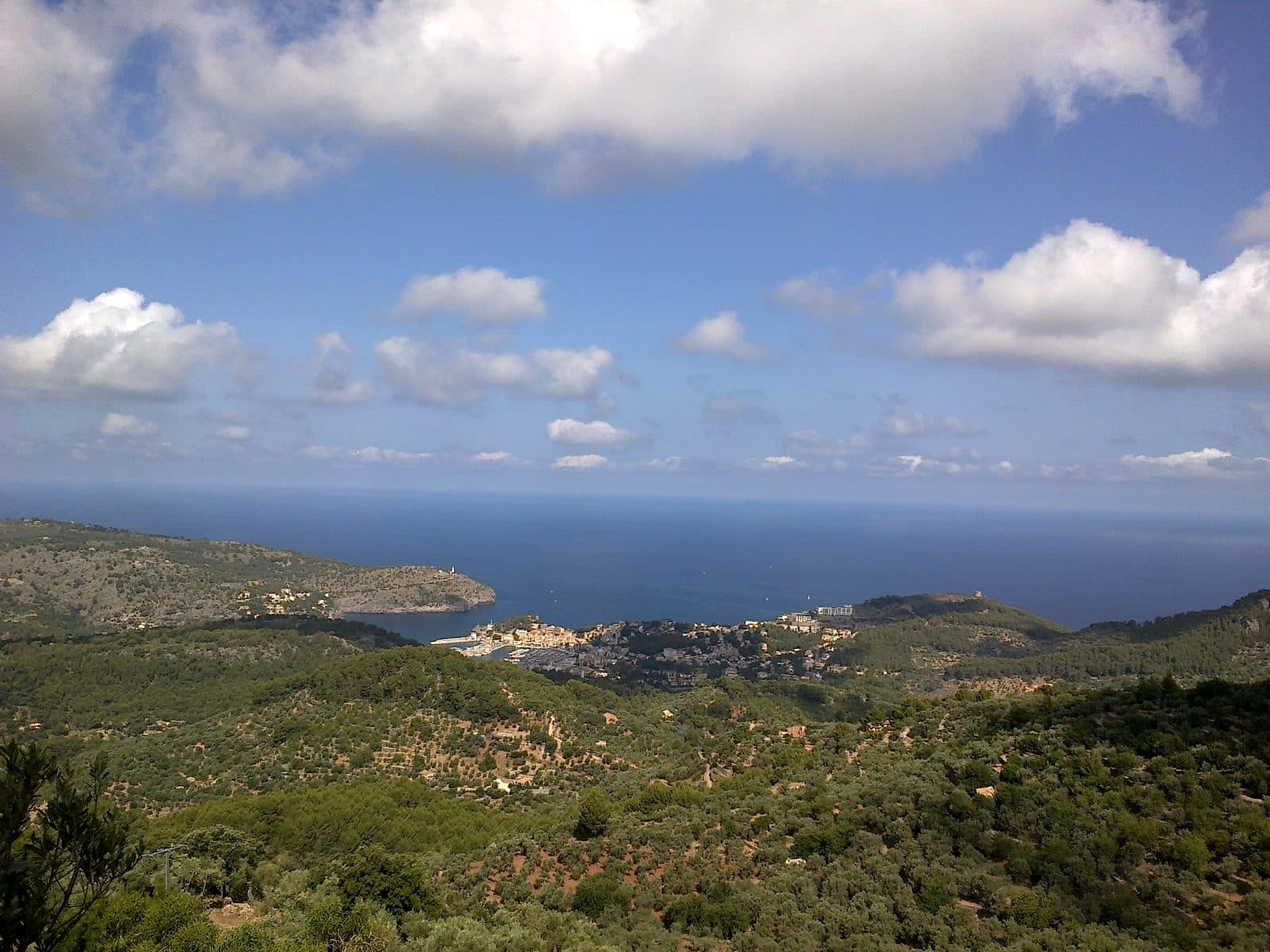

High above the bay, the view suddenly opens up: Port de Sóller and its harbor lie below, the sweeping coastline follows the sea beyond, and the mountains of the Serra de Tramuntana frame the scene. Mirador de ses Barques is not a viewpoint that requires a long search or a mountain hike to reach. It stands directly on the Ma-10, combining an easily accessible panoramic view with the feeling of already being deep in the mountains.
The Catalan name roughly means “view of the boats.” It fits, because from the viewing balcony, the harbor of Port de Sóller really does look like a carefully arranged miniature landscape. Its elevated position around 400 meters above the sea reveals how sheltered the bay is between the foothills of the Tramuntana. Only from up here can its complete shape be appreciated.
The Mirador is worthwhile both as a brief stop on a drive through the northwest and as an excursion destination from Sóller. Hikers also know it as the starting point and junction for old trails to Sóller, Fornalutx, the Bàlitx Valley, and onward toward Sa Costera and Cala Tuent. Those who only want the view can remain at the balcony; those who want to explore the landscape more closely can begin a trail here that soon disappears among olive groves, holm oak forest, and coastal slopes.
Its popularity does, however, have a simple consequence: the viewpoint rarely feels like a secret retreat. The terrace restaurant, parking lot, bus stops, and location on an important Tramuntana road create a steady flow of arrivals and departures. This is also part of its character. Mirador de ses Barques is a viewing terrace, roadside stop, and gateway to hiking trails all at once.
What to See
The Viewing Balcony
At the edge of the Mirador, the stop becomes either merely convenient or unforgettable. From the viewing balcony, the terrain drops steeply toward the coast; as a result, the view is not blocked by a nearby foreground but falls immediately toward the bay of Port de Sóller. The harbor basin, waterfront buildings, and boats appear small, while the contours of the coast and surrounding mountains stand out all the more clearly.
The panorama has a distinct sense of depth. The wooded and cultivated slopes lie in the foreground, the harbor opens farther below, and the Mediterranean stretches beyond it. The mountains of the Serra de Tramuntana frame the scene on either side. This perspective explains better than any map why Port de Sóller developed in this exact location: the bay is sheltered within an otherwise rugged coastal landscape.
Binoculars are genuinely useful here. The broad shape of the landscape is clear to the naked eye; with magnification, the boats, marina, and individual parts of the harbor town become easier to identify. Photographers should avoid focusing only on the harbor. A wider composition including the mountain slopes and coastline conveys the viewpoint's unusual elevation much more clearly.
Port de Sóller from Above
From the promenade in Port de Sóller, the bay is experienced as a harbor setting: water, beach, waterfront buildings, and boats are all roughly at eye level. From Mirador de ses Barques, this relationship is reversed. The entire town becomes part of a larger landscape. The bay appears as an opening between the mountains, and the buildings occupy far less space than the rock, forest, and sea.
The sweeping coastline is especially easy to see. It draws the eye from the harbor toward the open water and reveals the transitions between the developed waterfront and the Tramuntana slopes. Different areas stand out depending on the light: in clear conditions, the harbor and sea appear sharply defined, while lower light gives the mountains greater form. The viewpoint is therefore visited not only for the subject itself but also for the way it changes throughout the day.
The name “ses Barques” directs attention to the boats, but the real subject is broader. What you see is the interaction between the harbor, natural bay, and mountains. Anyone who has already walked through Sóller or Port de Sóller gains a wider understanding here of how the places in the valley and on the coast fit into the landscape.
The Terrace
A busy terrace restaurant stands immediately beside the viewing balcony. The view and the dining area almost merge: some visitors go only as far as the Mirador, while others take in the same scenery from the terrace. The place therefore feels less like an isolated mountain lookout and more like a stop on a mountain road.
The terrace extends the visit without changing the viewpoint's character. The view remains the main attraction. Anyone wishing to stop for food or drinks should not automatically assume that the business will be open or that a table at the edge will be available. Opening hours may change and should be checked separately before visiting the Mirador.
The terrace restaurant also explains why the Mirador is busier than many smaller viewpoints along the Ma-10. Hikers meet day-trippers, tour groups meet cyclists, and motorists stop only long enough to take a photo. For a peaceful look, it is worth being patient rather than leaving as soon as the first open space disappears.
The Start of the Old Trails
The Camí Vell de Bàlitx begins opposite the restaurant. The old trail descends into the Bàlitx Valley and continues over the Coll de Biniamar toward Cala Tuent. The Mirador therefore marks not only a place to look out over the landscape but also the transition from the roadside setting into the Tramuntana's historic trail network.
Other signposted old mule tracks connect the viewpoint with Sóller and Fornalutx. Along these routes, paved sections, cart tracks, olive groves, and shadier areas beneath holm oaks alternate with one another. The contrast with the viewing balcony is striking: moments after the view sweeps across the harbor and sea, the trail narrows and the landscape becomes more immediate.
The well-known longer route through the Bàlitx Valley and Sa Costera to Cala Tuent is not an add-on walk but a separate hike. Narrow paths and the length of the route require different preparation from a photo stop. Anyone who merely steps out of the car at the Mirador gains an impression of its starting point, but not of the demands of the coastal trail ahead.
Visiting the Viewpoint
A Short Scenic Stop
The simplest visit begins in the parking lot, continues to the viewing balcony, and ends after taking in the expansive view over Port de Sóller. Even this brief visit demonstrates the Mirador's key advantage: no hike is required to enjoy the panorama. Its location on the Ma-10 makes it a worthwhile stop on a drive between Sóller and the more northerly parts of the Tramuntana.
There is no fixed length of stay. Anyone who only wants to see and photograph the view needs to allow for no more than a short stop. Binoculars, changing light, or a break on the terrace can extend the visit considerably. As soon as a hiking trail becomes part of the plan, the Mirador should no longer be treated as a minor sight but as the starting point for a separate excursion.
Before visiting, it is advisable to check current access conditions and the terrace restaurant's operating hours. Reliable opening times and admission details are not permanently established. The viewpoint and restaurant should also be considered separately when planning: an accessible Mirador does not automatically mean that stopping for food or drinks will be possible.
Light and Crowds
Mirador de ses Barques is easy to reach and correspondingly popular. The viewing balcony can fill quickly when several vehicles or a group arrive at the same time. Guests from the terrace restaurant and hikers beginning or ending their route here add to the crowds. It is therefore impossible to identify a reliably quiet time.
Late afternoon is appreciated for photography because of the lower light. The shapes of the bay and surrounding mountains often stand out more clearly than under the high sun. This time can also be popular, especially when visitors want to combine the view with a stop at the restaurant. Those mainly seeking space at the balcony should avoid arriving with a rigid schedule and, if necessary, wait briefly for the visitors to change over.
Even in good visibility, it is worth looking again. At first, Port de Sóller attracts all the attention. Then the foreground slopes, coastline, and mountain backdrop become interesting. This progression is precisely what distinguishes a considered visit from a quick photo through the windshield.
From the Mirador onto the Hiking Trail
Hikers often begin at the Mirador on the Camí Vell de Bàlitx or follow the old connections to Sóller and Fornalutx. Those climbing from the valley experience the viewpoint in reverse: the panorama is not the beginning but the reward after a sustained ascent. Accounts of the route from Sóller describe a continuously climbing trail that becomes particularly strenuous in hot weather.
The route toward Cala Tuent leads through the Bàlitx Valley and the coastal landscape of Sa Costera. It is considered a classic hike, but it is long and runs in places along narrow paths away from developed roads. Onward transport from Cala Tuent must not be assumed without checking. Seasonal boat services and their schedules may change, so the return journey must be confirmed before setting out.
For a shorter hiking experience, the signposted trails toward Sóller or Fornalutx are suitable options. Sturdy footwear is advisable here as well, because old paving and rocky sections require more attention than the surfaced area at the viewpoint.
Getting There and Parking
Via Sóller to the Ma-10
From Palma and the airport, the reliable route information initially extends only as far as Sóller. The road distance from Palma Airport to Sóller is 31 kilometers; the drive takes around 38 minutes via the Ma-20 and then the Ma-11. From the center of Palma, the road distance to Sóller is 26 kilometers. The drive takes around 42 minutes and follows the Ma-11.
These figures expressly end in Sóller, not at the Mirador. For the final section, follow the Ma-10 from Sóller toward the Tramuntana and Pollença. The road gains elevation above the valley and winds through the mountain landscape. The Mirador lies directly beside this route, so no long walk from the road network is necessary.
Its location makes the viewpoint easy to reach, but the final stage requires attentive driving. The Ma-10 is a mountain road where bends, cyclists, and varying excursion traffic should be expected. The driving times to Sóller should therefore not be understood as the total travel time to the viewing balcony.
Parking at the Mirador
A larger parking lot is located at the viewpoint. It serves visitors to the Mirador and terrace restaurant as well as hikers setting out on longer routes from here.
The parking lot is directly at the destination; once the vehicle is parked, only a short walk remains to the viewing balcony. This convenience is one of the reasons for the high number of visitors.
Hikers should also remember that their car will remain at the Mirador. For point-to-point hikes to Cala Tuent, Sóller, or Fornalutx, return transportation must be arranged in advance. A route that ends by the sea on the map is not automatically complete from a practical standpoint.
By Bus
The Mirador de ses Barques 1 and Mirador de ses Barques 2 stops are located directly beside the viewpoint; Fornalutx is also included in the local stop network. This means that the Mirador can generally be reached without a private vehicle. However, schedules and seasonal service may change and should be checked for the specific day of travel.
The bus connection is particularly useful for hikers because it can make routes with different starting and ending points easier to organize. Nevertheless, planning should not rely solely on a previously published route number. The current timetable, the direction served by each stop, and the last available connection back to Sóller or Port de Sóller are what matter.
Bus lines to Mirador de ses Barques at a glance
| Line | Route | Departures/day | First | Last |
|---|---|---|---|---|
| 232 | Port de Sóller - Fornalutx | 174 | 06:45 | 21:35 |
| 204 | Port de Sóller - Palma | 76 | 00:35 | 23:32 |
| 203 | Valldemossa / Deià | 58 | 06:08 | 23:07 |
| 231 | Port de Sóller - Alcúdia | 24 | 09:02 | 20:22 |
From the official GTFS feeds (TIB/SFM), no real-time data. The figures cover all stops in the town; weekend and holiday services differ — check with the operator before travelling.
Getting there by bus
Mirador de ses Barques 1 (25001) · 0.1 km as the crow flies
- 231Port de Sóller - Alcúdia · Daily
Mirador de ses Barques 2 (25002) · 0.1 km as the crow flies
- 231Port de Sóller - Alcúdia · Daily
Fornalutx (25004) · 1.7 km as the crow flies
- 232Port de Sóller - Fornalutx · Daily
Sóller nord 2 (61005) · 2.3 km as the crow flies
- 203Valldemossa / Deià · Daily
- 204Port de Sóller - Palma · Daily
- 231Port de Sóller - Alcúdia · Daily
- 232Port de Sóller - Fornalutx · Daily
Sóller nord 1 (61004) · 2.3 km as the crow flies
- 203Valldemossa / Deià · Daily
- 204Port de Sóller - Palma · Daily
- 231Port de Sóller - Alcúdia · Daily
- 232Port de Sóller - Fornalutx · Daily
Timetable data: official GTFS feeds (TIB/EMT), no real-time — check with the operator before travelling.
Nearby Places
Sóller
Down in the valley, Sóller provides a fitting contrast to the Mirador. While the entire landscape appears at a glance from above, the town below reveals itself step by step: around Plaça Constitució, along the streets of the center, and among the traces of the transport routes connecting the valley and harbor. The Mirador therefore works well as a scenic introduction to or conclusion of a stay in Sóller.
The sequence from the valley to the heights is particularly rewarding. Those who first walk through Sóller and then drive up to the Ma-10 can see from the viewing balcony how the town lies between the mountains and how the terrain opens toward the coast. Conversely, the view from above provides orientation before exploring the town's streets and squares later.
Connections also exist on foot. Old, partly paved trails climb between Sóller, the olive groves, and the Mirador. They turn the view into a destination that must be earned, but the sustained ascent should not be mistaken for a walk through town.
Port de Sóller
Port de Sóller is the Mirador's main subject and also the most obvious addition to a visit. From above, the shape of the bay becomes clear; below, the harbor, waterfront, and boats can be experienced at close range. The two perspectives present the same place in completely different ways.
Combining them is especially worthwhile for travelers who want more than a panoramic photo. After seeing the view from above, visitors can find the areas along the promenade that previously appeared tiny far below. The historic tram connection with Sóller also places the harbor within the context of the valley, which is only partly visible from the Mirador.
The viewpoint does not replace a visit to Port de Sóller. The details of harbor life, the promenade, and the effect of the surrounding bay at sea level remain hidden from above. Nor does the harbor replace the Mirador, because only from the heights does the overall form of the coastal landscape become clear.
Fornalutx, Bàlitx, and Cala Tuent
Fornalutx is connected to the area around the Mirador by old trails and makes a suitable additional stop in the Sóller Valley. Rather than hurriedly checking off several places, the viewpoint can be sensibly included between Sóller and Fornalutx. Hikers can experience parts of these historic connections directly.
In the other direction, the Camí Vell de Bàlitx leads into the Bàlitx Valley. From there, the well-known route continues over the Coll de Biniamar and along the coastal landscape of Sa Costera to Cala Tuent. This is an undertaking for a separate hiking day, not merely a detour from the parking lot.
Sa Capelleta also lies along one of the trails around the Mirador. However, the same principle applies when combining several destinations as it does to the coastal hike: the old trails, elevation changes, and return transportation options shape the day's plan more than the apparently short distances on the map.
The place it belongs to
Sóller in the place guidePractical Visitor Information
Footwear and Trails
Everyday footwear is sufficient for the surfaced viewpoint. As soon as the visit extends onto one of the old mule and cart tracks, the requirements change. Paved passages, loose stones, narrow paths, and steep inclines make sturdy shoes with good grip advisable.
The route from Sóller in particular climbs continuously. In intense heat, this ascent becomes considerably more strenuous than the easily accessible roadside Mirador might suggest. The parking lot should therefore not obscure the fact that the onward trails can be genuine mountain and coastal hikes.
Sun, Wind, and Visibility
The appeal of the Mirador depends heavily on long-distance visibility. Clear air makes the harbor, coastline, and mountains stand out distinctly; haze reduces the panorama's depth. Checking the weather is therefore worthwhile not only for hikers. Those with flexible plans should choose a day with good visibility rather than a particular day of the week.
Visiting with Children
As a short scenic stop, the Mirador is easier for families than many mountain destinations accessible only on foot because the parking lot and viewpoint are close together. Smaller children should nevertheless be supervised continuously at the viewing balcony and near the road. This is a roadside stop on a mountain road, not an enclosed viewing garden.
Hikes must be assessed separately. A short break at the Mirador says nothing about whether the trail through the Bàlitx Valley or to Cala Tuent is suitable for a family. Length, heat, gradient, rocky ground, and return transportation should match the children's experience.
What Not to Expect
Mirador de ses Barques is not a museum, visitor center, or extensive park. Its essence is the viewing balcony, the view of Port de Sóller, and its role as the starting point for old trails. Anyone expecting an exhibition or a long circuit at the viewpoint itself will finish quickly.
Nor is it a secluded insider secret. The terrace restaurant, direct roadside location, and easy access regularly bring visitors to the Mirador. Quiet is more likely to occur during brief intervals or on the trails continuing from here. This is precisely why it is worth treating the stop as more than an obligatory photo opportunity: a few steps along the balcony, a look without a camera, and some patience reveal more of the landscape than a hurried snapshot.
Local insider tips
Bring Binoculars for the Harbor
From the viewing balcony, Port de Sóller looks like a miniature. Binoculars reveal the boats, marina, and individual waterfront areas, while the overall shape of the bay is most apparent to the naked eye.
Do Not Zoom in Only on the Harbor
The more impressive composition often comes from a wide frame: the foreground slope, bay, coastline, and Tramuntana mountains show the Mirador's elevation better than a telephoto shot focused only on the boats.
Take the Old Trail Instead of Just Stopping
The Camí Vell de Bàlitx begins opposite the terrace restaurant. Its opening section already reveals the transition from the busy roadside Mirador into the historic trail network; however, the long route to Cala Tuent requires separate planning.
Plan for Late Light
In the late afternoon, lower light often defines the bay and surrounding mountain slopes especially clearly. This time is popular, so it is worth being patient until space becomes available again at the viewing balcony.
Point-to-Point Hike Without a Car
The Mirador de ses Barques 1 and 2 stops are located directly beside the viewpoint. This can make hikes with different starting and ending points easier, provided the outward and return journeys have been checked against the current timetable.