
Torre Picada – Watchtower and Viewpoint above Port de Sóller
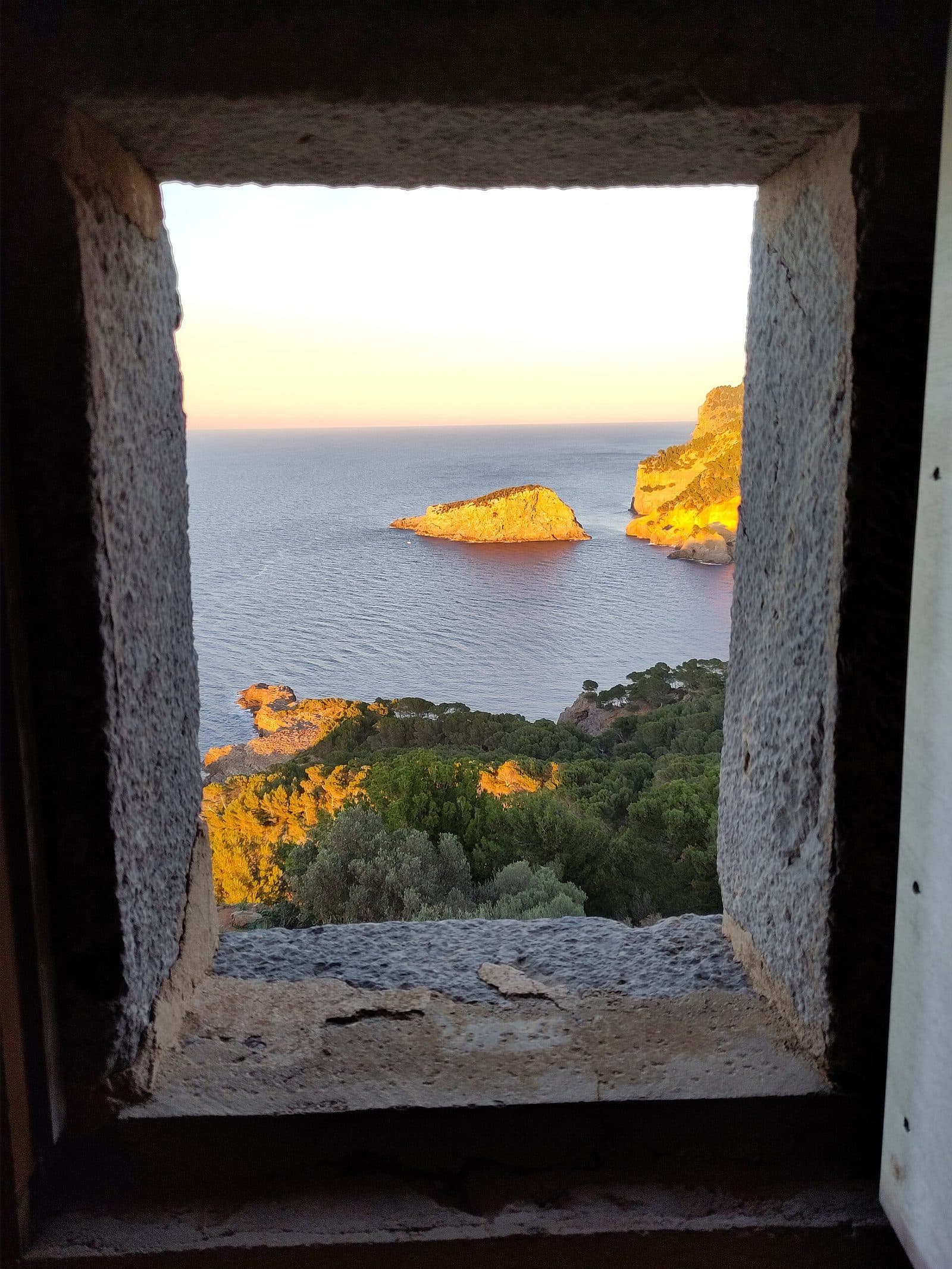

Above the olive terraces of Port de Sóller, Torre Picada stands in a location that immediately makes its former purpose clear. From the old coastal watchtower, the view extends across the Mediterranean, the rugged northwest coast, the mountains of the Serra de Tramuntana, and down to the sheltered bay of the port town. It is less a conventionally developed monument than a viewpoint reached on foot.
The route begins in the built-up area of Port de Sóller, climbs along narrow streets, and eventually becomes a quieter path between old, sometimes gnarled olive trees. New stretches of coastline appear with every bend along the way. At the top, there is no museum tour, but rather a sturdy historic tower in a landscape that provides the real appeal of the visit.
Torre Picada is especially suited to travelers who prefer experiencing history in its original setting rather than behind glass. It is also ideal for a shorter hike from the harbor, a scenic start to a day in Port de Sóller, or a route combined with the Camí de S’Illeta. The climb is considered relatively easy, but the gradient, unpaved sections, and wind along the ridge still require care.
History and significance
Before a foreign ship could reach the bay, it was meant to be spotted from up here. Torre Picada belonged to a network of observation posts extending along the Mallorcan coast. These towers, known as talaies, formed an early warning system against attacks from the sea. The elevated position above Port de Sóller was crucial: From here, guards could monitor not only the entrance to the bay but also a broad stretch of open water and the rugged northwest coast.
The threat from the sea
For the Sóller valley, the harbor was both a link to the outside world and a vulnerable point. Pirate raids and other attacks from the sea shaped the coastal region, particularly in the 16th and 17th centuries. What appears today as an impressive panorama was an area the guards had to scan carefully. A sail on the horizon could signal trade, but it could also mean danger.
The system was not limited to a single tower. Observation posts along the island’s coast were intended to relay messages and alert the relevant authorities as far away as Palma when hostile ships approached. Torre Picada was therefore part of a larger defensive strategy: visibility, elevation, and links to other posts were at least as important as the strength of the structure itself.
The 17th-century watchtower
Torre Picada dates from the 17th century. Its construction therefore falls squarely within the period when the threat of raids in the western Mediterranean was part of everyday life in coastal communities. The tower was neither a prestigious building nor a residence. Its purpose was observation and warning; its position on the ridge explains its form and character better than any later description.
Today, the tower is classified as a cultural asset of interest. Its significance lies not only in the age of its walls. At hardly any other point above Port de Sóller is it so easy to understand why a coastal watchtower was needed in this location. The historic gaze of the guards and the modern gaze of hikers follow the same line: out to sea, along the coast, and down toward the entrance to the bay.
From warning post to hiking destination
Once its original defensive role ended, the lookout became a scenic destination. Today, Torre Picada is primarily a viewpoint and a stop on walking and hiking routes above the harbor. This restrained use helps preserve its character. The tower, its elevated position, and its sightlines explain for themselves why the site was once chosen.
The change in meaning is clear: Where the horizon was once searched for danger, the view now focuses on the shapes of the Tramuntana, the coastline, and the blue Mediterranean. The tower remains the historic focal point. Without it, the site would be an attractive scenic ridge; with it, it becomes a tangible piece of Mallorcan coastal history.
What to see
Shortly before the destination, Torre Picada emerges above the olive-covered slopes. It does not look like a decorative excursion site, but like what it once was: a sturdy observation post in an exposed location. The visit centers on the tower’s exterior and the surrounding landscape. Anyone expecting exhibition rooms, a furnished guardroom, or an accessible viewing platform will misunderstand the character of the place.
Torre Picada
Seen up close, the old tower forms a striking counterpoint to the open coastal landscape. Its enclosed, defensive appearance initially draws attention to the structure; a few steps later, the panorama pulls the eye out to sea. This contrast is precisely what makes the location so evocative. The architecture is spare and functional, while the surroundings feel almost limitless.
The interior is not the focus of the visit. Torre Picada is essentially experienced from the outside. As a result, there is no prescribed circuit and no sequence of museum displays. Instead, the exterior view of the tower takes center stage. Depending on the angle, it appears as a coastal guard post, a landmark, or the quiet conclusion to the climb.
Even without access to the tower’s interior, its function is easy to understand. The exposed position provides views over the waterways from which danger once threatened. By slowly scanning the horizon and the harbor entrance, visitors in a sense repeat the most important task of the former guards—though without their tension today.
The bay of Port de Sóller
On the harbor side, the view opens down toward the bay of Port de Sóller. From above, its sheltered, horseshoe-like shape stands out clearly from the open coast. The harbor basin, waterfront buildings, and surrounding mountain slopes can be seen as a continuous landscape, whereas from the promenade below they are visible only in sections.
This elevated view clearly explains the distinctive geography of the place. Port de Sóller does not lie on a straight stretch of beach, but in a natural indentation between the foothills of the Tramuntana. From Torre Picada, the bay appears both sheltered and open to the sea. This makes the viewpoint rewarding for anyone who already knows the harbor from below and now wants to understand its location from another perspective.
Costa de S’Illeta
On the other side, Costa de S’Illeta accompanies both the route and the view. The coastline here appears rougher than the developed bay: Rocky slopes drop toward the sea, and the horizon becomes more prominent. The track from Coll de S’Illa already offers views in this direction; at the tower, they expand into a broad coastal panorama.
This contrast is one of the defining impressions of Torre Picada. On one side lies the sheltered harbor with its promenade and boats; on the other is the more open northwest coast. The former watchtower stands precisely between these two faces of the landscape. This makes it easy to understand why the location was strategically valuable and why it offers such varied photographic opportunities today.
Serra de Tramuntana
Behind Port de Sóller rise the mountains of the Serra de Tramuntana. In clear weather, the panorama extends as far as Puig Major; in winter, its summit may wear a white cap. The mountains are more than a backdrop. They frame the bay and recall how strongly the Sóller valley was separated from the rest of Mallorca by the range for many years.
The light noticeably changes the effect of the view. While the sea shows different shades of blue depending on the weather, shadows trace the folds and ridges of the mountains. Clouds, haze, or a winter streak of snow on Puig Major can shape the scene more strongly than the tower itself. Torre Picada is therefore not a viewpoint that looks the same on every visit.
The ridge
From the tower, a path leads toward the point above the bay. It follows the ridge and opens up additional perspectives, but it is also where the exposed location becomes particularly noticeable. Strong winds can sweep across the ridge along the northwest coast. The enticing view should therefore not encourage carelessness near edges or on loose ground.
Sheltered spots are better for a break than the most exposed point. Anyone carrying a small snack can combine the tower visit with a rest and take time to enjoy the view. Everything needed should therefore be brought from Port de Sóller and taken away again afterward.
Visiting Torre Picada
The transition happens gradually: First, streets lead through Port de Sóller, then the path narrows, the houses recede, and olive trees accompany the climb. An excursion to Torre Picada is not a quick roadside photo stop. The route is part of the experience because the view opens farther with every bend, while the harbor gradually falls away below.
The climb from the harbor
A common starting point is near the tram terminus. From there, the route initially follows the Través harbor promenade before continuing via Carrer Antoni Montis and Avinguda Onze de Maig to Carrer de Bèlgica. This road climbs steeply. The route then continues along Camí de S’Illeta, which winds upward between olive-covered slopes.
Several paths meet at Coll de S’Illa. For Torre Picada, take the track leading toward the coast. After a prominent bend, it reaches a flatter area with olive trees; from there, the path continues to the tower. Because junctions and similar-looking paths can easily cause confusion, a current hiking map or saved route is advisable.
One hiking description gives the climb itself as just under half an hour. This should not be understood as the duration of the entire excursion: Time must also be allowed for reaching the starting point, breaks, the visit to the tower, and the return journey. Anyone wishing to savor the coastal views or explore more of Camí de S’Illeta should not squeeze the visit between two tightly scheduled activities.
Time at the tower
There is no fixed sightseeing route at the top. Most visitors first look out over the sea, then turn toward the harbor and the mountain scenery. Even small changes in position can alter the view considerably. For photographs, it is therefore worth looking beyond the area directly in front of the tower and checking the perspectives along the path and ridge.
How long visitors stay depends more on the weather and their interests than on any set circuit. Anyone primarily interested in seeing the tower can turn back after a short break. Landscape enthusiasts will remain longer because the bay, coast, and Tramuntana cannot be appreciated in a single glance. In strong winds, the time spent on the open ridge often becomes shorter automatically.
Time of day and visitor levels
Port de Sóller is a popular daytime destination. Particularly during the high season, traffic, the busy promenade, and the search for parking can make the beginning of the excursion less peaceful. Toward evening, many day visitors leave the harbor and the town becomes quieter. Warm light then falls across the mountain slopes surrounding the bay. For a late climb, however, the return route, weather, and remaining daylight must be assessed carefully.
Anyone mainly seeking comfortable conditions for the ascent should avoid intense midday heat. On the ridge, the wind is also more important than the temperature down by the harbor. Before setting out, it is therefore worth checking not only the general forecast but also the wind and visibility conditions on the northwest coast.
Access and expectations
Current opening hours and admission conditions should be checked before visiting. Regardless of these details, Torre Picada is not a conventionally developed museum. Its appeal lies in the exterior structure, the walk there, and the view. The tower is not open; the visit is primarily about seeing it from outside and enjoying the panorama.
This simplicity is one of the destination’s strengths. Between the harbor and the tower, the surroundings change without artificial staging: Streets become paths, buildings give way to terraces, and the former observation post ultimately stands before the sea. Anyone who understands this sequence as part of the excursion will experience Torre Picada more fully than someone merely searching for the next scenic photograph.
Getting there and parking
The road journey ends in Port de Sóller, not directly at Torre Picada. The final section to the viewpoint is completed on foot via rising streets and Camí de S’Illeta. Setting the tower itself as a navigation destination can therefore be misleading; it is better to head first for the harbor town and switch there to the described walking route.
From Palma Airport
From Palma Airport, the drive initially follows the Ma-20 and then the Ma-11 to El Port, meaning Port de Sóller. The road distance to the harbor town is 36 kilometers, and the journey takes around 48 minutes. The walk to Torre Picada begins in Port de Sóller; the stated driving time expressly does not include this climb.
The Ma-11 leads through the Sóller valley to the northwest coast. During the high season, reaching the harbor can take longer because Port de Sóller attracts many visitors and parking spaces become scarce. Anyone arriving by car should therefore not assume that a free parking space will be available directly at the start of the hiking route.
From central Palma
From central Palma, the route follows the Ma-11 to Port de Sóller. The road distance to the harbor town is 31 kilometers, and the journey takes around 52 minutes. The same applies here: These details end at El Port. Torre Picada is then reached on foot through the town and along the rising Camí de S’Illeta.
The combination of city traffic, the drive through the Sóller valley, and the search for parking makes generous time planning advisable. Particularly on busy days, public transport may be more relaxing than looking for a parking space around the harbor.
Parking in Port de Sóller
Free parking spaces can be difficult to find in Port de Sóller. A well-known alternative is a parking garage on Calle de Lepanto. From there, the tram terminus area can be reached and serves as an easy-to-follow starting point for the walk to Torre Picada.
Driving far up the narrower access roads on the hillside is not a good basis for the excursion. The route becomes narrow, climbs steeply, and turns into a track. Torre Picada should therefore be planned as a hiking destination from Port de Sóller, not as a viewpoint with parking directly outside the structure.
By bus and tram
The Port de Sóller bus stop has the identifier 61027. From there, the route leads down into the harbor area and onward to the starting point of the climb. There is no direct bus connection to the tower; the final section remains a walk.
An appealing alternative is to travel via Sóller and take the historic tram to Port de Sóller. Its terminus provides a useful reference point for the beginning of the route. This allows the journey itself to be combined with the scenery of the Sóller valley while avoiding the search for parking and heavy traffic around the harbor.
Bus lines to Torre Picada at a glance
| Line | Route | Departures/day | First | Last |
|---|---|---|---|---|
| 204 | Port de Sóller - Palma | 76 | 00:40 | 23:30 |
| 203 | Valldemossa / Deià | 58 | 06:05 | 23:15 |
| 232 | Port de Sóller - Fornalutx | 58 | 07:05 | 21:15 |
| 231 | Port de Sóller - Alcúdia | 8 | 09:00 | 20:35 |
From the official GTFS feeds (TIB/SFM), no real-time data. The figures cover all stops in the town; weekend and holiday services differ — check with the operator before travelling.
Getting there by bus
Port de Sóller (61027) · 0.9 km as the crow flies
- 203Valldemossa / Deià · Daily
- 204Port de Sóller - Palma · Daily
- 231Port de Sóller - Alcúdia · Daily
- 232Port de Sóller - Fornalutx · Daily
Timetable data: official GTFS feeds (TIB/EMT), no real-time — check with the operator before travelling.
Nearby
After descending, visitors do not simply return to a parking lot but arrive in the heart of Port de Sóller. Below are the promenade, the yacht and fishing harbor, and the sheltered bay; above, Torre Picada remains visible as a small dark point over the slopes. This immediate transition between coastal hike and harbor town makes the excursion particularly easy to combine with a longer stay.
Port de Sóller
The town stretches around a horseshoe-shaped bay framed by the foothills of the Serra de Tramuntana. The tram tracks run along sections of the promenade, while fishing boats and yachts lie in the harbor. After returning from Torre Picada, the waterfront paths offer a peaceful conclusion to the excursion; food and ice cream can also be enjoyed here if only a short rest was planned at the top.
The perspective from the tower changes the way the harbor is seen. From above, the complete shape of the bay was visible; below, its ends once again disappear behind buildings and waterfront lines. Comparing both views provides a better understanding of why this sheltered location was economically important to the Sóller valley and why it also had to be defended against attacks from the sea.
Camí de S’Illeta
Camí de S’Illeta is more than merely the access route to the tower. It leads through a cultivated landscape of terraces and old olive trees and opens up views of Costa de S’Illeta along the way. The paths divide at Coll de S’Illa, allowing Torre Picada to be incorporated into a longer hike if the route, weather, and fitness levels are suitable.
For a first visit, it is enough to choose the tower as the main destination and return along the same route. Anyone wishing to continue should plan the route beforehand rather than improvising at a junction. Although the coastal landscape may look easy to navigate, its ridges, terraces, and different paths make it more intricate than it appears from the harbor.
Sóller and the valley
Port de Sóller and the town of Sóller are connected by the historic tram. This makes it possible to combine a visit to the tower with time in Sóller’s old center without treating both places as a single destination. The harbor is maritime and open, while Sóller lies inland in the mountain-enclosed valley.
A logical sequence for a day trip is to visit Sóller first, then take the tram to the harbor and climb to Torre Picada—or to reverse the order if the cooler part of the day is to be used for the hike. The key is to leave enough time for the walk and the view.
The place it belongs to
El Port (Port de Sóller) in the place guidePractical visitor information
The route is considered easy, but “easy” here does not mean level and fully paved. Carrer de Bèlgica climbs steeply, Camí de S’Illeta becomes narrower, and the remaining approach follows a track. Sturdy, well-fitting shoes are therefore more suitable than smooth-soled sandals. After rain, unpaved sections may require additional care.
Sun, wind, and water
The wind is often noticeably stronger on the ridge than down in the sheltered bay. Lightweight items should be secured, and keeping a safe distance from exposed areas on the coastal sides is sensible. In strong winds, the ridge path loses much of its ease; it is better to take a break in a sheltered spot.
Water and sun protection should therefore be carried, even though the climb is described as short. Food and drink are available at the harbor, but not as a reliable service directly at the viewpoint.
With children
The combination of an old watchtower, pirate history, and a manageable climb can appeal to children. Historic coastal towers are attractive destinations for younger hikers because their former purpose is easy to imagine: spotting ships from the highest point and raising the alarm.
Nevertheless, the ridge remains a natural coastal landscape. Wind, unpaved paths, and exposed areas require close supervision. Whether the excursion is suitable depends less on age alone than on sure-footedness, stamina, and willingness to walk uphill. A small snack for a break in a sheltered spot can make the return journey more pleasant.
Finding the way at Coll de S’Illa
Several paths meet at Coll de S’Illa. The turn toward Torre Picada must be chosen deliberately there. A saved map is particularly helpful on the return journey, when similar tracks and bends can look different from the opposite direction. Although the tower is a prominent landmark, it is not visible throughout the climb.
Anyone wishing to visit only Torre Picada will find it easiest to return along the same route. Spontaneous shortcuts across terraces or private property are not a sensible alternative. The established approach follows existing roads and paths.
What not to expect
The tower’s interior is not at the heart of the experience. Visitors should instead expect a historic structure, a rewarding walk, and broad landscape views without extensive tourist staging.
The view also depends on the weather. Haze can obscure distant mountain forms, clouds change the colors of the sea, and strong winds can shorten the visit. This is precisely why the place feels authentic: Torre Picada does not stand before a controlled backdrop, but remains in the same open coastal landscape it was built to observe.
Local insider tips
See both sides of the tower
Do not stop at the first sea view: On the harbor side lies the sheltered bay of Port de Sóller, while Costa de S’Illeta reveals the rougher open coast. Only both perspectives fully explain the watchtower’s location.
Take the wind seriously on the ridge
The path from the tower toward the viewpoint above the bay follows the ridge. It can be considerably windier there than down by the harbor. For a break, a sheltered spot is better than the most exposed edge.
Enjoy the route itself
The climb is more than just an access path: Above Carrer de Bèlgica, Camí de S’Illeta winds through terraces of old olive trees. Even before the tower, every bend reveals new stretches of coastline.
Use the tram as your reference point
The tram terminus in Port de Sóller is an easy-to-follow starting point. From there, the route can be traced via the promenade, Carrer Antoni Montis, Avinguda Onze de Maig, and Carrer de Bèlgica.
A quieter harbor and warm light later
Toward evening, many day visitors leave Port de Sóller, and warm light falls across the surrounding mountains. Anyone choosing this time for the tower should check the wind, weather, and remaining daylight for the return journey particularly carefully.