
Mirador d'en Josep Sastre: Views of Sa Dragonera
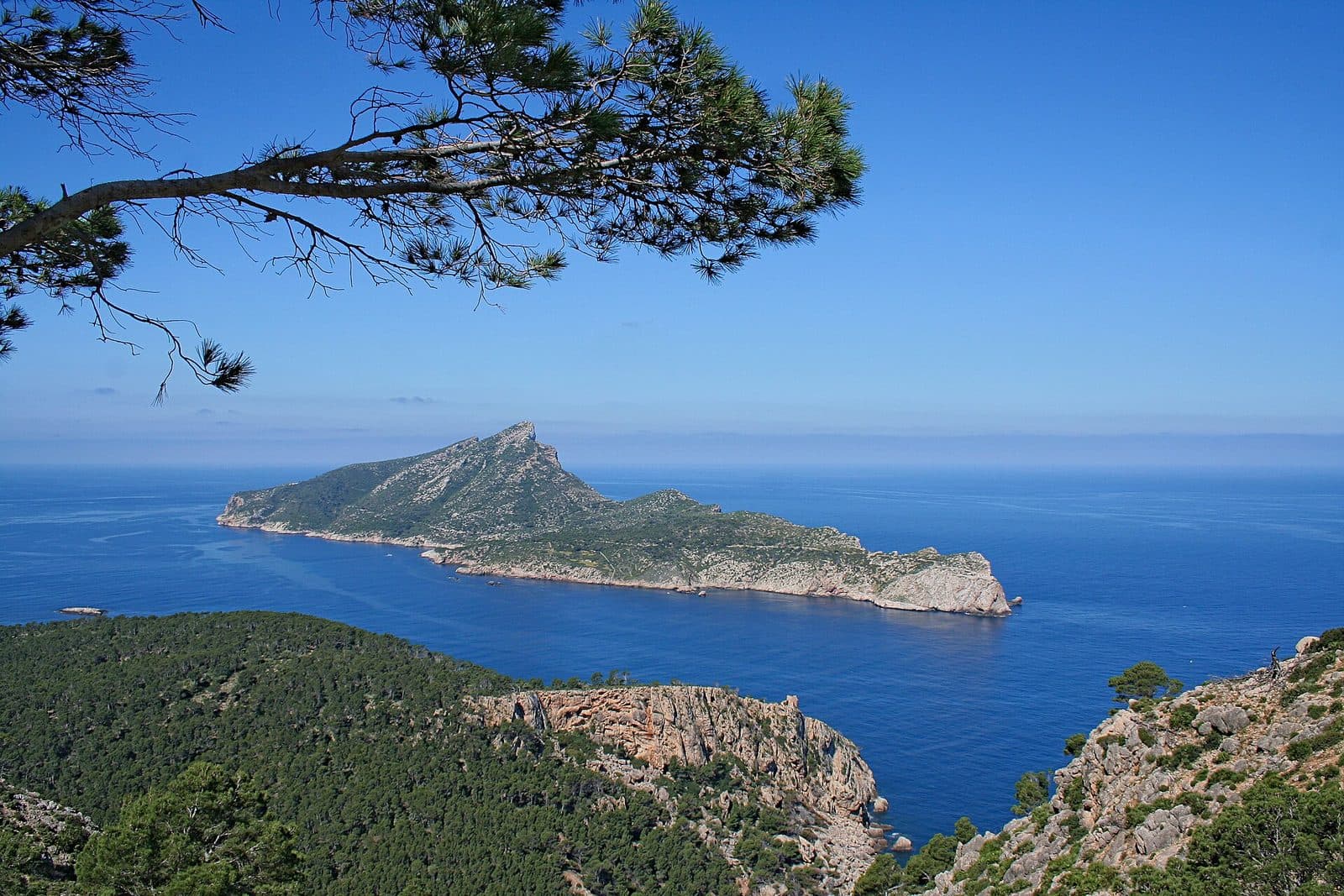

Mirador d'en Josep Sastre rewards not a quick roadside stop, but the journey on foot. High above Mallorca's wild southwest coast, views open across steep rocky slopes, the sea, and the elongated silhouette of Sa Dragonera. The viewpoint lies in the southern foothills of the Serra de Tramuntana, far from cafés and the large crowds found along better-known scenic roads. This simplicity is precisely what gives the place its special appeal: there is no elaborately designed viewing terrace at the destination, only a stone parapet at the edge of a rugged rocky landscape. The German hiking pioneer Herbert Heinrich aptly nicknamed it the “Devil's Pulpit.” Standing here means more than seeing a picturesque stretch of coast; it reveals the abrupt boundary between mountains and sea.
The Mirador is particularly appealing to hikers, landscape photographers, and visitors who want to discover Mallorca's southwest beyond the coastal resorts. Access is via hiking trails with rocky and, in places, exposed terrain. Fitness, sure-footedness, and sensible preparation are therefore essential for a visit. The viewpoint is worthwhile both as a destination in its own right and as a stage on a longer hike along the GR 221 Dry Stone Route. Combining it with La Trapa makes particular sense: ruins, historic cultivated landscapes, and coastal panoramas all lie along the same hiking corridor, without reducing the Mirador to a mere intermediate stop. Its view of Sa Dragonera remains the defining moment of the route.
What to See
Even before reaching the stone parapet, the landscape dominates the scene. The path crosses the rocky coastal foothills of the Serra de Tramuntana and approaches terrain that feels far more open and unspoiled than the developed viewpoints along Mallorca's major roads. With every unobstructed section, Sa Dragonera emerges more clearly off the coast, while the cliffs below drop toward the sea.
The “Devil's Pulpit”
The parapet at Mirador d'en Josep Sastre is the small man-made feature that identifies the viewpoint. The German hiking pioneer Herbert Heinrich called it the “Devil's Pulpit.” The nickname suits its setting: the masonry resembles a pulpit above the abyss, with sea and sky opening beyond it. The parapet should not, however, be mistaken for a fully secured visitor terrace. The Mirador stands in rugged rocky terrain, with exposed edges nearby. It is precisely the contrast between the human-made wall and the untamed coast that makes the place so striking. For photographs, the parapet provides a distinctive foreground; during a visit, it also serves as a clear reminder to keep away from unsecured edges.
Sa Dragonera
The main view belongs to Sa Dragonera. From here, the offshore island does not appear as a small dot on the horizon, but as a long, jagged body against the open sea. Depending on where you stand along the trail, its relationship to the coastline changes: at times it seems to lie close to Mallorca, while elsewhere a broad band of water separates the two islands.
This perspective explains why the Mirador is known among hikers and photographers, despite not being an easily accessible viewing terrace. The scene has clearly defined layers: rock and parapet in the foreground, the steep southwest coast in the middle, and Sa Dragonera beyond. Anyone who does not move on immediately after the first photograph will notice how even small changes in position shift the contours.
The Cliffs
Alongside Sa Dragonera, the coast itself deserves attention. The viewpoint stands 450 metres above the sea. From this height, the scale of the rocky landscape becomes visible: ridges and gullies descend toward the water, pale limestone alternates with vegetated areas, and the coastline appears far less accessible than it does below near Sant Elm.
The view is not focused on a single bay or harbour, but follows an entire sequence of cliffs, rocky projections, and slopes. This sets the Mirador apart from many classic photo stops: the panorama can hardly be captured in a single frame. It is worth letting your gaze travel both toward Sa Dragonera and along Mallorca's coastline.
The Approach as Part of the Panorama
The views begin well before the parapet. Along the hiking trails via La Trapa or from Coll de Sa Gramola, repeated openings reveal the sea and the island. The longer route from the mountain pass also links the Mirador with the Les Bardes viewpoint. This creates a succession of different perspectives, with Josep Sastre offering the most distinctive view from the high, rocky coastal edge.
This gradual approach in particular changes the experience of the visit. Sa Dragonera appears along the way, disappears behind the terrain, and later comes back into view. By the time you reach the Mirador itself, the scene is already familiar, yet still feels new because of the elevated, open setting. The trail is not merely an access route, but a spatial introduction to the panorama.
Visiting the Viewpoint
The first important moment takes place not at the viewpoint, but while planning the hike. Mirador d'en Josep Sastre is a hiking destination. Anyone who simply navigates to an address and expects parking immediately beside the parapet has misunderstood the character of the place. The starting point, weather, fitness level, and available walking time all determine how the visit unfolds.
From Sant Elm via La Trapa
The frequently used option begins in Sant Elm and leads through the La Trapa area. The walk to the Mirador is said to take around one and a half to two hours. The route passes through pine-covered areas and across exposed limestone paths; the ruins of the former Trappist monastery lie along the way. This route is shorter than the approach from Coll de Sa Gramola, but includes steeper sections.
Anyone including La Trapa should not treat the viewpoint as a quick add-on. The trail crosses uneven terrain, and enough time and energy must remain for the return journey. A steady pace with breaks at the coastal viewpoints that appear along the way is advisable. The stone parapet marks the viewpoint; the surrounding rocky terrain requires correspondingly cautious behaviour.
From Coll de Sa Gramola
The second well-documented option starts at Coll de Sa Gramola on the Ma-10 north of Andratx. It follows the signposted GR 221 Dry Stone Route and the Camí de ses Basses. As an out-and-back hike, this tour covers 14,3 kilometres, 496 metres of elevation gain, and approximately four hours of walking. It is considered moderately difficult.
The advantage of this route lies in its long scenic progression. In addition to Josep Sastre, it reaches Les Bardes before the hike can continue toward La Trapa. Sections of the paths have been renewed, and signs and maps help with navigation. A separate hiking map or a route saved in advance is nevertheless advisable, since navigation in remote terrain should not depend solely on individual signs.
Time at the Parapet
How long you stay at the viewpoint depends largely on the weather and personal interest. A visit consists of taking in the scenery, photographing it, resting, and deliberately shifting your gaze between Sa Dragonera and the cliffs. On windy days, even a short break can be demanding. In calm, clear conditions, however, it is worth not leaving immediately after taking a souvenir photograph. The outline of Sa Dragonera, the course of the coastline, and the sense of depth created by the rocky drops are easier to appreciate from several safe positions. The duration of the overall visit is determined by the walk there and back, however, not by the size of the Mirador.
Crowds and Seasons
The Mirador is considered less well known than Mallorca's developed viewpoints. Even so, the small area around the parapet can quickly feel busy when several hiking groups arrive at the same time. There is no reliably documented daily time when the site is free of visitors. Anyone seeking quiet should therefore not rely on a particular hour, but allow enough time and, if necessary, wait until a group has moved on.
Spring and autumn are recommended hiking seasons for the longer tour from Coll de Sa Gramola. Current weather conditions remain the decisive factor. The exposed sections offer neither shelter nor infrastructure, while heat, strong winds, or poor visibility can substantially change the character of the route. Opening hours and admission details are not reliably documented; current conditions and possible access notices should therefore be checked before setting out.
Getting There and Parking
The drive does not end at the Mirador. S'Arracó is used as the nearest place of reference in directions, while the viewpoint itself can only be reached on foot via the hiking trail network. Route planning must therefore consider two separate stages: first the drive into the southwest, followed by the choice of a suitable hiking access point.
From Palma
It is 33 kilometres by road from central Palma to S'Arracó. The drive takes around 40 minutes and follows the Ma-1. These figures expressly apply only as far as S'Arracó, not to the stone parapet and not automatically to any particular trailhead parking area.
In S'Arracó, you must decide which route to the Mirador you intend to take. The common approach via Sant Elm requires continuing toward the coast and then ascending on foot through La Trapa. For the longer hike, by contrast, the destination is Coll de Sa Gramola on the Ma-10. Anyone who waits until arrival to compare the two options risks unnecessary driving and starting too late.
From Palma Airport
It is 44 kilometres by road from Palma Airport to S'Arracó. The drive takes around 41 minutes and follows the Ma-20 onto the Ma-1. This calculated route also ends in S'Arracó. The final drive to the chosen starting point and the entire hike to the Mirador must be added.
The time required for the walking route should not be underestimated directly after a flight. Even the shorter option from Sant Elm is a proper hike over uneven and partly exposed trails. A visit on an arrival or departure day therefore requires consideration of daylight, equipment, and sufficient reserves; the Mirador is not a quick detour between the airport and your accommodation.
Coll de Sa Gramola
Parking is available at Coll de Sa Gramola on the Ma-10. From there, the hike follows the GR 221 and the Camí de ses Basses. This option provides a clear starting point for the 14,3-kilometre out-and-back tour and opens up additional coastal views alongside the Mirador.
As this is a trailhead on a mountain road, vehicles should be left only in suitable areas without narrowing the carriageway or blocking access. Before setting off, it is advisable to make one final check of the route, weather, and planned return time. There is neither parking nor a roadside pickup point at the Mirador itself.
Bus and Onward Journey
No bus stop is documented in the immediate vicinity of the viewpoint. A journey by public transport therefore cannot be planned in the same way as a visit to a viewpoint in a town centre. Even if a coastal resort or S'Arracó is reached by bus, the demanding walk to the Mirador and the return journey still need to be considered.
Anyone travelling without a car should check the entire chain of the hike in advance rather than considering only the connection to S'Arracó. Particularly on a point-to-point hike between S'Arracó, La Trapa, and Sant Elm, the start, destination, and return transport must all align. The Mirador itself is not a transport hub, but a remote point within the trail network.
Nearby Places
Between village, coastal resort, and mountain pass, the southwest presents three very different faces here. S'Arracó is the Mirador's local reference point and a sensible area from which to begin planning. Sant Elm provides access from the sea, while Coll de Sa Gramola enables the longer approach across the heights of the Serra de Tramuntana.
S'Arracó
S'Arracó lies inland in the municipality of Andratx. For visitors to the Mirador, the village is less a final destination than a point of orientation between the Ma-1, the coast near Sant Elm, and the hiking trails in the mountains. Several recorded routes connect S'Arracó across the heights with Josep Sastre, La Trapa, and Sant Elm, although such hikes require precise route planning.
Anyone starting or finishing in the village experiences a pronounced transition: the sheltered settlement gives way to mountain paths and finally to the open coastal landscape. This transition explains why the Mirador, despite its association with S'Arracó, cannot be visited like a sight within the village. Between the village street and the view lie rugged terrain, elevation changes, and a distinct hiking stage.
Sant Elm
Sant Elm is the most common starting point for the shorter route via La Trapa. The coastal resort lies directly opposite Sa Dragonera, allowing the island to be viewed from two different elevations before or after the hike. From below, it appears separated by the sea and broad on the horizon; from the Mirador above, Mallorca's cliffs also become part of the scene.
Combining the hike with Sant Elm is particularly suitable when the outward and return routes are planned along the same coastal side. Anyone who instead continues to S'Arracó is undertaking a point-to-point hike and needs suitable return transport. Cala en Basset and its tower are also part of the hiking area around Sant Elm, but should be added only when there is sufficient time and the route has been designed accordingly.
La Trapa
La Trapa is the most obvious place to combine with a walk to the Mirador. The ruins date back to a Trappist monastery. The valley had already been used for agriculture for a long period before then. Today, its ruins, historic cultivated landscape, and views of Sa Dragonera form the focal point of many hikes.
Mirador d'en Josep Sastre should nevertheless not be confused with the viewpoint at La Trapa. Both offer views of Sa Dragonera, but they lie at different points along the route. Anyone approaching from Coll de Sa Gramola can combine Josep Sastre and La Trapa on the same hike; from Sant Elm, the usual approach first passes through the La Trapa area before continuing to the Mirador.
Les Bardes
Les Bardes lies along the longer route from Coll de Sa Gramola. The viewpoint adds another perspective on Sa Dragonera and the steep coastal sections. It is a worthwhile intermediate stop, but does not replace Mirador d'en Josep Sastre with its characteristic stone parapet.
Especially on the return journey, the succession of several viewpoints helps you read the landscape in a different way. What appeared to be a distant destination on the outward route now becomes part of a continuous coastline. On a hiking day of this kind, the total duration of the route should remain the key consideration; spontaneous detours must not use up the reserves needed for the return journey.
The place it belongs to
S'Arracó in the place guidePractical Information for Your Visit
There is no kiosk or café at the Mirador. This simplicity is part of its appeal, but requires self-sufficiency. Water, sun protection, navigation tools, and the food needed for the chosen route must already be in your backpack at the starting point.
Footwear and Terrain
The trails cross uneven terrain and exposed sections of limestone. Sturdy hiking shoes with good grip are therefore more appropriate than sandals or smooth-soled leisure shoes. Even visitors who intend to see only the viewpoint rather than complete the entire route to La Trapa are walking on a mountain trail, not a paved promenade.
Loose stones, irregular footing, and exposed sections require particular attention. The pace should be based on the most difficult section and the least experienced member of the group. The open sea view can easily tempt walkers to look sideways while moving; for prolonged viewing, stopping in a safe position is the better choice.
Sun, Wind, and Weather
Shade is not continuously available on the open heights. Sun protection and sufficient water are therefore essential even outside the height of summer. At the same time, the exposed setting can be much windier than S'Arracó or Sant Elm. A light additional layer is useful when the forecast suggests changing conditions.
In poor visibility, the hike loses more than a large part of its panorama. Wet rocks, strong winds, and hard-to-see terrain edges also increase the difficulty. The hike should not be assessed solely on the basis of weather in the coastal resort; the relevant conditions are those on the open heights and at Coll de Sa Gramola.
Visiting with Children
For young children, the Mirador is not a straightforward family viewpoint. The route includes uneven trails and exposed places, while the coastal terrain is not fully secured. A visit is most suitable for children with hiking experience who can reliably remain on the trail and manage longer distances across mountain terrain.
Close supervision is required at the parapet and near open cliff edges. The choice of route should be conservative: fitness and concentration, rather than a desire to add La Trapa or another viewpoint, should determine the turnaround point. A pushchair is not a suitable solution for the hiking trails described.
Hunting Area and Dogs
Sections of the route from Coll de Sa Gramola cross a designated hunting area. Signs such as “Caça major,” “Coto de Caza,” or “No Sortiu del Camí” instruct walkers not to leave the marked trail. These notices must be taken seriously, even if the landscape away from the path appears to offer a better photographic position.
Dogs must remain on a lead there. This not only protects wildlife, but also prevents dogs from entering difficult-to-see or exposed terrain. Anyone hiking with a dog should also consider its water requirements, the rocky ground, and the length of the chosen route.
What Not to Expect
The Mirador is not an accessible roadside stop or a staffed terrace. The stone parapet marks a viewpoint in open mountain terrain; it does not transform the surroundings into a fully secured platform. This is precisely why the impression remains so clear: after the long walk, only rock, wall, coast, sea, and Sa Dragonera fill the view. Anyone who arrives with this expectation and understands the hike as an essential part of the visit will experience Mirador d'en Josep Sastre at its most powerful: as the quiet highlight of a journey through Mallorca's wild southwest.
Local insider tips
Use the Parapet as a Foreground
The stone “Devil's Pulpit” makes a striking foreground for photographs of Sa Dragonera. For additional perspectives, use only safe positions and do not step toward unsecured cliff edges for a picture.
The Longer Panoramic Route
From Coll de Sa Gramola, the hike follows the GR 221 and the Camí de ses Basses. It connects the Mirador with Les Bardes and reveals Sa Dragonera from several angles along the way.
Combine It with La Trapa
From Sant Elm, the frequently used approach passes through the La Trapa area. This makes it possible to experience the ruins of the former Trappist monastery and the Mirador on one continuous hike.
Keep Dogs on a Lead in the Hunting Area
Signs along the route from Coll de Sa Gramola indicate a hunting area. Do not leave the marked trail; dogs must remain on a lead, even if a spot away from the path looks tempting for photographs.