
Mirador Puig de na Morisca near Son Ferrer
.jpg)
Between the residential areas of southwestern Mallorca, a landscape of paths, rocks, and low vegetation suddenly opens up. Mirador Puig de na Morisca near Son Ferrer is a viewpoint for anyone who wants to see the countryside around Santa Ponça, Son Ferrer, and El Toro from somewhere other than a car. Its appeal lies less in a spectacular viewing platform than in the combination of scenery, walking, and historic ground.
The name can easily cause confusion. The Mirador is not the same as the entire Puig de sa Morisca Archaeological Park, nor is it necessarily its highest point. However, it lies in a landscape whose paths lead to the archaeological remains of Puig de sa Morisca. Visitors to the viewpoint can look out over modern towns and the surrounding countryside.
The site is particularly suitable for travelers who want to combine a view with a walk. The terrain requires more care than a paved promenade: Some sections cross natural, unpaved ground, and paths can be steep or uneven. Good footwear and water are therefore sensible essentials. The Mirador can be visited specifically for a brief look. The visit gains more depth by continuing along some of the paths afterward. This can turn a viewpoint stop into a short walk.
History and Significance
The Talayotic Cultural Landscape
Mirador Puig de na Morisca is a good starting point for a change of perspective, but the viewpoint itself must not be described as a Talayotic structure.
What to See
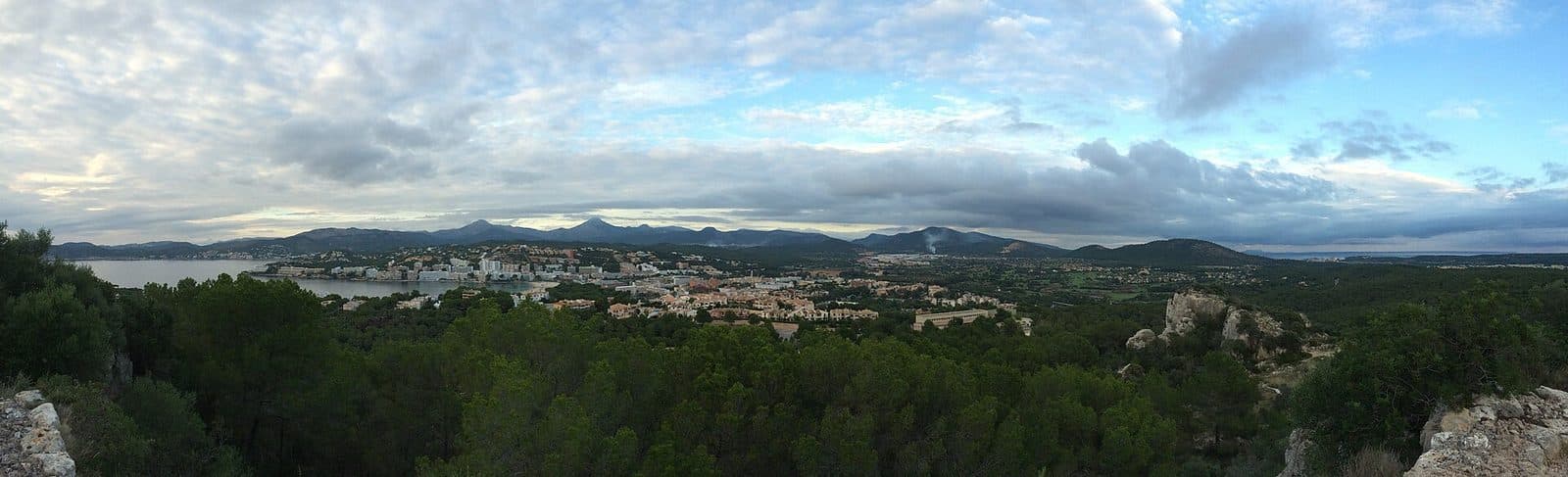
The first impression comes not from a façade but from the expansive view. Around Mirador Puig de na Morisca, residential areas, wooded land, and the varied topography of the southwest come together. The view extends toward Son Ferrer, El Toro, and Santa Ponça; farther along the park's paths, Santa Ponça Bay also opens into view.
The Viewpoint
The Mirador is above all a place to pause. The terrain rises above the surrounding residential and coastal areas, making roads and houses appear from above as part of a larger landscape. The contrast is clear: modern towns below, with rocks, open land, and Mediterranean vegetation above and between them. At the same time, the Mirador belongs to a landscape shaped by walking and culture. Its impact comes from the route leading there and from the opportunity to continue along the natural paths afterward.
Views of Son Ferrer and El Toro
Toward Son Ferrer, it becomes clear how closely residential areas and undeveloped land lie together in southwestern Mallorca. El Toro provides another landmark. This view is less a postcard image of a single monument than a panorama that makes the spatial relationship between the towns easy to understand.
For that very reason, it is worth changing position several times. Just a few steps may allow vegetation to frame part of the view or reveal a different section of the residential landscape. The best impression does not necessarily come from the first open spot, but from calmly exploring the permitted paths.
Santa Ponça Bay
On the route toward Puig de sa Morisca, the view of Santa Ponça Bay becomes one of the scenic highlights. From the higher ground, the bay and the land behind it can be surveyed. The view also provides useful orientation and connects the archaeological context with today's coastal landscape. Hotels and residential areas do not disappear; instead, they become part of the scene. Puig de sa Morisca is not an isolated mountain range but a peri-urban natural and historic area immediately beside inhabited places.
The Park's Paths
The park's paths lead through open sections, natural vegetation, and areas with historic remains. Not every visit needs to cover the entire network. From the viewpoint, the route can be shortened or extended according to fitness, weather, and available daylight. The paths are part of the experience, not merely connections between individual sights. Paved stretches alternate with natural ground. The focus of the view changes as well: At times the panorama dominates, while elsewhere a wall, an archaeological structure, or the terrain directly beside the path comes to the fore.
Visiting the Viewpoint
The most enjoyable visits begin without rushing. After the final stretch through Son Ferrer, the route enters terrain better suited to a walk or short hike than a quick photo stop. At the Mirador itself, it is worth allowing a few minutes to get oriented: Where are Son Ferrer and El Toro, and in which direction does the landscape open toward Santa Ponça?
A Short Viewpoint Stop
Anyone who only wants to see Mirador Puig de na Morisca can keep the visit brief. Even so, it is important to allow time for walking over the natural ground and looking in several directions. A short visit works particularly well as a stop during a drive through the southwest, but only by consciously taking in the terrain, towns, and coast can the character of the place be fully appreciated.
Combining It with the Archaeological Park
Visitors heading only to the viewpoint will need correspondingly less time; anyone including archaeological sites and scenic detours should avoid planning too tightly. The route can be experienced in stages: First comes the view, followed by stone structures, dry-stone walls, and traces of traditional woodland work. There is no abrupt transition between nature and history. Both accompany the route at the same time.
The Best Time of Day
The terrain is generally more pleasant early in the morning: Temperatures are lower, and fewer visitors are on the paths. On warm days in particular, this advantage is more important than perfect photography light. The sun can be intense on exposed sections, while the natural ground requires additional care.
The later part of the day is also valued for the view, although it can attract more visitors. Sufficient daylight for the return journey is essential. Because not all sections are paved, a route should not be completed only when uneven ground has become difficult to see. Current access conditions should be checked before visiting.
Getting There and Parking
The journey first leads to Son Ferrer. This distinction is important because the stated road distances and driving times refer to the town, not to a parking area immediately beside the viewpoint. The final stretch passes through the local road network and then continues to the access point for the Mirador or onto the paths through the site.
From Palma
Son Ferrer is 22 kilometers by road from central Palma. The drive takes around 37 minutes and follows the Ma-1 toward the southwest of the island. Depending on the starting point within Palma and traffic conditions, the urban section may account for a noticeable part of the journey. Navigation should therefore not end upon reaching the center of Son Ferrer.
From Palma Airport
Son Ferrer is 32 kilometers by road from Palma Airport. The drive takes around 37 minutes. The route initially follows the Ma-20 and then the Ma-1 toward the southwest. Here too, the measured distance ends in Son Ferrer; the local access route and walk to the viewpoint are additional.
Anyone arriving directly after a flight should bear in mind that the Mirador is not a suitable place for walking with heavy luggage. Natural ground and uneven sections make it advisable to leave bags securely in the vehicle or at the accommodation and take only what is needed for the walk.
Bus and the Final Walk
Several bus stops serve the surrounding area. The Puig de sa Morisca stop most clearly indicates the destination area; other stops are located along the roads of Santa Ponça. A walk remains from the chosen stop, with its length and route depending on the selected connection.
For the return journey, it is sensible to check the timetable before setting out into the terrain. The path network offers various options, and a longer circuit may end at a different point from a short detour to the Mirador.
Bus lines to Mirador Puig de na Morisca at a glance
| Line | Route | Departures/day | First | Last |
|---|---|---|---|---|
| 123 | Santa Ponça - Cas Català | 216 | 00:11 | 23:48 |
| 106 | El Toro - Palma | 164 | 06:20 | 22:52 |
| 103 | Santa Ponça - Palma | 155 | 00:10 | 23:55 |
| A11 | Peguera - Aeroport | 52 | 00:25 | 23:45 |
| 107 | Es Capdellà - Palma | 42 | 00:08 | 22:58 |
| 122 | Port d'Andratx - Santa Ponça | 36 | 06:55 | 23:20 |
| 131 | Santa Ponça - Banyalbufar | 4 | 10:15 | 17:30 |
From the official GTFS feeds (TIB/SFM), no real-time data. The figures cover all stops in the town; weekend and holiday services differ — check with the operator before travelling.
Getting there by bus
Puig de sa Morisca (11182) · 0.2 km as the crow flies
- 106El Toro - Palma · Daily
Av. Santa Ponça - Av. Golf (11201) · 0.4 km as the crow flies
- 106El Toro - Palma · Daily
Av. Santa Ponça - Gran Via del Port (11181) · 0.5 km as the crow flies
- 106El Toro - Palma · Daily
Santa Ponça oest 2 (11148) · 0.7 km as the crow flies
- 123Santa Ponça - Cas Català · Daily
Sa Pinada (11089) · 0.8 km as the crow flies
- 122Port d'Andratx - Santa Ponça · Daily
- 123Santa Ponça - Cas Català · Daily
Platja de Santa Ponça (11178) · 0.8 km as the crow flies
- 106El Toro - Palma · Daily
- 131Santa Ponça - Banyalbufar · Daily
Santa Ponça oest 1 (11147) · 0.8 km as the crow flies
- 106El Toro - Palma · Daily
- 123Santa Ponça - Cas Català · Daily
Caló d'en Pellicer 2 (11085) · 0.8 km as the crow flies
- 123Santa Ponça - Cas Català · Daily
Caló d'en Pellicer 1 (11086) · 0.8 km as the crow flies
- 106El Toro - Palma · Daily
- 123Santa Ponça - Cas Català · Daily
Santa Ponça centre 1 (11188) · 0.8 km as the crow flies
- 103Santa Ponça - Palma · Daily
- 107Es Capdellà - Palma · Daily
Santa Ponça centre 2 (11179) · 0.9 km as the crow flies
- 103Santa Ponça - Palma · Daily
- 107Es Capdellà - Palma · Daily
- A11Peguera - Aeroport · Daily
Av. Santa Ponça - Shakespeare (11180) · 1.0 km as the crow flies
- 106El Toro - Palma · Daily
Timetable data: official GTFS feeds (TIB/EMT), no real-time — check with the operator before travelling.
Nearby Places
At first, Son Ferrer feels like a modern residential town rather than the starting point for a historic walk. This transition is precisely what makes the Mirador interesting. Just a few steps from the developed area, a landscape begins in which archaeological remains and traditional forms of land use become visible.
Son Ferrer
The town is divided into residential and commercial areas and belongs to the municipality of Calvià. For visitors, Son Ferrer primarily serves as a practical starting point: The regional journey ends here before the final stretch to the viewpoint begins. The town itself should not be confused with the Archaeological Park, whose access points and paths extend between Son Ferrer and Santa Ponça.
An ancient burial site is also located near Son Ferrer. It emphasizes that the archaeological importance of the area is not limited to a single hill. To combine the sites, it is enough to include the burial ground as another historic stop; the Mirador and Puig de sa Morisca nevertheless remain separate destinations.
Santa Ponça
Santa Ponça lies on the other side of the historic landscape and provides a clear contrast to the quieter path around the viewpoint. The bay is visible from higher points in the park. A subsequent visit to the coast below shows just how much the perspective changes: What appears from the Puig as a continuous coastal area becomes a sequence of roads, beach, and buildings at shore level.
El Toro and Port Adriano
El Toro can be identified from the area as a neighboring town. Port Adriano lies near the coast, making it easy to combine the Mirador with a later visit to the sea. Both destinations provide a deliberate contrast: natural paths, stone remains, and sweeping views above; a modern harbor and coastal landscape below.
This combination is particularly suitable when choosing only a shorter route. Anyone exploring a larger section of the paths, however, should avoid filling the day with too many additional activities.
The place it belongs to
Son Ferrer in the place guidePractical Visitor Information
Mirador Puig de na Morisca is not an urban viewing terrace. Access is through terrain with natural and partly unpaved sections. Understanding this simple distinction prevents the most common misconceptions and is more helpful than elaborate equipment.
Footwear and Terrain
Sturdy shoes with good grip are advisable. Paths may be steep, rough, or uneven, and loose stones require sure footing. Sandals with smooth soles are poorly suited to a longer circuit. Even anyone planning only a short viewpoint stop should not underestimate the terrain. After rain, natural paths may offer different conditions from a promenade or sidewalk. Walking speed should then be adjusted to the ground.
Sun, Water, and Daylight
There is no continuous shade on exposed sections. Water, a hat, and sun protection are particularly important on warm days. Early morning generally offers more pleasant temperatures and fewer people. Anyone starting later should choose a shorter route rather than placing the return walk in the hottest part of the day.
In the evening, the remaining light matters as much as the view. Uneven ground becomes harder to identify on the return journey once darkness falls. A flashlight is no substitute for sensible timing in unfamiliar terrain.
Visiting with Children
Younger children need close supervision on steeper and uneven sections. For families, a short route with clearly planned breaks is generally more sensible than trying to cover as many paths as possible.
What Not to Expect
The Mirador is neither a traditional museum nor a fully reconstructed prehistoric settlement. Many remains consist of wall lines, stones, and traces in the terrain. Without careful attention, they can easily look like ordinary parts of the landscape. This subtlety is precisely what makes the site worth visiting: It does not provide a ready-made backdrop but a combination of views and historical discovery. Visitors who embrace this will no longer see Son Ferrer, Santa Ponça, and southwestern Mallorca solely as a modern holiday and residential landscape.
Local insider tips
Start Early
Early in the morning, the paths are generally cooler and quieter. This makes the climb over natural sections easier and leaves more time to compare the views toward Son Ferrer, El Toro, and Santa Ponça.
Do Not Stop at the First View
The Mirador reveals itself as you change position. A few steps along the permitted paths can alter the scene significantly: Sometimes Son Ferrer comes to the fore, sometimes El Toro, and farther along the route, Santa Ponça Bay.
Look for the Subtle Traces
Alongside the archaeological remains, dry-stone walls and former charcoal-burning sites tell the story of traditional woodland work. These inconspicuous traces are easier to overlook than Torre III.
Combine the Mirador and Park
The viewpoint is only one part of the landscape. Visitors with time and sturdy shoes can continue along the paths of the Archaeological Park; allow 1 to 2 hours for a suitable selection.
Head Down to the Coast Later
After seeing the view from above, it is worth changing perspective in Santa Ponça or El Toro. At the coast, it becomes clear how different the bay, buildings, and terrain appear without the elevated overview from the Puig.