
Talaiot de Son Miralles near Son Ferrer
.jpg)
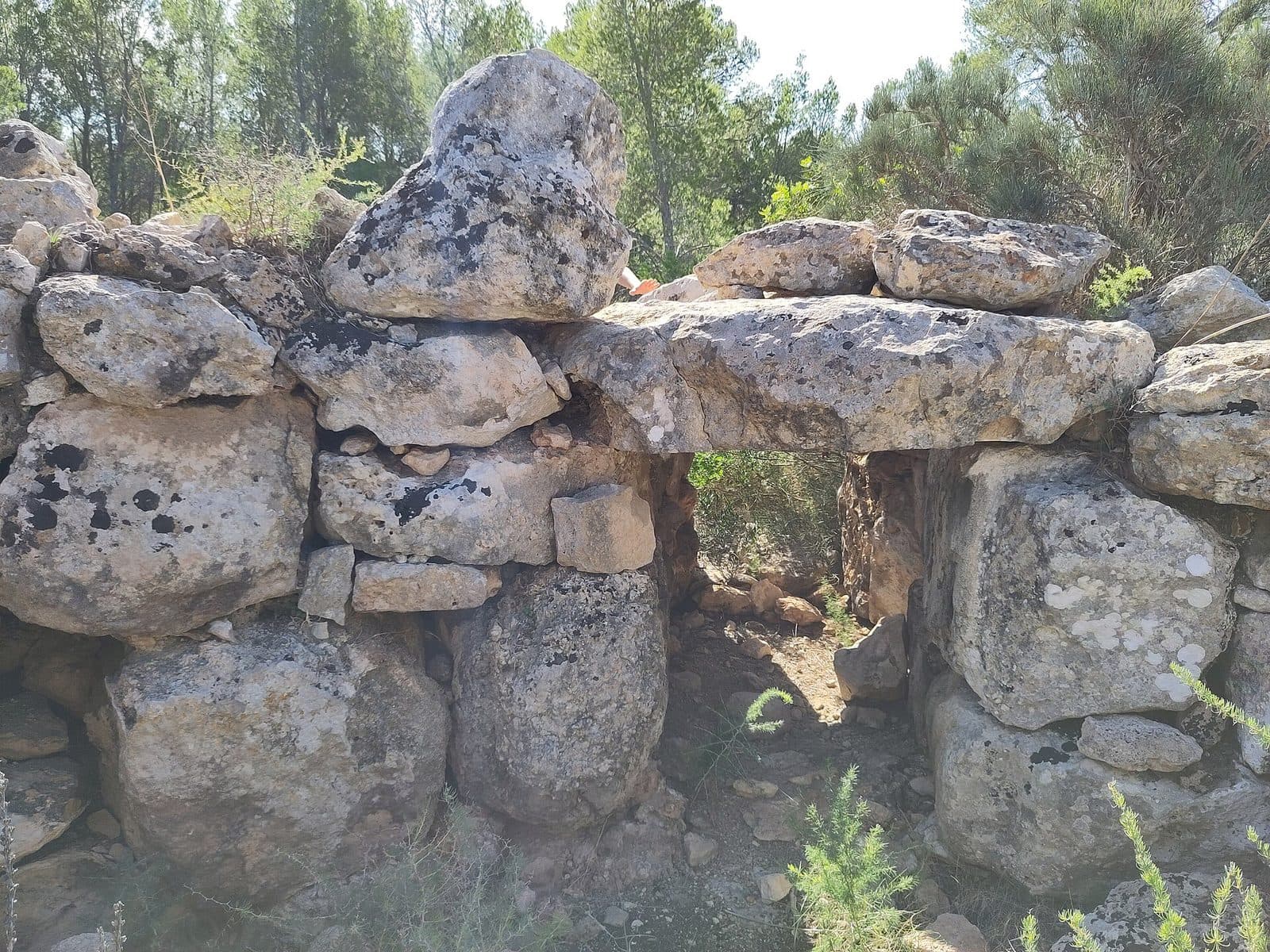
Between Son Ferrer and the archaeologically rich area around Puig de sa Morisca stands a monument that is easily overlooked: Talaiot de Son Miralles. Large stones laid without mortar form a round tower whose entrance and covered corridor still reveal how deliberately the prehistoric builders positioned each block. The site is not one of Mallorca's conveniently developed attractions. For that very reason, it offers an unfiltered impression of how many traces of prehistory still lie beyond the well-known excavation sites.
The talaiot is located within the Puig de sa Morisca archaeological park but stands on private property. A visit therefore requires permission from the owner or the responsible authority. This is not a minor formality but the essential requirement for planning. Anyone who arrives unannounced at a locked or inaccessible property may have reached the archaeological site geographically but cannot visit it legally.
Son Miralles is especially rewarding for people who want to experience prehistoric architecture as more than a reconstruction or museum exhibit. Here, a specific structure demonstrates how heavy stones were used to create a monumental space. The talaiot is also a good starting point for understanding the archaeological landscape of southwestern Mallorca: not as a collection of isolated ruins, but as an area where different communities related their buildings, settlements and access routes to one another.
Son Miralles requires preparation and close observation. Those who take the time will discover in its southeast-facing portal, massive capstones and difficult-to-read interior the details from which archaeology builds a story in the first place.
History and significance
The name of the structure leads directly into Mallorca's prehistory. The Catalan word talaiot is related to talaia, meaning a watchtower or lookout tower. This linguistic origin long shaped the idea that the massive towers served primarily for observation and defense. Archaeological research now presents a more cautious picture: communal, economic, representative and ritual purposes are also discussed for talaiots. No single function applying to every structure has been established.
The Talaiotic period
Talaiots gave their name to an entire prehistoric culture of Mallorca and Menorca. Its core period falls within the first half of the first millennium BC, between the Late Bronze Age and the Early Iron Age. The communities of the time lived in small settlements and practiced agriculture and animal husbandry. At the same time, the monumental stone buildings show that labor could be organized and construction planned beyond the needs of everyday life.
That is the true historical message of a talaiot: the stones were not the only large element. The social undertaking was considerable as well. Blocks had to be selected, moved, fitted together and assembled into stable walls without mortar. Such construction projects required collective decisions, practical expertise and an understanding of which location within the settlement area deserved particular prominence.
Son Miralles and Puig de sa Morisca
Talaiot de Son Miralles lies about one kilometer southeast of Puig de sa Morisca, at the beginning of comparatively flat terrain. Although both sites are now considered part of the same archaeological park, the talaiot did not necessarily belong to the settlement on the Puig. Its entrance faces a different direction. This has led to the cautious suggestion that Son Miralles may have belonged to another settlement.
It is precisely this uncertainty that makes the site archaeologically interesting. Modern park boundaries group archaeological sites together for practical reasons; they do not automatically reflect prehistoric boundaries of ownership, visibility or community. The orientation of a portal can therefore become an important clue. It shows that even an apparently simple architectural element raises questions about routes, neighboring communities and the organization of life at the time.
A monument without a clear instruction manual
No specific use of the tower at Son Miralles has been established. General research into talaiots offers several interpretations, but none should be applied to this structure without specific excavation evidence. Its form may have created visibility and separation; an interior space may have accommodated gatherings or other communal activities. What exactly happened here remains unknown.
This is not a weakness of the site. Instead, Son Miralles is a reminder that prehistory does not consist of fully preserved narratives. The architecture is itself the source. Location, portal, wall lines and collapsed stones must be read like individual sentences from a text whose remaining pages are missing.
What to see
The round outer line immediately distinguishes the talaiot from ordinary field walls. The structure has a diameter of approximately ten meters and still reaches a height of more than two meters. Today it does not resemble a completely preserved tower but rather a massive, partially collapsed structure. Nevertheless, key elements of its design remain legible: the circular ground plan, thick wall, portal, covered entrance and interior.
The circular structure
The talaiot was built from large stones fitted together without mortar. When particularly large blocks are used, this dry-stone construction is often described as Cyclopean masonry. Stability comes not from a binding agent but from weight, carefully prepared bearing surfaces and the skillful arrangement of differently shaped stones.
Its dimensions also suggest how compactly such towers were designed. A comparatively limited interior remained behind the thick outer wall. The monument was therefore not simply a large house. Its effect depended largely on the mass of its walls and the clear separation between outside and inside.
The southeast-facing portal
The surviving entrance faces southeast. It provides the clearest access to the original layout and is also one of the site's most informative details. Through this portal, people of the Talaiotic period not only entered an interior space; they followed a deliberately chosen direction.
The orientation is also notable because it does not correspond to what might be expected if the talaiot had been directly associated with the settlement at Puig de sa Morisca. This raises the possibility that the talaiot faced another settlement, another route or a distinct local reference point. A doorway thus becomes archaeological evidence for how the landscape was organized at the time.
The covered entrance corridor
Beyond the portal, an entrance corridor leads into the talaiot. Its roof consists of three large stone blocks. This detail is among the most impressive features of Son Miralles because the construction method can be read directly here: heavy stones span a narrower space to form a ceiling.
The corridor creates a transition between the open landscape and the enclosed interior. It is not merely a gap in the wall but a distinct structural element. Its narrowness emphasizes the strength of the structure, while the capstones demonstrate the loads that had to be moved and positioned precisely during construction.
Anyone permitted to view the monument should examine the side walls, supports and capstones in sequence. This reveals the construction more clearly than a quick glance through the opening. It is particularly informative to consider where the large blocks actually rest and how the stones below support their weight.
The interior
Several stones inside suggest the possible former existence of a central pillar. Such a pillar is a familiar feature of many Mallorcan talaiots: it could support the roof structure and reduce the span between the center of the room and the outer wall. At Son Miralles, however, the pillar is not fully preserved; its former existence is inferred from the position of the stones.
The interior therefore requires some imagination. Instead of a fully legible chamber, visitors see the present condition of a structure exposed over a long period to decay, vegetation and accumulated deposits. It is particularly important here to distinguish between observation and reconstruction. The stones and enclosed area are visible. The former pillar and a possible roof belong to a well-founded interpretation of the structure's design.
The Tumulus of Son Miralles
A Tumulus of Son Miralles is also documented near the talaiot. It is barely perceptible in the terrain and should not be confused with the much more substantial round structure. While the talaiot stands out architecturally through its wall, portal and interior, the tumulus shows how inconspicuous archaeological structures can become after extensive alteration over time.
Its low visibility offers a useful lesson for the entire visit: not every archaeological site looks like a ruin. Sometimes the archaeological value lies precisely in faint traces in the terrain and layers of stone that can easily appear to be natural unevenness without expert interpretation. Stones should therefore neither be moved nor uncovered.
Visiting Talaiot de Son Miralles
The most important step comes before setting out. Talaiot de Son Miralles stands on private property, although it is part of the Puig de sa Morisca archaeological park. Permission is required to enter. An unplanned detour in the hope of gaining access is therefore not a good visiting strategy; access arrangements should be confirmed in advance.
Preparation rather than a spontaneous tour
Opening hours and admission details are not reliably documented. Because access arrangements may change, it is advisable to make a current inquiry with the responsible authorities of the archaeological park or the municipality of Calvià. Visitors should ask not only about a possible appointment but also from which side the property may be entered and which rules apply to the private land.
Once access has been approved, the visit remains manageable and focused. Its value lies in closely reading a single talaiot and its immediate surroundings. Anyone who carefully studies the portal, corridor, masonry and interior will gain more than from a hurried photo stop.
A useful viewing sequence
Begin by examining the entire circular structure. From some distance, the ground plan becomes easier to understand and the surviving height easier to assess. Next comes the southeast-facing portal. Its direction should be considered consciously because it is significant to the site's possible relationship with another prehistoric settlement.
The covered corridor should then become the focus. The three large capstones demonstrate particularly clearly how the weight above the entrance was supported. Only afterward is it worth looking into the interior and at the stones interpreted as evidence of a former central pillar. This sequence moves from the overall form to the structural details and prevents the site from being reduced to a single photo opportunity.
Visitor numbers and planning your day
No reliable regular visitor frequency is documented for Son Miralles. Because access requires permission, the visit cannot be usefully planned according to the usual rules for busy attractions. The agreed access arrangements are what matter. Anyone also wishing to explore Puig de sa Morisca should view the two sites as parts of a related archaeological theme without assuming that they were directly connected historically.
The site is less suitable as the sole destination for an entire day trip than as an in-depth stop within an archaeological exploration of southwestern Mallorca. Its strength lies not in the number of visible buildings but in the clarity of individual structural elements and the question of which community the tower once belonged to.
Getting there and parking
From Palma and the airport, the main roads initially lead to Son Ferrer. The stated distances and driving times apply expressly to the town, not to the talaiot on private property. The final stretch depends on the approved access arrangements and should not be improvised solely from a map marker.
From Palma Airport
The road distance from Palma Airport to Son Ferrer is 32 kilometers. The journey takes around 37 minutes and initially follows the Ma-20, then the Ma-1 into southwestern Mallorca. From Son Ferrer, the talaiot lies in the archaeological area toward Puig de sa Morisca and Son Miralles. The specific access route that may be used should be confirmed when obtaining permission to visit.
From Palma
From central Palma, the road distance to Son Ferrer is 22 kilometers. The journey via the Ma-1 takes around 37 minutes. Here too, the reliable route directions end in the town. Because the talaiot is located within an archaeological park but also on private land, an apparently direct approach is not automatically an authorized visitor route.
Parking and public transport
No confirmed public parking arrangements are documented for the talaiot itself. Visitors should therefore ask in advance where they may leave their vehicle and keep driveways, field tracks and property entrances clear. When parking, respecting the site's private location is more important than minimizing the distance to the map marker.
The Puig de sa Morisca bus stop and several stops along Avinguda de Santa Ponça lie within the wider area. They may provide public transport to the surroundings but do not replace the required permission or coordination for the final part of the route. Anyone traveling by bus should first confirm where the approved access begins and whether the onward route complies with the relevant conditions.
Bus lines to Talaiot de Son Miralles at a glance
| Line | Route | Departures/day | First | Last |
|---|---|---|---|---|
| 123 | Santa Ponça - Cas Català | 216 | 00:11 | 23:48 |
| 106 | El Toro - Palma | 164 | 06:20 | 22:52 |
| 103 | Santa Ponça - Palma | 155 | 00:10 | 23:55 |
| A11 | Peguera - Aeroport | 52 | 00:25 | 23:45 |
| 107 | Es Capdellà - Palma | 42 | 00:08 | 22:58 |
| 122 | Port d'Andratx - Santa Ponça | 36 | 06:55 | 23:20 |
| 131 | Santa Ponça - Banyalbufar | 4 | 10:15 | 17:30 |
From the official GTFS feeds (TIB/SFM), no real-time data. The figures cover all stops in the town; weekend and holiday services differ — check with the operator before travelling.
Getting there by bus
Puig de sa Morisca (11182) · 0.5 km as the crow flies
- 106El Toro - Palma · Daily
Av. Santa Ponça - Av. Golf (11201) · 0.5 km as the crow flies
- 106El Toro - Palma · Daily
Av. Santa Ponça - Gran Via del Port (11181) · 0.8 km as the crow flies
- 106El Toro - Palma · Daily
Av. Santa Ponça - Shakespeare (11180) · 1.1 km as the crow flies
- 106El Toro - Palma · Daily
Sa Pinada (11089) · 1.1 km as the crow flies
- 122Port d'Andratx - Santa Ponça · Daily
- 123Santa Ponça - Cas Català · Daily
Platja de Santa Ponça (11178) · 1.1 km as the crow flies
- 106El Toro - Palma · Daily
- 131Santa Ponça - Banyalbufar · Daily
Santa Ponça oest 2 (11148) · 1.1 km as the crow flies
- 123Santa Ponça - Cas Català · Daily
Santa Ponça centre 1 (11188) · 1.1 km as the crow flies
- 103Santa Ponça - Palma · Daily
- 107Es Capdellà - Palma · Daily
Santa Ponça centre 2 (11179) · 1.2 km as the crow flies
- 103Santa Ponça - Palma · Daily
- 107Es Capdellà - Palma · Daily
- A11Peguera - Aeroport · Daily
Caló d'en Pellicer 2 (11085) · 1.2 km as the crow flies
- 123Santa Ponça - Cas Català · Daily
Santa Ponça oest 1 (11147) · 1.2 km as the crow flies
- 106El Toro - Palma · Daily
- 123Santa Ponça - Cas Català · Daily
Caló d'en Pellicer 1 (11086) · 1.2 km as the crow flies
- 106El Toro - Palma · Daily
- 123Santa Ponça - Cas Català · Daily
Timetable data: official GTFS feeds (TIB/EMT), no real-time — check with the operator before travelling.
Nearby places
Son Miralles belongs to a landscape where prehistoric sites lie unusually close together. The most important reference point is Puig de sa Morisca. The talaiot is situated approximately one kilometer southeast of it, already at the transition to flatter terrain. Their proximity makes it sensible to consider them together, but the portal's differing orientation cautions against interpreting both sites too quickly as a single settlement.
Son Ferrer
Son Ferrer is the practical starting point for the journey. This modern residential town lies in southwestern Mallorca between the coastal resorts and the archaeological areas of the municipality of Calvià. Visitors will not find an enclosed historic center here but a modern settlement beside which much older traces have survived.
This contrast sharpens the perception of prehistory. The talaiot does not stand in a past separated off as a museum. It lies in a landscape that continues to be used, developed and crossed by roads. The fact that access must now be arranged across private property reflects the real situation of many archaeological sites on Mallorca.
Puig de sa Morisca
The Puig de sa Morisca archaeological park is the most natural addition to a visit. It provides the broader landscape context, while Son Miralles focuses attention on the architecture of an individual round talaiot. Together, the two sites show how hills, flat areas, settlements and monuments could have played different roles within a prehistoric living environment.
When combining them, Son Miralles should not be regarded merely as an outpost of the Puig. The southeast orientation of its entrance may indicate a connection with another settlement. This open question is precisely what makes the comparison productive: the Puig provides the overview, while Son Miralles offers an architectural detail that challenges simple classifications.
Other archaeological traces
The surrounding area includes the Tumulus of Son Miralles and Turó de ses Abelles. The Tumulus of Son Ferrer also demonstrates that the area was shaped not only by talaiots but preserves various forms of prehistoric monuments. For an excursion, it is enough to understand these places as parts of a broader archaeological landscape; each has its own history and should not be confused with Talaiot de Son Miralles.
Anyone seeking a scenic or maritime contrast after the archaeology will find further excursion destinations toward Santa Ponça and along the southwestern coast. The strongest thematic companion, however, remains Puig de sa Morisca because it most directly explains the position of Son Miralles within the prehistoric landscape.
The place it belongs to
Son Ferrer in the place guidePractical information for your visit
Son Miralles rewards preparation more than spontaneity. Anyone who has received permission should treat the talaiot as a sensitive archaeological monument and use only the approved paths and access points.
Respect private property
Being part of the archaeological park does not mean the property may be entered freely. Fences, gates and other boundaries must be respected; an apparently shorter route is not an authorized entrance. Agricultural or privately used land around the site must not be treated as parking or as a shortcut.
This rule protects more than property rights. Uncontrolled access can damage subtle archaeological traces that are barely visible in the terrain. This applies particularly to the difficult-to-recognize tumulus. What looks like an insignificant layer of stones may form part of a documented archaeological feature.
Footwear and clothing
Sturdy, closed footwear is recommended. Clothing should be suited to the sun, wind and current weather conditions; visitors should not rely on finding facilities directly at the monument.
Visiting with children
For older children, the talaiot can vividly demonstrate how people built monumental walls without mortar or modern lifting equipment. The corridor covered by three large blocks provides a tangible introduction to structural engineering. Close supervision is essential: stones must neither be climbed nor moved, and the visit must comply with the conditions of the permission granted.
What not to expect
Son Miralles does not present a completely preserved tower chamber or a definitive explanation of its original function. The possible central pillar is inferred only from the stones in the interior, and the suggested connection with another settlement also remains an interpretation. This is precisely why careful observation matters more than searching for a spectacular reconstruction.
Anyone expecting only a large, easily accessible ruin for a quick photo stop may find the site inconspicuous. Those who compare the portal's direction, capstones, wall thickness and location will instead recognize an archaeological site where even the unanswered questions are part of the experience.
Local insider tips
Look closely at the portal
The entrance faces southeast. This orientation is considered a clue that Son Miralles may not have belonged to the settlement at Puig de sa Morisca but instead had a different connection within the prehistoric landscape.
The three capstones
Three large blocks cover the entrance corridor. Rather than looking only into the interior, examine their bearing points: this is where the structural logic of the mortarless building becomes particularly clear.
Combine it with the Puig
Puig de sa Morisca lies approximately one kilometer northwest. The two sites work well together thematically, but they should not too quickly be interpreted as a single historical settlement.
Invisible archaeology
The nearby Tumulus of Son Miralles is barely perceptible in the terrain. For that very reason, do not uncover or move anything: an inconspicuous layer of stones may be more archaeologically significant than its present appearance suggests.