
Poble Espanyol in Mallorca: Spanish Architecture in Palma
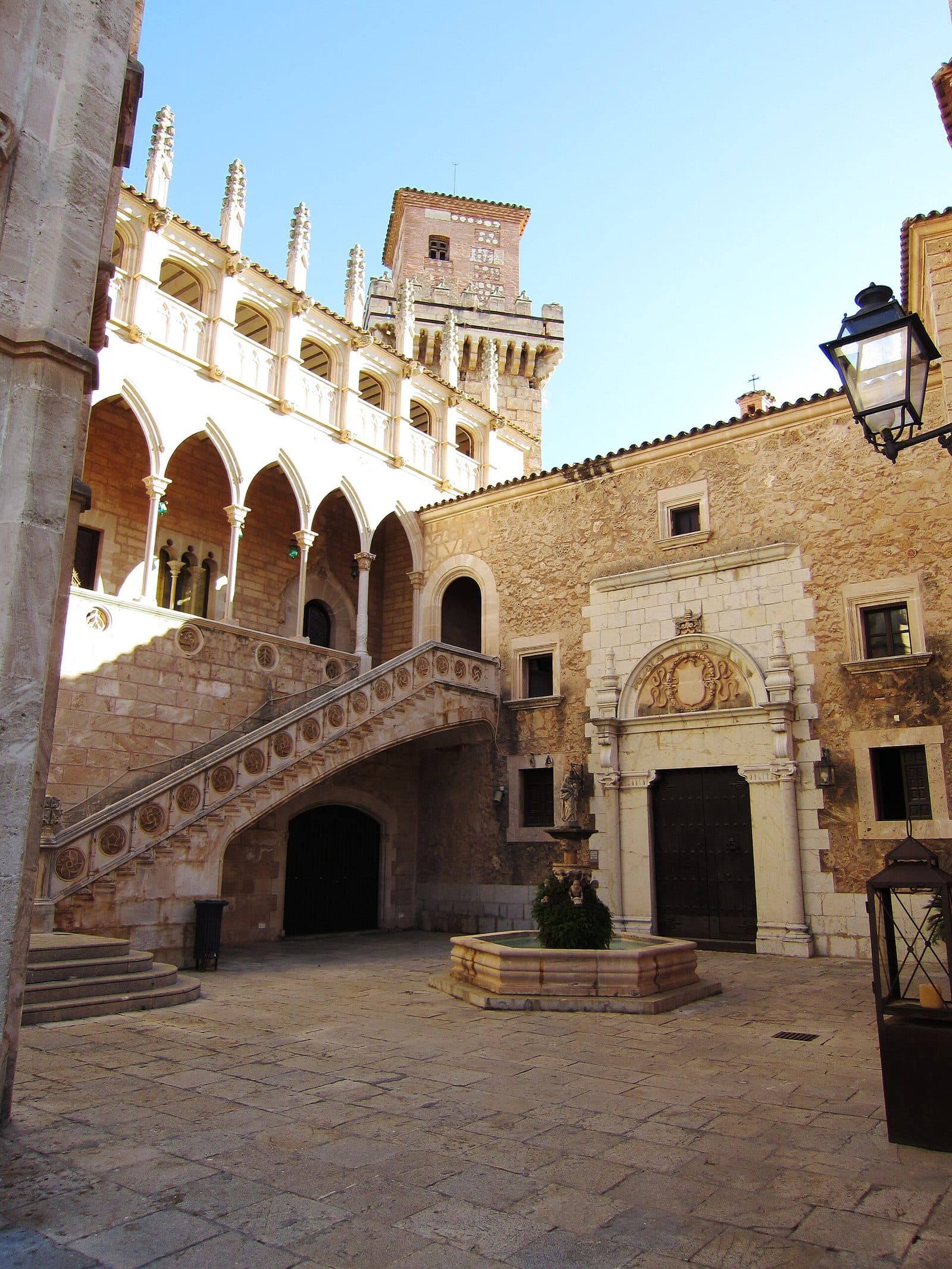

Beyond a city gate begins a journey that would normally require many stops across Spain. Poble Espanyol brings together replicas of famous buildings, regional house types, squares, and winding lanes in a walk-through architectural panorama. Unlike in a traditional museum, the exhibits are not viewed in display cases: You walk among them and, within just a few steps, move from Moorish-influenced forms to Christian church and palace façades.
The complex is one of Palma's more unusual attractions. It is not a historic old town, nor does it aim to reconstruct a single period. Instead, it condenses striking examples of Spanish architecture into an imaginary village. This constant change is precisely what makes it appealing: Beyond one gate, an Andalusian-looking area may begin, while the next façade evokes Toledo, Valencia, or the Canary Islands.
Poble Espanyol is particularly rewarding for people who enjoy examining architecture up close, photographers, and families whose children would rather explore lanes than stand in front of information panels for long periods. Even those already familiar with different regions of Spain may enjoy rediscovering familiar forms and comparing them directly.
The Mallorcan complex should not be confused with the famous Poble Espanyol on Montjuïc in Barcelona. The architectural open-air museum described here was created in Palma in the sixties from a design by the Spanish architect and architectural historian Fernando Chueca Goitia.
History and significance
It began not as a naturally developed settlement but as the idea of an architectural historian. Fernando Chueca Goitia studied the recurring characteristics and regional expressions of Spanish architecture in depth. For Poble Espanyol, he transformed this academic interest into a walk-through design: Important forms and buildings from different parts of the country were not merely to be described but experienced spatially.
Fernando Chueca Goitia
Chueca Goitia was born in Madrid in 1911 and studied history as well as architecture. He was particularly interested in historical architectural styles and in how Christian and Moorish influences overlapped in Spanish architecture. This perspective still shapes the tour today. The complex does not tell the chronological story of a single city but places different traditions close together.
The architect was later also involved in the construction of the Almudena Cathedral in Madrid. His expertise was therefore not limited to theory or the study of monuments; he worked on one of the most prominent Spanish churches in recent history. In Poble Espanyol, by contrast, his ability to organize, reduce in scale, and make architecture accessible to a broad audience becomes apparent.
Created in the sixties
The complex was planned and built in the sixties. 1967 is given as the year of completion and opening. This period coincided with the early phase of Mallorca's major tourism boom. The project offered travelers the unusual opportunity to gain a concentrated overview of architectural forms from mainland Spain and other regions while on an island.
The result was not merely a row of individual façades. Gates, walls, streets, and squares were connected to create a continuous route. In places, the result resembles a small fortified town, although the buildings are deliberately selected replicas. The setting was intended not to detach architecture from its spatial context but to convey the impression of walking through a village.
From architectural model to event venue
The heart of Poble Espanyol remains the open-air museum. At the same time, parts of the complex are used for exhibitions and events; its official presentation mentions art, galleries, and event spaces as additional features. The atmosphere can therefore vary depending on the schedule. On a quiet visiting day, the focus is on closely examining the façades and squares, while an event may bring more activity to certain areas or change how they are used.
Its significance today lies primarily in this dual role. On the one hand, Poble Espanyol documents how architecture was presented in the sixties; on the other, it is an adaptable setting that continues to be used. Visitors therefore see not only replicas of older architecture but also an idea—now historical in its own right—of how Spain's diversity could be conveyed in a single tour.
What to see
The strongest impression comes not from any single building but from the transitions. Cobblestones lead through gates and narrow lanes, open onto squares, and disappear again between façades. Together, the replicas form a deliberately composed village. Many of the original buildings were reproduced at a scale of 1:2, large enough to create a spatial experience yet small enough to bring very different regions close together.
The city gate and walled complex
The entrance itself makes it clear that a small world of its own begins behind the wall. The city gate separates the ordinary urban environment from the staged sequence of architecture. Beyond it, winding paths do not lead in a straight line past an exhibition but through a network of streets, lanes, and squares.
The wall is more than a decorative boundary. It visually unites the diverse models. Churches, fortifications, houses, and palace façades conceptually come from different regions and centuries, yet within the enclosure they appear to be parts of one village. During the tour, it is therefore worth looking not only for the well-known replicas but also at the passageways and arches.
The Alhambra of Granada
The Alhambra of Granada is among the most prominent models. In Poble Espanyol, it represents Spain's Moorish-influenced architecture. Rather than expecting to rediscover Granada's extensive palace complex in full, the key is the concentrated encounter with its characteristic forms and ornamental references.
This area is particularly suitable for comparison with the Christian-influenced façades elsewhere in the complex. Within a short walk, it becomes apparent how differently space, decoration, and monumental impact can be conceived. This juxtaposition was a central concern for Chueca Goitia: Influences were not to be isolated but made recognizable as parts of Spanish architectural history.
The El Greco House from Toledo
The replica of the El Greco House refers to Toledo, the city closely associated with the painter El Greco. On the tour, the building also represents a different form of urban architecture from the palatial or fortified sections. The change of scale makes it possible to take in the proportions of the façade from a relatively short distance.
Anyone familiar with the original will find a recognizable landmark here. Without prior knowledge, the building serves as an invitation to observe the differences between a historic residence and the village's more representative buildings. Windows, entrances, rooflines, and the relationship between the façade and the lane often reveal more than a quick glance at the name of the original building.
The Casa Canaria from Tenerife
The Casa Canaria extends the architectural range beyond mainland Spain. The house refers to Tenerife and thus to the architectural tradition of the Canary Islands. It plays an important role in the imaginary village: It prevents the collection from being seen as merely a sequence of Castilian and Andalusian monuments.
The strength of the concept is especially evident in regional house types like this. Monumental palaces attract attention first, but residential architecture reveals differences in everyday life. The Casa Canaria should therefore not be treated merely as an intermediate stop on the way to the next grand façade. It is one of the buildings that best demonstrates the project's geographical scope.
The Santa Catarina tower from Valencia
Another clearly identified landmark is the hexagonal Santa Catarina tower from Valencia. Its geometric shape distinguishes it from the straight street façades and provides vertical orientation along the route. In a real city, towers often fulfill religious, representative, or urban-planning functions; here they also create a highly visible focal point within the miniature town.
It is worth viewing the tower from different directions. Up close, its shape and façade structure stand out; from a lane or across a square, it becomes clearer how the tower rises above the surrounding buildings. Photographically, it therefore works not only as a subject in its own right but also as a backdrop for the artificially assembled streetscapes.
Churches, palaces, and fortifications
Alongside the specifically highlighted replicas, the ensemble includes churches, palaces, monuments, fortifications, and houses. Their models refer to Córdoba, Toledo, Granada, and Madrid, among other places. They come from different periods, so a single date or architectural style would fail to capture the character of the complex.
During the tour, it is worth observing how power and public life are represented through architecture. Palaces open onto squares differently from houses, while churches emphasize different elements from fortress walls. Because the distances are short, such differences can be compared directly. Poble Espanyol works best when the buildings are viewed not merely as photo backdrops but as different responses to similar urban functions.
Lanes, squares, and craft spaces
The streets and squares are the museum's unifying exhibit. Without them, the complex would be a collection of reduced-scale standalone structures; with them, it becomes a route featuring surprising sightlines. At times, only the top of a tower appears above a roofline; then a square opens up to reveal several façades at once. Walking slowly is therefore part of the essential visitor experience.
Some buildings have been or continue to be used for arts and crafts, studios, shops, dining, or exhibitions. Which spaces are active or accessible during a particular visit may change. The architecture remains legible even when there is no permanent museum interior behind every façade. Poble Espanyol is primarily a museum of outdoor space: Its most important exhibition halls are the lanes and squares themselves.
Visiting Poble Espanyol
The best way to begin a tour is without trying to check off every façade as quickly as possible. The paths branch out beyond the entrance, and part of the enjoyment lies in following an archway or narrow lane without already knowing which square lies beyond it. The complex is manageable in size but more densely composed than individual photographs might suggest.
Tour and time needed
About 45–60 minutes is recommended for an introductory visit. This allows enough time to see the main lanes, squares, and well-known replicas. Anyone photographing architectural details, comparing façades, or visiting an exhibition should allow more time. Open studios, dining options, or an event may also extend the visit.
The ideal length of a visit therefore depends more on personal interest than on the site's size alone. A focused walk is enough for a quick overview. Anyone wishing to understand how Chueca Goitia connected the different regions and styles will pause at transitions and sightlines and walk through some passages a second time in the opposite direction.
Quiet museum visit or event
Poble Espanyol serves not only as an open-air museum but also as a venue for art and events. It is therefore worth checking the current program before visiting. An event can open additional spaces and give the ensemble a lively atmosphere; at the same time, it may affect the route, access to certain areas, and the overall character of the visit.
Those who primarily want to photograph and study the architecture should, if possible, choose a date without a major event. Those who want to experience the village as a cultural setting can instead look specifically for a suitable program. No reliable general statement can be made about the quietest time of day because visitor numbers and event activity vary.
Opening hours and admission
Current opening hours and admission prices should be checked directly before traveling. Particularly at a site that hosts events alongside normal museum operations, visiting arrangements may change. Outdated information from older travel guides is not a reliable basis for planning.
It is also important not to assume that all studios, shops, dining areas, or exhibition spaces will be open throughout the entire museum visit. The architectural route is the most consistent part of the experience. Anyone coming for a particular gallery, craft business, or event should check its schedule separately.
Getting there and parking
It is particularly easy to select the wrong location when using navigation. The Mallorcan Poble Espanyol is located in Son Sardina. Poble Espanyol in Barcelona is also a different open-air museum and should not be entered as the destination.
From the airport via the Ma-20
The provided route information leads from Palma Airport via the Ma-20 to Son Sardina. The distance is 17 kilometers by road, and the drive takes around 18 minutes.
Especially when driving directly from the airport, it is advisable to check the full name and Son Sardina as the destination. A route to the complex of the same name in Barcelona would obviously be incorrect, but it may still appear in an imprecise web search.
From central Palma
The route information gives a distance of 4 kilometers by road and a journey time of around 13 minutes from central Palma to Son Sardina. Poble Espanyol is located in Son Sardina and can easily be combined with time in Palma.
Normal city traffic should be expected on the return journey to the old town. Anyone combining the visit with other destinations in Palma can avoid unnecessary detours by deciding in advance whether to leave the car at the museum or move it afterward to a more central parking garage.
Parking at Poble Espanyol
A municipal parking lot with 35 spaces is located directly at Poble Espanyol. According to the available parking information, parking there is free. However, the limited number of spaces means that availability cannot be guaranteed.
Another free parking lot on Carrer de Bellpuig is mentioned as an alternative. Anyone requiring a particularly short, obstacle-free route should examine the local situation more closely: No designated accessible parking spaces are listed for the parking lot directly at Poble Espanyol.
Arriving by bus
The provided public transport information lists the stops Andrea Doria–Picasso and Picasso–Col·legis. Because routes and timetables may change, the specific connection should be checked on the day of the visit. Here too, choosing the correct destination, Son Sardina, is essential.
Getting there by bus
134-Andrea Doria - Picasso · 0.2 km as the crow flies
- 29Son Espases - Pl. Progrés · 08:00–08:00 · Daily
- 47Gènova - la Bonanova - Sindicat (esquerra) · 08:00–08:00 · Daily
154-Andrea Doria - Picasso · 0.2 km as the crow flies
- 29Son Espases - Pl. Progrés · 08:00–08:00 · Daily
- 46la Bonanova - Gènova - Sindicat (dreta) · 08:00–08:00 · Daily
982-Picasso - Col·legis · 0.2 km as the crow flies
- 29Son Espases - Pl. Progrés · 08:00–08:00 · Daily
74-Picasso - Col·legis · 0.3 km as the crow flies
- 29Son Espases - Pl. Progrés · 08:00–08:00 · Daily
155-Andrea Doria - Poble espanyol · 0.3 km as the crow flies
- 29Son Espases - Pl. Progrés · 08:00–08:00 · Daily
- 46la Bonanova - Gènova - Sindicat (dreta) · 08:00–08:00 · Daily
133-Andrea Doria - Poble Espanyol · 0.3 km as the crow flies
- 29Son Espases - Pl. Progrés · 08:00–08:00 · Daily
- 47Gènova - la Bonanova - Sindicat (esquerra) · 08:00–08:00 · Daily
308-Picasso - Centre d'esports · 0.3 km as the crow flies
- 29Son Espases - Pl. Progrés · 08:00–08:00 · Daily
1171-Fra Juníper Serra - Poble Espanyol · 0.3 km as the crow flies
- 20Portopí - Son Espases · 06:06–22:40 · Daily
1170-Bartomeu Rosselló Porcel - Son Espanyolet · 0.4 km as the crow flies
- 20Portopí - Son Espases · 06:06–22:40 · Daily
1173-Bartomeu Rosselló-Porcel - Son Espanyolet · 0.4 km as the crow flies
- 20Portopí - Son Espases · 06:06–22:40 · Daily
1172-Fra Juníper Serra - Poble Espanyol · 0.4 km as the crow flies
- 20Portopí - Son Espases · 06:06–22:40 · Daily
980-Picasso - Centre d'esports · 0.4 km as the crow flies
- 29Son Espases - Pl. Progrés · 08:00–08:00 · Daily
Timetable data: official GTFS feeds (TIB/EMT), no real-time — check with the operator before travelling.
Practical visitor information
Poble Espanyol calls for different expectations from an art museum with a fixed sequence of galleries. Its most important exhibit is the ensemble itself: Walls, paving, lanes, and squares are as much a part of it as the individual replicas. Anyone looking only for interiors or an extensive collection of original objects will miss the site's central idea.
Shoes for cobblestones
Comfortable, secure footwear is advisable for the tour. Cobblestones and winding paths are deliberate elements in the design of the imaginary village. Smooth soles or delicate shoes are less suitable for a visit that involves frequent stops, crossing from one side of the street to the other, and viewing individual passages from different perspectives.
People with limited mobility should ask the operator directly about accessibility and the route in advance. According to the available information, the parking lot immediately beside the complex also has no specifically designated accessible spaces.
Sun, warmth, and outdoor areas
Much of the visit takes place outdoors. Sun protection and water are therefore sensible essentials on warm days. The lanes and building edges may provide shade in some sections, but visitors should not expect a fully air-conditioned museum route. In rainy weather, the movement between open squares, streets, and accessible indoor areas remains a defining part of the experience.
Directional daylight is particularly interesting for photography because projections, arches, and façade details cast distinct shadows. However, there is no generally verifiable quietest or photographically best time; the season, weather, and events all change the conditions.
Visiting with children
Children may find the complex easier to explore than a museum consisting mainly of text panels and display cases. Gates, towers, and narrow streets give the tour the feel of a small discovery trail. Adults should nevertheless bear in mind that this is an architecture museum, not an amusement park. Rides or a staged historical population are not central to the experience.
A simple search activity can make the tour more vivid: Which building has a hexagonal tower, where does the style change most noticeably, and at what point does the narrowest lane open onto a square? Such observations draw on real features of the ensemble without requiring additional entertainment.
What not to expect
The replicas are no substitute for visiting the originals. The Alhambra in Granada, the El Greco House in Toledo, and the Santa Catarina tower in Valencia possess historical and urban contexts at their actual locations that a reduced-scale reconstruction cannot fully reproduce. Poble Espanyol instead focuses on direct comparison and on the idea of how Spain can be represented through selected architecture.
Nor is the complex an old Mallorcan village. It was constructed in the sixties as a planned ensemble. Anyone who sees this staging not as a flaw but as a starting point will discover an additional layer: Alongside its historical models, Poble Espanyol also tells the story of how architecture was collected, explained, and spatially condensed for visitors at the beginning of the tourism boom.