
a Marc Ferragut – Historic Landmark in Palma
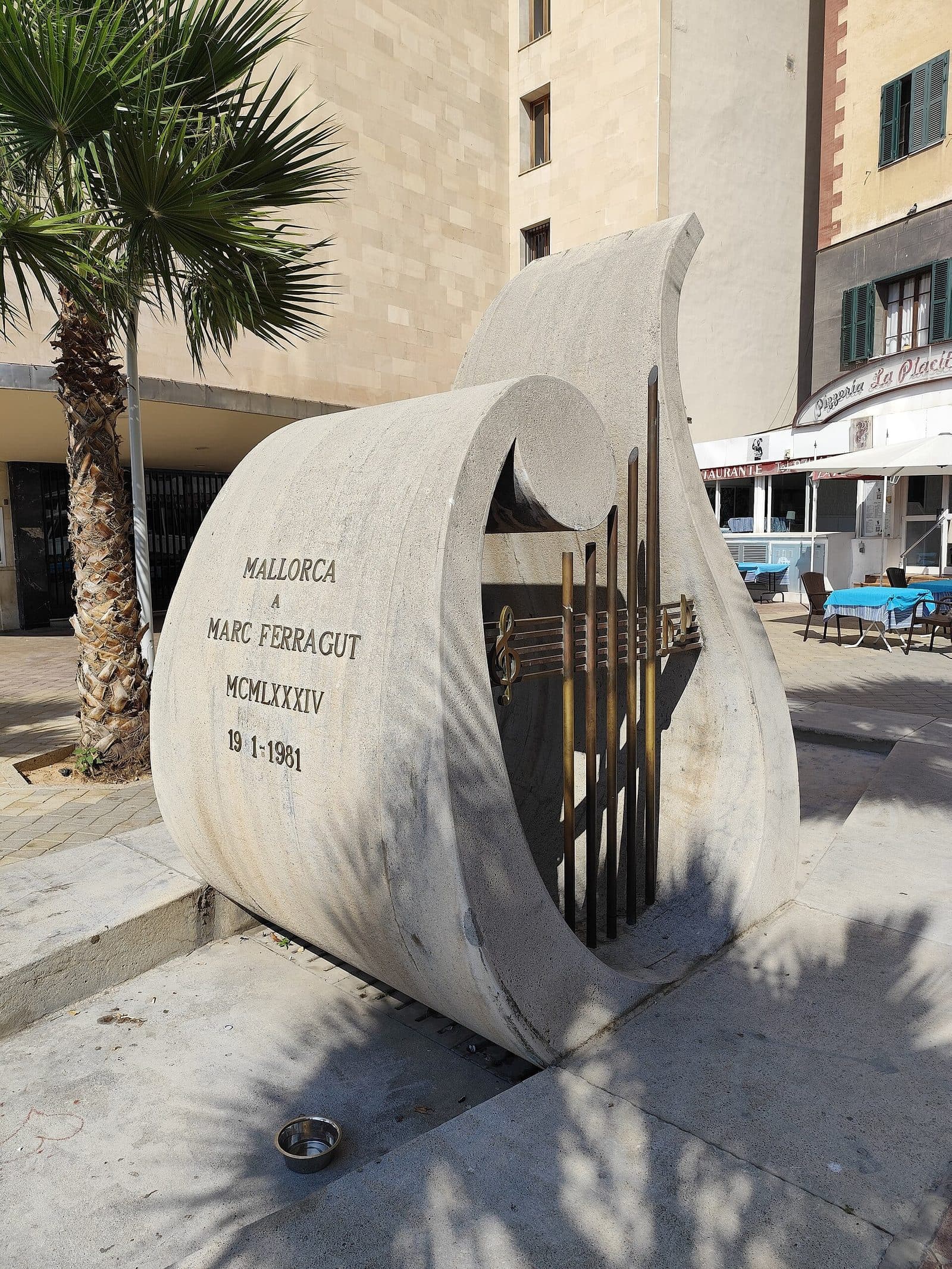

The historic landmark a Marc Ferragut in Son Serra Perera draws attention to a man whose life took him from the footwear industry through local politics and persecution to one of Mallorca’s most ambitious privately funded cultural projects. Visitors who want to discover Palma beyond Old Town façades and promenades will find an unusual way to explore the island’s recent history here.
Marc Ferragut Fluxà was neither an architect nor a performing artist. He was an entrepreneur, art lover, and patron. His name is primarily associated with the Auditorium de Palma, which he created on his own initiative and with private capital. His story therefore has a significance that extends beyond one individual: it raises the question of who creates cultural spaces before an orchestra can play, an ensemble can perform, or an audience can take its seats there.
The visit is especially worthwhile for people interested in Palma’s cultural history, the social upheavals of the past century, and the creation of the Auditorium. a Marc Ferragut is not a substitute for attending a theater performance or concert. The biography reveals that major institutions often have a deeply personal story behind them.
The very brevity of the name calls for some background knowledge. Only through Ferragut’s biography does it become clear why his name appears here—and why his hometown of Inca later honored him with its highest personal distinction.
History and Significance
A life that eventually led to a concert hall began with shoes. Marc Ferragut Fluxà was born in 1901 in Inca into a family involved in the footwear business. As a young man, he went to Paris to sell shoes. There he stayed with the Inca-born pianist Antoni Torrandell. His encounters with concerts, theater performances, and exhibitions inspired a passion for art that remained with Ferragut after his return to Mallorca.
Entrepreneur, Football Coach, and Cultural Politician
Ferragut’s interests soon extended beyond the family business. In the twenties, he became the first coach of the Constància football club from Inca. After seeing the Uruguayan national team play, he adopted its black-and-white kit for his own team. The episode fits the image of a man who absorbed ideas from abroad and adapted them into his own form in Mallorca.
During the Second Republic, Ferragut served on the Inca city council, where he was responsible for culture. Art was therefore more than a private passion for him. It was part of his public engagement. The Civil War brought this period to a violent end. After returning to Mallorca, his property was confiscated; Ferragut was imprisoned in Can Mir and spent three years there. In 1939, he was released under certain conditions. Among those whose murder affected him personally was his friend, the mayor of Inca, Antoni Mateu.
The Move to Palma
In 1943, Ferragut left his hometown of Inca and moved to Palma. There he regularly attended cultural events, including concerts by the Mallorcan symphony orchestra. The conditions for larger performances apparently failed to convince him. From this experience emerged the idea of giving Palma a venue specifically designed for music, theater, and events.
Ferragut did not treat the project as a casual investment. He traveled through several countries and studied other concert and event venues, their architecture, and their acoustics. The Royal Festival Hall in London is cited as an important reference point. The fact that a footwear entrepreneur from Inca studied international models to create a cultural building in Mallorca explains much of the distinctive impact of his story.
The Auditorium as a Legacy
After three years of construction, the Auditorium de Palma opened on September 3, 1969. The opening concert was performed by the Berliner Philharmoniker under Herbert von Karajan; Juan Carlos and Sofía were also present. The building was regarded as the first auditorium of its kind in Spain and remained in the ownership of the Ferragut family.
Marc Ferragut died in 1981. Decades later, Inca declared him Hijo Ilustre de la Ciudad. This distinction honored not merely the financier of a building, but an entrepreneur who invested a substantial part of his fortune in culture. The name Marc Ferragut thus represents both the man behind the Auditorium and a life story that combines a passion for art, political persecution, and a persistent determination to create.
Historical Background
The significance of a Marc Ferragut is best understood through Marc Ferragut’s biography and his connection to Palma. The concisely worded name refers to a person whose cultural legacy continues in the Auditorium de Palma.
The a Marc Ferragut Entry
For English-speaking visitors, the exact designation is particularly useful because the entry can otherwise easily be confused with the Auditorium, a street of the same name in Inca, or another place associated with the Ferragut family.
Marc Ferragut should not be confused with Carrer Marc Ferragut in Inca or with country houses named Son Ferragut. Nor is the Auditorium itself the landmark described here. It does, however, provide the essential historical background for understanding Marc Ferragut.
The Name Behind the Auditorium
The most revealing perspective therefore focuses on the connection between the person and the city. Ferragut was a footwear manufacturer, not an established cultural figure. Nevertheless, he commissioned a venue intended for concerts, theater, dance, and conferences. Its opening by the Berliner Philharmoniker under Herbert von Karajan demonstrates the project’s ambitions from the outset.
The Auditorium is still managed by the Ferragut family today. This continuity links Ferragut’s story to a privately initiated cultural project that has endured for several generations. To understand its significance, it is therefore worth tracing the path from Ferragut’s artistic experiences in Paris through the difficult years after the Civil War to the opening of the Auditorium.
The Urban Context
Son Serra Perera lies in the part of Palma where the harbor, Paseo Marítimo, and modern cultural and event venues shape the cityscape. This makes the surroundings distinctly different from the historic monuments of the medieval Old Town. Ferragut’s story belongs to Palma’s more recent history: a period when the city expanded, tourism profoundly transformed Mallorca, and new cultural institutions emerged at the same time.
The surroundings therefore help place the site geographically. Amid traffic, the waterfront, and event activity, the location forms part of everyday Palma. Ferragut’s name is brief and understated, while the cultural legacy he initiated extends far beyond this point.
Visiting a Marc Ferragut
A little preparation is helpful before visiting. The significance of a Marc Ferragut is primarily revealed through Marc Ferragut’s biography. Knowing his story makes it easier to understand an extraordinary Mallorcan life.
As a Standalone Historic Stop
It makes sense to begin by consciously reading the name and then placing Ferragut’s life in context: his work as an entrepreneur, his cultural ambitions, and his desire to connect the island’s capital with international concert and theater traditions.
Current access arrangements should be checked before setting out. This is particularly important if the detour is to be combined with an event at the nearby Auditorium. A concert or theater performance follows its own schedule and is not the same as visiting the historic landmark.
Combined with the Auditorium
The detour is especially meaningful before or after a performance. The historic individual can then be directly connected with the cultural venue that remains in use today. The Auditorium offers various halls for concerts, theater, dance, and other events. Its history as a family-run venue distinguishes it from an ordinary municipal event building.
Anyone who wants to experience how Ferragut’s idea still functions today should visit the location in connection with an evening performance.
How Much Time to Allow
The time required depends on whether a Marc Ferragut is viewed as a single historic stop or together with Ferragut’s biography, the history of the Auditorium, and a walk along Paseo Marítimo. For a rewarding visit, enough time should be allowed to understand these connections.
The historical context stretches from Inca to Paris, through the island’s political conflicts, and finally to a concert by the Berliner Philharmoniker in Palma. In this way, the name connects several chapters of Mallorca’s modern cultural history.
Getting There
From Palma Airport, the journey first leads to Son Serra Perera. The recorded road route covers 10 road kilometers, and the journey takes around 18 minutes. These figures apply specifically as far as the Son Serra Perera district. For the final stretch, precise navigation based on the location displayed locally is recommended.
The route leads into Palma’s densely built-up urban area rather than to an isolated rural monument. Additional time should therefore be allowed for city traffic and finding your way around the waterfront area.
On Foot and by Bus
Several city bus stops are located in the wider area. These include stops at the intersection of Marquès de la Senia and Fra Juníper Serra, on Passeig Marítim by the Auditorium, and at Marítim and Monsenyor Palmer. The most convenient connection depends on the starting point and current timetable. Since routes and frequencies can change, the connection should be checked on the day of the visit.
From the waterfront promenade, a Marc Ferragut can easily be included as a stop on a city walk. The route also conveys the spatial relationship between a Marc Ferragut, the Auditorium, and modern Palma along the water. Anyone already exploring the city center can therefore avoid an additional car journey and combine the historic site with the promenade.
Finding the Right Destination
It is important to distinguish between similarly named places. Searching only for “Marc Ferragut” may lead to Carrer Marc Ferragut in Inca or to other entries featuring the family name. The correct destination is near Son Serra Perera in Palma. The Auditorium and Paseo Marítimo serve as useful landmarks within the city and also illustrate the historical connection to Ferragut.
Bus lines to a Marc Ferragut at a glance
| Line | Route | Departures/day | First | Last |
|---|---|---|---|---|
| 108 | Son Caliu - Palma | 21 | 00:15 | 23:00 |
From the official GTFS feeds (TIB/SFM), no real-time data. The figures cover all stops in the town; weekend and holiday services differ — check with the operator before travelling.
Getting there by bus
59-Marquès de la Senia - Fra Juníper Serra · 0.1 km as the crow flies
- 4Ses Illetes - Pl. Columnes · 08:00–08:00 · Daily
- 46la Bonanova - Gènova - Sindicat (dreta) · 08:00–08:00 · Daily
100-Marquès de la Senia - Fra Juníper Serra · 0.1 km as the crow flies
- 4Ses Illetes - Pl. Columnes · 08:00–08:00 · Daily
- 47Gènova - la Bonanova - Sindicat (esquerra) · 08:00–08:00 · Daily
10-passeig Marítim - Auditòrium · 0.2 km as the crow flies
- 1Portopí - Sindicat · 08:00–08:00 · Daily
- 30Marivent-Palau de Congressos · 08:00–08:00 · Daily
- N1Portopí - Porta des Camp · 08:00–08:00 · Daily
Marítim - Monsenyor Palmer 1 (40074) · 0.2 km as the crow flies
- 108Son Caliu - Palma · Daily
31-pg. Marítim - aparcament Marquès de la Sènia · 0.2 km as the crow flies
- 1Portopí - Sindicat · 08:00–08:00 · Daily
- 30Marivent-Palau de Congressos · 08:00–08:00 · Daily
- N1Portopí - Porta des Camp · 08:00–08:00 · Daily
30-passeig Marítim - Auditòrium · 0.2 km as the crow flies
- 1Portopí - Sindicat · 08:00–08:00 · Daily
- 30Marivent-Palau de Congressos · 08:00–08:00 · Daily
- N1Portopí - Porta des Camp · 08:00–08:00 · Daily
1986-pg. Marítim Aparcament Marquès de la Sènia · 0.2 km as the crow flies
- 1Portopí - Sindicat · 08:00–08:00 · Daily
- 30Marivent-Palau de Congressos · 08:00–08:00 · Daily
- N1Portopí - Porta des Camp · 08:00–08:00 · Daily
61-Joan Miró - s'Aigua Dolça · 0.3 km as the crow flies
- 4Ses Illetes - Pl. Columnes · 08:00–08:00 · Daily
- 20Portopí - Son Espases · 06:06–22:40 · Daily
- 46la Bonanova - Gènova - Sindicat (dreta) · 08:00–08:00 · Daily
1172-Fra Juníper Serra - Poble Espanyol · 0.3 km as the crow flies
- 20Portopí - Son Espases · 06:06–22:40 · Daily
1171-Fra Juníper Serra - Poble Espanyol · 0.3 km as the crow flies
- 20Portopí - Son Espases · 06:06–22:40 · Daily
98-s'Aigua Dolça · 0.3 km as the crow flies
- 4Ses Illetes - Pl. Columnes · 08:00–08:00 · Daily
- 20Portopí - Son Espases · 06:06–22:40 · Daily
- 47Gènova - la Bonanova - Sindicat (esquerra) · 08:00–08:00 · Daily
155-Andrea Doria - Poble espanyol · 0.3 km as the crow flies
- 29Son Espases - Pl. Progrés · 08:00–08:00 · Daily
- 46la Bonanova - Gènova - Sindicat (dreta) · 08:00–08:00 · Daily
Timetable data: official GTFS feeds (TIB/EMT), no real-time — check with the operator before travelling.
Nearby Attractions
Son Serra Perera reveals a side of Palma that differs markedly from the narrow streets around the cathedral and Plaça Major. Harbor facilities, broad traffic routes, Paseo Marítimo, and cultural venues define the area. Visitors to a Marc Ferragut are therefore exploring a part of the city shaped by the development of modern Palma.
Auditorium de Palma
The most obvious connection is the Auditorium de Palma. It should not be equated with a Marc Ferragut: one is the historic landmark described here, while the other is Ferragut’s major cultural project. It is precisely this combination that makes the visit meaningful. The Auditorium opened after three years of construction and contains halls for concerts, theater, dance, and events. A large terrace offers views over the harbor and bay.
Checking the current program can add depth to the historic detour. A performance demonstrates that Ferragut’s project continues to serve the purpose for which it was created. Even without an event, the building remains an important reference point for his biography.
Paseo Marítimo and the Harbor
Paseo Marítimo is ideal for continuing on foot. Along the waterfront, visitors encounter a different part of Palma from the historic Old Town. While the Old Town is characterized by churches, aristocratic palaces, and medieval streets, this section is shaped by the harbor, mobility, and modern cultural attractions.
Anyone wishing to experience the contrast consciously can later combine the visit with the historic Old Town. This places two different eras of Palma side by side: the center that evolved over centuries and the modern city where Marc Ferragut created his concert and event venue.
Inca as a Biographical Counterpoint
For travelers with a particular interest in Ferragut’s life, Inca provides the biographical counterpoint. He was born there, his family’s footwear business had its roots there, and he worked there as a football coach and cultural politician. The city later named him Hijo Ilustre. In Palma, by contrast, he realized the chapter of his life in which a personal passion for art became a cultural project for the island’s capital.
It is not necessary to combine both places in one day to understand Ferragut’s story. As a thematic connection, however, the Inca–Palma axis shows how Ferragut’s path developed from the industrial town in the island’s interior to the cultural stage on Palma’s waterfront.
Local insider tips
Combine It with a Performance
Ferragut’s legacy is clearest before or after an event at the Auditorium. Ferragut then represents more than the past: the cultural venue he financed continues to fulfill its original purpose.
Notice the Lowercase Letter
The “a” before Marc Ferragut is part of the exact designation. It makes the entry easier to distinguish from Carrer Marc Ferragut in Inca and from other places featuring the family name.
Approach from Marítim
The location makes more sense as a stop on a walk along Paseo Marítimo than as an isolated photo stop. The waterfront, Auditorium, and a Marc Ferragut together tell the story of modern Palma in the past century.
Karajan as the Key Story
To understand its significance, remember the opening of the Auditorium: the Berliner Philharmoniker performed under Herbert von Karajan. That ambition explains why Ferragut’s name lives on in Palma’s cultural history.