
Sant Marçal near Cas Capità: Church, Art, and History
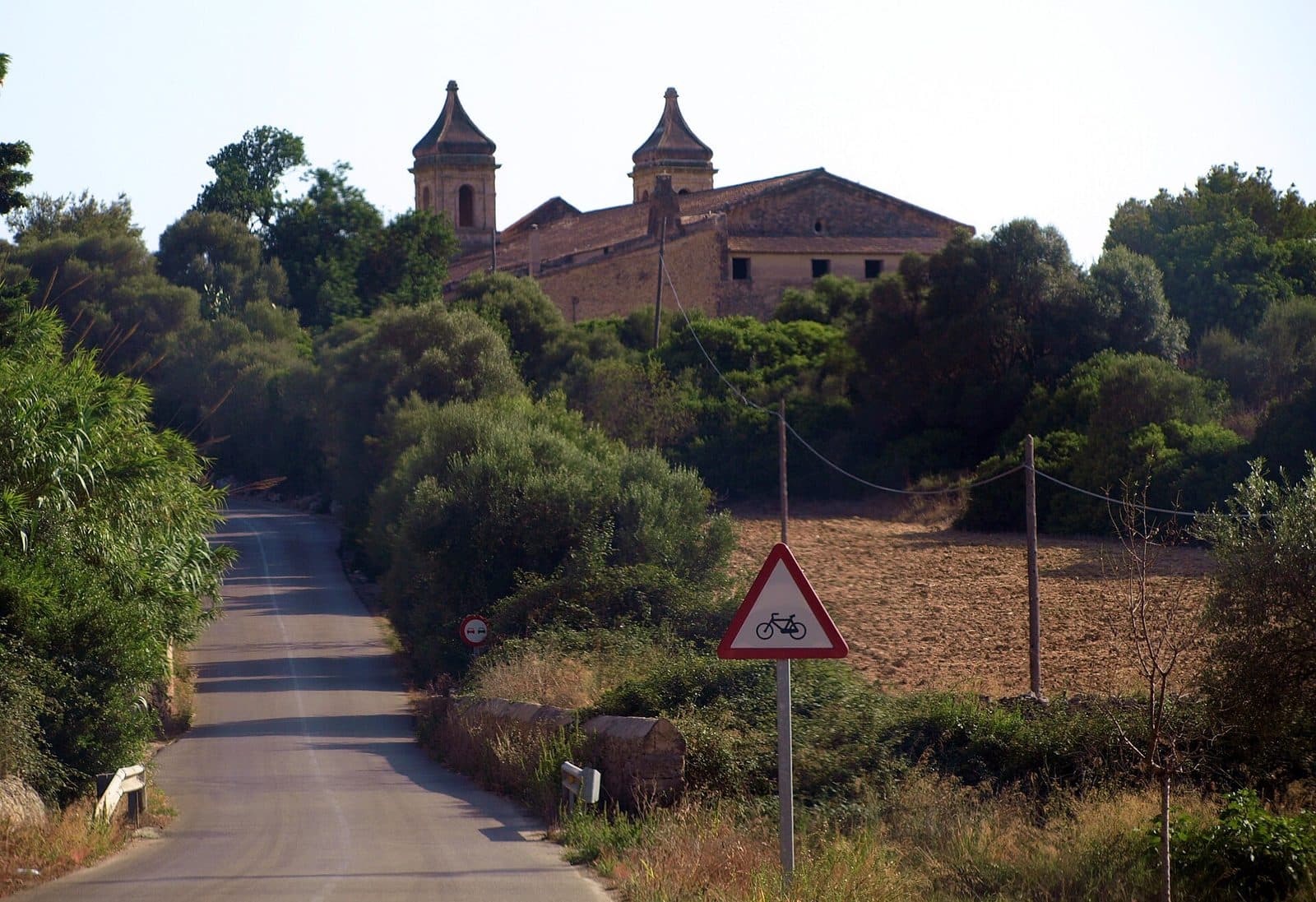

Even from a distance, the two towers with their onion-shaped domes give Sant Marçal an unmistakable silhouette. The church near Cas Capità, at the entrance to Sa Cabaneta in the municipality of Marratxí, is neither a remote monastery nor a visitor attraction staged for tourists. It is a parish church, a historic landmark, and still a setting for community life today.
A visit is especially worthwhile because of the contrast between the exterior and interior. A spacious esplanade opens in front of the classically styled main façade; behind it lies a Baroque church interior with a single nave, side chapels, and a richly gilded high altarpiece. Anyone wishing to explore Mallorcan religious architecture beyond Palma's major churches will find a vivid example here of a place of worship that was expanded, damaged, altered, and restored again over the centuries.
Sant Marçal appeals to travelers interested in history, church art, and local Mallorca away from the coastal resorts. The church also works well as a short cultural stop on a drive through Marratxí. The forecourt and towers can be viewed regardless of whether the interior is accessible; to see the altarpieces, chapels, and interplay of the different construction phases, however, the church must be open. The site does not require a lengthy sightseeing route. Its strength lies in close observation: the tiered façade, the bell towers, and the Baroque altars inside. At the same time, Sant Marçal explains why the church is more than a historic building for Marratxí. The patron saint's festival, services, and community events keep it present in everyday life.
History and significance
The story does not begin with the present building. A church in Marratxí was already documented in the Middle Ages: a papal bull issued by Innocent IV mentions it in 1248. According to the municipality, the first known place of worship was built in the 13th century, several years after Jaume I conquered Mallorca. It was dedicated to Sancta Maria de Barraxino and belonged to Santa Maria del Camí. Sant Marçal did not become the titular saint of Marratxí until a century later.
The early churches of Marratxí
The location of the church apparently changed several times. In the 16th century, a church was finally built on land belonging to the Son Verí estate. This building was not simply the Sant Marçal seen today either: the documented development passes through several sites and construction phases before reaching the church building that has shaped the local landscape since the late 17th century.
When construction began at the present site in 1699, the church stood largely isolated in scrubland. Sa Cabaneta had not yet grown into a settlement around it. This historical contrast is important for understanding the site: what now appears to be a parish church on the edge of a built-up area was originally a religious focal point in a sparsely populated landscape.
Lluc Mesquida and the new Baroque church
Lluc Mesquida, a respected stonemason who rose to become the site's master builder and first architect, was commissioned to carry out the work. A large part of the building was completed within the first fifteen years. Its original character was Baroque, although later interventions significantly altered its appearance. The church should therefore not be interpreted as a stylistically unchanged work from a single era: its core belongs to the Baroque construction phase, while extensions, repairs, and a more recent façade design introduced other elements. This layering is precisely what makes Sant Marçal an illuminating example of how Mallorcan parish churches were adapted to new needs without completely losing their older furnishings.
The earthquake of 1851
The earthquake of 1851 was a decisive moment. It damaged not only Sant Marçal but also important buildings in Palma and churches in other municipalities. In Marratxí, confidence in the building's structural safety was so shaken that services were temporarily held outdoors. The church interior could be used again without this concern only after the façade had been rebuilt.
Further changes followed soon afterward: the church was enlarged in 1861, and the two towers were added to the main façade two years later. Nevertheless, the exterior visible today is not solely a product of the 19th century, as the main façade acquired its classically inspired appearance in the middle of the 20th century. A comprehensive restoration was completed in 1992.
Sant Marçal as patron saint
Sant Marçal is the patron saint of Marratxí. His feast is celebrated on 30 June and connects the church with a broader program of religious, cultural, and community events. Over the centuries, the significance of the name thus shifted from the dedication of a church to an established point of reference for the entire municipality.
The development of the surrounding area also tells this story. Even in the 20th century, the construction of more houses around the formerly isolated church was encouraged; improvements at the time even included the installation of a telephone line. Sant Marçal therefore did not merely stand within a growing settlement but itself served as the center around which local life became concentrated.
What to see
The towers make the first impression. They frame the façade symmetrically and end in striking, bulbous domes. From the esplanade, the front and towers can be viewed together. The exterior speaks the language of later alterations; inside, the route leads back to the Baroque core.
The main façade
The defining form of today's main façade dates from the middle of the 20th century and recalls classically composed church fronts. Its clear order should therefore not be confused with the age of the building as a whole. Behind it stands a structure whose main construction phase began as early as 1699 and which was enlarged in the 19th century.
The broad square in front creates distance from the façade. This is unusually helpful for viewing it: instead of standing directly beneath the portal, visitors can take in the two towers, their domes, and the proportions of the entire façade together. During community festivals, the same space becomes a stage and meeting place; on ordinary days, by contrast, it emphasizes the church's representative character.
The bell towers
The twin towers are Sant Marçal's most distinctive landmark. They were added two years after the extension of 1861, serve as bell towers, and are distinguished by onion-shaped crowns.
The largest bell is named na Bàrbara. Its Latin inscription asks Saint Barbara for protection from lightning and severe weather. Anyone looking at the towers therefore sees not merely a façade motif but also an expression of what was once a very immediate fear of the forces of nature.
The nave
Inside, a single-nave space opens up. Five chapels line the sides, while a semicircular apse containing the altar area closes the space. This clear basic form directs the eye forward and makes the side altars appear like individual stations along the main nave.
The furnishings represent different phases of the Baroque. This does not mean that every part was created at the same time or follows the same design program. Instead, works and forms from different periods meet within the space. This benefits visitors: rather than walking only toward the high altarpiece, it is worth looking slowly from chapel to chapel. Differences in composition, arrangement of figures, and ornamentation then become easier to recognize.
The high altarpiece
The large high altarpiece forms the centerpiece of the interior. Around three thousand applications of gold leaf give it its intense brilliance. Depending on the angle of the light, individual gilded surfaces stand out clearly while deeper sections remain darker. As a result, the structure does not resemble a flat golden wall but a layered architectural framework.
The combination of different periods is particularly remarkable: the altarpiece includes an image of Sant Marçal from the 15th century, making it older than the present church building. It traces the history of his veneration back well before construction began in 1699. Its art-historical appeal lies precisely in this combination of an older image of the saint with a later Baroque setting.
The altarpieces by Joan Deyà
Among the artistically important furnishings are altarpieces by Joan Deyà, a respected Mallorcan sculptor of the 18th century. His works combine influences from Italy, France, and the German-speaking world. Sant Marçal therefore does not present a self-contained, purely local visual language but a Mallorcan expression of the Baroque that absorbed European influences.
For visitors without prior knowledge of art history, the contrasting effects are especially interesting. The large high altarpiece dominates the space through its gold and scale, while the works at the sides can be viewed from a shorter distance. Figures, columns, frames, and ornamental transitions are often easier to appreciate there than in the overall view from the entrance.
The esplanade
The square in front of the church is not merely a passageway. Community events are held here, and it also provides the outdoor setting for baptisms, weddings, and other celebrations. It is particularly closely associated with the Fira del Fang, Marratxí's ceramics and pottery fair. Handmade tableware and decorative pieces highlight the craft for which the municipality is widely known.
During such events, the perception of Sant Marçal changes completely. The church no longer stands isolated as a monument in the background but forms part of a lively public space. Anyone wishing to view the building in peace should therefore check in advance whether an event is scheduled on the esplanade. Those who want to experience local community life will find such days especially suitable.
Visiting Sant Marçal
A visit is best begun on the esplanade. From there, the façade and towers can be taken in as a whole before attention shifts to the portal, tower domes, and belfries. If the church is accessible, the tour continues in the nave: first with the broad view toward the high altarpiece, then along the five side chapels, and finally back to the older image of the church's patron saint.
Viewing the interior
Sant Marçal is an active parish church, not a museum with guaranteed continuous visiting hours. Opening times and admission details are not reliably documented. It is therefore advisable to check current access immediately before visiting.
For an exterior-only visit, a short stop is sufficient because the façade, towers, and forecourt are close together. If the interior is open, enough time should be allowed to view the side chapels and high altarpiece at a relaxed pace. The length of a visit therefore depends less on the building's size than on access and personal interest in religious art.
Quiet days and festival dates
The busiest periods do not follow a typical tourist schedule but the community calendar. The patron saint's festival centered on Sant Marçal, events in the forecourt, and the Fira del Fang can make both the church and esplanade considerably livelier. On such days, the site is especially atmospheric but less suitable for quietly studying the architecture.
Anyone seeking peace should choose a date without an announced celebration or Mass. It is not possible to provide a generally reliable best time of day because access depends on church activities. Checking current service and event notices is therefore more practical than relying on a fixed time. Outside organized events, visitors are generally spread between the manageable church interior and the large forecourt.
Conduct inside the parish church
Inside, visitors should show the usual consideration appropriate to an active place of worship. Conversations should remain quiet, and during a liturgical celebration, art-historical sightseeing must take second place. The high altarpiece can already be viewed well from the nave; there is no need to enter restricted altar areas. The gold leaf is particularly interesting from changing positions: a step to the side alters the reflections and brings out different sections of the altarpiece.
Getting there and parking
Sant Marçal is located near Cas Capità at the entrance to Sa Cabaneta and belongs to the municipality of Marratxí. The church is not in Palma's historic center, but it can be reached via the island's highway network without a long cross-country drive. It is important to note that the following distances apply only as far as Cas Capità. The final section leads from there through the local built-up area to the church and its twin-towered façade, which is visible from afar.
From Palma Airport
The road distance from Palma Airport to Cas Capità is 15 kilometers. The drive takes around 20 minutes and follows the Ma-30. From Cas Capità, a short final local section leads toward Sa Cabaneta and Sant Marçal.
From central Palma
The road distance from central Palma to Cas Capità is 19 kilometers. The drive takes around 25 minutes; the route follows the Ma-20 and then the Ma-13. From there, local roads continue to the church. The two tower domes are more useful for orientation than expecting a large tourist access area.
Parking and buses
Parking is available directly by the entrance to the church and is convenient for a short cultural stop on ordinary days. The surrounding area can also be reached by bus. The Sant Marçal 1 and Sant Marçal 2 stops bear the church's name; Olesa 1 and Nicolau Cotoner are also nearby. The most suitable connection depends on the point of departure and the current timetable. From the stop, the final section leads through the built-up surroundings to the church esplanade.
Bus lines to Sant Marçal at a glance
| Line | Route | Departures/day | First | Last |
|---|---|---|---|---|
| 341 | Pòrtol - Son Llàtzer - FAN | 516 | 06:42 | 22:07 |
| T3 | Palma - Manacor | 154 | 06:20 | 23:25 |
| T2 | Palma - sa Pobla | 146 | 06:00 | 22:49 |
| T1 | Palma - Inca | 128 | 06:10 | 22:13 |
From the official GTFS feeds (TIB/SFM), no real-time data. The figures cover all stops in the town; weekend and holiday services differ — check with the operator before travelling.
Getting there by bus
Sant Marçal 2 (36095) · 0.1 km as the crow flies
- 341Pòrtol - Son Llàtzer - FAN · Daily
Sant Marçal 1 (36041) · 0.1 km as the crow flies
- 341Pòrtol - Son Llàtzer - FAN · Daily
Olesa 1 (36038) · 0.3 km as the crow flies
- 341Pòrtol - Son Llàtzer - FAN · Daily
Nicolau Cotoner (36035) · 0.4 km as the crow flies
- 341Pòrtol - Son Llàtzer - FAN · Daily
Son Verí (36074) · 0.6 km as the crow flies
- 341Pòrtol - Son Llàtzer - FAN · Daily
Es Campet (36034) · 0.7 km as the crow flies
- 341Pòrtol - Son Llàtzer - FAN · Daily
Olesa 2 (36039) · 0.7 km as the crow flies
- 341Pòrtol - Son Llàtzer - FAN · Daily
Es Caülls Estació (210) · 1.1 km as the crow flies
- T1Palma - Inca · Mon-Fri
- T2Palma - sa Pobla · Daily
- T3Palma - Manacor · Daily
Jaume I (36073) · 1.1 km as the crow flies
- 341Pòrtol - Son Llàtzer - FAN · Daily
Olesa 3 (36040) · 1.2 km as the crow flies
- 341Pòrtol - Son Llàtzer - FAN · Daily
Can Domingo (36033) · 1.3 km as the crow flies
- 341Pòrtol - Son Llàtzer - FAN · Daily
Marratxí Estació (209) · 1.5 km as the crow flies
- T1Palma - Inca · Mon-Fri
- T2Palma - sa Pobla · Daily
- T3Palma - Manacor · Daily
Timetable data: official GTFS feeds (TIB/EMT), no real-time — check with the operator before travelling.
Nearby
Several place names converge around Sant Marçal: directions are calculated as far as Cas Capità, the church itself marks the entrance to Sa Cabaneta, and both belong to the municipality of Marratxí. This explains why, depending on the source, the church's name may be associated with Marratxí, Sa Cabaneta, or Sant Marçal as a local designation.
Cas Capità and Sa Cabaneta
Cas Capità is primarily a practical reference point for the journey. The final section leads into the built-up surroundings of Sa Cabaneta, where Sant Marçal is perceived not as an isolated attraction but as a parish church and public meeting place. Today's settlement makes it easy to overlook how alone the church initially stood in the scrubland after it was built.
A walk through the surrounding area should not be understood as a conventional old-town tour. More interesting is the transition from the residential area to the broad church esplanade. This open space gives the building the distance it needs for its twin-towered front to remain a striking focal point despite the later development around it.
Marratxí and its ceramics tradition
Marratxí is closely associated with pottery and ceramic crafts. This tradition is most clearly encountered at Sant Marçal during the Fira del Fang, when the esplanade becomes an exhibition and sales venue for handmade pieces. Anyone wishing to connect a church visit with the municipality's cultural identity will find the clearest link here.
Even outside the fair, Sant Marçal can serve as a starting point for a drive through Marratxí. Sa Cabaneta, Pòrtol, and other districts reveal a municipality that does not consist of a single compact center. The church helps explain this structure historically: it was the religious focal point before today's development grew more densely around it.
Combining it with Palma
Thanks to the direct road connections, Sant Marçal is a convenient stop between Palma and the island's interior. Its character differs markedly from that of the capital's monumental churches. Instead of a large tourist program, visitors find a manageable parish interior whose significance comes from the interplay of Baroque art, local history, and an active community role.
To create a meaningful combination, it is enough to frame the visit thematically: first the major religious buildings of Palma, then an organically developed parish church in Marratxí—or the other way around. Sant Marçal does not require an entire day trip, but it benefits greatly from a deliberately planned stop rather than merely being passed by.
The place it belongs to
Cas Capità in the place guidePractical information for your visit
Sant Marçal is best understood as an active parish church with an art-historically interesting interior. There is no documented museum route, extensive exhibition, or monastic complex with a cloister. Anyone expecting a large monastic site because it is categorized as a church or monastery should adjust their expectations: the focus is on the church itself, its five side chapels, the high altarpiece, and the esplanade.
Clothing and footwear
Because Sant Marçal is not a tourist display space separated from religious life, its use as a place of worship determines the conditions of a visit. Quiet and consideration are therefore important inside the church, especially during a celebration.
Visiting with children
The two tower domes, the bell na Bàrbara, the five side chapels, and the golden high altarpiece can be turned into a small scavenger hunt. Staying close to accompanying adults is also important.
Before or after viewing the interior, the esplanade provides space to see the façade from a distance. During community events, however, it becomes an event venue and is correspondingly lively. Families, like other visitors, should therefore check the current calendar if they prefer a quiet visit.
What is often overlooked
Many visitors' eyes remain fixed on the gold of the high altarpiece. It is easy to overlook that the image of Sant Marçal from the 15th century is older than the present building. It is also worth avoiding the temptation to assign the church too quickly to a single style: the Baroque core, the 19th-century extension, the towers added later, and the classically styled façade of the 20th century all contribute to its present appearance.
The inscription on the largest bell also deserves attention. Its appeal to Saint Barbara for protection from lightning and storms connects the architecture with the fears and religious beliefs of earlier generations. Such details make Sant Marçal particularly interesting even if the interior is closed: a substantial part of its history can already be read from the façade, towers, and forecourt.