
Talaiot de Son Taixaquet d'en Ramonell near Tolleric
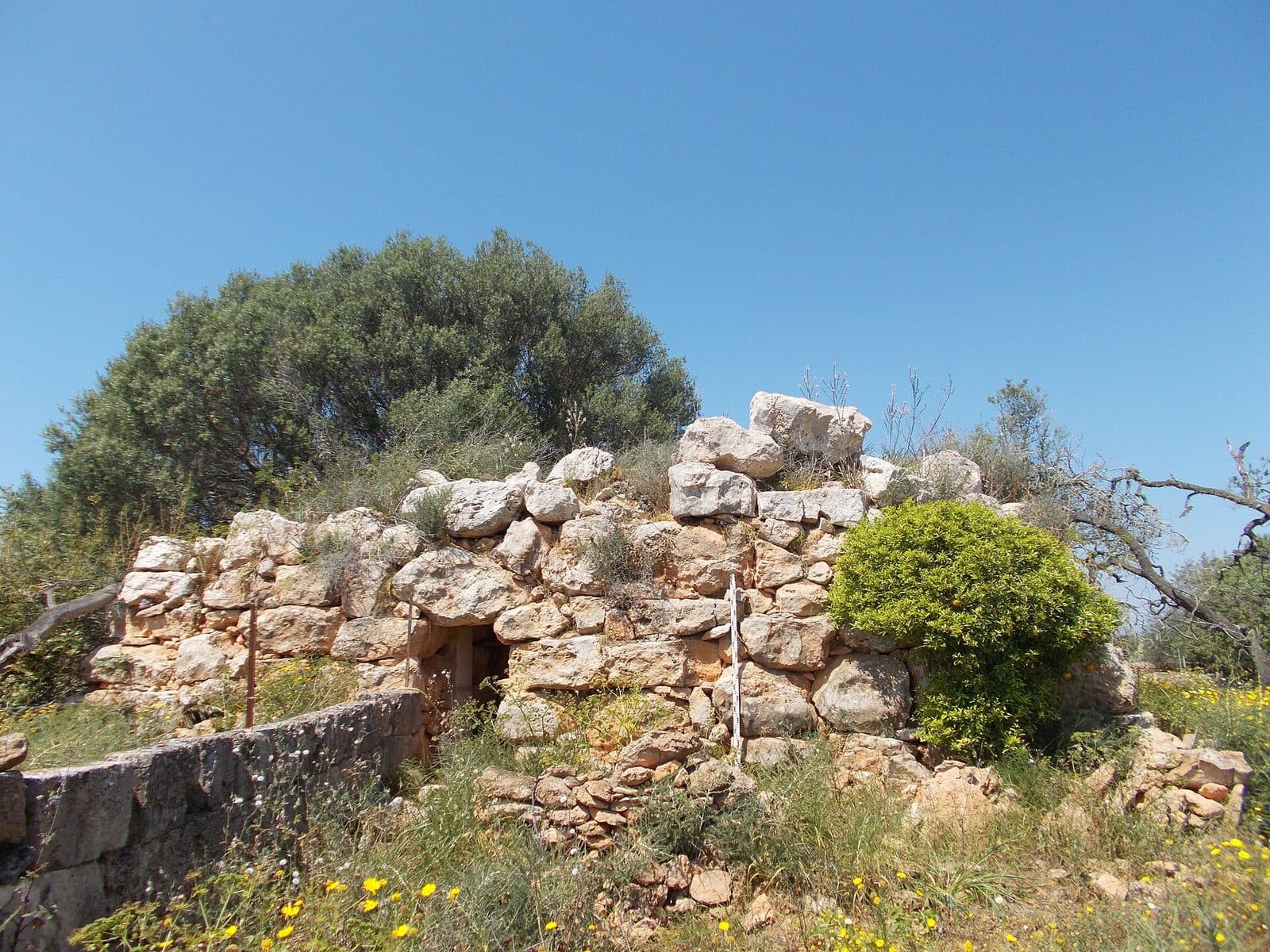

The Talaiot de Son Taixaquet d'en Ramonell is a prehistoric stone structure in southern Mallorca, near Tolleric and within the municipality of Llucmajor. Amid more recent development and subdivided land, a freestanding, square talaiot has survived here—a monumental testament to the communities that shaped the island long before the Roman era.
Its impact comes not from a large excavation site or elaborate presentation, but from the structure itself: massive courses of stone, strikingly rounded corners, an almost arched portal, and an interior chamber that remains clearly legible. Missing elements such as the former central column and the roof slabs also reveal how much of the original construction has been lost.
The site is particularly rewarding for travelers who want to explore Mallorca's prehistory away from the well-known major sites. A close look reveals not only Talaiotic architecture, but also traces of later alterations and uses. This layered history is precisely what makes the talaiot more than an isolated pile of stones: it tells how a prehistoric monument was reinterpreted and altered over centuries before finally being protected as a cultural asset.
History and significance
Long before written sources recorded life on Mallorca in detail, Talaiotic communities erected highly visible structures from large stone blocks. Scholars generally place the Talaiotic period around the first half of the first millennium BC and associate it technologically with the Late Bronze Age and Early Iron Age. Small settlement communities shaped by agriculture and livestock farming organized their landscape around monumental towers and other communal buildings.
The name “Talaiot” derives from the Catalan word “talaia,” meaning a tower or lookout point. This term long shaped the idea that such buildings primarily served as watchtowers and defensive structures. Today, their function is assessed more cautiously: depending on the site, talaiots may have served communal, economic, representative, territorial, or defensive purposes. Gatherings and the processing or distribution of food are also discussed. However, no single use has been conclusively established for the Talaiot de Son Taixaquet d'en Ramonell.
The Talaiotic construction phase
The freestanding structure belonged to a larger group of prehistoric monuments on the Son Taixaquet estate. Its square ground plan distinguishes it from the circular talaiots also common on Mallorca. Nevertheless, the massive walls and relatively small interior follow a basic principle of Talaiotic monumental architecture: large quantities of stone were layered to create a durable building with a powerful physical presence.
Its construction required organized communal labor. The blocks were assembled without mortar to form thick wall masses; inside, a column together with stone roof slabs probably supported the upper structure. Although the column and roof are now missing, preventing a complete reconstruction, the building's technical concept remains recognizable.
Excavation and finds
Around 1920, the talaiot was cleared. A bronze point, glazed-paste beads, pottery, and grinding stones were discovered in the process. Such objects connect the monument with specific activities and human lives, although their precise association with individual phases of use is not always clear.
At the same time, adjoining rooms were destroyed. This resulted in the loss of part of the archaeological context that would have been important for interpreting the talaiot. Flat inhumation burials above stone slabs were also documented later. They show that the site was revisited and used differently after its original construction and occupation period.
From monument to dovecote
A particularly vivid later episode is its conversion into a dovecote. The prehistoric structure was not merely observed or ignored, but adapted for a practical purpose. Such interventions can alter historic fabric, yet they have themselves become part of the site's long biography.
Since 10 September 1966, the talaiot has been protected as an asset of cultural interest. Its designation underlines its importance as part of the archaeological heritage of Llucmajor—not as an immaculately preserved standalone object, but as a monument where prehistoric construction, later use, and modern heritage protection directly intersect.
What to see
At first glance, the talaiot appears compact and enclosed. Its distinctive features only become clear when you walk around it: the ground plan is square, but the corners are gently rounded. Rather than a sharp-edged block, this creates a structure whose outer walls seem to flow around the chamber. With a footprint of approximately 11.8 by 11.6 meters and a surviving height of around 3.7 meters, it still has an impressive mass despite its losses.
The square masonry
The exterior walls are the most important part to examine. Large, irregular stones are stacked in substantial courses, demonstrating a construction technique that used no mortar. Up close, you can observe how the shape, weight, and position of the individual blocks work together. The wall was not intended as a smooth façade; its effect comes from the depth of the masonry and its heavy, almost sculptural surface.
The rounded corners of the building are particularly revealing and are best compared while slowly walking around it. From the front, the structure initially appears angular, while the side view reveals the transition between the exterior surfaces. This detail characterizes the construction more clearly than any abstract description of its ground plan.
The entrance portal
The entrance is one of the structure's most distinctive features. Its opening appears almost arched and includes a small threshold. Unlike a true masonry arch, its shape results from the arrangement of large stones. This is where it becomes especially clear how the builders dealt with limited space, great weight, and the pressure of the masonry above.
The threshold is easy to overlook because attention is usually drawn first to the portal opening and the chamber beyond. Yet it very clearly marks the transition between the exterior and interior. Viewing the entrance from different angles also reveals how deeply the opening is cut into the massive wall structure.
The interior chamber
Beyond the portal lies a surviving chamber measuring approximately 6.1 by 5.7 meters. Its dimensions emphasize the relationship between the large exterior volume and the comparatively limited interior. A substantial part of the footprint is taken up by the walls—a characteristic that defines the monumental nature of the talaiot.
The chamber is also the best place to imagine the lost roof construction. Originally, a central column probably supported the stone slabs above. Neither this central column nor the roof slabs have survived, so the interior now appears more open than it likely did during the Talaiotic period. The missing center is not a minor loss: it alters the spatial effect and deprives the building of an essential part of its original structural system.
Traces of later use
Not everything visible necessarily belongs to the initial construction phase. Its use as a dovecote brought alterations, and the clearing around 1920 also affected the surviving fabric. The talaiot should therefore not be read as a frozen moment from prehistory. Its present appearance is the result of several historical periods.
The documented burials above stone slabs also belong to this long history. They indicate that the site retained significance after the end of its original function. Without archaeological interpretation, such findings are not always easy to identify on site. Nevertheless, knowing about them changes the way the monument is viewed: beneath and between the visible walls lies a more complex site than its compact exterior initially suggests.
Visiting the talaiot
The best approach is to begin not at the portal, but by walking completely around the structure. This allows you to grasp its almost square ground plan without overlooking the rounded corners. Moving between the front, sides, and rear makes it easier to understand how enclosed the talaiot appears from the outside and how much of its footprint is occupied by massive walls.
Walking around the exterior
As you circle the building, it is worth following individual stone courses with your eyes. Some blocks form long horizontal lines, while others compensate for differences in height or interlock neighboring sections. This reveals more about the construction technique than the simple impression of “large stones.” It also highlights areas where later alterations or losses interrupt the original pattern of the masonry.
The rounded corners should be viewed from a few steps away, as their proportions quickly disappear from view when standing directly beside the wall. From an oblique angle, however, it becomes clear that the curve is not an accidental result of decay, but defines the exterior form of the square structure.
Portal and chamber
Next, focus on the almost arched portal. The small threshold, the depth of the entrance, and the transition into the interior chamber can be read together here. Inside the chamber, looking toward the center and upward helps you mentally restore the missing column and the roof slabs that no longer survive. Only then does it become clear that today's open appearance does not reflect the room's original condition.
It makes little sense to prescribe a fixed amount of time for visiting this site. Anyone interested only in the exterior form will need considerably less time than someone who wants to compare the masonry technique, portal, chamber, and later alterations. The talaiot is not a site that leads visitors through a long sequence of stops; its value lies in the focused, attentive examination of a single monument.
Planning before you set out
Current access conditions should be checked before visiting. The talaiot stands in a subdivided landscape in the area of Can Ramonell, associated with the former Son Taixaquet estate, rather than at an urban museum site. Opening hours and admission are not documented with lasting reliability, so it is advisable to confirm current access immediately before traveling.
Its remote location does not automatically mean that access is possible at all times. The time of day, property situation, and final approach to the monument should therefore not be left to chance.
Getting there and parking
The stated driving figures lead to Tolleric, not directly to the masonry. The road distance from Palma Airport to Tolleric is 18 kilometers, and the journey takes around 16 minutes. From the center of Palma, the road distance is 24 kilometers, with approximately 26 minutes to allow for the drive. This route follows the Ma-19 south toward Llucmajor.
From Palma and the airport
The Ma-19 is the main fast connection from the Palma area. Travelers starting in the city center follow it out of the urban area toward Llucmajor. From the airport, Tolleric is also quickly accessible because of its southeastern location. However, both journey times end in Tolleric and should not be understood as arrival times directly at the talaiot.
For the final stretch, using the destination's full name is important. In addition to the Talaiot de Son Taixaquet d'en Ramonell, there are other prehistoric sites in the Son Taixaquet area, including the similarly named Talaiot de Son Taixaquet des Llobets. A shortened search for “Son Taixaquet” can therefore lead to the wrong monument. Can Ramonell and the Son Taixaquet estate are useful additional place names for orientation.
The final stretch
In the immediate area, the route leaves the main road and enters the local street network of the subdivision. Before setting out, check which access route is currently permitted. Briefly reviewing the exact map location before departure will prevent unnecessary searching on arrival.
No bus stop is recorded in the immediate vicinity. Travelers arriving without their own vehicle should therefore not assume that the final meters can be conveniently covered by a regular bus service. Anyone using a taxi or ride service should have the talaiot's full name, along with Tolleric, Can Ramonell, and Llucmajor, ready to avoid confusion with the other Son Taixaquet archaeological sites.
Nearby
Tolleric lies on Mallorca's southern coast within the extensive municipality of Llucmajor. Here, modern coastal development and the prehistoric remains of the hinterland are unusually close together. The talaiot is a reminder that this landscape was used, organized, and marked with monumental stone structures long before today's residential areas existed.
Son Taixaquet
The name Son Taixaquet does not refer only to this one talaiot. The historic estate includes or once included several archaeological monuments, among them the Talaiot de Son Taixaquet des Llobets, the Cova de Son Taixaquet d'en Toni, and the prehistoric complex of Son Taixaquet de Son Pons Cardaix. There are also other prehistoric sites in the Llucmajor area.
For visitors interested in archaeology, a themed exploration may therefore be worthwhile, provided that access conditions for each site are clarified in advance. The individual places should not be treated as interchangeable variants: Ramonell is distinguished by its freestanding square structure, rounded corners, and surviving chamber. The similarly named Talaiot de Son Taixaquet des Llobets is a separate attraction.
Tolleric and the southern coast
After the focused examination of the stone structure, the excursion can be combined with the coastal region. Badia Blava, Badia Gran, and Cala Blava are among the nearby destinations along this section of the southern coast. Smaller coves such as Cala Mosques and Caló de ses Lleonardes are also considered part of the wider area.
Such a combination creates an appealing contrast without overloading the archaeological visit: first the heavy, inward-looking architecture of a prehistoric tower structure, then the open coastal landscape. Travelers arriving from Palma can also include the talaiot as a short historic stop on a journey south rather than turning it into a lengthy standalone circuit of the island.
The place it belongs to
Tolleric in the place guidePractical information for your visit
The full name is more than a formal designation here. “Talaiot de Son Taixaquet d'en Ramonell” distinguishes the monument from several similarly named sites on the same historic estate. It is advisable to save the exact map location in advance rather than searching only for “Talaiot Son Taixaquet.”
Read the structure rather than reconstructing it
Do not expect a completely preserved tower. The central column and stone roof slabs are missing, adjoining rooms were destroyed around 1920, and the structure was later altered for use as a dovecote. This is precisely why a clear sequence helps: first examine the exterior form and rounded corners, then the portal and threshold, and finally the chamber with its lost center.
Attention should be paid not only to the ground underfoot, but also to the historic fabric: loose stones should neither be moved nor used as seats or climbing aids. Its massive appearance should not obscure the fact that dry-stone masonry and archaeological remains can be damaged by careless interference.
Visiting with children
For children, the site becomes especially engaging when the structure is not presented as a nameless ruin. The portal, unusually thick walls, and missing central pillar offer easy-to-understand observation tasks: Where does the corner begin to curve? How small is the interior compared with the exterior form? Which stones support the opening above the entrance?
The talaiot requires imagination and calm observation. Anyone planning a visit with children can show them an illustration of a fully reconstructed talaiot beforehand; this makes the missing column and lost stone roof easier to understand on site.
Respecting the site and property
The monument's protected status does not override property boundaries or current access rules. Access should therefore be checked before setting out. On site, visitors should respect paths and clearly marked boundaries. In any case, the strongest impression comes not from stepping into every corner, but from carefully reading the visible architecture.
Local insider tips
View the corners from an angle
The square form is easiest to understand from an oblique angle. This reveals how gently the exterior walls curve around the rounded corners—one of the talaiot's most distinctive details.
Notice the threshold
At the almost arched entrance portal, attention is usually drawn straight into the chamber. Directly below, however, is a small threshold marking the passage through the unusually deep masonry.
Look for the missing center
Inside the chamber, deliberately look toward the center and upward. The supporting column for the stone roof slabs once stood there; both are now missing, fundamentally changing the character of the space.
Read the layers of history
The structure is not only prehistoric: it was later altered into a dovecote. Documented burials above stone slabs also show that the site continued to be used after its original function had ended.
Do not confuse Ramonell
Always use the full name when navigating. The Talaiot de Son Taixaquet des Llobets is another monument on the same historic estate and can easily be confused with this site in shortened searches.