
Talaiot de Son Noguera near Tolleric
.JPG)
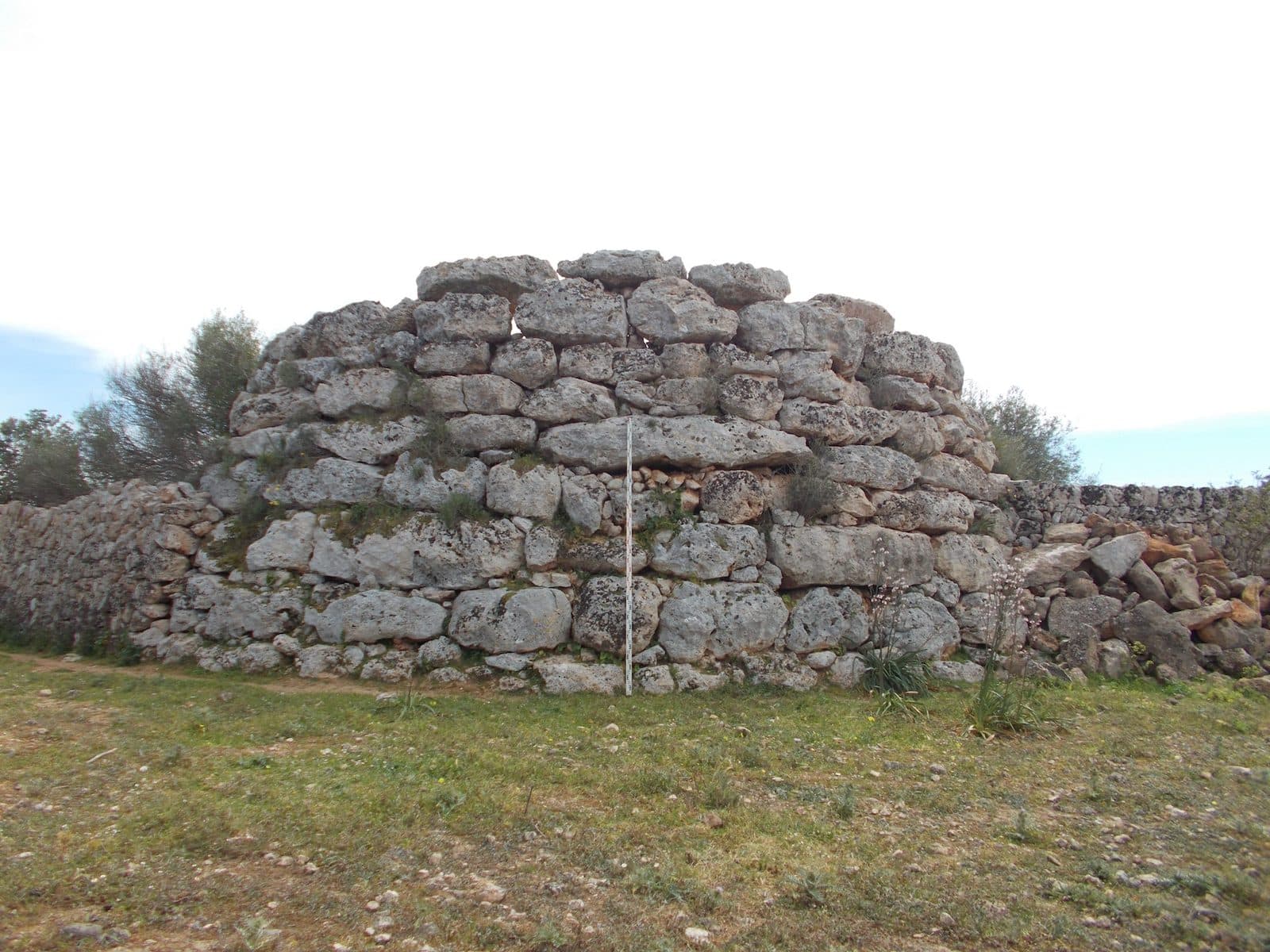
Surrounded by newer development and everyday life near Tolleric, a structure from a time before Mallorca's history was written down still stands its ground. The Talaiot de Son Noguera is a prehistoric stone structure in the municipality of Llucmajor and is protected as a cultural heritage site. Its appeal lies in the direct encounter with the ancient masonry.
The monument itself takes center stage: its heavy stones, the entrance into the interior, and the visible point of contact between prehistoric architecture and masonry added later. This compact, unadorned setting is precisely what makes the site interesting for visitors who want to discover Mallorca beyond its beaches, churches, and manor houses.
Caution is important when placing it in context. The function of talaiots remains a matter of debate, and not every observation made at better-researched sites can be applied to Son Noguera. What is certain is that the structure belongs to the monumental stone architecture that gave its name to an entire era of Balearic prehistory. A visit is therefore especially worthwhile for archaeology enthusiasts, observant photographers, and anyone who wants to use a single structure to appreciate how deep the history of settlement runs in southern Mallorca.
History and significance
The strongest historical statement made by Talaiot de Son Noguera lies in its material. Large stones were assembled without mortar to form a massive structure—a construction method associated with the so-called Cyclopean architecture of the Balearic Islands. Such monuments shaped Mallorca and Menorca during the Late Bronze and Early Iron Ages. Archaeological research places the core period of the Talaiotic communities between the middle of the 10th and the middle of the 6th centuries BC.
Talaiotic society
The people behind these stone structures were not a mysterious culture detached from the rest of island life, but a society largely shaped by farming. They lived in small settlements, cultivated crops, raised livestock, and increasingly organized their territory into social and spatial units. Talaiots were the most conspicuous structures built by these communities. Their construction required the selection, transportation, and collective handling of large quantities of stone—and therefore planning and coordinated action.
The individual tower is thus more than an isolated piece of masonry. It points to a community capable of mobilizing enough labor to create lasting monuments. In a landscape without modern machinery, size itself became a statement. Anyone standing before Son Noguera is looking not only at construction techniques, but also at a result of social organization set in stone.
A name, but no confirmed function
The word “Talaiot” is related to the Catalan “talaia,” meaning a watchtower or lookout tower. This linguistic connection influenced early interpretations: for a long time, the structures were regarded primarily as observation or defensive towers. The name, however, is not proof of their original use.
Researchers have considered several possible functions. Talaiots may have served to provide territorial and visual oversight, host communal gatherings, process and distribute food, or accommodate ritual activities. A combination of several purposes is also conceivable. No single function has been established so clearly for Talaiot de Son Noguera that it can be regarded as the definitive explanation. During a visit, it is therefore more useful to examine the structural features closely than to hastily label the monument a fortress, dwelling, or ritual site.
From prehistoric structure to cultural monument
The talaiot did not remain in a museum-like landscape of isolated ruins. Later development moved closer to it; a more recent wall visibly connected or integrated the monument with the houses of Son Noguera. This layering is historically revealing because it shows how prehistoric fabric remained part of an environment that continued to be used over a long period rather than being treated as a freestanding monument.
Today, Talaiot de Son Noguera has the status of a “Bien de Interés Cultural,” meaning a cultural asset under special protection. This designation emphasizes its archaeological value. Son Noguera remains first and foremost an authentic archaeological feature: an enduring structure where prehistoric fabric and more recent interventions meet directly.
What to see
Attention immediately falls on the mass of the walls and the opening through which the structure can also be experienced from inside. Only by changing the direction of view—first along the exterior wall, then through the entrance, and finally back out from the interior—does it become clear how powerfully the talaiot works with only a few architectural elements.
The massive structure
From the outside, the talaiot appears as a compact structure assembled from large stones. What matters is less a decorative façade than the weight of the individual blocks and the way they work together. The stones were not shaped into uniform ashlars. Their irregular forms remain visible, creating masonry in which each course must respond to the blocks below it.
This construction explains why talaiots are often described as Cyclopean. The term does not imply the involvement of mythical giants but refers to the effect created by exceptionally heavy, roughly worked stones. It is architecture without a façade in the later sense: construction and appearance are one and the same. When looking around, it is therefore worth taking time to search for lines, joints, and changes in the stone material.
The entrance
One particularly illustrative detail is the preserved entrance. From the outside, it marks the transition from the open surroundings into the compact stone structure; from the inside, it frames the view back out. This reverse perspective reveals more about the construction than simply looking at the exterior wall. The depth of the wall becomes directly tangible in the passage because the route leads not merely through a thin opening but through the heavy body of the structure.
The entrance should not be mistaken for a ceremonial portal. Its effect comes from narrowness, stone, and wall thickness. Anyone examining its construction can see that openings presented a particular structural challenge in a building of this kind: the weight of the wall had to be safely transferred above and beside the passage. Even without a technical information panel, it is possible to understand here how closely form and structural stability are connected.
From the interior, the view leads back outside through the same opening. This viewpoint is particularly rewarding for understanding the monument because it makes the boundary between interior space and surroundings visible. It also creates one of Son Noguera's characteristic photographic motifs: the entrance as a stone frame.
The interior
Inside, perception changes: the exterior is dominated above all by mass, while the interior draws attention to the course of the wall and the enclosed space. Its significance lies in what has survived. Stone surfaces, the opening, and the confined space are enough to convey an impression of the construction effort involved.
Caution is required when interpreting it. Typical talaiots may have a small interior, a central supporting pillar, and a roofed superstructure, but these general features must not automatically be treated as a complete description of Son Noguera. What matters on site is what has actually survived and remains visible. Missing structural elements should not be mentally reconstructed as though a particular interpretation had been proven.
The interior is best viewed as archaeological evidence: not as complete original architecture, but as a surviving fragment from which the course of the wall, the entrance, and the relationship between load-bearing mass and usable space can be read. This sober perspective does not diminish the experience; rather, it preserves the distinction between observation and speculation.
The later wall
To the left of the monument, a wall of more recent date can be seen that connected the talaiot with the houses of Son Noguera. This feature does not belong to the original Talaiotic architecture. It is nevertheless worth seeing because it reveals the site's later history of use. The ancient stone structure was not always perceived as an isolated archaeological monument but was incorporated into a changed built environment.
This is a particularly good place to practice distinguishing between different historical layers. Differences in the course of the wall, its construction, and its relationship to the neighboring buildings help with orientation. The later section of wall is not an intrusive footnote but a visible indication that the talaiot was incorporated into later architecture.
This contrast makes Son Noguera unusually vivid. Instead of an idealized monument stripped of all later traces, visitors encounter a structure with a subsequent history. Prehistory and more recent development do not stand neatly separated side by side but meet within the masonry.
Visiting the site
Talaiot de Son Noguera can be viewed from a few carefully chosen perspectives. Begin by looking at the entire structure. Then focus on the entrance, the depth of the wall, and—as far as current access allows—the reverse perspective from the interior looking out. Finally, it is worth examining the point where the prehistoric monument and the later wall meet.
Observe rather than tick it off
The monument is compact enough for a quick photo stop. However, anyone wishing to compare the courses of stone and distinguish original sections from later additions can engage with it far more intensively. A fixed visiting time would be misleading: the time required depends primarily on whether the talaiot is merely viewed or read as an architectural feature.
A simple sequence is helpful: first consider the overall form from some distance. Closer to the wall, the size and irregular working of the stones become apparent. At the entrance, the thickness of the wall is revealed, while the view through the opening emphasizes the spatial boundary. This short sequence prevents the visit from ending with a single exterior photograph.
Access and visiting conditions
No reliable specific opening hours or current admission price have been recorded. Because access conditions at archaeological sites can change, they should be checked shortly before visiting. Barriers, gates, and notices on site take precedence; neighboring buildings and properties must not be regarded as part of a freely accessible visitor route.
There is also no reliable basis for identifying regularly busy periods. Son Noguera should therefore not be planned like a major attraction with predictable waves of visitors. Anyone wishing to observe or take photographs without disturbance can check the current situation before traveling but should not assume that any particular time of day is guaranteed to be quiet.
The real value of the visit lies in concentration. A single entrance, a heavy wall, and the transition to a later construction phase tell more when they serve as more than just a backdrop for a photograph. No prior knowledge is required; distinguishing between what is clearly visible and what remains a possible interpretation is already the most important archaeological perspective.
Getting there and parking
The talaiot lies near Tolleric in southern Mallorca, within the municipality of Llucmajor. The stated driving distances and travel times lead to Tolleric, not directly to the monument. For the final section, precise navigation using the name “Talaiot de Son Noguera” is therefore advisable. Access should not be equated with a guaranteed public parking area or a road open to unrestricted traffic.
From Palma to Tolleric
From central Palma, the driving distance to Tolleric is 24 kilometers. The journey takes around 26 minutes and follows the Ma-19. The route takes visitors into the coastal area southeast of the capital; within or near Tolleric, follow directions toward the archaeological destination. Because the measured travel time ends in Tolleric, additional flexibility should be allowed when looking for the final access point.
When parking, local signs, property entrances, and applicable parking regulations are decisive. A parking space should not be assumed to exist simply because a spot appears convenient on the map. Access to houses and land used for agricultural or private purposes must remain unobstructed.
From the airport to Tolleric
The driving distance from Palma Airport to Tolleric is 18 kilometers; the journey takes around 16 minutes. These figures also refer explicitly to Tolleric and not to a parking area directly beside the talaiot. The same guidance applies to the final section: navigate precisely, observe current signs, and use only routes and parking options that are clearly permitted.
The comparatively short drive means that Son Noguera can generally be included in an itinerary through southern Mallorca. However, an archaeological site is suitable as a stop immediately before a flight only if current access conditions and sufficient extra time are taken into account. The monument's compact size does not automatically eliminate the need to find the correct access point.
By bus
Polígon Son Noguera is listed as a nearby stop. The final section from a bus stop to an individual archaeological monument may differ from an urban sidewalk. Before traveling, check the current service, the location of the stop, and the onward route. The mere proximity of a stop does not indicate that there is a signposted or accessible footpath to the talaiot.
Bus lines to Talaiot de Son Noguera at a glance
| Line | Route | Departures/day | First | Last |
|---|---|---|---|---|
| 501 | Manacor - Campos - Palma | 207 | 00:15 | 23:20 |
| 508 | Sa Ràpita - Palma | 47 | 06:51 | 22:33 |
| A51 | Campos - Aeroport | 38 | 04:53 | 23:58 |
From the official GTFS feeds (TIB/SFM), no real-time data. The figures cover all stops in the town; weekend and holiday services differ — check with the operator before travelling.
Getting there by bus
Polígon Son Noguera (31061) · 0.7 km as the crow flies
- 501Manacor - Campos - Palma · Daily
- 508Sa Ràpita - Palma · Daily
- A51Campos - Aeroport · Daily
Timetable data: official GTFS feeds (TIB/EMT), no real-time — check with the operator before travelling.
Nearby places
Tolleric represents a very different part of Mallorca from Palma's historic lanes or the mountain villages of Serra de Tramuntana. The settlement lies in the south of the island and serves as the modern point of reference for visiting Son Noguera. The talaiot bears witness to the prehistoric past of this coastal area.
Tolleric
The settlement is a useful starting point and landmark. The talaiot stands in surroundings where older fabric and more recent development lie close together. As a result, the visit feels less like an excursion into an isolated world of ruins and more like a search for traces within a modern settlement.
This contrast sharpens the eye. In travel guides, prehistoric monuments often appear isolated and timeless. Son Noguera, by contrast, shows that Mallorca's landscape has continued to change: walls were added and buildings moved closer. The talaiot endured as a heavy, fixed point and is now both an archaeological site and a protected cultural asset.
The southern coast
A visit can be combined with places and stretches of coastline in the south. Possible stops include Badia Blava, Cala Blava, Cala Mosques, Caló de ses Lleonardes, and s’Arenal. They should not be regarded as parts of the archaeological site but as independent destinations on a route along the southern coast. Which combination is appropriate depends on current accessibility, the season, and the chosen means of transportation.
The contrast between prehistory and the modern coastal landscape is particularly appealing. Son Noguera does not offer a lengthy museum visit but a concentrated historical introduction. The route can then continue without reducing the talaiot to a mere stopover: anyone who has consciously examined the entrance, masonry technique, and later addition will also notice other ancient stone structures on Mallorca more attentively.
The place it belongs to
Tolleric in the place guidePractical information for your visit
Talaiot de Son Noguera requires attention above all, particularly when interacting with its historic masonry.
Protecting the masonry
The large stones appear immovable, but archaeological remains are fragile. Climbing on the masonry, moving stones, or using joints as footholds damages the surviving structure and can be dangerous. The best perspective does not come from above anyway, but from alternating between a distant view, the side of the wall, and the entrance. This keeps both the overall form and the structural details legible.
Touching and looking are also not the same as interfering. Small stones can be important to the stability of a dry-stone wall, even if they appear to be loose material. Finds, pottery fragments, or unusual stones should be left where they are found. The monument's protected status covers not only the visible tower but also its archaeological context.
With children
Children may find the talaiot exciting if the visit is framed as a discovery task: Where does the entrance begin, which stones are especially large, and how can the later wall be identified? Such specific questions work better than a lengthy explanation of prehistoric chronology. The structure is not a climbing area.
Families can plan the talaiot as a short, focused archaeological visit whose quality lies in seeing the original. This is precisely what can make it a good introduction: the structure can be examined directly, while its unresolved function leaves room for questions without presenting speculation as fact.
Realistic expectations
Son Noguera is not a fully excavated Talaiotic site with multiple houses, streets, and sanctuaries. What can be seen is a single monument with an entrance, an interior perspective, and masonry added later. Anyone expecting a large complex or a complete explanation of its original use will miss the character of the site.
Its strength lies in the fragment. The talaiot demonstrates how monumental construction using large, unmortared stones works and how a prehistoric structure was incorporated into a more recent setting. Nothing more is needed for a rewarding visit—provided the masonry is given time and attention.
Local insider tips
Read the wall from the side
Do not stop after the first frontal view. From the side, it is easier to distinguish the mass of the talaiot, the irregular courses of stone, and the transition to later masonry.
Look back through the entrance
The entrance is particularly striking from the interior: the opening frames the view outside while also revealing how deeply the passage runs through the heavy structure.
Look for the later wall
To the left of the monument, a wall of more recent date can be seen that connected the talaiot with the houses of Son Noguera. It is not part of the original structure but tells the story of its later history.
Observation before interpretation
The original function of the talaiot has not been conclusively established. The most rewarding approach is to examine the entrance, wall thickness, and stone construction first, and only then consider possible explanations.