
Mallorca Holiday Rental Licence: How to Apply for an ETV Licence Legally
Anyone wishing to legally let their property on Mallorca to holidaymakers needs an ETV licence – the Estancia Turística en Vivienda. Without it, you risk substantial fines, and no platform in the world will protect you from an inspection. Since February 2022, a strict moratorium had been in place that completely froze the issuing of new licences. In spring 2026, the Balearic government released an official quota for the first time: 1.069 tourist places, this time allocated through a transparent lottery process. In this guide you will learn which property types are eligible to apply, what a licence costs, which technical requirements you must meet, how the process works step by step – and what happens if you let without a licence.

Do you already know whether your property is eligible for a licence at all?
- 📩 Submit a personal enquiry — We assess your property's ETV eligibility free of charge
- Buying holiday properties strategically — what investors should look out for when purchasing
What the ETV licence is – and why you are not permitted to let without one
The abbreviation ETV stands for Estancia Turística en Vivienda – in English: tourist accommodation in a residential property. It is the official Balearic authorisation that entitles you to let your house or finca on a short-term basis – i.e. for individual days or weeks – to tourists.
Without a valid ETV licence, any tourist short-term let on Mallorca is illegal, regardless of how many positive reviews you have on Airbnb. The Balearic tourism law provides for fines of from €20.000 for violations – and repeat offenders risk considerably higher penalties.
It is important to understand that the ETV licence is not the same as an ordinary commercial permit. It is governed through the concept of so-called plazas turísticas (tourist places). Each plaza corresponds to one guest sleeping place. The total number of places on Mallorca is capped – which is precisely what makes a licence, once granted, so valuable.
Short-term let vs. long-term let: where is the boundary?
The ETV licence requirement applies exclusively to tourist short-term lets. Anyone letting their property for periods of more than one month (classic long-term let) is operating within the framework of Spanish tenancy law and does not require an ETV licence. For anything below this threshold that is used for tourist purposes, the ETV is mandatory.
Please note: The boundary between short-term and long-term letting is not always straightforward in practice. If in doubt, have the classification of your specific letting model checked legally – especially if you are planning mixed-use arrangements (e.g. personal use combined with seasonal letting).
The moratorium and the 2026 opening: what currently applies
To understand the development of the current legal framework, you need to look briefly at recent history.
From 11. February 2022, a strict moratorium came into force that completely suspended the granting of new ETV licences and the transfer of tourist places across the Balearic Islands – Mallorca, Menorca, Ibiza and Formentera. The background was political debate around tourist overcrowding and pressure on the local housing market.
As a result, purchasing a property with an existing ETV licence became the only legal route into the holiday letting market. Properties with a valid licence rose sharply in value.
What changed in 2025: In April 2025, the government of Marga Prohens passed a decree on measures to curb tourism. This decree introduced, among other things, a general ban on new holiday flats in multi-family buildings across the entire archipelago – in line with the model that had previously applied in Palma and Ibiza. At the same time, existing permits granted before 2017 were placed on a more secure legal footing.
The 2026 lottery process: In March 2026, the island government decided to allocate a new contingent of tourist places for the first time — a total of 1.069 places. Unlike before, allocation is no longer on a first-come, first-served basis, but through a public lottery process. The application deadline ran until 8. April 2026.
| Date | Event |
|---|---|
| 11. Feb. 2022 | Moratorium: no new ETV licences in the Balearic Islands |
| Apr. 2025 | Decree on tourism containment; ban on new licences in multi-family properties |
| Sep. 2025 | Limited contingent of 654 places released (according to Balearic Properties) |
| Mar. 2026 | New lottery process: 1.069 places advertised |
| 8. Apr. 2026 | Application deadline for the lottery process expired |
Please note: The window from March/April 2026 has already closed. Anyone looking to enter the market now must either wait for the next contingent or purchase a property with an existing ETV licence. We will keep you informed as soon as a new process is announced.
Which property types are eligible to apply
Not every property on Mallorca can obtain an ETV licence. The current regulatory framework (as of 2026) draws a strict distinction based on property type.
| Property type | ETV licence possible? | Notes |
|---|---|---|
| Detached house | ✅ Yes | Full licence possible |
| Terraced house (adosado) | ✅ Yes | Permitted under the current lottery process |
| Semi-detached house (pareado) | ✅ Yes | Permitted under the current lottery process |
| Primary residence (ETV60) | ✅ Restricted | Max. 60 rental days per year |
| Flat in a multi-family building | ❌ No | Generally prohibited since the Apr. 2025 decree |
| Apartment in Palma | ❌ No | Prohibited for some time already |
The category ETV60 is new and particularly interesting for owners who wish to let their primary residence on a partial basis during peak season: up to 60 days per year are permitted. This option is more cost-effective, but clearly limited by the 60-day restriction.
Note: The classification of your property also depends on the urban planning zoning (zonificación urbanística). A property may structurally be a detached house, yet be located in a zone where holiday letting is not permitted. The land register alone tells you nothing here — you will need a zoning check with your local council (Ajuntament).
Costs of an ETV licence: what you need to budget for
The licence costs themselves are moderate relative to the potential rental income. They are calculated per tourist place (plaza turística), not as a flat rate per property.
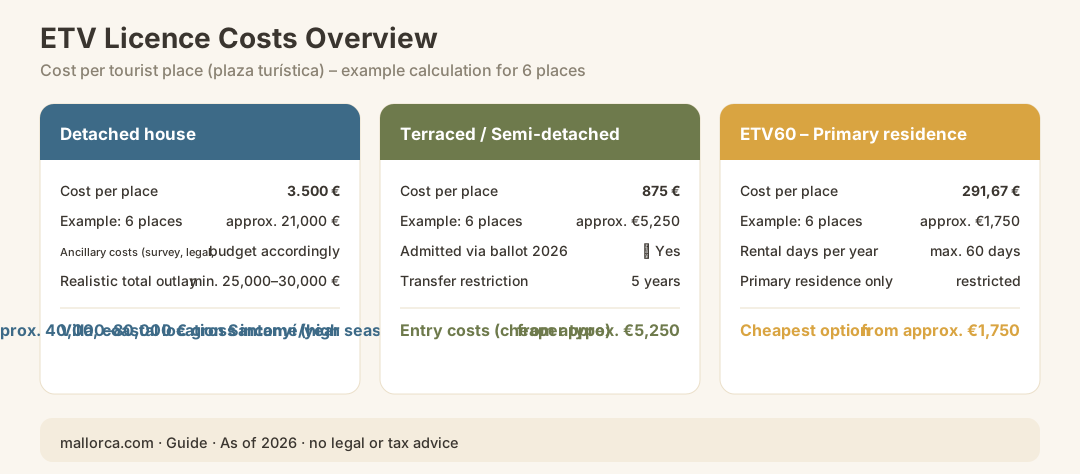
| Licence type | Cost per place | Typical house (6 places) total cost |
|---|---|---|
| Detached house | 3.500 € | approx. €21,000 |
| Terraced/semi-detached house | 875 € | approx. €5,250 |
| ETV60 (primary residence, max. 60 days) | 291,67 € | approx. €1,750 |
In addition, there are one-off ancillary costs that you should definitely factor in:
- Technical reports (energy certificate, certificate of habitability – cédula de habitabilidad)
- Legal and administrative fees for the application
- Any structural adaptations should the property not yet meet the technical requirements
A realistic estimate should allow for a total outlay of at least €25,000–€30,000 for a medium-sized detached house, once preparation costs are also taken into account.
Technical requirements: what the property must meet
The ETV licence will not be granted if the property does not meet certain structural and technical standards. The key requirements can be grouped into four areas:
1. Urban planning prerequisites The property must be located in a zone where holiday letting is permitted under the applicable municipal development plan. Unauthorised structures (illegal works) or non-legalised extensions can block the application.
2. Energy certificate A valid energy efficiency certificate (certificado de eficiencia energética) is mandatory. Without this document, no application can proceed. Find out more in the Guide to Energy Certificates in Spain.
3. Habitation certificate The cédula de habitabilidad confirms that the property meets the minimum legal standards for residential use. If it is missing, a new one must be applied for.
4. Safety and accessibility standards The Balearic legal framework requires compliance with safety and accessibility regulations — specifically regarding escape routes, smoke detectors, and accessible sanitary facilities.
Note: Older fincas and rural properties often fall short when it comes to the habitation certificate or the energy certificate. Have the structural condition assessed by an independent architect or surveyor before submitting your application.
The 2026 lottery process: explained step by step
The new allocation procedure differs fundamentally from the old first-come-first-served principle. Here is how the process worked for the 2026 quota:
- Checking eligibility – Owners or those with the right to use the property may submit an application. Only one application per property is permitted.
- Preparing the documents – Proof of ownership (land registry extract), energy certificate, habitation certificate, and if applicable, a power of attorney for a gestor or lawyer.
- Submitting the application – Within the application period (in the 2026 process: until 8 April 2026) with the relevant island council (Consell de Mallorca) or via the online portal of the Balearic administration.
- Lottery draw – Once the deadline has passed, the available 1.069 places are drawn by lot from all valid applications. The process is public and transparent.
- Decision and payment – Those who win the draw pay the applicable fee per place and receive the official ETV licence.
- Registration and commencement of operations – The licence is entered in the Balearic tourism register. Only after this may you legally let the property.
Please note: Newly issued licences may not be transferred or resold during the first five years. This clause protects against purely speculative licence purchases.
Ongoing obligations as a licensed holiday landlord
A granted ETV licence is not a free pass — it comes with permanent obligations towards the authorities and your guests:
| Obligation | Detail |
|---|---|
| Guest registration | The identity and length of stay of every guest must be reported to the police (Guardia Civil or Policía Nacional) |
| Tourism tax (Ecotasa) | Collect and remit the Balearic tourism tax; more on this in the Sustainable Tourism Tax Guide |
| Income tax | Rental income is taxable in Spain (IRPF or IRNR for non-residents) |
| Register staff | Any cleaning staff or property managers must be officially registered with social security |
| Enforce house rules | The landlord is liable in the event of rule violations by guests |
| Insurance | Specialist public liability insurance for tourist rentals is strongly recommended |
Please note: The tax treatment of your rental income depends on whether you are tax-resident in Spain or not. As a non-resident, you pay IRNR on rental income. Seek advice from a tax adviser registered in Spain — the rules are complex. For an overview of property-related taxes, see Taxes & Legal.
Return expectations: what you can realistically plan for
Licences are valuable because the income from holiday rentals in Mallorca can be substantial. Here are some well-evidenced benchmark figures:
| Property type & location | Annual gross income (high season) |
|---|---|
| Villa with pool, coastal location Santanyí | approx. 40.000–80.000 € |
| Well-equipped apartment, Cala d'Or | approx. 20.000–35.000 € |
| Detached house, mid-range location | depending on specification and management |
For well-positioned coastal locations in the south-east, market observers cite gross yields of 5–7 % per annum. The net margin depends on management costs, taxes, maintenance, and occupancy rate.
The ETV licence itself noticeably increases the property's value: during the moratorium, properties with an existing licence were traded as particularly sought-after assets — and this value premium remains relevant even after any potential reopening, as long as the total number of places remains capped.
The most common mistakes when applying for an ETV
Many owners lose valuable time and money through avoidable mistakes. These are the most common:
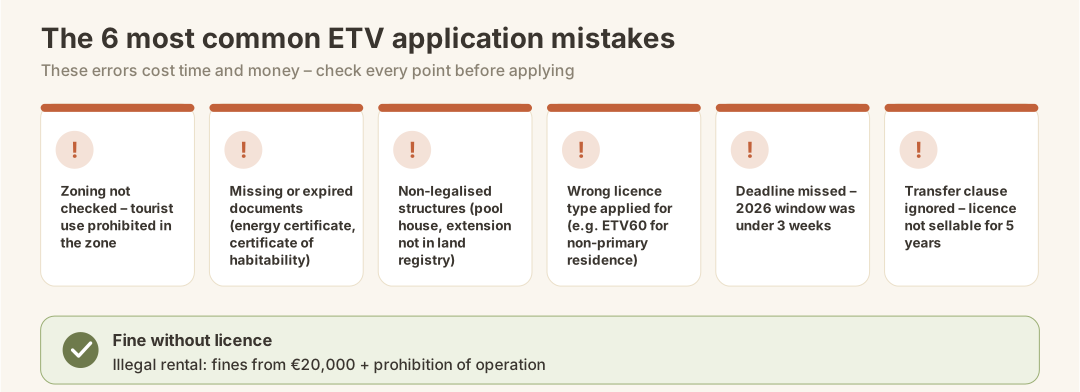
1. Zoning not checked The property is located in a zone where tourist rentals are not permitted. This only comes to light once the application has already been submitted.
2. Missing or expired documents The energy certificate or certificate of habitability is missing, has expired, or was issued for a different type of use.
3. Unauthorised Buildings A pool house, roof terrace or extension is not registered in the land registry or has not received planning permission. More on this in the Guide to Legalising Unauthorised Construction.
4. Wrong Licence Type Applied For ETV60 for a property that is not a primary residence, or an application for a flat in a multi-unit building that has no longer been permitted since the 2025 decree.
5. Deadlines Missed The window for the 2026 lottery procedure was extremely short (less than 3 weeks). Anyone who did not act immediately was left out.
6. Transfer Clause Ignored The new licences cannot be sold or transferred for five years. Anyone wishing to sell the property in the short term will therefore forfeit the added value of a fresh licence.
Illegal Letting: What Consequences Are You Risking?
Anyone who lets without a valid ETV licence risks serious consequences:
- Fines from €20,000 for illegal short-term tourist letting
- Prohibition of operations by the competent tourism authority
- Liability for damages caused by guests — without insurance cover
- Reputational damage in the event of a public inspection
The Balearic authorities have significantly increased the frequency of inspections in recent years. Platform reports, tips from neighbours and targeted inspections make the risk of detection very real.
What Comes After the Licence? Your Next Step
An ETV licence is the starting gun, not the finishing line. These are the questions you should ask yourself immediately after it is granted:
- Manage yourself or outsource? Professional property management companies handle booking management, cleaning, guest services and police registration. Their commission is typically 15–25% of revenue.
- Set your tax strategy — IRPF or IRNR, input tax deduction, correct bookkeeping: these matters are best clarified with a tax adviser specialising in Spain.
- Take out insurance — Specialist policies for tourist letting exist; a standard household contents insurance policy will generally not cover you.
- Set up the Ecotasa — The Balearic tourism tax must be collected per night and per guest and remitted correctly.
Checklist: Applying for an ETV Licence in Mallorca
Before submitting an application, check the following points:
- Property type permitted (detached house, terraced/semi-detached house or ETV60 primary residence)
- Zoning in the local development plan permits tourist use
- Land registry entry correct and complete (no unregistered structures)
- Valid energy certificate in place
- Habitability certificate (cédula de habitabilidad) currently
- safety requirements met (smoke detectors, emergency exit signage)
- proof of ownership complete and uninterrupted
- application submitted on time and in full
- transfer clause (5 years) taken into account in investment strategy
- tax and insurance advice obtained
Conclusion: Is the ETV licence still worth it in 2026?
Yes – but with realistic expectations. The lottery process in 2026 has shown that the market absorbs the available places immediately. Demand far exceeds supply, which keeps the value of a valid licence stable in the long term.
For owners who wish to rent out their house or finca legally to holidaymakers, there are two routes: wait for the next allocation window and prepare as thoroughly as possible – or buy a property with an existing ETV licence right now. Both options have advantages and disadvantages that depend heavily on your personal goals, your property and your timeframe.
Anyone who rents without a licence is playing an expensive game of roulette. Anyone who applies for and operates the licence properly gains a lasting competitive advantage in one of Europe's most attractive tourism markets.
For an individual assessment of your property – from zoning checks to application support – get in touch with us directly.
Official Sources
- Consell de Mallorca – Departament de Turisme: www.conselldemallorca.net – responsible authority for ETV licence allocation on Mallorca
- Govern de les Illes Balears – Tourism: www.caib.es – official information on the Balearic tourism law
- ATIB – Agència Tributària de les Illes Balears: www.atib.es – Ecotasa (tourism tax), tax obligations
- AEAT – Agencia Estatal de Administración Tributaria: www.agenciatributaria.es – IRPF / IRNR, income tax obligations for landlords
- BOE – Boletín Oficial del Estado: www.boe.es – legislative texts and decrees (including Decree-Law 3/2022, Decree April 2025)
- Habtur – Associació d'Habitatges Turístics de Balears: Tel. 656 604 852 – industry association for holiday rentals in the Balearen