
Buying a holiday home in Mallorca: costs, mortgages and legal checks
Anyone looking to buy a holiday property in Mallorca in 2026 faces a market that has changed fundamentally: strong international demand is meeting increasingly limited supply, while new regulations – above all the ban on new holiday rentals in apartment buildings under Decreto-ley 4/2025 – are rewriting the rules. At the same time, the island still offers steady capital appreciation, a well-established mortgage system and a transparent conveyancing process overseen by a notary. This guide shows you which locations currently have the strongest fundamentals, how to arrange financing as a non-resident, which taxes and deadlines actually apply, and where the most common legal pitfalls lie – from checking the Land Registry to the question of an ETV licence.

Why Mallorca remains attractive for holiday property buyers in 2026
Mallorca is the most sought-after holiday destination among German speakers – and that is reflected in its property market. According to market reports from spring 2026, the island’s property market as a whole is growing by around 9.8 %, with the luxury segment seen as the main driver. International capital – not only from Germany and Austria, but increasingly from Northern Europe and outside Europe – is focused on a geographically limited supply. Little land is available for new development; protected natural areas (ANEI) and the Tramuntana, a UNESCO World Heritage Site, rule out new construction across substantial parts of the island. This puts structural upward pressure on prices.
At the same time, tighter regulation – particularly of holiday rentals – means that the simple investment strategy of ‘buy and rent out immediately’ requires more careful planning today than it did five years ago. Buyers who understand the legal framework and find the right property are buying into a market with solid long-term fundamentals.
The best locations for a holiday property – region by region
Mallorca can broadly be divided into five buying regions, with marked differences in price, character and rental potential. The following table provides a structured overview based on current market observations:
| Region | Character | Typical property types | Price range (rough guide) | Key features |
|---|---|---|---|---|
| South-west (Andratx, Puerto Andratx, Camp de Mar) | Exclusive, international | Villas, apartments with sea views | Upscale to ultra-luxury | Highest concentration of expensive properties, strong demand from overseas buyers |
| Palma & surrounding area (Son Vida, Santa Catalina, Bonanova) | Urban Mediterranean, lively | City apartments, townhouses, villas | Mid-range to luxury | UNESCO-listed old town, strong long-term and holiday rental markets |
| North-west / Tramuntana (Sóller, Valldemossa, Esporles) | Rich in culture, mountainous, UNESCO-listed | Historic fincas, townhouses | Mid-range to high-end | Strict building regulations, exceptional locations |
| North (Puerto Pollença, Alcúdia, Artà) | Family-friendly, spacious | Villas, fincas, apartments | Mid-range to upmarket | Close to nature parks, good holiday rental potential |
| South-east (Santanyí, Portocolom, Campos) | Quiet, authentic | Fincas, country houses | Mid-range to upmarket | Growing popularity, rural charm |
Note: Prices per square metre vary considerably within each region depending on location, property condition and features. For a guide to current prices per square metre, see our guide to Mallorca property prices.
In the south-west, properties in Puerto Andratx are firmly in the top price bracket – villas with sea views and a pool often start above the €3 million mark. In the north and south-east, however, fincas and country houses can still be found in the mid-six-figure range if you are willing to budget for renovations.
Legal essentials: what you need to know before signing
The Spanish notary system is fundamentally different from the German one
The key difference: a Spanish notary is a public official who certifies documents, not an impartial legal adviser. They certify signatures and check formal requirements – providing comprehensive legal advice to both parties, as is customary in Germany, is not part of their role. That means you need an independent Spanish lawyer (Abogado) who represents your interests alone. Do not cut corners here.
Essential: NIE number and Land Registry check
Before signing any contract, you need a Spanish tax identification number for foreigners – the NIE (Número de Identificación de Extranjero). Without an NIE, you cannot complete a notarised transaction or open a Spanish bank account.
At the same time, have your lawyer obtain a complete Land Registry extract (Nota Simple). This shows who is actually registered as the owner and whether the property has any mortgages, charges, rights of way or other encumbrances. It can also reveal unpaid municipal taxes (IBI) or extensions and alterations that have not been registered. Find out more in our guide to checking the Spanish Land Registry.
Reservation agreement and preliminary purchase contract (Arras)
The typical Spanish buying process has several stages:
- Reservation agreement (Contrato de Reserva): Temporarily secures the property for you; you pay an initial reservation fee. Find out more at Property reservation agreement in Spain.
- Preliminary purchase agreement with a deposit (Contrato de Arras Penitenciales): Usually 10% of the purchase price. If both parties have the right to withdraw, you lose the deposit if you pull out as the buyer; if the seller pulls out, they must repay twice the deposit.
- Signing before a notary (Escritura de Compraventa): Ownership is formally transferred, and all additional purchase costs become payable at the same time.
- Land Registry registration: Arrange this immediately after signing the deed; only then are you fully protected.
The guide explains the entire process, including deadlines: Buying property: the process.
Additional purchase costs: What you’ll actually pay
As a non-resident buying an existing property in Mallorca, you should generally budget for additional purchase costs of between 10% and 14% of the purchase price. The main items are:
| Type of cost | Who pays | Amount / notes |
|---|---|---|
| Property transfer tax ITP (Impuesto sobre Transmisiones Patrimoniales) | Buyer | Progressive Balearic tax rates (see table below) |
| VAT (IVA) + stamp duty (on new builds) | Buyer | 10% IVA + 1.5% AJD in the Balearics |
| Notary fees | Buyer (main share) | Depends on the purchase price |
| Land Registry registration | Buyer | Depends on the purchase price |
| Lawyer’s fees | Buyer | Usually 1% of the purchase price |
| Estate agent’s commission | Seller (as is customary in Mallorca) | See Estate agent’s commission in Mallorca |
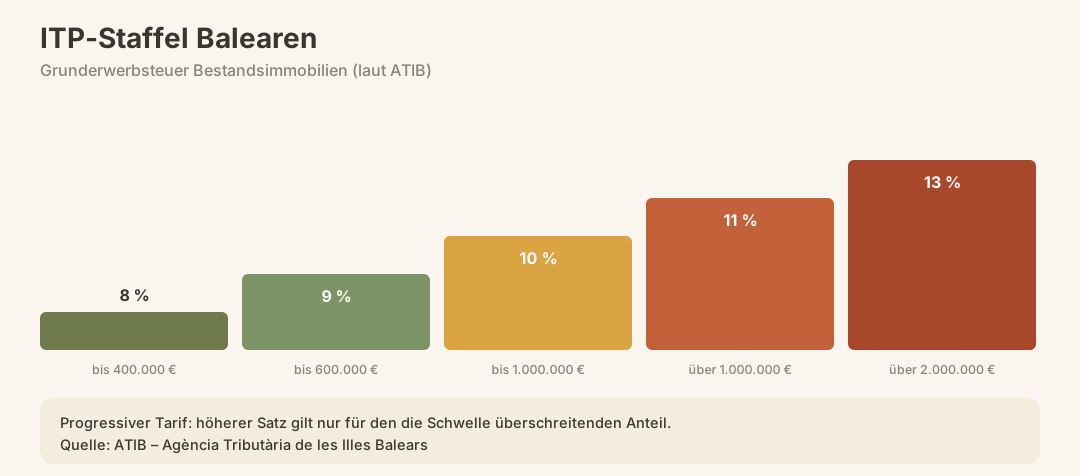
Balearic ITP tax bands (resale properties)
The Balearic Islands levy property transfer tax in bands based on the purchase price. The current rates according to ATIB are:
| Purchase price (up to …) | Tax rate |
|---|---|
| €400,000 | 8% |
| €600,000 | 9% |
| €1,000,000 | 10% |
| €2,000,000 | 12% |
| over €2,000,000 | 13% |
Please note: The tax bands are progressive – each higher rate applies only to the portion above its threshold. Always check the current rates with ATIB (Agència Tributària de les Illes Balears) or ask your lawyer to calculate them. For a full breakdown of additional purchase costs, see Additional property purchase costs in Mallorca.
ETV licences and holiday lets: The new legal framework for 2025/2026
This is currently the most sensitive issue when buying a holiday home in Mallorca. With the Decreto-ley 4/2025 the Balearic government has banned new holiday rentals (ETV – Estancias Turísticas en Viviendas) in apartment buildings. What this means in practice:
- Apartments in multi-unit buildings (propiedad horizontal) can no longer be newly registered. For detached, terraced and semi-detached houses, the Consell de Mallorca now allocates places only from limited quotas by lottery (2026: 1,069 places). In Palma, no new places have been available since February 2026.
- Existing licences, which are tied to the property rather than the owner, can be transferred under certain conditions – making them a valuable feature when buying.
- A property without an ETV licence cannot be let short-term to holidaymakers; only tenancy agreements under the LAU tenancy law are permitted, meaning residential tenancies or seasonal lets with a demonstrably non-tourist purpose.
Warning: Anyone who buys a property without an ETV licence but still hosts holiday guests risks substantial fines. Always check the licence status before signing a contract – and make sure the licence is explicitly transferred to you in the purchase contract.
Properties with an existing ETV licence therefore command a premium. How a transfer works: Transferring an ETV licence in Mallorca. Full details of the licensing requirements: ETV licence in Mallorca.
Financing as a non-resident: German bank or Spanish mortgage?
Financing DE/ES
Explanation
The acquisition price of the property. Enter your agreed price.
Explanation
Your financing need in euros, identical for both routes. The preset is an illustrative choice.
- Available lending · ES route
- €525,000.00
- Basic security costs
- €1,742.95
- Model monthly instalmentDE route
- €2,381.97
- Model monthly instalmentES route
- €2,299.34
Legal status: 1 January 2025
This calculation is provided for guidance only and is not a substitute for tax or legal advice in specific cases.
Both are viable options – but they have different characteristics. The key differences:
| Criterion | German bank / building society | Spanish bank (Hipoteca) |
|---|---|---|
| Maximum loan-to-value ratio (non-residents) | Depends on the lender; often 60–70 % of market value | Generally max. 60–70 % of the appraised value |
| Fixed-rate period | Typically fixed for 10 years (repayment mortgage) | Often variable (Euribor-based); fixed rates available |
| Additional products | Generally none | Often tied to insurance policies, bank accounts and credit cards |
| Valuation process | Challenging from Germany | Local valuers on the ground (Tasación) |
| Specialisation | Few banks; e.g. PSD Bank Rhein-Ruhr for Mallorca/Ibiza | Many local and national providers |
What you need to know when planning your financing
Non-residents generally need to provide at least 30–40% of their own funds, as banks in the Balearic Islands rarely finance more than 60–70% of the appraised value for foreign buyers who are not Spanish tax residents. The appraised value (Valor de Tasación) is not necessarily the same as the purchase price – it is often lower, increasing the effective funding gap.
One potentially useful consideration: taking out a Spanish mortgage reduces the property's net value for Spanish wealth tax purposes, as liabilities are deductible. This may matter for tax purposes if the property exceeds the tax-free threshold – more on that in the next section.
Spanish banks typically require the following documents:
- The last two to three income tax assessments (Germany: Steuerbescheid)
- Recent payslips or, for self-employed applicants, a profit and loss statement
- Bank statements for the last 3–6 months
- Full documentation showing the source of your own funds (anti-money-laundering requirements)
Separate reporting requirements apply when transferring money to Spain – read Transferring money to Spain and AWV reporting requirements for Spain. Find all the mortgage details at Mortgages in Mallorca.
Taxes during ownership and on sale
Calculate wealth tax
Explanation
The value of your taxable assets and rights before deducting debts. Property is valued at the highest of the cadastral value, the purchase price and any value assessed by the authorities.
Explanation
Documented debts and charges attributable to the assets above, such as the outstanding balance of a mortgage on the property.
Explanation
Non-residents may apply the rules of the autonomous community holding the greater part of their Spanish assets (disposición adicional cuarta of Ley 19/1991). This decides both the allowance and the scale.
- Annual tax burden
- €14,571.42
- Wealth tax (Impuesto sobre el Patrimonio)
- €14,571.42
- Solidarity tax after credit
- €0.00
- Allowance (mínimo exento)
- €3,000,000.00
Legal status: 1 January 2024
This calculation is provided for guidance only and is not a substitute for tax or legal advice in specific cases.
Annual taxes
Owning a holiday property in Mallorca brings recurring tax obligations:
| Tax | Who pays? | Note |
|---|---|---|
| IBI (Imuesto sobre Bienes Inmuebles) | All property owners | Municipal tax based on the cadastral value; the amount varies by municipality |
| Income tax (IRNR) for non-residents | Non-residents | Imputed income is taxable even if the property is vacant |
| Wealth tax (Impuesto sobre el Patrimonio) | Non-residents above the net wealth threshold | Tax-free allowance in the Balearic Islands since 1.1.2024: €3,000,000 (Spanish net wealth only) |
Wealth tax in detail: The tax-free allowance in the Balearic Islands was raised to €3,000,000 on 1 January 2024. If your net wealth located in Spain is below this amount, you must still file a return, but no tax is actually due. Above the allowance, progressive rates of between 0.28% and 3.45% apply. One possible strategy is to divide ownership between several people (e.g. a married couple) so that each person stays below the threshold. Find out more under Wealth tax in Spain.
On IBI tax: IBI tax in Spain.
When selling
When you eventually sell, Plusvalía Municipal (a municipal tax on the increase in the land’s cadastral value) and income tax on the actual gain are payable. For non-residents, 3% of the sale price is also withheld at source and credited against the final tax bill. Full details under Taxes when selling property in Spain.
Special legal risks: What only insiders know
Unauthorised buildings and illegal extensions
Spain – and Mallorca in particular – has a long history of informal building work. Pool terraces, guest houses, garages or loft conversions built without planning permission can reduce a property’s value or lead to legal problems. Crucially, what appears in the land register often does not match what is actually there. Have a local architect or building surveyor check that the land register entry, cadastral description and property as built all match. More under How to spot illegal extensions and Legalising unauthorised building work in Mallorca.
Ley de Costas – Coastal Protection Act
Properties near the sea may be subject to Spain’s coastal protection law (Ley de Costas). This can mean restrictions on alterations, time-limited rights of use or even the risk of demolition if a property is too close to the coast. Be sure to check before buying – even if the property has been lived in for decades. Details: Ley de Costas Mallorca.
Fincas on Suelo Rústico
Rural properties on rustic land (Suelo Rústico) are subject to particularly strict planning rules. Extensions are often prohibited or allowed only to a very limited extent, and minimum plot sizes must be met. Wells and water supply are also key considerations for rural properties. Read more: Finca on Suelo Rústico in Mallorca and Water supply for a finca.
Ownership structure: individual, couple or SL?
Whether you buy a property on your own, jointly with your partner or through a Spanish company (Sociedad Limitada, SL) has tax and inheritance implications. Using an SL can reduce wealth tax in certain circumstances, but it also brings its own administrative costs and obligations. It is strongly recommended that you consult a tax adviser specialising in Spain before buying. More: Buying a property through an SL. Inheritance and gift law in the Balearic Islands also differs significantly from German law: Inheritance and gifts in the Balearic Islands.
Power of attorney, notary and completing a purchase from Germany
If you cannot be in Mallorca throughout the process, a notarised power of attorney (Poder Notarial) for your lawyer or someone you trust is essential. It allows them to carry out every step of the purchase legally on your behalf, from signing the Arras contract to signing the deed before a notary. The power of attorney can be issued in Germany and given an apostille. Details: Power of attorney and notaries in Spain. On the notary’s role: Notaries in Spain.
Most common mistakes when buying a holiday home in Mallorca
| Mistake | Consequence | How to protect yourself |
|---|---|---|
| Not appointing an independent lawyer | Missed charges, hidden debts, invalid contracts | Appoint an Abogado before signing the first contract |
| Not checking the ETV licence status | Paying the purchase price without being allowed to rent out the property | Verify the licence in the Land Registry extract and with ATIB |
| Failing to check for unauthorised buildings | Risk of demolition, fines, missing Cédula | Architect’s report before signing the Arras agreement |
| Ignoring the difference between the valuation and the purchase price | An unexpected funding shortfall | Get a bank valuation early |
| Failing to clarify whether Ley de Costas applies | Restricted renovation rights, expiry of concessions | Check the cadastral boundary and coastal protection zone |
| Failing to plan the ownership structure in advance | Unnecessary wealth tax, costly inheritance | Consult a tax adviser and lawyer before completing the purchase |
| Failing to prepare proof of the source of funds | Delays, mortgage refusal | Complete documentation of the source of funds |
What comes next? Living in and looking after your holiday home
After the purchase, the day-to-day running begins – and that brings its own requirements:
- Property management: If you’re not on the island full-time, you’ll need a local property manager or management company to handle maintenance, tradespeople, dealings with the authorities and, if you rent out the property, guests. More: Property management for a holiday home in Mallorca.
- Owners’ association: If you live in an apartment building or residential complex, you’re automatically part of the Comunidad de Propietarios, with obligations to pay contributions and the right to vote. Details: Owners’ associations in Spain.
- Insurance: Contents and buildings insurance are not legally required in Spain, but they are usually compulsory if you have a mortgage and are generally advisable. Contents insurance in Spain.
- Energy performance certificate: Mandatory for years when buying or renting out a property – check that the property has a valid certificate. Energy certificate Spain.
- Renovation plans: Many types of work require planning permission; particularly strict rules apply in rural areas and nature reserves. Planning permission Mallorca.
Checklist: buying a holiday property in Mallorca
- Applied for an NIE number or appointed someone to obtain one
- Instructed an independent Spanish lawyer (Abogado)
- Checked the Nota Simple (Land Registry extract) for charges, ownership and property details
- Verified the ETV licence status (does one exist, is it valid, and is it transferable?)
- Compared the property as it stands with its Land Registry entry and cadastral description (any unauthorised building work?)
- Checked for Ley de Costas restrictions (if the property is by the sea)
- Checked Suelo Rústico requirements (for fincas on rural land)
- Decided on a financing strategy (German/Spanish financing, equity, total costs)
- Budgeted for purchase costs (10–14%)
- Optimised the ownership structure for tax purposes (sole ownership/couple/SL)
- Prepared complete documentation showing the source of funds
- Granted power of attorney for the purchase process (if you cannot be there in person)
- Confirmed that a Cédula de Habitabilidad is in place or can be obtained
- Arranged insurance and property management for after the purchase
Conclusion
Buying a holiday property in Mallorca has become more demanding in 2026 – but by no means riskier if you are well prepared. The market is growing structurally, supply remains limited, and the island continues to attract international capital across every price bracket. The biggest pitfalls – ETV licence status, unauthorised building work, Ley de Costas restrictions and financing shortfalls caused by valuation figures – can be reliably avoided with the right lawyer, thorough due diligence and realistic cost planning. If you also optimise the ownership structure for tax purposes in advance and understand your ongoing obligations, you lay the foundations for an investment that brings long-term enjoyment – and grows in value.
Official sources
- ATIB – Agència Tributària de les Illes Balears (ITP tax rates, Balearen wealth tax): https://www.atib.es
- Govern de les Illes Balears – Tourism & ETV licences (Decreto-ley 4/2025 and current ETV regulations): https://www.caib.es
- Property Registry – Nota Simple online: https://www.registradores.org
- AEAT – Spanish Tax Agency (IRNR, wealth tax): sede.agenciatributaria.gob.es
- Catastro – online portal: https://www.sedecatastro.gob.es
- BOE – Official State Gazette (Coastal Law, tax regulations): https://www.boe.es
- Consell de Mallorca – Spatial Planning (building regulations, ANEI protected natural areas): https://www.conselldemallorca.net