
Building Permit Mallorca: Licencia de Obras, New Build Process & Decenal
You want to build a new property on Mallorca – a villa, a finca, or a modern townhouse. The path to achieving this necessarily runs through a building permit in Mallorca, known as the Licencia de Obras. Without it, you cannot break ground, and anyone who does so regardless risks a stop-work order, substantial fines, and in the worst case, demolition. This guide takes you step by step through the entire process: from the land check and the planning application with the local authority, through the urban planning parameters, the official building inspection, the mandatory Decenal insurance, all the way to the habitation certificate and the land registry entry. You will learn which documents you need, how long each phase can take, and what it will all cost you – in concrete terms and without sugarcoating.

Are you planning a new build on Mallorca and want to know whether your plot will support what you have in mind?
- 📩 Submit a personal enquiry — We connect you with experienced architects and solicitors on the ground
- Understanding purchase ancillary costs when buying land
Two types of permit: Obra Mayor and Comunicación Previa
Balearic planning law essentially recognises two approval routes, which differ according to the scope and depth of the proposed works. Earlier terms such as Licencia de Obra Menor or Licencia de Obra Mayor are still used in practice; however, the formal terminology has evolved and is handled differently depending on the municipality.
| Permit type | Former designation | Typical projects | Procedure |
|---|---|---|---|
| Licencia de Obras (major) | Obra Mayor | New build, demolition, adding a storey, structural work, larger conversions | Full planning application with Proyecto Básico |
| Comunicación Previa | Obra Menor | Interior refurbishments without structural work, floor coverings, kitchen/bathroom without room alterations, non-load-bearing walls, façade repairs | Prior notification + basic documentation |
For a new build, the full planning permit (Licencia de Obras, formerly Obra Mayor) is always required. The same applies to demolition, extensions, adding storeys, and any works affecting the load-bearing structure.
Important: The precise distinction between the two types is a matter for each municipality. What counts as a Comunicación Previa in Palma may require a full Licencia in Pollença. Always clarify this in advance with the Departament d'Urbanisme of your municipality.
Urban planning parameters: what is actually possible on your plot
Before you engage an architect or purchase a plot, you need to understand the so-called parámetros urbanísticos. These planning law parameters determine how much you may build and at what density. They are set out in the local development plans (PGOU or Normes Subsidiàries) of the respective municipality — and they can differ considerably.
| Parameter | Meaning | Example |
|---|---|---|
| Ocupación máxima | Maximum built footprint as a % of the plot | 30 % of 1,000 m² = 300 m² footprint |
| Edificabilidad | Maximum total usable floor area across all storeys | 0.4 of 1,000 m² = 400 m² usable floor area |
| Altura máxima | Maximum building height | Varies depending on municipality and building zone |
| Separaciones | Minimum distances to plot boundaries | Varies depending on municipality and zoning plan |
| Parcela mínima | Minimum plot size for building | Often significantly larger on rural land than in urban areas |
On rural land (suelo rústico), even stricter rules apply than on urban building land (suelo urbano). Protected areas, proximity to rivers, forest zones, or flood plains can further restrict or entirely preclude building rights.
Tip: Before purchasing a plot, a preliminary feasibility study is worthwhile. An architect can clarify with the responsible planning authority (Departament d'Urbanisme) what is permitted on the plot — including information on electricity and water connections. A corresponding deadline for obtaining this information can be written into the preliminary purchase contract.
Also read our guide on the legal process for buying property, as the land registry extract provides important information on encumbrances and restrictions.
The complete new-build process: 10 steps from concept to land registry
A new build on Mallorca follows a clearly structured bureaucratic process. Deviations from the standard procedure can lead to considerable delays.
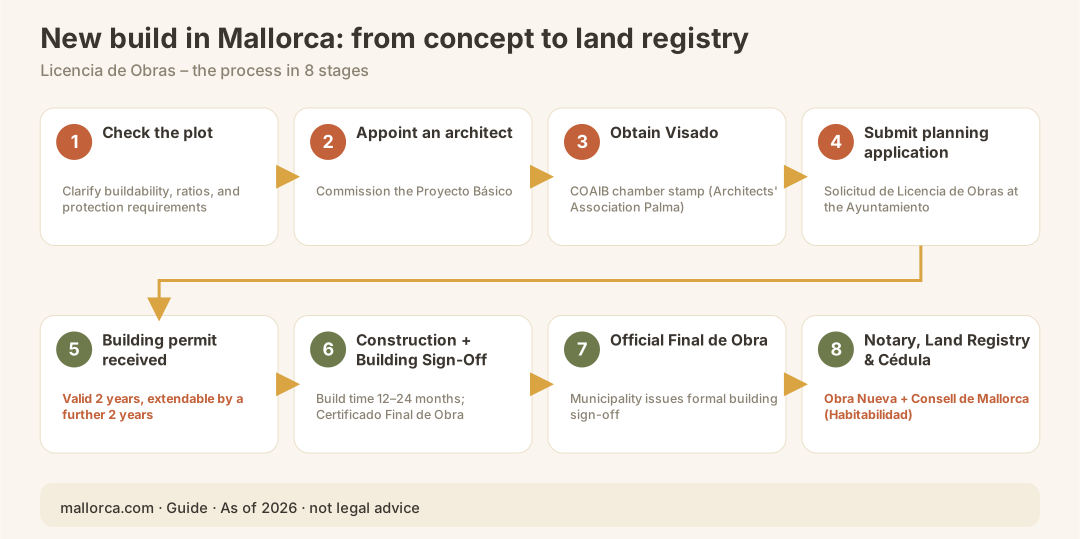
- Check the plot — Clarify buildability, key figures, and any potential conservation requirements (architect + local authority)
- Appoint an architect — They prepare the planning application drawings (Proyecto Básico)
- Obtain visado – The Proyecto Básico is stamped by the architects' chamber in Palma (Col·legi Oficial d'Arquitectes de les Illes Balears, COAIB)
- Submit planning application – You or your authorised architect submit the Proyecto Básico together with the completed application form (Solicitud de Licencia de Obras) to the Departament d'Urbanisme of the local authority
- Receive planning permission – The local authority reviews the application and issues the Licencia de Obras; the permission is valid for two years from the date of issue and can be extended by a further two years before it expires
- Detailed design phase – Only now does the architect prepare the detailed execution plans and specification (Proyecto de Ejecución)
- Carry out construction – Building work must commence within the validity period of the permission
- Building completion inspection – Once construction is finished, the architect carries out the completion inspection together with the client and issues the Certificado Final de Obra; the architects' chamber endorses it with a certification stamp
- Official statutory sign-off – On the basis of the completion report, the architect applies to the local authority for the formal statutory sign-off (Final de Obra)
- Notary, Land Registry & Cadastre – The Escritura de Declaración de Obra Nueva is drawn up at the notary's office; this is then followed by registration in the Land Registry (Registro de la Propiedad) and in the Cadastre (Catastro)
The client then applies to the Consell de Mallorca for the certificate of habitability (Cédula de Habitabilidad).
Documents for the planning application: what you need to submit
The specific documents required may vary slightly depending on the local authority. The following overview shows the typical scope for a Licencia de Obras (new build):
| Document | Prepared by | Note |
|---|---|---|
| Proyecto Básico | Architect | With visado from the architects' association COAIB |
| Solicitud de Licencia de Obras | Client / Architect | Official application form from the local authority |
| Topographic survey | Surveying engineer | Precise representation of the plot's location and levels |
| Proof of land ownership | Client | Land registry extract or purchase deed |
| Cost estimate for the project | Architect | Basis for calculating the planning permission fee |
| Additional specialist reports if applicable | Specialist planner | E.g. in special protected zones |
Costs: architects, planning fees, and construction costs
The total costs of a new build on Mallorca comprise several components. Gross indicative figures for pure construction costs currently range between 1,800 and 2,800 € per square metre – depending on location, quality of materials, construction method, and building type. Luxury villas can be significantly above this. These figures do not automatically include architect's fees, planning fees, landscaping, or unforeseen items.
| Cost block | Indicative figure / basis | Note |
|---|---|---|
| Pure construction costs | 1.800–2.800 € / m² (2026) | Highly dependent on specification and location |
| Architect's fee | Typically a % of the construction sum | Dependent on scope of services, no fixed fee |
| Planning fee charged by the local authority | Calculated on the basis of the cost estimate | Rates vary depending on the local authority |
| Topographic survey | Flat rate depending on the plot | Mandatory component of the application |
| Notary & land registry (Obra Nueva) | In accordance with Spanish fee regulations | Dependent on the declared construction value |
| Taxes on land purchase (private) | 8–11 % of the purchase price | Balearic ITP rates, see Additional purchase costs |
| Taxes on land purchase (company) | 21 % IVA + 1,5 % | If the seller is a company |
Please note: Detailed cost planning by a local construction supervisor is essential to avoid budget overruns. Blanket statements about total costs should be treated with great caution in Mallorca.
How long does all this take? Realistic timeframes
The question of duration is the one that preoccupies self-builders the most — and is the hardest to answer in general terms. Practical experience shows considerable variation depending on the municipality and the workload of the relevant authority.
| Phase | Typical duration |
|---|---|
| Feasibility study + Proyecto Básico | 2–4 months |
| Review and granting of planning permission | Several months to over a year (depending on the municipality) |
| Detailed design planning | 1–3 months |
| Construction period (turnkey) | 12–24 months depending on project size |
| Building sign-off & official Final de Obra | Weeks to months |
| Notary, land registry, Cédula de Habitabilidad | Weeks to months |
Please note: The planning permission is valid for two years from the date of issue and can be extended by a further two years before it expires. Plan generously and secure the extension in good time.
The Decenal insurance: mandatory for new builds
For the construction of new residential buildings in Spain, a so-called Decenal insurance (Seguro Decenal) is required by law. It covers damage to the load-bearing structure of the building for a period of ten years from completion. Without proof of this insurance, the notary will generally refuse to certify the Escritura de Obra Nueva and the land registry will refuse to make the entry.
The key points at a glance:
- The insurance is tied to the building, not the owner — it therefore remains in place upon sale and benefits the buyer
- It must be before construction begins be taken out
- The insurer typically sends their own surveyor (Organismo de Control Técnico, OCT), who carries out inspections throughout the build
- The costs depend on the construction value and the insurer; obtain several quotes
Please note: The Decenal insurance is a cost that is frequently underestimated. Factor it in early — it is not an optional extra, but a legal requirement.
Habitability Certificate (Cédula de Habitabilidad): The Final Piece of the Puzzle
The Cédula de Habitabilidad is the official certificate confirming that a building meets the minimum habitability requirements. Without it, you can neither take out a standard electricity and water contract in Mallorca, nor permanently occupy or let the property.
The application is submitted to the Consell de Mallorca — not to the local council. Among other things, you will need:
- The architect's Certificado Final de Obra (with the professional college endorsement)
- The local council's official building sign-off (Final de Obra)
- The Escritura de Obra Nueva (notarial deed)
- Proof of registration in the land registry
Tip: Plan the application for the Cédula in parallel with the notary and land registry steps to avoid unnecessary delays. You can find details on the procedure in our article on the Energiezertifikat Spanien, which is also mandatory for new lettings.
Suelo Urbano vs. Suelo Rústico: Considerations for Rural Plots
Anyone wishing to build a finca or rural house on a rural plot will encounter a distinct set of regulations. In the Balearen, suelo rústico is subject to considerably stricter rules than urban building land as a matter of principle.
| Aspect | Suelo Urbano | Suelo Rústico |
|---|---|---|
| Minimum plot size | Varies by municipality, often smaller | Considerably larger (depending on category) |
| Building density | Higher densities possible | Strictly limited |
| Protection requirements | Less common | Frequent (nature conservation, forestry zones, water protection) |
| Responsible planning authority | Ayuntamiento | Ayuntamiento + where applicable Consell / Govern Balear |
| Additional expert reports | Rarely required | Often mandatory (environment, water, etc.) |
Plots near watercourses, in flood zones, or in forestry areas may rule out certain building projects entirely. These restrictions are not always visible in the land registry — consulting the urban planning register and seeking advice from a local architect are essential. See also our guide on checking the land registry in Spain.
Most common mistakes when building in Mallorca
Experienced architects and lawyers see these mistakes time and again — and almost all of them are avoidable.
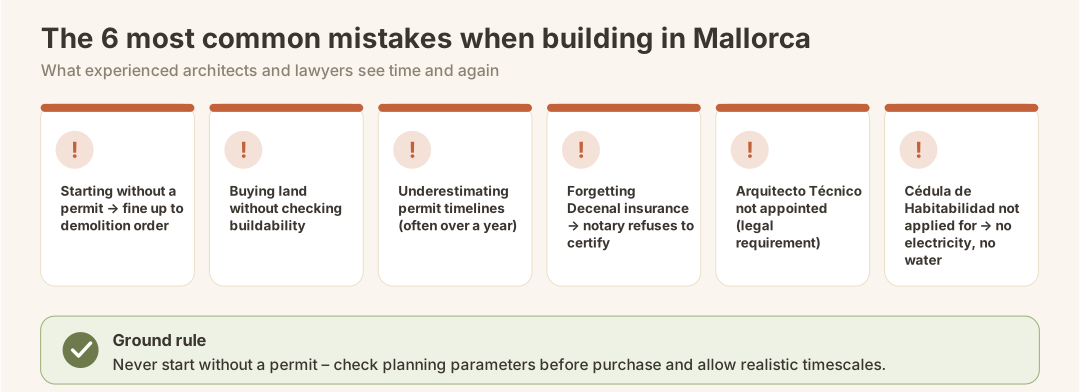
- Starting without a permit — Sounds obvious, yet it happens regularly. The consequences range from fines to a demolition order.
- Buying a plot without checking whether it can be built on — Not every plot for sale is actually buildable or permits the desired volume.
- Underestimating how long approval takes — Anyone who assumes the permit will arrive within a few weeks is frequently left bitterly disappointed.
- Forgetting the Decenal insurance — Without it, the notarial deed cannot be executed.
- Not appointing an Arquitecto Técnico (site manager) — In Spain, for larger building projects an Arquitecto Técnico (formerly known as an Aparejador) is required alongside the architect to supervise the construction.
- Overlooking unauthorised building work on an existing property — Anyone who buys an already-built property and later carries out alterations may be held liable for previous building irregularities. More on this in the guide legalising unauthorised construction.
- Not applying for the Cédula de Habitabilidad — Without it, you cannot obtain electricity or water contracts.
What comes next? Taxes, insurance and use
Once the Cédula de Habitabilidad has been issued and the property registered in the land registry, the formal new-build process is complete. What follows is equally important:
- IBI (council tax / property tax): From the date of the land registry entry you will be subject to the annual property tax. Details in the guide IBI tax in Spain.
- Contents and buildings insurance: Technically recommended immediately upon completion. More in the guide home contents insurance in Spain.
- Letting: If you wish to let your new-build property, separate rules apply — particularly for holiday rentals. The current situation regarding the ETV licence Mallorca should be checked for every new property in advance.
- Energy certificate: A valid energy certificate is required for every rental or sale.
- Retrofitting air conditioning: Depending on the municipality, a permit may also be required for this – see Installing air conditioning in Mallorca.
New Build Mallorca Checklist
Use this overview as a roadmap for your project:
- Have the plot checked for buildability and planning parameters (parámetros urbanísticos)
- Clarify any protection obligations (nature conservation, water, forestry)
- Obtain a feasibility study from the local planning authority
- Appoint an architect and Arquitecto Técnico
- Prepare the Proyecto Básico and have it stamped by the COAIB
- Submit the Solicitud de Licencia de Obras to the municipality
- Take out Decenal insurance (OCT surveyor) before construction begins
- Keep track of the validity period of the planning permission (2 years)
- Complete the Proyecto de Ejecución
- Start construction and ensure site supervision
- Have the Certificado Final de Obra issued by the architect (incl. chamber endorsement)
- Apply for the official Final de Obra from the municipality
- Have the Escritura de Obra Nueva notarised
- Arrange registration in the Registro de la Propiedad and the Catastro
- Apply for the Cédula de Habitabilidad from the Consell de Mallorca
- Set up electricity and water contracts
- Have the energy certificate drawn up (for rental/sale)
Conclusion
Obtaining planning permission in Mallorca is no dark art – but it is a complex, multi-stage process with clear rules and serious consequences for mistakes. The most important thing: never start without permission, check the planning parameters before purchasing a plot, and allow for realistic timescales. An experienced local architect who knows the quirks of the relevant municipality is not a luxury but a necessity. Anyone who follows these basic rules can approach their new build in Mallorca with considerably more peace of mind.
Want to know whether your dream plot is genuinely buildable?
- 📩 Submit an enquiry now — we'll connect you with verified architects and solicitors in Mallorca
- All tips on buying property in Mallorca
Official sources
- Col·legi Oficial d'Arquitectes de les Illes Balears (COAIB) – The architects' chamber, responsible for the Visado and chamber stamp: https://www.coaib.cat
- Consell de Mallorca – Departament de Territori – Responsible for the Cédula de Habitabilidad and spatial planning: https://www.conselldemallorca.net
- Govern de les Illes Balears – Habitatge – Balearic housing and construction policy: https://www.caib.es
- Catastro (Spanish Land Registry) – Land and building data: https://www.sedecatastro.gob.es
- Registro de la Propiedad (Land Registry) – Registrations and enquiries: https://www.registradores.org
- Agencia Tributaria Estatal (AEAT) – Tax aspects of construction and sale: https://www.agenciatributaria.es
- Agència Tributària de les Illes Balears (ATIB) – Balearic taxes (ITP and others): https://www.atib.es