
Legalising Wells in Mallorca: Pozo, Cistern & Drilling Permit
Anyone buying a finca on Mallorca or running a rural property will sooner or later come up against a central question: where does the water come from? The public network does not reach many rural plots at all, or supplies only limited quantities – and the island's groundwater table is under increasing pressure from tourism, climate change, and rising population figures. Anyone who wants to legalise a well on Mallorca faces a multi-stage process involving water-law authorisation, registration in the water register, and, where applicable, retrospective regularisation of an already existing, unauthorised pozo. This guide explains step by step what you need, what it costs, what to check when buying a finca with an existing well – and how the Balearic amnesty regulation for unauthorised structures (Gesetz 7/2024) may also affect your well.

Are you buying a finca with a well or would you like to have a new pozo drilled?
- 📩 Submit a personal enquiry — We connect you with vetted solicitors and architects experienced in water law
- Legalising an unauthorised structure on Mallorca — Everything about the building amnesty until February 2028
Why water is a serious property issue on Mallorca
Mallorca is, geologically speaking, a karst island. The Serra de Tramuntana in the west, composed of limestone and marl, is the most important catchment area for groundwater. Yet the natural cycle has been falling out of balance for decades: periods of drought are growing longer, tourism massively increases consumption during the summer months, and many wells were drilled without permission over the past few decades. The result is a falling groundwater table across large parts of the island – and in coastal areas, freshwater aquifers are additionally being contaminated by saltwater intrusion from the sea.
For property owners this means: a functioning, legal well or a well-designed cistern is today a genuine value driver. An unauthorised pozo, on the other hand, can become a problem when selling or undertaking renovations – particularly if the authorities investigate whether the water is being used for the basic supply of a (possibly equally illegal) building.
Please note: Traditional village wells and rainwater cisterns that collect only roof run-off are subject to different rules from deep boreholes (sondeos) that tap into groundwater. The following sections draw a clear distinction between both types.
Pozo, sondeo, and cistern: what is what?
On Mallorca you will encounter three fundamentally different methods of water abstraction in everyday life – each with a different legal framework:
| Type | Spanish term | Depth / function | Permit required |
|---|---|---|---|
| Shallow well | Pozo tradicional | Up to approx. 20–30 m, draws from the upper groundwater | Yes, water-law authorisation required |
| Deep borehole | Sondeo | 150–300 m, taps deep aquifers | Yes, mandatory (Confederación Hidrográfica) |
| Rainwater cistern | Aljibe / Cisterna | Collects roof run-off or surface water | Depends on the municipality; registration is generally required |
Traditional village wells frequently collect groundwater from shallow depths or store rainwater from the roof. According to experts, the water is generally not suitable for drinking, but can be used for the garden and household purposes. Deep boreholes, by contrast, often yield water of good drinking-water quality according to practical experience – although a laboratory analysis is expressly recommended. Any pharmacy on Mallorca can help to obtain the relevant certificate.
The legal position: who is responsible?
Water is a public good in Spain (dominio público hidráulico). Anyone wishing to use groundwater – whether for a new well or to legalise an existing one – requires a concession or use permit from the competent water authority. For the Balearic Islands, this is the Confederación Hidrográfica del Júcar (CHJ), headquartered in Valencia; parts of the administration are handled through the Govern de les Illes Balears (specifically the Direcció General de Recursos Hídrics).
Key overlapping responsibilities:
| Authority | Responsibility |
|---|---|
| Confederación Hidrográfica del Júcar (CHJ) | Water law, concessions, Registro de Aguas |
| Govern Balear – DRRHH | Balearic-specific water planning, protected areas |
| Ajuntament (local council) | Planning permission for the well structure / drilling installation |
| Consell de Mallorca | Spatial planning on suelo rústico |
Please note: The CHJ's jurisdiction over the Balearic Islands is sometimes confused with its jurisdiction over the Spanish mainland. Before submitting any application, confirm which office is responsible for your specific case.
Drilling a new well: the permitting process step by step
A new deep borehole well (sondeo) on Mallorca is not a private matter – drilling without a permit is illegal and can result in substantial fines. The process broadly follows these steps:
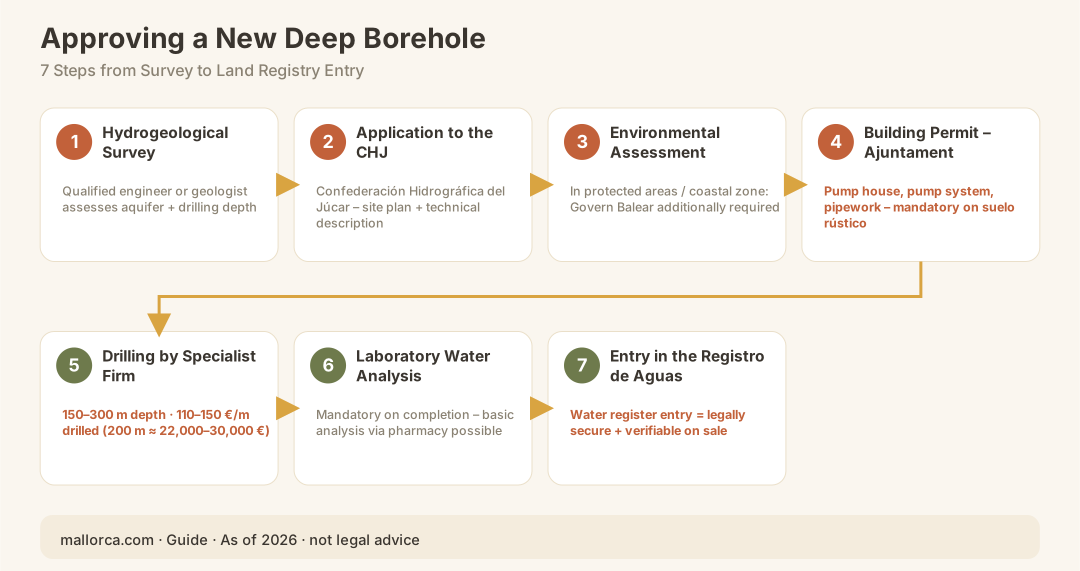
- Obtain a hydrogeological survey – A specialist engineer or geologist assesses whether a productive aquifer can reasonably be expected on your plot and what depth will be required.
- Apply for a drilling permit from the CHJ – The application must include: a site plan, a technical description of the planned drilling profile, the intended use (irrigation, household, pool, etc.), and proof of property ownership.
- Environmental assessment – Depending on the location (proximity to protected areas, coastal zone), an additional assessment by the Govern Balear may be required.
- Planning permission from the Ajuntament – A local planning permit is required for the well structure, the pump installation, and any pipework. On suelo rústico special restrictions apply – see our guide on Baugenehmigung Mallorca.
- Drilling by a certified company – The drilling itself must be carried out by a specialist firm registered with the Ministry. Typical depths in practice: 150 to 300 metres; costs depending on ground conditions: 110 to 150 Euro per metre drilled.
- Water analysis – Once drilling is complete, a laboratory analysis is mandatory to determine drinking-water quality or any restrictions on use.
- Registration in the water register (Registro de Aguas) – Only once this registration has been completed is the use legally protected and verifiable upon the sale of the property.
Please note: The drilling depth has a direct impact on costs: at a drilling depth of 200 metres, the drilling costs alone already range between €22,000 and €30,000 – excluding the pump, casing, and connections. Budget generously.
Legalising an existing well (legalising a pozo)
Many fincas on Mallorca have a well that was drilled decades ago without any permit. Such wells appear neither in the cadastre nor in the land registry – and can become a stumbling block when selling, inheriting, or renovating. Legalising such a pozo essentially follows three routes:
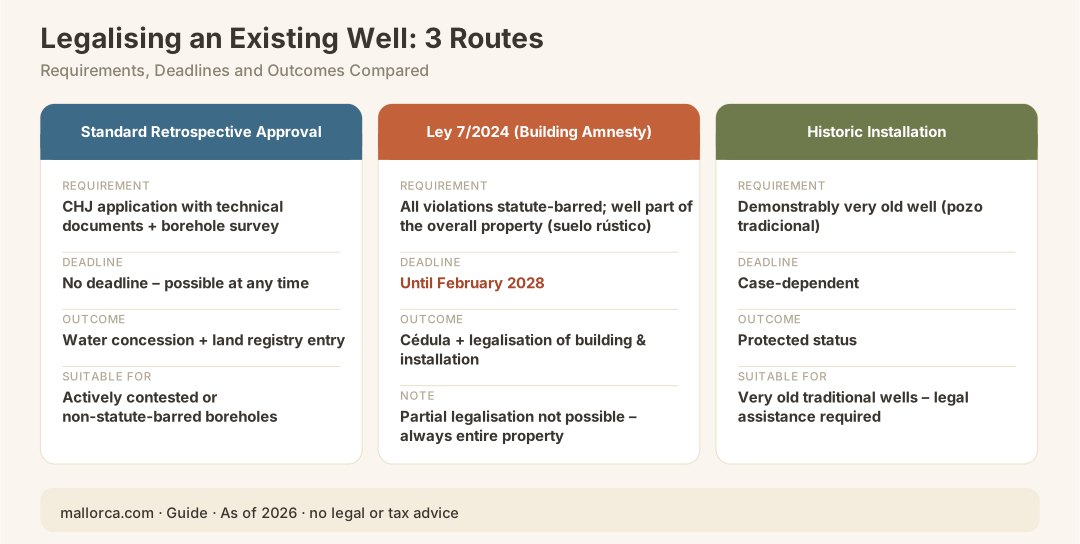
Route 1: Standard retrospective permitting
If the drilling has not yet become statute-barred, or the well is actively being challenged, a standard retrospective permit from the CHJ is the only option. All documents are submitted as for a new application; in addition, a technical survey of the existing borehole is required.
Route 2: Inclusion in the building amnesty (Gesetz 7/2024)
If the well forms part of a broader unauthorised-construction situation on suelo rústico – for example as the water supply for an unpermitted building – legalisation can be incorporated into the process under Gesetz 7/2024 (the Balearic building amnesty, in force since December 2024). This law permits the retrospective legalisation of certain illegal structures on rural land, provided all legal infringements are statute-barred. The deadline runs until February 2028. Important: partial legalisation is not possible – either the entire property including all installations (and therefore the well) is legalised, or nothing is.
Route 3: Registration as a historic installation
In some cases – particularly for very old traditional wells (pozos tradicionales) – it may be possible to declare the existing structure as a historically established installation. This is a specific procedure that requires legal support.
| Route | Requirement | Deadline | Outcome |
|---|---|---|---|
| Standard retrospective permit | CHJ application with technical documentation | No deadline, possible at any time | Water concession + land registry entry |
| Inclusion under Gesetz 7/2024 | All infringements statute-barred, entire property | Until February 2028 | Cédula + legalisation of building + installation |
| Historic installation | Demonstrably very old existing structure | Case-dependent | Protected existing status |
Cisterns on Mallorca: obligation, blessing, or both?
Cisterns (aljibes) have a history stretching back thousands of years on Mallorca. Traditional stone cisterns store rainwater from the roof – a technique brought to the island by the Moors. Today, cisterns are experiencing a renaissance: in the face of rising water prices and increasingly frequent dry summers, they are being used as a standard solution in both new builds and renovations.
Advantages of a modern cistern:
- Independence from the mains water supply (important for remote fincas)
- Reduction of the water bill through use for irrigation, pool filling and household applications
- Sustainable: the collected water returns to the local cycle
- A reusable investment: a well-built underground cistern lasts for decades
What types are there?
| Type | Characteristics | Use |
|---|---|---|
| Underground concrete cistern | Space-saving, well protected against evaporation and contamination | Large volumes, new construction |
| Above-ground plastic tank | Cost-effective, flexible to position | Smaller volumes, interim solution |
| Historic stone cistern (aljibe) | Subject to heritage protection, in need of renovation | Older fincas |
Cisterns may also require planning permission — particularly if they are connected to a drainage system or require substantial excavation work. Check with the relevant Ajuntament before you begin construction.
Testing water quality: what is mandatory and what is advisable?
According to specialists, water from deep boreholes on Mallorca generally has good drinking water quality — but "generally" is no guarantee. The mineral composition can vary considerably; salinity levels are elevated near the coast and in certain areas of the plain.
Recommended analysis steps:
- Basic analysis for bacteria and nitrates — mandatory after every new borehole; can be arranged cost-effectively through pharmacies on Mallorca
- Extended mineral analysis — advisable for drinking water use; tests for, among other things, calcium, magnesium, chloride and sulphate
- Salinity measurement — particularly relevant near the coast (proximity to the sea increases the risk of salinisation through seawater intrusion)
- Repeat analysis — recommended after heavy rainfall or extended dry spells
If the water does not display consistent quality, there are two practical options: filtration (reverse osmosis for drinking water) or a separate drinking water tank filled by tanker lorry — a model widely used on Mallorca for remote rural estates.
Buying a finca with an existing well: due diligence checklist
When purchasing a finca with an existing Pozo, you must clarify the following points as part of the legal review:
- Is the well registered in the Grundbuch? → Check the Grundbuch in Spain
- Is there a CHJ water concession in place (Registro de Aguas)?
- Is the well listed in the cadastre?
- Is there a valid laboratory analysis of the water quality (no more than 2–3 years old)?
- What extraction volumes have been approved (m³/Jahr)?
- Is the property located in a groundwater protection zone or an area subject to extraction restrictions?
- Is the well part of an unauthorised construction situation that affects the possibility of legalisation?
- Is the pump system functioning (submersible pumps are long-lasting, but replacement should be carried out by specialist contractors)?
Note: An unregistered well is, in formal terms, an unauthorised interference with public water resources. This restricts planning permissions, operating licences, and the saleability of the property.
Most common mistakes regarding wells on Mallorca
1. Simply drilling ahead without authorisation The temptation is great: the neighbour drilled and everything went smoothly. But without a permit, the drilling is illegal — and fines as well as obligations to backfill the well are very real consequences.
2. Failing to check an existing well Many buyers take over a pozo without knowing whether it even holds a concession. If it turns out after the purchase that it is illegal, the problem falls squarely on the new owner.
3. Building a cistern without planning permission A municipal planning permit is required in particular for underground concrete cisterns that involve substantial excavation work. Anyone who overlooks this risks the structure being classified as an unauthorised build.
4. Never having the water quality checked Water from wells can contain high mineral content, nitrates, or — near the coast — elevated salinity levels. Anyone who drinks untested well water is taking an avoidable health risk.
5. Missing the amnesty deadline Anyone who has a well that forms part of a broader illegal construction situation and allows the deadline under Gesetz 7/2024 (until February 2028) to pass without acting may lose the last opportunity for legalisation.
6. Not engaging a professional drilling company Well construction is specialist work. Only registered specialist firms are permitted to carry out deep drilling on Mallorca — and their involvement is also a prerequisite for official recognition.
Cost overview
All figures are based on the values cited in the research; individual quotes may vary.
| Item | Cost (approx.) | Note |
|---|---|---|
| Deep well drilling | 110–150 €/drilling metre | At 200 m: approx. 22,000–30,000 € |
| Pump + pipework | Depending on depth and model | Specialist contractor recommended |
| Water analysis (basic) | Low cost, via pharmacy | Extended laboratory analysis: request a quote |
| CHJ authorisation process | Depending on scope of work | Add solicitor/engineer fees |
| Legalise well (amnesty) | Part of the legalisation project | Total project costs vary considerably |
| Underground cistern (new build) | Highly dependent on volume | Including excavation work |
Note: The return on investment for a deep well through saved water costs accumulates over time, particularly with larger gardens and pools – once the initial investment has been made, the ongoing irrigation costs are virtually eliminated entirely.
What comes next? Operation and maintenance
After successful legalisation and registration in the water register, the well officially becomes part of your property assets. This has direct implications:
- When selling: A legal well is a documented added value – visible in the land registry and in the building description
- When financing: Banks generally assess fincas with a legal water supply more favourably → Hypothek Mallorca
- When letting: A legal water supply is a prerequisite for the Cédula de Habitabilidad and therefore for any planning consent → Bauen & Renovieren
- Ongoing operation: Deep well pumps are generally very long-lasting; repairs and replacements should be carried out by specialist contractors
- Regular water analysis: A repeat analysis is advisable particularly after heavy rainfall or extended dry spells
Checklist: legalising a well on Mallorca
- Clarify the type (deep borehole, shallow well, cistern)
- Check whether a concession/entry in the Registro de Aguas exists
- Commission a hydrogeological survey (for new wells)
- Prepare the authorisation application for the Confederación Hidrográfica del Júcar
- Apply for municipal planning permission from the Ajuntament
- Engage a registered drilling company
- Have the water quality analysed in a laboratory
- Check whether the well can be incorporated under the building amnesty (Law 7/2024) (deadline: February 2028)
- Arrange registration in the land registry following legalisation
- Plan regular maintenance and analysis
Conclusion: A legal well = a secure investment
Water is not a given on Mallorca – and an unauthorised well is not a minor offence, but a concrete liability risk when buying, selling or renovating a property. Anyone wishing to legalise an existing pozo or have a new one drilled cannot avoid the water-law authorisation procedure with the CHJ. Those fortunate enough to bring their unauthorised construction situation under the amnesty provisions of Law 7/2024 should take the deadline of February 2028 seriously – partial legalisation is expressly not permitted under current legislation. A cistern for rainwater harvesting is often the more affordable and less bureaucratic addition – but depending on its size and integration, it too requires a permit. In short: do it properly, and you will benefit from it for decades.
Official sources
- Confederación Hidrográfica del Júcar (CHJ) – Water-law concessions and Registro de Aguas for the Balearic Islands: https://www.chj.es
- Govern de les Illes Balears – Direcció General de Recursos Hídrics: https://www.caib.es
- Consell de Mallorca – Departament de Territori: https://www.conselldemallorca.net
- Boletí Oficial de les Illes Balears (BOIB) – Official gazette for Law 7/2024 and implementing regulations: https://www.boib.es
- Agència Tributària de les Illes Balears (ATIB) – Tax aspects relating to property value and charges: https://www.atib.es