
Property finance in Mallorca: Spanish mortgages for foreign buyers
On Mallorca, anyone looking to buy a property soon faces a key question: should I take out a mortgage with a Spanish bank on the island, or arrange the loan in Germany? The answer depends on your tax residency, the purchase price, how much certainty you want over interest rates and your willingness to navigate a Spanish bank’s application process. This guide takes you through both options step by step: how much of your own money you really need, which documents Spanish banks require, how Spanish mortgage law differs from German lending, and which mistakes could, in the worst case, cost you the financing. By the end, you’ll know what to expect – and what not to.

Mortgage calculator
Explanation
The loan amount is the capital originally granted. The preset is arithmetically consistent with the selected loan-to-value share of the example purchase price.
Explanation
These are this calculator’s three modelling paths, not a statutory product classification: a fixed rate, index plus margin, or a fixed phase followed by a variable phase.
Explanation
TIN (tipo de interés nominal) is the nominal annual interest rate before costs; TAE (tasa anual equivalente) includes costs and payment timing and does not belong in this field. The preset is a round worked example, not a market rate.
Explanation
The total term determines the number of monthly payments. The preset is a worked example.
- Monthly payment (cuota)
- €1,280.37
Why this figure?
The cuota is the regular monthly payment of interest and principal under the French annuity system.
Model calculation: twelve equal months, first payment one month after disbursement, no stub period and the calculator’s own cent rounding. The bank schedule can differ because of its day-count convention, stub period and rounding. The controlling documents are the FEIN (European Standardised Information Sheet containing the binding loan information) and the escritura (notarial loan deed).
Legal status: 1 January 2023
This calculation is provided for guidance only and is not a substitute for tax or legal advice in specific cases.
The Mallorca property market in 2026: what it means for your financing
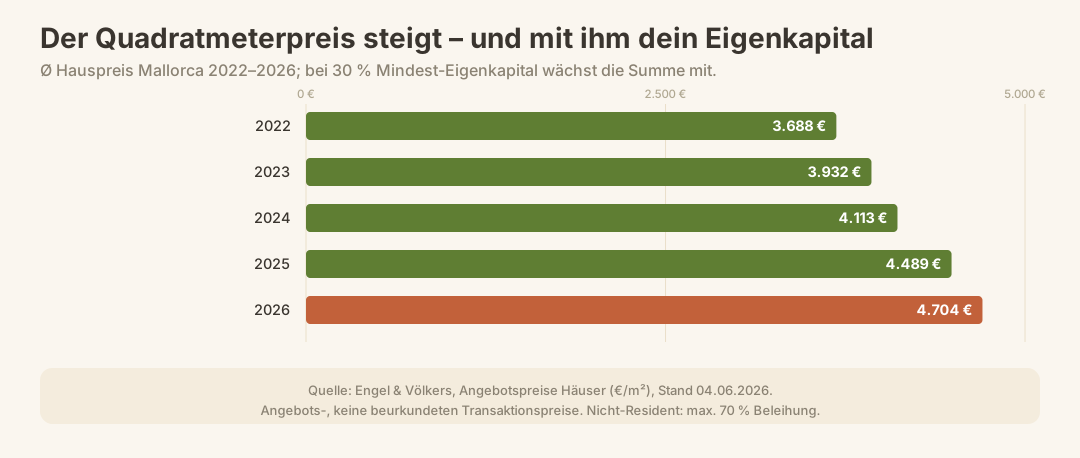
Before getting into the details, it’s worth looking at the market – because it largely determines how much you’ll need to borrow. According to Engel & Völkers, average asking prices on Mallorca in mid-2026 were around €4,704/m² for houses and around €5,384/m² for flats. In prime locations such as Puerto Andratx, asking prices had already reached around €8,687/m² in 2024.
| Year | Average house price/m² | Change vs previous year | Average flat price/m² | Change vs previous year |
|---|---|---|---|---|
| 2022 | €3,688 | – | N/A | – |
| 2023 | €3,932 | +6.6% | €4,009 | +9.6% |
| 2024 | €4,113 | +4.6% | €4,537 | +13.2% |
| 2025 | €4,489 | +9.2% | €5,095 | +12.3% |
| 2026 | €4,704 | +4.8% | €5,384 | +5.7% |
Source: Engel & Völkers, asking prices on property portals, as of June 2026
What this means in practice: For a 150 m² flat at the average price (approx. €807,000), as a non-resident you'll need between roughly €240,000 and €325,000 in your own funds (30–40%) – before purchase costs. At these prices, sound financial planning is essential, not optional.
Note: According to notarial statistics published in January 2026, transactions in the Balearic Islands fell by 13.9% year on year in November 2025. The market is slowing, giving you a little more room to negotiate as a buyer, even though prices are not falling overall.
The two financing routes: Spanish bank vs. German bank
Financing DE/ES
Explanation
The acquisition price of the property. Enter your agreed price.
Explanation
Your financing need in euros, identical for both routes. The preset is an illustrative choice.
- Available lending · ES route
- €525,000.00
- Basic security costs
- €1,742.95
- Model monthly instalmentDE route
- €2,381.97
- Model monthly instalmentES route
- €2,299.34
Legal status: 1 January 2025
This calculation is provided for guidance only and is not a substitute for tax or legal advice in specific cases.
There are essentially two routes you can take. Each has clear advantages and disadvantages that go well beyond the interest rate.
Route 1: Spanish bank
Spanish banks finance the property directly on the island. The mortgage is registered in the Spanish land registry (Registro de la Propiedad), with the property serving as security. Spanish lenders know the local market, carry out their own valuation (tasación) and can make decisions more quickly.
Typical terms for non-residents (2026):
- Loan-to-value ratio: up to 70% of the lower of the purchase price and the bank's valuation
- Interest rate: often variable and linked to Euribor, with fixed-rate options increasingly available
- Term: 10 to 25 years
- Special consideration: banks often tie the loan to additional products (insurance, opening an account, etc.)
Route 2: German bank
Some German banks and savings banks are willing to finance a property in Mallorca – either through a German land charge on another property or by using the Spanish property itself as security. According to Dr. Klein, PSD Bank Rhein-Ruhr, for example, offers financing specifically for properties in Mallorca and Ibiza.
Typical terms offered by German banks:
- Interest rate type: repayment mortgage with a fixed interest rate, typically fixed for 10 years
- Loan-to-value ratio: generally up to 70%, and higher in some cases
- Advantage: German law, familiar terms, no unfamiliar add-on products
- Disadvantage: Many banks do not know the Mallorca property market well enough and either decline the application or value the property conservatively
| Criterion | Spanish bank | German bank |
|---|---|---|
| Maximum loan-to-value (non-resident) | 70% | Generally 70%, possibly more |
| Interest rate type | Variable (Euribor) or fixed | Usually fixed, with the rate fixed for 10 years |
| Term | 10–25 years | 10–25 years |
| Add-on products | Often required | Usually not required |
| Knowledge of the local market | High | Often limited |
| Language barrier | Possible | None |
| Property valuation | Local valuation (tasación) | Financing from Germany – often conservative |
Tip: Another option is to finance a property in Mallorca through a German building society. You would then get a standard repayment mortgage with a fixed interest rate for ten years. However, many German lenders have little interest in financing property abroad because they lack knowledge of the local market.
Deposit: How much you really need
This is what many buyers underestimate. For non-residents in Spain, Spanish banks lend a maximum of 70% of the purchase price or the bank's valuation – whichever is lower. For tax residents, this can rise to as much as 80%.
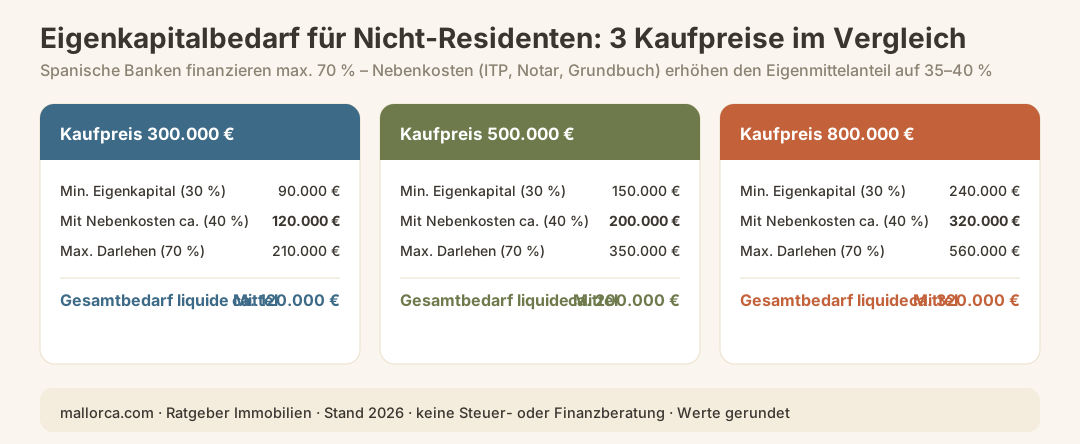
That means that, as a non-resident, you need at least 30% of the purchase price as a deposit. Add the costs of buying property in Mallorca – ITP (property transfer tax), notary fees, land registry fees and estate agent's commission – and the amount you need to provide yourself quickly rises to 35–40% of the purchase price.
| Purchase price | Minimum deposit (30%) | Including costs, approx. (40%) | Maximum mortgage (70%) |
|---|---|---|---|
| €300,000 | €90,000 | €120,000 | €210,000 |
| €500,000 | €150,000 | €200,000 | €350,000 |
| €800,000 | €240,000 | €320,000 | €560,000 |
| €1,200,000 | €360,000 | €480,000 | €840,000 |
Note: Spanish banks assess a property's value through their own valuation (tasación). If the valuation is lower than the purchase price, the lower figure is used as the basis – so you will need more of your own money.
The importance of tax residency
Spanish banks make a fundamental distinction between residents (tax residents in Spain) and non-residents. This directly affects mortgage terms:
- Non-residents generally qualify for a lower loan-to-value ratio (max. 70 %), tend to pay higher interest rates and must provide more documents.
- Residents can borrow up to 80 % of the property's value and benefit from slightly better terms.
Tax residency matters for tax purposes too: non-residents pay IRNR (Impuesto sobre la Renta de No Residentes) on rental income, while residents pay regular income tax. If you plan to establish a permanent home on Mallorca, find out about the tax implications beforehand – they belong in your overall budget.
What documents you need – step by step
The list of documents required for a mortgage in Spain as a foreigner is longer than in Germany. Allow plenty of time – in our experience, at least four to eight weeks to gather everything.
Documents required by Spanish banks for non-residents:
- NIE (Número de Identificación de Extranjero) – the Spanish tax identification number for foreigners; without an NIE, you cannot proceed
- Valid passport or national identity card
- Recent proof of income (payslips from the last 3–6 months or a tax assessment)
- Recent bank statements (usually covering 3–6 months)
- Proof of available funds (bank statements, investment account statements)
- Credit report from your home country (e.g. a Schufa report from Germany)
- Employment contract or business registration / company documents if self-employed
- Preliminary contract (contrato de arras or contrato privado) for the property
- Energy performance certificate for the property (required for all sales; read more in the Guide to Energy Performance Certificates in Spain)
- Land Registry extract (nota simple) for the property
Note: Documents not issued in Spanish generally need to be translated by a sworn translator (traductor jurado). This also applies to Schufa reports and payslips.
The process: from mortgage application to signing
The process in Spain is slightly different from Germany. Here are the main steps:
- Apply for an NIE – at the Spanish consulate in Germany or directly with the Policía Nacional on Mallorca; without an NIE, you cannot open a bank account or get a mortgage
- Open a Spanish bank account – most banks require a local account to handle the mortgage
- Submit initial enquiries to several banks (solicitud de hipoteca) – compare their terms
- Bank valuation (tasación) commission – the bank commissions an approved valuer; the buyer usually pays the cost (several hundred euros, depending on the property’s value)
- Receive mortgage approval and the FEIN – the Ficha Europea de Información Normalizada is the standardised European information sheet you must receive before signing
- Observe the statutory cooling-off period – after receiving the FEIN, you have a cooling-off period of at least 10 days before you can sign the mortgage (as required by law)
- Notary appointment for the mortgage – the mortgage deed (escritura de hipoteca) is notarised separately, often on the same day as the property purchase deed
- Registration in the Land Registry – the bank registers the mortgage in the Spanish Land Registry (Registro de la Propiedad)
Important: Since the mortgage law reform (Ley 5/2019), Spain has had clear consumer protection rules. The bank must disclose all costs to you before the notary appointment. The bank chooses the notary for the mortgage deed, but you have the right to arrange the mortgage deed appointment separately from the property purchase deed appointment.
Variable or fixed interest: Which is right for you?
Variable-rate mortgages have traditionally been more common in Spain than in Germany. The variable interest rate is usually based on Euribor (the 12-month rate) plus a fixed margin charged by the bank. If Euribor rises, your monthly payment rises.
Fixed-rate mortgages (hipoteca fija) are now available in Spain and have become more attractive to many buyers following the interest rate rises of recent years.
| Interest rate type | Advantage | Disadvantage | Recommendation |
|---|---|---|---|
| Variable interest rate (Euribor + margin) | Often a lower initial interest rate | Fluctuating repayments and less certainty when planning | If you plan to pay off the mortgage or make extra repayments in the near term |
| Fixed interest rate (hipoteca fija) | Predictable repayments throughout the term | A slightly higher initial interest rate | If you want long-term financing and certainty |
| Mixed interest rate (hipoteca mixta) | Fixed for the first few years, then variable | More complicated to compare | Only after careful calculation |
German banks typically offer a standard repayment mortgage with a 10-year fixed-rate period – broadly equivalent to a hipoteca mixta with a long fixed-rate period, but clearly regulated under German law.
Additional mortgage costs: How Spain differs
Spanish mortgage costs
Explanation
The principal amount paid out under the mortgage loan.
Explanation
The responsabilidad hipotecaria is the mortgage liability amount stated in the escritura (notarial deed). It includes secured principal and any secured interest, costs and penalties; if no amount is stated, Article 30.1 TRLITPAJD uses principal plus three years of interest. Copy the figure from the deed.
Scope: property in the Balearic Islands and a loan within Ley 5/2019 (consumer and professional lender).
- Paid by the bankCalculated bank item (AJD)
- €4,500.00
- Paid by youyour calculated one-off ancillary costs
- €0.00
Legal status: 1 January 2025
This calculation is provided for guidance only and is not a substitute for tax or legal advice in specific cases.
One important difference from German mortgages: Spanish banks often link loans to additional products and services. This can significantly affect the effective interest rate (TAE – Tasa Anual Equivalente).
Typical additional products:
- Buildings and life insurance through the bank
- Opening and maintaining a current account
- A credit card from the bank
- Pension products or savings plans
Note: You are not obliged to take out every additional product. They do, however, generally improve the interest rate offered. Always ask for the TAE – not just the nominal interest rate – so you can compare offers from different banks fairly.
The mortgage itself also comes with costs: as the buyer, you pay for the bank valuation (tasación). Since the 2019 reform, the costs of registering the mortgage in the land registry and the notary fees for the mortgage deed have been paid by the bank – not the buyer.
The most common mistakes when financing a property in Mallorca
The same pattern comes up time and again in practice: most problems arise from mistakes that are easy to avoid with a little preparation.
1. Underestimating the deposit and other funds needed Buyers budget for a 20% deposit, as they would in Germany, and forget that Spanish banks finance only 70% for non-residents, with additional purchase costs on top. The result: the financing falls through shortly before the notary appointment.
2. Applying for the NIE too late No NIE means no bank account; no bank account means no mortgage. Depending on the consulate and the season, the application can take several weeks. Start early.
3. Overlooking the bank valuation The bank bases its financing on the valuation, not the purchase price – and the valuation is sometimes lower. If you have not planned for this, you will need to find more of your own funds at short notice.
4. Approaching only one bank Mortgage terms can vary noticeably between banks in Mallorca. Get several offers and compare their TAE figures.
5. Failing to check the property's legal status A mortgage is no use if the property has charges registered against it or unresolved ownership issues. Checking the land registry extract is essential before you accept a financing offer.
6. Ignoring the reflection period The statutory reflection period of at least 10 days between receiving the FEIN and signing is mandatory. Build it into your timetable – pressure from the seller or the bank does not change that.
7. Failing to calculate the tax implications A mortgage is not just a banking product. Interest payments, property transfer tax, wealth tax and potentially IRNR all belong in the overall calculation. If you plan to rent out or sell the property later, you should also consider the taxes on selling a property from the outset.
What happens next? Mortgage, purchase and land register
Mortgage overpayments
Explanation
The outstanding loan is the principal still to be repaid; the preset continues the mortgage example.
Explanation
TIN (tipo de interés nominal) is the nominal annual interest rate before costs; copy it from your contract.
Explanation
The remaining term is the number of full years still agreed; the preset is a round calculation scenario, not a statement of banking practice.
Explanation
The annual overpayment (amortización anticipada, early repayment of principal) is booked once a year; 5,000 is an intentionally round illustrative amount, not a market or bank figure.
- Net saving
- €37,949.43
compared with the loan without overpayments
Legal status: 1 January 2025
This calculation is provided for guidance only and is not a substitute for tax or legal advice in specific cases.
The mortgage has been signed – but the process is not over yet. After the notary appointment (for the purchase and mortgage), both deeds must be registered with the Registro de la Propiedad. Only once they are registered are your ownership and the mortgage charge official.
Also:
- Pay taxes: Property transfer tax (ITP) on resale properties, or AJD on new builds, must be declared and paid within one month of the notary appointment
- Transfer utility contracts: Put electricity, water and internet in your name
- Set up mortgage payments: Spanish banks collect the payments from your local account
If you later want to pay off the mortgage or sell the property, you must have the mortgage removed from the land register (cancelación registral) – this also requires a separate notary appointment and incurs fees.
You can find more on the full purchase process in the guide The legal process of buying property and a detailed breakdown of the additional costs under Additional costs of buying property in Mallorca.
Checklist: financing a property in Mallorca
Use this list as a practical roadmap – tick off each item before signing a purchase contract:
- Own funds calculated (at least 30–40% of the purchase price, including additional costs)
- NIE applied for (at a consulate or in Mallorca)
- Spanish bank account opened or opening planned
- At least three bank offers obtained (Spanish and, if applicable, German)
- TAE (annual percentage rate) compared across all offers – not just the nominal interest rate
- Additional products and their costs listed for each offer
- Bank valuation (valuation) commissioned or costs budgeted for
- Land Registry extract (nota simple) for the property checked
- Energy Performance Certificate for the property available
- FEIN received and 10-day cooling-off period allowed for
- Notary appointments for the mortgage deed and purchase deed coordinated
- Tax implications (ITP/AJD, IRNR, wealth tax) calculated in advance
Conclusion
Financing a property in Mallorca is not complicated, but it works differently from financing one in Germany. Non-residents need to bring more equity (30–40%), must have a NIE and should expect the documentation stage to take longer. The advantage of a Spanish bank is its knowledge of the local market and speed; the advantage of a German bank is a familiar interest-rate structure without hidden product tie-ins.
With average prices of around €4,700 to €5,400/m² in 2026, the sums involved are substantial – good advice is therefore essential, not optional. Always combine your financing plans with a thorough legal review of the property: check the Land Registry, understand the purchase process and factor in the additional purchase costs realistically – then the path to owning a property in Mallorca is clearly mapped out and predictable.
Official sources
- Banco de España – mortgage law, consumer protection, FEIN requirement: https://www.bde.es
- Ley 5/2019 reguladora de los contratos de crédito inmobiliario (Spanish mortgage law): https://www.boe.es/buscar/act.php?id=BOE-A-2019-3814
- Registro de la Propiedad / Colegio de Registradores (Spanish Land Registry): https://www.registradores.org
- ATIB – Agència Tributària de les Illes Balears (Balearic property transfer tax, ITP): https://www.atib.es
- AEAT – Agencia Estatal de Administración Tributaria (NIE, IRNR, tax law): https://www.agenciatributaria.es
- Consell de Mallorca – Departament de Territori (building and land-use regulations): https://www.conselldemallorca.net
- Notariado.org – Statistical portal of Spanish notaries (Balearic property transaction data): https://www.notariado.org
IBAVI guarantee for buying a main residence
If you are buying a permanent main residence in Mallorca, you may be eligible for IBAVI’s Nova Hipoteca Jove under certain conditions. The Balearic housing institute provides a guarantee for the portion of the loan exceeding 80% of the property’s value. For applicants under 40, as well as certain families and people with disabilities, the guarantee can be up to 20%; for other eligible applicants, it is at most 15%.
The programme requirements include use as a permanent main residence, the purchase price and financing through a participating bank. The bank must assess the mortgage application and approve the loan; the guarantee is not a promise of financing. You must budget separately for purchase taxes and other purchase costs. IBAVI states that the fee for processing the guarantee is 0.50% of the guaranteed amount.
Note: This is general information, not financial, legal or tax advice.