
Listed Buildings in Mallorca BIC: Buying and Renovating Under Restrictions
A town palace in Palma with a baroque portal, a centuries-old finca in the Serra de Tramuntana, a stately manor house in the village centre of Sineu – listed property mallorca bic sounds like character and history, but it also means: extensive conditions, close coordination with the authorities, and a planning horizon measured in years, not months. Anyone buying a listed property on Mallorca is not merely acquiring square metres – they are taking on responsibility for a piece of cultural heritage. This guide explains how the protection system on Mallorca works, what categories of protection exist, what you need to check before buying, what restoration requirements apply, which tax implications are relevant – and where the most common mistakes occur.

Are you planning to buy or renovate a listed property on Mallorca?
- 📩 Submit a personal enquiry — We will connect you with an architect and solicitor on Mallorca specialising in listed properties
- Everything about buying on Mallorca
The Spanish BIC system: what does listed status mean in legal terms?
In Spain, the Bien de Interés Cultural (BIC) represents the highest level of protection for properties. The term translates literally as "asset of cultural interest" and is equivalent to what is known in Germany as a national cultural monument. According to the specialist publication Consorseguros Digital of the state insurance agency Consorcio de Compensación de Seguros (2020 edition), approximately 18,000 properties across Spain are classified as BIC – a figure that has risen steadily since 2000.
The BIC system operates on multiple levels. At national level, the state cultural heritage law applies; however, the Balearic Islands – like other autonomous communities in Spain – have enacted their own regional regulations that define responsibilities in greater detail. The lead authority for Mallorca is the Consell de Mallorca with its heritage protection committee. Local planning departments of the individual municipalities are also involved, and their regulations can differ considerably from one locality to another.
Please note: BIC status is not a single, uniform designation. A building may be classified as BIC while simultaneously falling within a protected ensemble – resulting in overlapping protection regimes. Both levels must be examined before purchase.
| Level of protection | Responsible authority | Relevant body to consult |
|---|---|---|
| BIC (national/regional) | Consell de Mallorca, Govern Balear | Catalogue of Cultural Assets of the Balearic Islands |
| Catalogued buildings | Municipality / Ajuntament | Municipal Heritage Catalogue (PGOU) |
| Protected Ensembles / Old Town Zones | Municipality + Consell | Plànol de conjunt protegit |
| Façade / Streetscape Protection | Municipality | Municipal Development Plan |
An Overview of the Three Protection Categories in Mallorca
Research from practice reveals three main categories that are relevant in Mallorca:
1. BIC – Bien de Interés Cultural
The highest protection category. This covers significant town palaces (such as those in Palma's old town), monasteries, castles, watchtowers, and outstanding country estates. The BIC regime generally rules out demolition entirely. Every structural alteration — from window replacement to roof renovation — requires prior approval from the heritage protection authority. The overriding principle is, without exception:Preservation over demolition.
2. Listed Buildings (Edificios Catalogados)
One level below BIC. These buildings are listed in the municipal heritage catalogue of the relevant development plan (PGOU). They possess historical, artistic, or urban planning significance and are frequently found in old towns and village centres. The restrictions are noticeable, but often less stringent than those for BIC. Depending on the municipality, certain interventions may be permitted, provided they do not materially alter the appearance of the building.
3. Streetscape and Façade Protection
The 'lightest' form of protection concerns individual elements: street-facing façades, building volumes, or defining structural features. In many cases, the interior may be configured more freely, as long as the protected element is retained.
| Category | Demolition possible? | Internal alterations | External alterations | Approval |
|---|---|---|---|---|
| BIC | Generally no | Only with special permit | Only with heritage protection decision | Consell de Mallorca + planning authority |
| Listed | No / very restricted | Partly more flexible, depending on municipality | Restricted, appearance must be preserved | Municipal planning authority |
| Facade protection | Internal alterations often possible | Largely unrestricted | Protected element must be retained | Municipal planning authority |
Before you buy: what you absolutely must check
The most important principle is: Never buy without a complete document review. With listed properties, the due-diligence effort is considerably greater than with a standard existing purchase.
Step-by-step checklist before the notary appointment
- Obtain a land registry extract (Nota Simple) – check whether a listed-building classification or catalogue entry has been recorded. Not all entries are up to date.
- Consult the municipal heritage catalogue – at the Ajuntament of the relevant municipality, either in person or via the council's digital PGOU portal.
- Check the Balearic catalogue – enquire with the Consell de Mallorca whether a BIC classification exists or whether classification proceedings are under way.
- Request an urban-planning certificate (Cédula Urbanística) – this document issued by the municipality consolidates all applicable protection requirements for the specific plot.
- Review existing planning permissions and habitation licences (Cédula de Habitabilidad) – have all past structural alterations been duly approved?
- Engage a technical architect (Arquitecto técnico) – to assess the actual renovation requirements under the conditions of the relevant protection category.
- Instruct a lawyer specialising in Balearic construction and heritage law – to check for any open proceedings relating to planning violations.
Please note: A land registry extract alone is not sufficient. Listed-building requirements are not always fully recorded in the land registry. The urban-planning certificate issued by the municipality is the more reliable document.
You can find more information about the purchase process in our guide Buying property on Mallorca: the legal process.
Renovating a listed building: what is permitted – and what is not
A full structural renovation is the only realistic option for BIC buildings — demolition and new construction is effectively out of the question. This is consistently confirmed by practice on Mallorca: listed building status means working within existing structures, not against them.
What is typically possible (with planning permission)
- Renewal of building services (pipework, heating, air conditioning), provided no protected structural fabric is affected
- Interior design, insofar as no originally preserved elements (vaulted ceilings, frescoes, historic floors) are affected
- Roof restoration using historically appropriate materials
- Window and door replacement using materials and proportions that match the existing structure
- Installation of photovoltaic panels on rear, non-visible roof surfaces (subject to individual assessment and planning permission)
What is generally not permitted
- Demolition of load-bearing elements of historic value (arches, vaults, courtyards)
- Alteration of the façade, window arrangement, or historic architectural ornamentation
- Adding additional storeys or extending the building's volume
- Use of materials that are incompatible with the character of the building (e.g. modern aluminium windows in a baroque town palace)
Please note: Even 'minor' measures such as painting the façade in a different colour, replacing roof tiles, or installing an air-conditioning outdoor unit on a visible façade may require planning permission or be prohibited outright. If in doubt, always check with the planning authority beforehand.
For air conditioning in the context of listed building protection, we recommend our specialist guide Installing Air Conditioning on Mallorca.
Planning permission for listed buildings
A building permit (Licencia de Obras) is required for every construction measure carried out on a listed property — this applies to both extensive full renovations and ostensibly minor interventions. For BIC buildings, a two-stage process also applies:
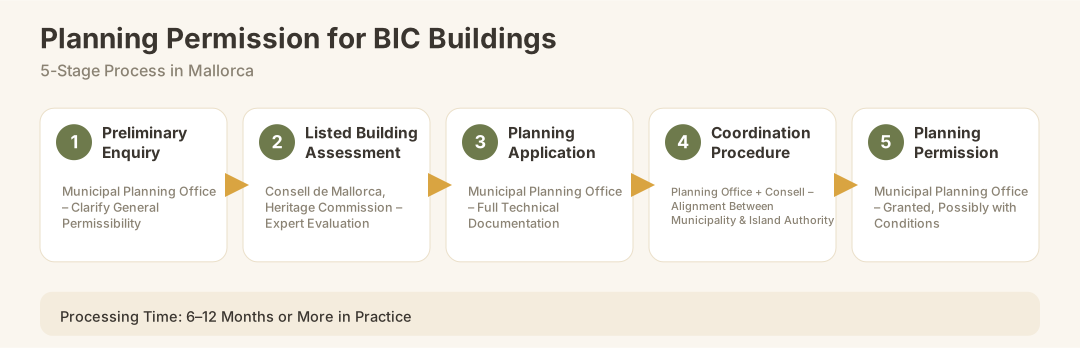
| Step | Authority | Content |
|---|---|---|
| 1. Preliminary enquiry (Consulta previa) | Municipal planning authority | Clarification of general permissibility |
| 2. Listed building assessment | Consell de Mallorca, Heritage Commission | Expert assessment of the project |
| 3. Building application (Solicitud de licencia) | Municipal planning authority | Complete technical documentation |
| 4. Coordination procedure | Planning authority + Consell | Coordination between the municipality and the island authority |
| 5. Planning permission | Municipal planning authority | Granted with a schedule of conditions where applicable |
Processing times are considerably longer than for standard building projects – in practice, six to twelve months or more is not uncommon. Factor this period into your financing plan.
An overview of the general planning permission process on Mallorca is provided in our guide Planning Permission Mallorca.
Tax aspects when purchasing a BIC property
When purchasing a listed property, the same taxes apply as with any property purchase in the Balearen. There is no automatic tax exemption solely on the basis of BIC status.
Impuesto sobre Transmisiones Patrimoniales (ITP)
The Balearic ITP is the most significant purchase cost item when acquiring a resale property. You can find the precise current graduated rates in our guide ITP Balearen 2026.
Annual IBI tax
Property tax (Impuesto sobre Bienes Inmuebles) also applies to BIC properties. In some municipalities on Mallorca there are reductions for listed buildings – however, this is not uniformly regulated and depends on the respective municipal statutes. It is worth enquiring at the Ajuntament.
Possible renovation funding
At the level of the Balearen and the Consell de Mallorca, funding programmes for the restoration of listed buildings exist depending on the budget year. These are subject to strict conditions (use of historic materials, proof from the heritage authority, etc.). Find out in good time, as the funding pots are limited and applications must be submitted before construction begins.
| Tax / levy | Due date | Special feature with BIC |
|---|---|---|
| ITP (property transfer tax) | Upon purchase | No automatic discount |
| AJD (stamp duty) | For new builds / first sales | Not applicable for resale properties |
| IBI (annual property tax) | Ongoing | Municipal discount possible, not guaranteed |
| Plusvalía (municipal land value increment tax) | Upon sale | Standard, no BIC special regime |
All purchase ancillary costs at a glance: Purchase costs in Mallorca.
Special status: BIC in the Serra de Tramuntana
The Serra de Tramuntana has been a UNESCO World Heritage Site since 2011. For properties in this area, listed building protection, nature conservation, and the special construction regulations of the Tramuntana protection regime all overlap. In practice, this means a three-tier level of oversight: the local planning authority, the Consell de Mallorca, and where applicable the UNESCO administrative body.
Construction projects in the Tramuntana are often subject to even stricter material requirements (traditional dry-stone walling style, local stone types, no reflective façades). Photovoltaic installations and new access roads can also be subject to particularly restrictive treatment in this zone.
Our guide Tramuntana Building Regulations Mallorca covers these overlapping requirements in detail.
Listed status and letting: what is and isn't permitted?
A BIC property may in principle be lived in and also let. Use as a holiday rental (ETV) is, however, a separate and complex matter. For long-term letting there are no listed-building-specific special restrictions — the general Spanish tenancy law rules apply. However, the property must have a valid Cédula de Habitabilidad (certificate of habitability), which cannot be taken for granted with unrestored older buildings.
More on this in our guide Long-term letting Mallorca.
The most common mistakes when buying a listed property
The same mistakes keep emerging time and again from real-world experience on Mallorca:
Buying without an urbanistic certificate – The land registry extract does not contain all the protection requirements. Anyone who relies on it alone risks a nasty surprise after the notary appointment.
Renovation budget set too low – Compliance with the conditions comes at a price: historic materials, specialist tradespeople, longer approval timescales, and frequent consultations with the heritage authority drive costs significantly higher compared with unrestricted renovations.
No pre-application enquiry before purchase – It is possible, before completing the purchase, to submit an informal pre-application enquiry (Consulta previa) to the planning authority asking what work is fundamentally permissible on the property. Anyone who skips this step is buying a pig in a poke.
Underestimated approval timescales – Anyone who buys a BIC property and expects to move in within a few months is planning unrealistically. The heritage protection assessment alone can take months.
No specialist on the team – An ordinary architect with no heritage conservation experience is out of place on BIC projects on Mallorca. You need an architect who knows the heritage commission and already has reference projects to show.
Overlooking ongoing planning enforcement proceedings – Are there open proceedings relating to unauthorised alterations carried out by the previous owner? These pass to the buyer. A legal review is essential.
Confusing existing-use protection with legality – A building with existing-use protection is not legal. For renovation works, this distinction can be decisive.
What comes next? Value and potential of BIC properties
Despite all the conditions, heritage-listed properties on Mallorca are highly sought-after assets. Well-restored town palaces in Palma, manor houses in the island's interior, or historic fincas in the Tramuntana achieve above-average prices per m² – and for understandable reasons: the combination of unique architecture, protected character, and the scarcity of comparable properties creates demand that remains stable across market cycles.
Anyone who buys a BIC property and restores it to an exemplary standard benefits in the long term from:
- Uniqueness – no new-build development can replicate this property
- Price resilience – the value of historic fabric is decoupled from general new-build market dynamics
- Prestige – particularly in Palma's old town (Casc Antic) and in village centres such as Alaró, Binissalem, or Artà
A comprehensive overview of market prices is provided in our guide Immobilienpreise Mallorca.
Checklist: buying and renovating a BIC property on Mallorca
- Nota Simple obtained from the land registry
- Municipal heritage catalogue (PGOU) consulted
- BIC status verified with the Consell de Mallorca
- Urbanistic Certificate (Cédula Urbanística) requested
- Cédula de Habitabilidad checked
- Outstanding planning law proceedings ruled out by a lawyer
- Architect with listed-building experience commissioned
- Preliminary enquiry (Consulta previa) submitted to the planning authority
- Renovation budget calculated with a contingency buffer for requirements and extended timescales
- IBI reduction enquired about with the Ajuntament
- Funding options (Consell, Balearic Government) reviewed before construction begins
- Financing plan aligned with realistic approval timescales
Conclusion
Listed-building protection Mallorca BIC is not an obstacle – it is a quality hallmark that you can turn to your advantage if you approach it correctly. The requirements are real, the approval timescales longer, the budgets more demanding. But anyone who invests in a historic building with the right team – an experienced architect, a Balearic planning lawyer, a locally knowledgeable estate agent – and restores it in accordance with heritage conservation standards will end up holding one of the most sought-after properties on the island market. Preparation is key: every hour you invest in due diligence and preliminary enquiries before exchanging contracts will save you weeks and thousands of euros later on.
Official Sources
- Consell de Mallorca – Cultura i Patrimoni: https://www.conselldemallorca.cat – the competent authority for BIC classifications and listed-building assessments on Mallorca
- Govern de les Illes Balears – Patrimoni Cultural: https://www.caib.es/govern/organigrama/area.do?lang=ca&coduo=223 – the regional heritage conservation authority for the Balearic Islands
- Boletí Oficial de les Illes Balears (BOIB): https://www.caib.es/eboibfront/ – the official publication for Balearic regulations and resolutions
- Ministerio de Cultura España – Base de datos de Bienes de Interés Cultural: https://www.pares.mcu.es/ParesBusquedas20/catalogo/autoridad/40 – the national BIC register
- Catastro España: https://www.sedecatastro.gob.es – cadastral information on properties
- Registro de la Propiedad: https://www.registradores.org – Land registry searches online